Born | Born into the prominent Shi family of Yongqing in Daxing, present-day Yongqing, Hebei.
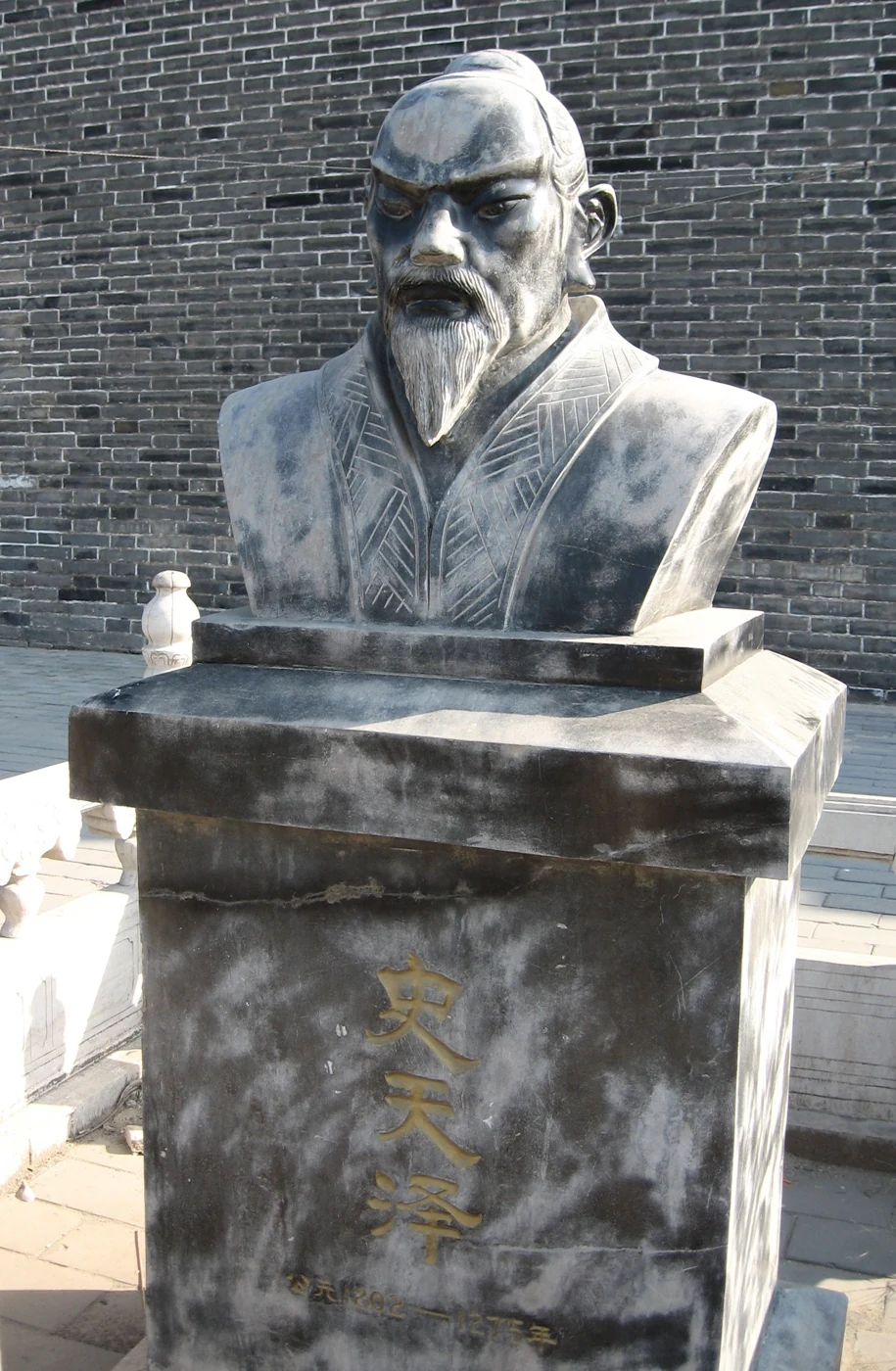
Image credits
David Chen (Iamdavidtheking 11:28, 10 September 2007 (UTC)) · CC BY 3.0Image sourceCC BY 3.0Source-provided thumbnail1202 CE–1275 CE
General
Shi Tianze
史天泽
Shi Tianze was a prominent general who submitted to the Mongols near the end of the Jin dynasty, eventually served as Right Chancellor of the Central Secretariat, and became one of the principal Han commanders in the wars against Jin and Song.
1202 CE–1275 CEYuan Dynasty
PROFILE
Shi Tianze was a prominent general who submitted to the Mongols near the end of the Jin dynasty, eventually served as Right Chancellor of the Central Secretariat, and became one of the principal Han commanders in the wars against Jin and Song.
- Other name
- Runfu
- Courtesy name
- Runfu
- Period
- Yuan
- Date of Birth
- 1202
- Date of Death
- 1275
- Dynasty / Polity
- Yuan
- Identity
- General
- Ethnicity / People
- Not recorded in historical sources
- Ancestral home
- Yongqing, Daxing (present-day Yongqing County)
- Place of birth
- Not recorded in historical sources
- Major achievement
- A prominent general who submitted to the Mongols near the end of Jin, rose to Right Chancellor of the Central Secretariat, and became one of the principal Han commanders in the wars that destroyed Jin and attacked Song.
LIFE TIMELINE
Age twelve | Followed his father Shi Bingzhi in surrendering to Muqali of the Mongols and became chief officer before the commander's tent.
Age nineteen | His elder brother Shi Tianni became Grand Marshal of Cavalry and Infantry of Hebei West Circuit and defended Zhending.
Age twenty-four | After Shi Tianni was killed by Wu Xian, Shi Tianze inherited his grand marshalship and recovered Zhending.
Age twenty-five | Captured and killed Peng Yibin, commander of Southern Song Red Coat forces.
Age twenty-eight | After Ögedei's accession, appointed commander of ten-thousand-household units for the five circuits of Zhending, Hejian, Daming, Dongping, and Jinan.
Age twenty-nine | Took part in the siege of Weizhou; led one thousand men around the enemy rear and defeated a detached Jin force.
Age thirty-one | Followed Ögedei across the Yellow River against Jin, took territory east of the capital, and pursued and killed the Jin general Wanyan Qingshannu.
Age thirty-two | Relieved Xinwei, pursued the Jin general Wanyan Baisa, and joined the siege of Caizhou.
Age thirty-three | Caizhou fell and Jin was destroyed; returned with his army to Zhending.
Age thirty-four | Joined Prince Köchü in the southern campaign, captured Zaoyang, and defeated Song forces at Qiaoshitan.
Age thirty-six | Followed Prince Ku'un Buqa in attacks on Guangzhou, Fuzhou, and Shouchun, then successively took Chuzhou, Xuyi, and Baoying.
Age fifty-one | Möngke granted him five cities in Weizhou as appanage territory; appointed Henan pacification commissioner and governed Henan.
Age fifty-six | When Alandar audited money and grain in Henan, Shi alone received leniency because of his old service; he strongly requested the release of others implicated in the investigation.
Age fifty-eight | Followed Möngke in the invasion of Song and defeated the Song general Lü Wende at Diaoyushan near Hezhou.
Age fifty-nine | Supported Kublai Khan's accession and joined the campaign against Ariq Böke.
Age sixty | Appointed Right Chancellor of the Central Secretariat, one of the earliest Han chancellors of the Yuan dynasty.
Age sixty-one | Followed the Mongol prince Ha Bi Chi in suppressing Li Tan's rebellion and strongly urged Li Tan's immediate execution.
Age sixty-six | Transferred to Left Chancellor of the Central Secretariat.
Age sixty-seven | Together with Aju and others, directed operations against Xiangyang.
Age sixty-eight | Returned to Zhending because of illness.
Age seventy-three | Ordered to command the invasion of Song with Bayan but declined because of illness.
Age seventy-four | Died of illness at Zhending; posthumously titled Zhongwu and later enfeoffed as Prince of Zhenyang.
BIOGRAPHY
Biography
Family Background and Early Life
Shi Tianze's ancestors were a wealthy and prominent family of Yongqing. By the time of his father Shi Bingzhi, the Jin dynasty was collapsing and local armed groups throughout the country often occupied territory for self-defense. Shi Bingzhi enjoyed reading, valued personal loyalty, and had substantial local influence. Shi Tianze was his third son. He was described as eight chi tall, with a voice like a great bell, skilled in riding and archery, and exceptionally strong and courageous.
In the autumn of 1213, the eighth year of Chinggis Khan's reign in the Mongol chronology used by the source, Chinggis Khan led his forces south. In the tenth month Muqali entered Hebei, and Shi Bingzhi led several thousand men to Zhuozhou to surrender. Muqali allowed Shi Bingzhi to continue commanding his clan's followers and stationed them at Bazhou. He appointed Shi Tianni commander of a tümen and made Shi Tianze chief officer before the commander's tent. The next year Shi Bingzhi joined Muqali in attacking the Jin northern capital at Dading and was rewarded with acting authority over the Six Ministries. The Shi family's military and political status was thereby established.
In 1220, the fifteenth year of Chinggis Khan's reign, Wu Xian, Jin pacification commissioner of Zhending, surrendered the city to the Mongols. Muqali appointed Shi Tianni Grand Marshal of Cavalry and Infantry of Hebei West Circuit and ordered him to defend Zhending, with Wu Xian as deputy commander. Shi Tianze joined his brother in the garrison and began building his own base in Hebei.
Succeeding His Brother and Pacifying Hebei
In the spring of 1225 Shi Tianze escorted his mother north. Soon afterward Wu Xian rebelled and lured Shi Tianni into a meeting where he killed him. Shi Tianni's staff members Wang Jin, Wang Shoudao, and others caught up with Shi Tianze at Yanjing and urged him to gather the troops scattered around the suburbs. Shi resolutely returned south and had assembled a substantial following by the time he reached Mancheng. He sent supervising officer Li Boyou to request aid from the Mongol prince Bo'ol. Bo'ol ordered his subordinate Xiao Nai Dai to provide three thousand soldiers. Shi Tianze inherited his brother's position as Grand Marshal of Cavalry and Infantry of Hebei West Circuit.
The combined armies attacked Lunu, present-day Dingzhou in Hebei. Wu Xian's commander Ge Tieqiang came with ten thousand men. Shi Tianze led from the front; his soldiers' morale rose and they fought with exceptional determination. Ge was captured and his troops collapsed. Shi's reputation soared. He then took Zhongshan, advanced through Wuji, captured Zhaozhou, and moved on Yexing, where he joined his elder brother Shi Tian'an, who had come as reinforcement. Together they defeated Wu Xian and recovered Zhending.
Soon Peng Yibin, Southern Song commander at Daming, allied with Wu Xian in an attempt to retake Zhending. Shi and his colleagues held Zanhuang, preventing Wu's advance. Peng, now isolated, burned the surrounding hills and defended himself. Shi selected fifty elite soldiers as vanguard and followed with armored cavalry, capturing and killing Peng. With Peng's death, the Southern Song lost its remaining footholds north of the Yellow River according to the source.
Wu Xian later sent agents into Zhending to organize sympathizers and coordinate an internal uprising, recapturing the city. Shi Tianze escaped with only a few followers to Dong Jun, commander at Gaocheng, who gave him several hundred elite troops. Shi marched overnight back toward Zhending and combined with Xiao Nai Dai. Wu Xian could not withstand them and retreated to Baodu Stockade in the western hills. Shi pressed the attack, forcing Wu to abandon the fort and flee. Yijian, Cangyu, Mawu, and other stockades, together with Xiangzhou, Weizhou, and surrounding places, then surrendered. Zhending was stabilized.
Using Zhending as his center, Shi employed Confucian scholars and officials who had previously served Jin, repaired walls and military defenses, gathered displaced people, and assisted the poor. Within several years he achieved a notable administrative record and developed Zhending into the power base of one of the major Han hereditary military houses under Mongol rule.
War to Destroy Jin
In 1229 Ögedei became khan and decided to launch a full campaign against Jin. He selected Shi Tianze, Liu Heima, and Xiao Zhala as three senior commanders of Han troops. Shi became commander of the tümen forces of the five circuits of Zhending, Hejian, Daming, Dongping, and Jinan.
In the autumn of 1230 Ögedei and Tolui led the main army through Shanxi and took Daizhou and Shizhou. In the tenth month they besieged Wu Xian at Weizhou. Jin general Wanyan Heda led one hundred thousand men to his relief and defeated the Mongol main force. Only Shi's thousand men moved around the enemy rear and defeated a detached Jin unit. Shi then rejoined the renewed attack, forcing Wu Xian to flee and enabling Weizhou to be retaken.
In 1231 Ögedei decided on a three-pronged invasion: the central army would attack Hezhong and enter Luoyang, the left army would advance toward Jinan, and the right army would move from Fengxiang through Baoji, borrow a road through Southern Song territory, and strike Bianjing from the rear. The armies were to converge the following spring. In the tenth month Ögedei personally led the central army in an attack on Hezhong, which fell in the twelfth month. Shi was meanwhile ordered to weaken Jin defenses on the eastern front.
In the spring of 1232 Ögedei crossed the Yellow River at Baipo and ordered Shi's army to cross into Henan from Mengjin and join Tolui. By the time Shi arrived, Tolui had already destroyed the Jin main army under Wanyan Heda at Sanfengshan near Junzhou. Shi advanced through the eastern capital region, secured the surrender of Taikang, Zhe County, Wagang, Suizhou, and other places, and killed Wanyan Qingshannu at Yangyi.
In the spring of 1233 Emperor Aizong of Jin broke out from Bianjing, crossed north of the river to Huanglonggang, and ordered Wanyan Baisa to strike Xinwei and Weizhou from the west. Shi immediately rode with light cavalry to the scene. The siege was already complete, but he fought his way to the wall and shouted encouragement that relief was coming, then broke back out through the encirclement. The Mongol main force arrived the next day, and Wanyan Baisa's army fled toward Pucheng. Shi pursued closely and captured or killed almost the entire force.
Emperor Aizong then traveled east by boat to Guide. Sa Ji Si Bu Hua ignored Shi's warning and camped with his back to the river at Suiyang, where his army was destroyed in the Battle of Guide. Emperor Aizong fled to Caizhou in the sixth month. Ögedei ordered Grand Marshal Tachar to besiege the city. Shi's troops attacked from the north, but the Ru River blocked their way. Shi ordered soldiers to lash rafts together and cross secretly, and they fought hard for several days.
In the first month of 1234 Caizhou fell, Emperor Aizong killed himself, and Jin came to an end. Shi returned with his army to Zhending.
Governing Zhending and Campaigning against Song
After Jin's destruction, Mongol armies continued campaigns south and west. Heavy taxation was collected with extreme urgency, and when households could not pay immediately, local offices borrowed money on their behalf from Central Asian merchants at very high interest, known as “lamb interest.” The debt was later recovered from registered households, and some people sold all their land and even family members without clearing it. Shi obtained approval for the government to pay the principal plus one level of interest on behalf of the people. He also selected middle-ranking households for military registration and adjusted tax quotas according to wealth.
Repeated locust disasters and droughts forced people to borrow again to meet tax obligations, producing arrears of thirteen thousand ingots of silver. Shi argued that the people could not bear further hardship, exhausted his own household wealth, and joined relatives and officials in repaying the debt.
Darughachi Monggeser allowed tens of thousands of Mongol army support households to scatter through the prefectures and commanderies, cutting mulberry trees and damaging crops so badly that local people could not survive. Shi petitioned for these groups to be moved north of the mountains, helping protect agriculture. Production recovered, and Zhending came to surpass neighboring commanderies in military resources and population, a development the source attributes in significant part to Shi's protection.
After destroying Jin, the Mongols turned toward Southern Song. In 1235 Prince Köden attacked Song territory in Shaanxi and Sichuan, while Prince Köchü and Mongol princes Hu Dou Tu and Ku'un Buqa attacked the Xiang-Han region. Shi joined the southern campaign. At Zaoyang the defenders resisted strongly, but Shi personally led the assault and climbed the walls, helping capture the city. In the attack on Xiangyang, Song forces deployed several thousand vessels at Qiaoshitan in a mutually supporting formation. Shi personally led two boats filled with selected men straight into the formation. Song morale collapsed and, according to the source, tens of thousands drowned.
In 1237 Shi joined Prince Ku'un Buqa in besieging Guangzhou, where he first broke the outer city and then the inner defenses. At Fuzhou, three thousand Song boats chained across the water formed a barrier. Shi personally beat the drum and led forty warriors in a direct attack that broke the barrier, frightening the garrison into surrender. At Shouchun, Shi commanded one sector alone. When Song troops raided the camp at night, he rode out alone, killed several men by hand, and held until his soldiers arrived; the Song force was driven into the Huai River and drowned. Shi then took Chuzhou, Xuyi, Baoying, and other places in eastern Huainan.
Governing Henan and Serving Kublai
In 1252 Möngke granted Shi five cities in Weizhou as an appanage. The source states that “the Han lands were not governed”: abusive local officials and heavy levies again caused population flight and abandoned fields, especially in Henan and Shaanxi. Kublai was charged with military and civil affairs south of the Gobi and appointed Shi Tianze and Zhao Bi as pacification commissioners for Henan. They selected capable men, created supervisory offices, investigated abuses, equalized taxation, revised paper-currency procedures, established supply granaries and frontier forts, punished criminals, disciplined officials, and organized military farms and mutual-security groups. Within two or three years Henan was said to be well governed, with people secure, trade flourishing, and military defenses strengthened. Shi also ordered his nephews Shi Quan and Shi Shu to garrison Tangzhou and Dengzhou with military farms, putting pressure on the Southern Song strongholds of Xiangyang and Fancheng.
In 1257 Möngke became suspicious of Kublai and sent Alandar, Liu Taiping, and others to audit money and grain in Shaanxi and Henan. Alandar fabricated charges against many Henan officials, while Shi, because of his long record of service, received exceptional leniency. Shi protested that as pacification commissioner he could not feel at ease if he himself was not blamed while others were punished. Many officials were consequently released.
In the autumn of 1258 Möngke invaded Song from western Sichuan. The next summer he camped at Diaoyushan near Hezhou, where a major epidemic struck the army and withdrawal was being discussed. Song commander Lü Wende led more than one thousand armored warships up the Jialing River. Mongol forces initially fought unsuccessfully. Möngke ordered Shi Tianze to meet them. Shi divided his forces on both banks for missile fire and personally led a naval force downstream in repeated attacks, winning three engagements.
After Möngke's death, Shi strongly supported Kublai in the succession struggle against Ariq Böke. In the fifth month of 1261, the second year of the Zhongtong era, Kublai appointed Shi Right Chancellor of the Central Secretariat, making him one of the earliest Han chancellors under Yuan rule. He also joined Kublai's campaign against Ariq Böke. In 1262, as adviser to the Mongol prince Ha Bi Chi, he helped suppress the rebellion of the Shandong warlord Li Tan. After a four-month siege Jinan fell and Li was captured. According to the History of Yuan, when Li was brought before the prince, Shi said that he should be executed immediately to settle the people's minds. Li was then beheaded.
As chancellor, Shi worked to dismantle autonomous Han warlord forces, reorganize North China, recommend capable Han officials, and advance policies based on Chinese administrative models.
Final Years and Death
In the fifth month of 1267 Shi became Left Chancellor of the Central Secretariat. In 1268 he and Aju served as commanders of the southern expedition and jointly attacked Xiangyang. In 1269 illness forced him back to Zhending. Xiangyang finally fell to Yuan forces in 1273, by which time Shi was no longer with the army.
In 1274 Kublai launched a large-scale invasion of Song and ordered Shi Tianze and Bayan to share overall command. Shi declined because of illness. Kublai sent Shi's son Shi Gang and an imperial physician to examine him and provided medicine. Shi submitted a final message saying that his life had a natural end and death was not to be regretted; his only wish was that when the imperial army crossed the Yangtze it should refrain from killing and plundering. He spoke of nothing else.
Shi died at Zhending on March 5, 1275, the seventh day of the second month of the twelfth year of the Zhiyuan era, at the age of seventy-four. Kublai grieved when the news arrived and sent a close official with 2,500 taels of silver for funeral expenses. Shi was posthumously appointed Grand Commandant and given the posthumous title Zhongwu. He later received the additional posthumous title Grand Preceptor, was promoted to Prince of Zhenyang, and received a temple.
Shi Tianze, courtesy name Runfu, was the third son of Shi Bingzhi, of a wealthy and locally prominent family. His father loved learning and was known for his sense of honor, carrying weight in the district. Eight feet tall with a voice like a bell, Shi Tianze was a fine rider and archer of great strength, serving from his youth with his elder brother Shi Tianni at Zhending. As the Jin declined and local forces armed themselves for self-protection, Shi Bingzhi came over to the Mongols with several thousand men when their army reached Hebei, making the Shi important collaborators there.
After Shi Tianni was killed by Wu Xian, Shi Tianze took his brother's place, defeated Wu Xian and recovered Zhending, commanding the Hebei region from that base for a long period as the most famous of the Chinese hereditary commanders of the early Mongol era. He took part in the campaigns against the Jin and the Song and accompanied Möngke south. On Kublai's accession he became right chancellor of the Secretariat, the first Chinese to hold that office under the Yuan.
When Li Tan rebelled in 1262 he urged a swift campaign and afterward asked of his own accord that the troops of the Shi family be disbanded, showing that he had no thought of setting himself up. The move bore directly on the Yuan's reduction of the Chinese commanders' military power, greatly weakening them and strengthening central authority. In his last years he took part in the campaign against the Song and died in 1274 at seventy-four with the posthumous name Zhongwu. Cautious in his own conduct and forward in surrendering power, he is a peculiar case among the Chinese commanders of the early Yuan.
The Chinese hereditary commanders of the early Yuan were mostly leaders of local forces under the late Jin who chose to submit when the Mongols came south, keeping their territories and followers. The Shi held Zhending for decades with many of the family in military and civil office, the most representative of that group; as Yuan centralization advanced the commanders' military authority was progressively recovered, Shi Tianze's own request to disband his troops being a crucial step in that process.
What set him apart among the hereditary commanders was that he never relied on territory and troops but went along with the center's demands, an approach that preserved his family's place in the Yuan bureaucracy and kept the Zhending area comparatively settled in the early dynasty.
His tenure as right chancellor was brief, after which he took part in military and central affairs chiefly as vice commissioner of the privy council, the great matters of state in his last years often involving him.
Yuan histories judge him highly, calling him steady and resourceful and careful in conduct — terms that fit his surrendering of military power among the hereditary commanders.
The family graves lie about Zhending, and the Yuan employed many of his descendants, the Shi remaining a noted northern house through the middle and late dynasty.
Yuan policy toward the Chinese hereditary commanders moved from reliance to reduction, and Shi Tianze's advance and withdrawal are that change in miniature.
In the campaigns against the Jin and the Song his role was generally to command a front or take part in central decisions, the scale and organization of the early Yuan campaigns depending directly on the support of such hereditary commanders.
His sons Shi Ge and Shi Zhang held office under the Yuan, the Shi still a leading family about Zhending in the middle and late dynasty.
The Yuan's handling of the hereditary commanders was not accomplished at once; Li Tan's rebellion was the turning point, their military authority before it being considerable and afterward progressively recovered through transfers and division of command. Shi Tianze's conduct at that juncture let his family continue under the dynasty.
Few Chinese served as chancellors under the Yuan, and Shi Tianze's post as right chancellor of the Secretariat is therefore symbolic, showing how much the early Yuan relied on Chinese talent in its first phase.
His grave and family remains lie about present-day Zhengding in Hebei, the related inscriptions and gazetteer records being important material for the study of the Shi family.
His posthumous name Zhongwu reflects how the Yuan placed his life's service.
The family's fortunes followed Yuan politics, its descendants also caught up in the disorders at the dynasty's end.
His voluntary surrender of military power among the Chinese hereditary commanders is regarded by later ages as a key link in the political consolidation of the early Yuan.
The Yuan's recovery of power from the northern hereditary commanders went along with its employment of southern scholars, forming two threads of early Yuan political consolidation.
Zhending was an important city of Hebei in the early Yuan, and the Shi governed it for decades, repairing the walls, founding schools and settling refugees, so that the area recovered after the wars. This local administration also earned the family its name for protecting the region and its people.
Yuan attitudes toward Chinese chancellors differed between the earlier and later periods: the early dynasty used Chinese hereditary commanders and scholars to steady the north, while in the middle and late periods Mongols and Central Asians generally held the key posts. Shi Tianze's tenure falls in the earlier phase.
The fortunes of the Shi house are often used to illustrate the common fate of the early Yuan Chinese commanders: rising in the disorders at the end of the Jin, keeping their lands by submitting to the Mongols, and at last losing military power as central authority grew, the family passing from local magnates to a bureaucratic house.
The Yuan continued to favor his family after his death, traces of his descendants appearing in middle and late Yuan officialdom — showing that the surrender of power did not cost the house its standing.
The epitaphs and inscriptions of his family offer a case for the study of the family form of the Chinese hereditary commanders under the Yuan.
So far as Zhending itself is concerned, the peace of the early Yuan is directly connected with the Shi family's management; with the later adjustment of Yuan administrative divisions it became one of the important prefectures under the Secretariat.
He also took part in the state sacrifices and ritual matters of the Yuan, his presence visible in several institutional arrangements of the early dynasty.
The Yuan's handling of the hereditary commanders brought the northern local powers back into the state bureaucracy, a process that went along with its search for ways to govern the Chinese lands.
Yuan sources judge his life chiefly on loyalty and caution, in keeping with his position as a hereditary commander and the political choices he made.
After the middle of the Yuan the sons of the hereditary commanders generally moved into civil office, the Shi family's transition part of that trend.
The prestige he accumulated over years in the army made him one of the key figures in steadying the north at the beginning of Kublai's reign.
His posthumous name and grants reflect the Yuan's treatment of its founding ministers.
The judgment in his Yuan biography stresses his carrying on the family's work and preserving its fortunes, an assessment matching his actual role in the politics of the time.
The family's standing under the Yuan and the place of Zhending in the political geography of the dynasty supported each other.
His career occupies a certain space in Yuan political history, and material on his family offers a reference for the social history of the dynasty.
The Yuan's reorganization of the northern hereditary commands ended in an administrative pattern centered on prefectures and counties, the Shi family's transition completed within it.
In histories after the Yuan his name is generally linked with the term hereditary commander.
His experience in government and arms was regarded by Yuan historians as important reference for the founding period.
His life spans the end of the Jin, the Mongol khanate and the early Yuan, his career itself one facet of the political changes in the north.
He and such contemporaries as Zhang Rou and Yan Shi were all northern hereditary commanders, cooperating and competing among themselves, the politics of early Yuan Hebei largely determined by relations among these families.
The Yuan's continued favor to his family and its commemoration of him after his death match the caution he maintained through life.
The rise and fall of the Chinese hereditary commanders is an important subject in Yuan studies.
Major Activities
Contributions to the Destruction of Jin
Shi played an important role in the campaigns that destroyed Jin. As commander of forces from five circuits he participated in the siege of Weizhou, operations east of the capital, pursuit of Wanyan Baisa, and the siege of Caizhou. At Weizhou, when other Mongol forces retreated, Shi moved one thousand men around the enemy rear and defeated a Jin detachment before rejoining the main attack. In eastern operations he secured the surrender of Taikang, Zhe County, Wagang, and Suizhou and killed Wanyan Qingshannu at Yangyi. In relieving Xinwei he fought his way to the walls and encouraged the defenders before joining the main army in destroying Wanyan Baisa's large force. At Caizhou he attacked from the north, crossed the Ru River on rafts, and fought for several days, contributing to Jin's final defeat.
Contributions to the War against Song
After Jin's fall Shi joined Prince Köchü and Prince Ku'un Buqa in southern campaigns. He led the assault on Zaoyang, personally attacked a Song fleet near Xiangyang, broke the outer and inner defenses at Guangzhou, led forty men in breaking a naval barrier at Fuzhou, fought a night raid at Shouchun, and helped take Chuzhou, Xuyi, and Baoying. In 1259, at Diaoyushan near Hezhou, he defeated Lü Wende's river force in three consecutive engagements.
Local Administration
Shi had a notable administrative record in Zhending and Henan. At Zhending he repaired walls and defensive towers, gathered displaced families, aided the poor, obtained government payment of exploitative interest debts, used his own wealth to cover tax arrears, and petitioned to move disruptive Mongol military support households northward in order to protect agriculture. In Henan, as pacification commissioner, he selected competent officials, investigated abuses, equalized taxation, revised currency practice, established supply granaries, built frontier defenses, disciplined corrupt officers, and organized military farms and mutual-security units.
Supporting Kublai
Shi was one of the principal Han officials supporting Kublai's adoption of Chinese-style administration. He backed Kublai in the succession struggle, joined the campaign against Ariq Böke, and helped suppress Li Tan's rebellion. As Right Chancellor of the Central Secretariat he worked to dismantle autonomous Han warlord power, reorganize North China, recommend capable Han officials, and support policies of Sinicized administration. The source says that across fifty years in high military and civil office, he retained the trust of those above him and generated little resentment below, and contemporaries compared him to Guo Ziyi and Cao Bin.
Personal Relations
- Father: Shi Bingzhi, who led his clan in surrendering to the Mongols near the end of Jin and received acting authority over the Six Ministries.
- Elder brother: Shi Tianni, Grand Marshal of Cavalry and Infantry of Hebei West Circuit, killed by Wu Xian.
- Elder brother: Shi Tian'an, who brought troops to help recover Zhending.
- Sons: Shi Ge, Shi Zhang, Shi Di, Shi Gang, Shi Qi, Shi Zi, Shi Kai, and Shi Bin, who held various regional, military, judicial, and central offices listed in the source.
- Nephews: Shi Quan and Shi Shu, who garrisoned Tangzhou and Dengzhou and established military farms.
- Chinggis Khan: the Shi family submitted to the Mongols in 1213.
- Muqali: accepted the Shi family's surrender and appointed Shi Tianni commander of a tümen.
- Bo'ol: sent Xiao Nai Dai with troops to support Shi and authorized him to inherit his brother's post.
- Ögedei: appointed Shi commander of five circuits and entrusted him with major campaigns against Jin.
- Möngke: granted him five cities in Weizhou and treated him leniently during the fiscal investigations because of his long service.
- Kublai Khan: strongly supported by Shi in the succession struggle; later appointed him Right Chancellor of the Central Secretariat.
- Dong Jun: commander at Gaocheng who lent Shi troops after the loss of Zhending.
- Xiao Nai Dai: Mongol commander who repeatedly cooperated with Shi.
- Liu Heima and Xiao Zhala: fellow senior commanders of Han troops.
- Zhao Bi: fellow pacification commissioner in Henan.
- Aju: fellow commander in the southern campaign against Xiangyang.
- Bayan: appointed with Shi to command the invasion of Song in the eleventh year of Zhiyuan.
- Wang Jin and Wang Shoudao: staff members of Shi Tianni who caught up with Shi Tianze at Yanjing and urged him to return south.
- Li Boyou: supervising officer sent to request aid from Bo'ol.
- Wu Xian: Jin commander who first surrendered to the Mongols, later rebelled, killed Shi Tianni, and repeatedly contested Zhending before fleeing in defeat.
- Peng Yibin: Southern Song commander at Daming who allied with Wu Xian and was captured and killed by Shi.
- Wanyan Heda: Jin general who led one hundred thousand troops to relieve Wu Xian at Weizhou.
- Wanyan Baisa: Jin general attacked and pursued by Shi after assaulting Xinwei.
- Wanyan Qingshannu: Jin general killed by Shi at Yangyi.
- Li Tan: Shandong warlord whose rebellion Shi helped suppress and whose immediate execution Shi advocated.
- Lü Wende: Song general defeated by Shi in three engagements near Diaoyushan.
Historical Assessment
Yuan / Contemporary
- Kublai trusted Shi deeply and appointed him chancellor. After Shi's death the emperor grieved, sent 2,500 taels of silver for funeral expenses, posthumously appointed him Grand Commandant and titled him Zhongwu, and later granted the titles Grand Preceptor and Prince of Zhenyang and established a temple. (History of Yuan, “Annals of Shizu”)
- The History of Yuan states that Shi spent fifty years moving between the highest military and civil offices while remaining trusted by those above and causing no resentment below; contemporaries compared him to Guo Ziyi and Cao Bin.
- Wang E described Shi as broad-minded, far-sighted, clear and decisive in affairs, personally frugal despite holding the highest offices, and cautious and self-effacing because he was a Han official participating in national government. (History of Yuan, “Biography of Shi Tianze”)
Ming and Qing Periods
- The early Ming compilers led by Song Lian placed Shi in juan 155 of the History of Yuan and praised his cautious and steady conduct, repeating the judgment that he served for fifty years without losing trust above or creating resentment below.
- Zhao Yi, in Notes on the Twenty-Two Histories, discussing Han hereditary lords under Yuan, argued that figures such as Shi built their achievements through Mongol power and reached an extraordinary degree of influence, but that few preserved themselves from beginning to end; Shi succeeded through caution.
- Ke Shaomin, in the New History of Yuan, gave Shi a biography and described him as a Han official who reached the chancellorship and stood at the forefront of Han officials under Yuan, praising his support for Kublai's Chinese-style institutions.
Modern Period
- Yuan historian Hsiao Ch'i-ch'ing, in studies of Han hereditary lords, regarded Shi as the most successful among them and the Zhending Shi family as one of the most powerful and durable Han military houses under Yuan. His caution and lack of greed for office helped maintain Mongol trust.
- Yao Congwu, in “Shi Tianze, Han Chancellor of the Yuan Dynasty,” examined Shi's life in detail and argued that he was the highest-ranking representative of Han political participation under Yuan, succeeding because he maintained a Han identity while adapting to Mongol political realities.
- Chen Gaohua, in “Yuan Statesman Shi Tianze,” called Shi one of the most outstanding Han political figures of the early Yuan and praised his military ability in the wars against Jin and Song, administrative ability in local government, and political skill in supporting Kublai's Chinese-style institutions.
FIGURES ASSOCIATED WITH THIS DYNASTY
Bibliography
- , relevant accounts of the northwestern princes and Emperor Chengzong;, History of Yuan, et al.
- , relevant accounts of the northwestern princes and Emperor Chengzong;, History of Yuan
- History of Jin, History of Jin, et al.
- Xiao Qiqing, New Explorations in Yuan History, 1983
- Yao CongWu, Bulletin of the Institute of History and Philology, Bulletin of the Institute of History and Philology, no. 47, 1976
- Chen Gaohua, Journal of Chinese Historical Studies, Research on Chinese History, 1981no. 3