Birth on the Onon
Born along the Onon River as the third son of Temujin and his primary consort Borte.
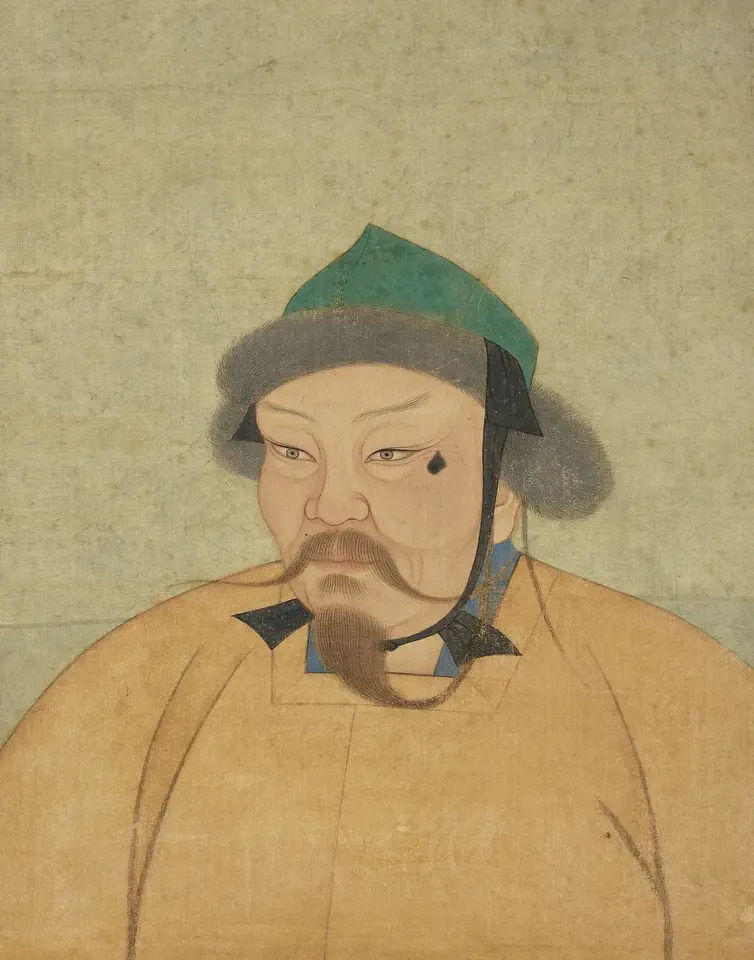
1186 CE–1241 CE
孛儿只斤·窝阔台
Borjigin Ogedei (孛儿只斤·窝阔台, 1186 – December 11, 1241), reigning from 1229 to 1241 as the second Khagan of the Mongol Empire and posthumously honored as Emperor Taizong of Yuan, was the third son of Genghis Khan and Empress Borte. In his youth, he campaigned alongside his father to unify the steppe and mediated disputes among his elder brothers during the siege of Urgench, prompting Genghis Khan to designate him as official…
Borjigin Ogedei (孛儿只斤·窝阔台, 1186 – December 11, 1241), reigning from 1229 to 1241 as the second Khagan of the Mongol Empire and posthumously honored as Emperor Taizong of Yuan, was the third son of Genghis Khan and Empress Borte. In his youth, he campaigned alongside his father to unify the steppe and mediated disputes among his elder brothers during the siege of Urgench, prompting Genghis Khan to designate him as official successor. In 1229, following two years of regency under his younger brother Tolui, he was formally acclaimed Khagan at the Kurultai assembly. Ascending the throne, Ogedei commanded the destruction of the Jurchen Jin Dynasty, annexing the fertile central plains of northern China. He launched the epic Great Western Campaign led by Batu, which conquered the Rus principalities and devastated Poland and Hungary, advancing to Vienna. Domestically, he erected the capital Karakorum, established the trans-continental Yam postal relay system, relied on Yelu Chucai to implement civil taxation, and inaugurated the 1238 Wuxu examinations for Confucian scholars, laying the institutional foundation for the imperial state.
Born along the Onon River as the third son of Temujin and his primary consort Borte.
Seriously wounded in the neck by an arrow at Kalakhaljid Sands; sucked clear of poison and rescued by general Boroghul.
Commanded the right wing alongside Jochi and Chagatai, overrunning major border fortresses south of the Yin Mountains.
Formally chosen as legal successor by Genghis Khan prior to the Khwarazmian campaign, coordinating the capture of Urgench.
Following Tolui's two-year regency, acclaimed Supreme Khagan at the Kurultai, taking the title Muyijian Khagan.
Shattered the Jin field army at Mount Sanfeng, taking Caizhou alongside Song allies as Emperor Aizong died, ending Jin.
Commenced construction of Karakorum and the Yam relay network, dispatching Batu on the Great Western Campaign.
Adopted Yelu Chucai's petition to institute civil examinations in northern China, selecting over four thousand scholars.
Passed away on December 11 at Dalan Dabaas during a hunting expedition at fifty-six, honored as Emperor Taizong.
Ogedei was born in 1186 along the Onon River in the northern Mongolian steppe as the third son of Genghis Khan (Temujin) and his primary consort, Empress Borte of the Khongirad clan. His name in medieval Mongolian signifies 'ascent' or 'wisdom.' From his early youth, Ogedei rode alongside his father across the northern plains, participating in the brutal campaigns that forged the unified Mongol confederation. Possessing a generous, composed, and pragmatic temperament, he avoided factional rivalries with his brothers, cultivating mature strategic judgment amidst harsh nomad warfare.
In 1203, at the desperate Battle of Kalakhaljid Sands against the Kereit host under Toghrul (Wang Khan), Temujin's forces suffered a sharp tactical reversal. The seventeen-year-old Ogedei was separated from the main vanguard, sustaining a severe neck wound from an enemy poisoned arrow that threw him from his horse. General Boroghul risked his life under dense arrow fire, lying across his charger while sucking poisoned blood from the youth's neck, before hacking a path through enemy lines alongside Bo'orchu to carry Ogedei back to camp. Temujin wept with relief, ever after holding Ogedei in special affection.
In 1206, the Great Mongol State was established, and Temujin was proclaimed Genghis Khan. Five years later, Genghis Khan launched his invasion of the Jurchen Jin Dynasty; Ogedei commanded the right-wing army alongside his elder brothers Jochi and Chagatai, overrunning strategic fortifications south of the Yin Mountains including Dongsheng and Shuozhou. In 1213, Genghis Khan launched another multi-pronged offensive; Ogedei advanced along the Taihang Mountains, taking Baodi and Ansu. Through continuous operational service, Ogedei developed formidable cavalry maneuver skills and mature strategic vision.
In 1219, on the eve of the invasion of the Khwarazmian Empire, Empress Yesui petitioned Genghis Khan to designate a royal successor to avoid future succession strife. When Genghis Khan convened his sons, eldest son Jochi and second son Chagatai engaged in fierce personal confrontation over Jochi's disputed paternity, drawing weapons. Observing the impasse, Genghis Khan recognized that only his third son Ogedei possessed the moderate temperament and universal respect required to unite the royal clan, formally naming Ogedei as his sole legal heir, a decision accepted by Jochi and Chagatai.
During the Khwarazmian campaign, Mongol forces advanced rapidly across Central Asia, besieging the capital Urgench by the autumn of 1220. Genghis Khan assigned Jochi as supreme commander, with Chagatai and Ogedei as deputies. However, Jochi and Chagatai quarreled bitterly over siege tactics, paralyzing operations for months and causing heavy casualties. Enraged by the stalemate, Genghis Khan issued an imperial decree stripping both elder sons of command, ordering the entire allied army to submit to the unified direction of Prince Ogedei.
Assuming command, Ogedei demonstrated exceptional tactical skill and diplomatic mediation. Visiting the pavilions of both elder brothers daily, he soothed their animosity and restored army morale, reorganizing siege artillery batteries and sapping tunnels. Under Ogedei's unified direction, the Mongol army breached the formidable defenses of Urgench in April 1221, subsequently linking up with Genghis Khan's main force to advance on Ghazni. Seeing Ogedei's ability to maintain discipline while preserving family harmony, Genghis Khan reaffirmed his succession choice.
In August 1227, Genghis Khan passed away in his military camp at Mount Liupan during the final campaign against Western Xia. In accordance with ancient Mongol customs of the youngest son guarding the hearth, Genghis Khan's fourth son Tolui administered the imperial heartland and commanded the central ordos and primary field armies as Regent for two years. During this interregnum, Ogedei remained modestly in his appanage along the Emil River, avoiding political haste. While princes observed the situation, Tolui remained faithful to his father's will, convening a Kurultai to elect the new Khagan.
In the autumn of 1229, Mongol royal princes, princesses, and senior commanders assembled along the Onon River for the imperial Kurultai. Elder brother Chagatai and younger brother Tolui led the proceedings, taking Ogedei by the hands to escort him to the elevated white felt throne amidst unanimous acclamation. Following customary ritual modesty, Ogedei accepted the crown as the second Khagan of the Mongol Empire, titled Muyijian Khagan, posthumously honored as Emperor Taizong. His accession consolidated centralized monarchical authority, initiating an era of institutional state-building.
Upon ascending the throne, Ogedei's foremost strategic priority was fulfilling his father's uncompleted goal: the total destruction of the Jurchen Jin Dynasty. In the autumn of 1230, Khagan Ogedei and Prince Tolui mobilized the primary field forces of the empire, executing a coordinated multi-pronged offensive into the central plains. Confronting massive Jin defensive lines fortified along the Yellow River and Tongguan Pass, Ogedei executed Genghis Khan's deathbed strategy of flanking through Song territory, dispatching Tolui to march through Hanzhong and strike the Jin rear.
In January 1232, Tolui's cavalry completed a winter march of over a thousand kilometers, emerging at Junzhou to threaten the Jin capital. Jin marshals Wanyan Heda and Yila Pua mobilized thirty thousand elite infantry and cavalry to intercept them. The two armies collided at Mount Sanfeng in Yuzhou amidst a blinding blizzard. Ogedei's main army completed the northern encirclement, trapping the Jin host in freezing mud. Subjected to unrelenting cavalry charges, the Jin army was annihilated, shattering the military backbone of the Jurchen state.
The triumph at Mount Sanfeng destroyed the last field army protecting the Jin capital of Kaifeng. Ogedei's armies advanced to encircle Bianjing as Emperor Aizong fled to Caizhou, leaving commander Cui Li to surrender the metropolis. Ogedei punished imperial nobles but adopted the counsel of Confucian statesman Yelu Chucai, strictly prohibiting a sack of the city and sparing hundreds of thousands of urban residents. Ogedei then dispatched general Taghachar alongside Southern Song allied forces to lay siege to Caizhou, trapping Emperor Aizong in his final stronghold.
Following the fall of Jin, Ogedei demonstrated humane governance to stabilize the war-torn central plains. Confronting desolate commanderies across Henan where decades of warfare had decimated the population, he strictly prohibited Mongol generals from enslaving free Han civilians. He established civil pacification commissions in Kaifeng, Luoyang, and Guide, distributing free seed grain and draft oxen while welcoming hundreds of thousands of displaced refugees hiding in the mountains to return and reclaim their farms. These relief measures rapidly restored agrarian order across the northern heartland.
In February 1234, allied Mongol and Song forces breached Caizhou's inner defenses. Emperor Aizong (Wanyan Shouxu) hanged himself at the Youlan Pavilion, and his successor Wanyan Chenglin fell in hand-to-hand combat, ending the 120-year-old Jin Dynasty. This total triumph eliminated the hereditary nemesis of the Mongols, annexing all lands between the Yellow and Huai rivers. Ogedei fulfilled his ancestral legacy, extending the southern borders of the empire directly toward the Yangtze River.
However, shortly following the fall of Jin, Southern Song armies attempted to seize Kaifeng and Luoyang in the Duamping Campaign, breaching the alliance. Enraged by this breach of faith, Ogedei dispatched armies to repel the invaders, routing the Song vanguard. Recognizing that southern rivers and fortifications precluded immediate conquest, Ogedei avoided overcommitting his forces in the south, establishing fortified lines along the middle Yangtze while redirecting the strategic momentum of the empire toward the conquest of Eastern Europe.
In the spring of 1235, Ogedei convened a grand Kurultai at Karakorum, authorizing the largest military expedition in Mongol history: the Great Western Campaign, known as the Campaign of the Eldest Sons. Ogedei appointed Batu, eldest son of Jochi, as supreme commander, requiring each branch of the Golden Clan to dispatch its eldest prince, including his own heir Guyuk, Tolui's son Mongke, and Chagatai's son Baidar. Mobilizing nearly two hundred thousand Mongol warriors and auxiliary troops, the allied host advanced toward Eastern Europe.
Commanded by Batu and veteran general Subutai, the expeditionary army swept across the steppes of Eurasia. Beginning in 1236, the Mongols overran the Volga Bulgars and Kipchak nomads before crossing the snowy Ural forests into the Rus principalities. Executing winter operations over frozen rivers, Mongol cavalry captured Ryazan, Vladimir, Moscow, and Kiev, dismantling the resistance of the fractured Rus feudal principalities and incorporating the vast Eastern European plain into the domain of the Mongol Khagan.
In the spring of 1241, Mongol columns penetrated deep into Central Europe. The northern wing shattered a combined army of Polish knights and Teutonic Order Crusaders at the Battle of Legnica, slaying Duke Henry II of Silesia. Simultaneously, Batu's southern host crushed the Hungarian army of King Bela IV at the Battle of Mohi along the Sajo River, sweeping across the Danube to threaten Vienna and the Adriatic coast. The speed and ferocity of the Mongol advance provoked panic throughout Western Christendom, leaving popes and emperors helpless.
Just as Mongol advance scouts prepared to cross the Alps into Central Europe, courier dispatches arrived from Karakorum announcing the death of Khagan Ogedei. In accordance with ancestral law, royal princes were required to halt offensive operations and return to the Mongolian steppe to participate in the Kurultai to elect the new sovereign. Batu and Guyuk halted their advance, withdrawing their armies eastward across the Volga. Europe was spared invasion, and the Great Western Campaign concluded having transformed world history.
The Western Campaign established the vast domain of the Golden Horde across Russia and the Ukrainian steppe, extending the western frontiers of the Mongol Empire to the Danube River. Ogedei exercised trans-continental operational leadership, simultaneously coordinating campaigns across thousands of kilometers—destroying the Jin Dynasty in East Asia while routing medieval knightly armies in Central Europe. This unprecedented conquest transformed the Mongol Empire into the largest contiguous land empire in human history.
Alongside imperial conquests, Ogedei recognized that nomadic tent encampments could not govern a complex Eurasian empire. In 1235, he mobilized thousands of artisans from China, Central Asia, and Europe to construct the permanent capital of the Mongol Empire at Karakorum along the Orkhon River, erecting the magnificent Wan'an Palace. Surrounded by ramparts and gates, Karakorum gathered Han engineers, Persian astronomers, Muslim merchants, and European goldsmiths, becoming the global diplomatic and commercial hub of the thirteenth century.
In his later years, celebrated for his achievements, Ogedei indulged in hunting and excessive alcohol consumption, damaging his physical health. Elder brother Chagatai appointed an attendant to monitor his daily intake, but Ogedei circumvented the limit by using an oversized silver goblet. Weakened by alcohol, he suffered multiple paralytic strokes. Meanwhile, Empress Toregene, supported by Central Asian tax-farmer Abd al-Rahman, accumulated influence in the inner court, instituting currency inflation and extortionate tax-farming that created political friction.
In December 1241, the fifty-six-year-old Ogedei participated in an imperial hunt at Dalan Dabaas near Karakorum, celebrating through the night with his companions. The following morning, attendants found the Khagan paralyzed and unable to speak following an acute stroke. Despite efforts by imperial physicians, he passed away in his pavilion on December 11, 1241, at the age of fifty-six. Reigning for twelve years, he conquered Jin, established the capital, and codified administrative laws, concluding the founding epoch of the Mongol Empire.
Following his demise, Ogedei's body was interred in the secret imperial cemetery at Qinian Valley in the Mongolian steppe, buried without mounds or markers according to ancient nomad custom. The court conferred the posthumous title Emperor Yingwen and the temple name Taizong. When Kublai Khan founded the Yuan Dynasty, Ogedei's spirit tablet was placed in the Imperial Ancestral Temple in Dadu. Historians praise Ogedei for his magnanimity, wisdom, and statesmanship, bridging nomadic conquest and civilized imperial statecraft.
Ogedei's most transformative institutional achievement was establishing the trans-continental Yam postal relay network (Jamchi) across the Eurasian expanse. Prior to his reign, Mongol armies requisitioned civilian mounts arbitrarily, causing severe popular hardship and communication delays. In 1235, Ogedei issued an imperial decree establishing permanent, state-funded relay stations every twenty-five to thirty miles along primary highways, equipped with fresh mounts, grain provisions, and dedicated stationmasters.
Ogedei promulgated strict regulations decreeing that imperial princes and commanders could not commandeer relay horses without an authorized golden paiza. Courier messengers riding with urgent dispatches changed horses continuously without halting, covering hundreds of kilometers daily. This postal relay network extended from Karakorum eastward to the Yellow Sea and westward across Central Asia to the Volga River and the Persian Plateau, enabling the central court to transmit military orders across thousands of kilometers within weeks.
The establishment of the Yam postal network consolidated imperial autocracy over distant appanages while revolutionizing global commercial transport. Merchants and diplomatic envoys bearing imperial paizas traveled through previously perilous deserts and mountain ranges, receiving food, lodging, and armed protection at station houses. The overland Silk Road experienced revival, creating the institutional infrastructure that facilitated cultural and economic integration across medieval Eurasia.
In implementing the Yam system, Ogedei established detailed regulations safeguarding remote postal lines across harsh climates. For stations traversing the Altai Mountains and northern steppe during freezing winters, he authorized heated station quarters and stockpiles of black beans and felt blankets, stationing dedicated snow scouts along treacherous passes to ensure courier dispatches traveled without interruption even during blizzards. This rigorous logistics system maximized the operational responsiveness of the empire.
In urban development, Ogedei's construction of Karakorum marked the transition of the Mongol state from a nomadic confederation toward a permanent imperial civilization. Mobilizing master builders from China, Central Asia, and Europe along the Orkhon River, he erected a walled capital featuring the grand Wan'an Palace. The metropolis housed central ministries, imperial workshops, international markets, Buddhist temples, mosques, and Christian churches, embodying an open, cosmopolitan world capital.
The rise of Karakorum provided the Mongol Empire with an administrative center capable of directing global governance. Silk from China, glassware from Central Asia, textiles from Persia, and metalwork from Europe flowed along relay highways into the capital, where foreign ambassadors resided. Through Karakorum and the Yam network, Ogedei converted the vast conquests of Genghis Khan into a structured, interconnected world empire equipped with centralized administrative institutions.
Ogedei's most consequential domestic decision was empowering the Khitan scholar-statesman Yelu Chucai to institute civil governance and systematic taxation. Following the conquest of Jin, conservative Mongol generals proposed exterminating the Han agrarian population to convert the fertile plains of northern China into pasture for herds. Recognizing that this policy would destroy civilization, Yelu Chucai petitioned Ogedei, arguing that agrarian taxation would generate perpetual wealth for imperial treasuries.
Ogedei recognized the wisdom of this advice, authorizing Yelu Chucai's fiscal reforms. In 1230, Ogedei established ten regional tax bureaus across northern China, appointing upright scholars to assess land, household, and commercial taxes, centralizing finance in Yanjing. The following autumn, the bureaus delivered five hundred thousand ounces of silver, eighty thousand bolts of silk, and four hundred thousand piculs of grain. Delighted by this revenue, Ogedei praised Yelu Chucai as an indispensable statesman, appointing him Director of the Secretariat to implement civil administrative laws.
Supported by Ogedei, Yelu Chucai overhauled the predatory tribute practices of early Mongol rule. Ogedei outlawed arbitrary exactions imposed by military commanders, prohibiting officers from enslaving commoners or conscripting forced labor. He instituted household registers and standardized tax codes, granting war-torn agricultural communities legal protection to recover. Northern Chinese agriculture was saved from destruction, initiating a steady economic revival.
To curb military warlordism, Ogedei separated civil and military authority across northern commanderies. He stripped Mongol commanders of civil and judicial jurisdiction, appointing educated civilian magistrates to supervise tax collection, agriculture, and water conservancy. He also standardized judicial sentencing, prohibiting summary executions and requiring capital sentences to receive Secretariat confirmation. These reforms transitioned Mongol governance in China from brutal military occupation toward lawful civil administration.
Ogedei's trust in Yelu Chucai preserved the lives of millions of Han civilians while ensuring the continuity of traditional Chinese civilization through nomad conquest. With magnanimous statesmanship, Ogedei embraced Confucian statecraft, enabling the Mongol Empire to harness the wealth and intellectual talent of China, establishing the administrative foundation for Kublai Khan's founding of the unified Yuan Dynasty.
In education and intellectual statecraft, Khagan Ogedei was a pioneering protector of classical scholarship in early Mongol history. Confronting conditions where thousands of educated scholars had been enslaved during wartime, Ogedei adopted Yelu Chucai's advice, issuing decrees protecting literati. He prohibited the execution of captured scholars, establishing bureaus in Dadu to verify their learning and redeeming thousands of scholars from private servitude to restore their free civil status.
In 1238 (the Wuxu year), Ogedei instituted the historic Wuxu Civil Service Examinations to recruit administrative talent for the empire. He authorized open examinations across northern China, testing candidates on the Confucian classics, history, and policy treatises under the supervision of eminent scholars, prohibiting interference by aristocrats. Successful candidates received exemptions from corvee labor and taxes, being appointed to prefectural tax, judicial, and civil offices.
The Wuxu examinations generated profound enthusiasm throughout northern China. Within months, 4,030 scholars passed the examinations, entering provincial administrative departments. Esteemed literati including Zhao Fu and Yao Shu reentered public service, preserving classical scholarship through late Jin warfare and establishing the precedent for Mongol dynasties recruiting civil bureaucrats through academic examination.
In ritual patronage, Ogedei ordered the repair of dilapidated Confucian temples across northern cities, issuing imperial decrees granting tax exemptions to the descendants of Confucius in Qufu. He established the Directorate of Education and printing bureaus to publish authoritative editions of the Four Books, Five Classics, and Zizhi Tongjian for study by Mongol nobles and Han students, revitalizing Neo-Confucian scholarship across northern China.
Ogedei's patronage of classical education and the Wuxu examinations held profound historical significance in Eurasian cultural history. It dismantled the nomad convention that martial valor alone determined social status, introducing moral and intellectual merit into imperial recruitment. Ogedei provided Chinese scholars with an avenue into the imperial administration, infusing the Mongol Empire with civilized governance that facilitated its institutional transition toward an enlightened state.
FIGURES ASSOCIATED WITH THIS DYNASTY