Birth by the Onon
Born into the Jalayir clan east of the Onon River as white vapor filled the tent; grew to seven feet tall, drawing a bow of over two piculs.
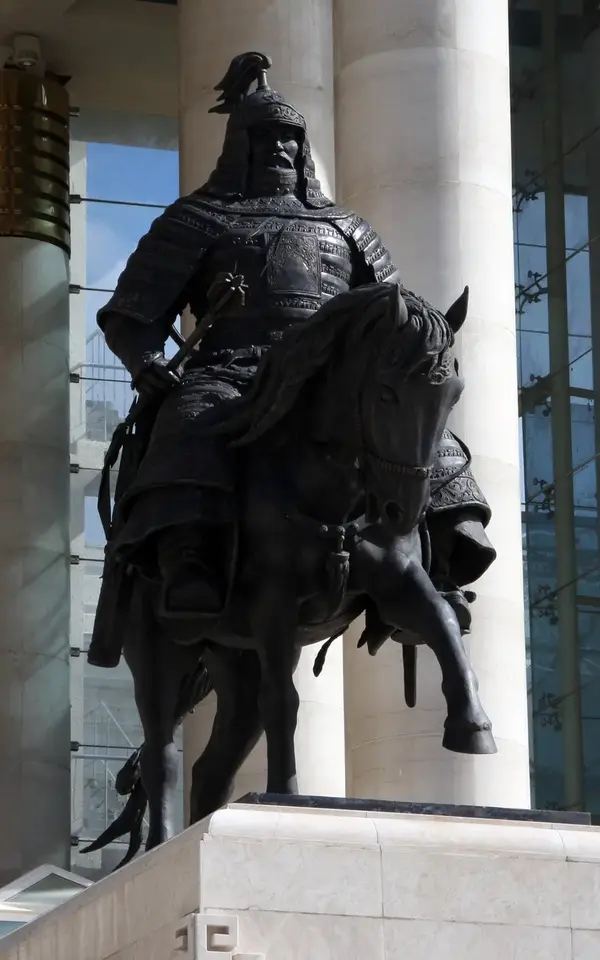
1170 CE–1223 CE
木华黎
Muqali (木华黎, 1170–1223 AD), of the Jalayir clan, was born east of the Onon River. A paramount founding merit subject and military commander of the Great Mongol State, he was celebrated alongside Bo'orchu, Boroqul, and Chilaun as one of the "Four Steeds" (Dorben Kulugud) serving Genghis Khan (Temujin). Rising to Grand Preceptor, Prince of the Realm (Guowang), Left Wing commander of a tümen, and Chief of the Grand Branch…
Muqali (木华黎, 1170–1223 AD), of the Jalayir clan, was born east of the Onon River. A paramount founding merit subject and military commander of the Great Mongol State, he was celebrated alongside Bo'orchu, Boroqul, and Chilaun as one of the "Four Steeds" (Dorben Kulugud) serving Genghis Khan (Temujin). Rising to Grand Preceptor, Prince of the Realm (Guowang), Left Wing commander of a tümen, and Chief of the Grand Branch Secretariat Acting by Imperial Mandate, he was posthumously created Prince of Lu with the posthumous title "Zhongwu." Entering Temujin's service in youth with his father Gü'ün U'a, Muqali stood in the snow all night holding a felt canopy over Temujin, repelled bandits in a ravine with three arrows, and led a night raid against Ong Khan of the Kereit in 1203 AD. Upon the founding of the Great Mongol State in 1206 AD, he was appointed Chiliarch, Left Wing commander of a tümen governing the eastern territories up to the Greater Khingan Mountains, and commander of the keshig imperial guard. Campaigning against the Jin Dynasty in 1211 AD, he led the Balu regiment on foot through Huan'erzui at the Battle of Yehuling to rout Wanyan Chengyu's 400,000 troops. From 1214 to 1216 AD, he conquered Jin's Northern Capital (Beijing) in Liaoxi and suppressed the rebellions of Zhang Jing and Zhang Zhi in Jinzhou. In the eighth month of 1217 AD, Genghis Khan invested him as Grand Preceptor and Prince of the Realm, granting him a hereditary oath certificate and the Nine White Banners to direct all campaigns south of the Taihang Mountains, earning him the appellation "Acting Emperor" in Song envoy Zhao Gong's Mengda Beilu. Adopting Shi Tianni's counsel to forbid pillaging, he recruited Han warlords such as Shi Tianni, Yan Shi, Wu Xian, and Shi Tianying, conquering Hebei, Shandong, Hedong (Shanxi), and northern Shaanxi, routing Jin armies at Huanglonggang and east of Yan'an before dying of illness at Xiamacun in Wenxi County in the third month of 1223 AD.
Born into the Jalayir clan east of the Onon River as white vapor filled the tent; grew to seven feet tall, drawing a bow of over two piculs.
Presented by his grandfather Telegütü Bayan and father Gü'ün U'a (along with younger brother Buqa) to serve Temujin during the Jurkin campaign.
Having shielded Temujin with a felt in a snowstorm and repelled ravine bandits, he led elite horsemen in a night raid that routed Ong Khan.
Appointed Chiliarch (ranking third among ninety-five) and Left Wing commander of a tümen governing east to the Greater Khingan Mountains, and keshig commander.
Defeated Duji Sizhong at Wushabao; led the Balu camp on foot through Huan'erzui in the eighth month to rout Wanyan Chengyu's 400,000 Jin troops.
Defeated Jin troops at Wuhuiling, took Zhuozhou, Yizhou, Yidu, Binzhou, and Dizhou, and received the surrender of Shi Bingzhi and Shi Tianni at Bazhou.
Defeated Yinqing's 200,000 troops at Jin's Northern Capital in the second month, spared surrendered generals on Xiao Yexian's advice, and crushed Zhang Zhi in 1216 AD.
Invested as Grand Preceptor and Prince of the Realm with the Nine White Banners in the eighth month, establishing a Branch Secretariat in Yanjing with 100,000 troops.
Marched through Yanmen Pass to capture Daizhou, Taiyuan, and Pingyang, and in 1219 AD took Kelan, Shizhou, Xizhou, and Jiangzhou across Shanxi.
Received Wu Xian's surrender at Mancheng, forbade pillaging on Shi Tianni's advice, accepted Yan Shi's 300,000 households, and routed 200,000 Jin troops at Huanglonggang.
Took Dongping in the fourth month; crossed the Yellow River via Western Xia into Jiazhou in the tenth month, ambushing Wanyan Heda's 30,000 troops east of Yan'an.
Captured Hezhong Prefecture in the tenth month, crossed the Yellow River to take Tongzhou and Pucheng, blocked Tongguan Pass, and besieged Fengxiang.
Died of illness at Xiamacun west of Wenxi County in the third month at age fifty-four, urging his brother Taisun to capture Bianjing; succeeded by his son Bo'ol.
Muqali was born into the Mongol Jalayir clan (Jat Jalayir) residing east of the Onon River. When he was born, white vapor filled the yurt, prompting a shaman to marvel that he was no ordinary child. Growing to seven feet tall with a tiger-like head, curly beard, and dark complexion, he was calm, resolute, resourceful, and long-armed, capable of drawing a bow exceeding two piculs in weight. When the Kiyat chief Temujin campaigned against the Jurkin clan, Muqali's grandfather Telegütü Bayan instructed his father Gü'ün U'a to bring Muqali and his younger brother Buqa into Temujin's service (Gü'ün U'a later died in battle against the Naimans while covering Temujin's escape).
Assisting Temujin alongside Bo'orchu, Boroqul, and Chilaun, all four became renowned for loyalty and valor as the "Dorben Kulugud" ("Four Steeds"), praised by Temujin as the two shafts of his cart and the two arms of his body. Once, after a setback against the Tatars during a heavy snowstorm, Temujin lost his royal tent and lay in a grassy marsh at night; Muqali and Bo'orchu stood in the snow all night holding a felt canopy to shelter him.
On another occasion, riding through a ravine with over ten horsemen, Temujin asked Muqali what he would do if bandits appeared; Muqali replied that he would block them with his own body. When bandits soon ambushed them with a rain of arrows, Muqali drew his bow and hit three attackers with three successive shots, unstrapping his horse saddle to shield Temujin until the raiders were driven off. After joining Bo'orchu to rescue Ong Khan of the Kereit from the Naimans, Muqali led elite horsemen in a night raid on Ong Khan's camp during the 1203 AD war between Temujin and Ong Khan, putting Ong Khan to flight and uniting the steppe tribes.
When the Great Mongol State was established in the first year of Emperor Taizu (1206 AD), Muqali was appointed Chiliarch (ranking third among the ninety-five chiliarchies) and Left Wing commander of a tümen, governing the vast eastern territories from the royal court to the Qara'un Jidun (Greater Khingan Mountains) with hereditary succession, ranking alongside Bo'orchu at the head of all generals and serving as commander of the keshig imperial bodyguard.
In the sixth year of Emperor Taizu (1211 AD), Muqali accompanied Temujin against the Jin Dynasty, defeating Jin general Duji Sizhong at Wushabao, receiving the surrender of Guo Baoyu, and capturing Xijing (Datong), Changzhou, Huanzhou, and Fuzhou. As the Mongol army marched south from Fuzhou, Jin Assistant Grand Councilor Wanyan Chengyu arrayed 400,000 troops north of Yehuling (northwest of present-day Zhangjiakou, Hebei) to neutralize the Mongol cavalry in the mountains. In the eighth month, after winning over Jin envoy Shimo Ming'an to learn the Jin deployment, Temujin ordered Muqali to lead the Balu camp in a concentrated assault through Huan'erzui. Swearing not to return alive if he failed to break the Jin army, Muqali ordered his men to dismount and storm the Jin lines on foot, driving straight toward Wanyan Chengyu's central camp. As Temujin launched a general advance, the Jin army collapsed and was pursued to Huihebao with corpses strewing over a hundred li, destroying Jin's elite forces.
After taking Xuandezhou in 1212 AD, Muqali served in the central army under Temujin and Tolui in 1213 AD, defeating Jin troops at Wuhuiling, capturing Zhuozhou and Yizhou, and leading a detachment into Shandong to take Yidu, Binzhou, Dizhou, and Mizhou. Returning via Bazhou, he received the surrender of local leader Shi Bingzhi, his sons Shi Tianni and Shi Tianze, and Xiao Bodie, appointing Shi Tianni and Xiao Bodie as chiliarchs.
After joining the siege of Jin's Central Capital (Zhongdu) in the spring of 1214 AD, Muqali was sent in the tenth month with Khitan and Han troops under Shi Tianxiang and Xiao Yexian to conquer Liaoxi and Liaodong, receiving the surrender of Lu Cong and Jin Pu at Gaozhou and Zhang Jing at Jinzhou. In the second month of 1215 AD, attacking Jin's Northern Capital (west of Ningcheng, Inner Mongolia), Muqali routed garrison commander Yinqing's 200,000 troops and beheaded over 80,000 men.
When the starving garrison killed Yinqing and surrendered under Wugulun Yindahu, Muqali initially intended to bury the surrendered officers alive, but Xiao Yexian persuaded him that pardoning them was essential to win hearts in Liaoxi; Muqali appointed Yindahu and Wuyer to hold the city, and appointed Shi Tianying as governor of Xingzhong Prefecture after its citizens surrendered. In the fourth month, detecting that Zhang Jing planned to rebel while marching south, Muqali had Xiao Yexian monitor and execute him at Pingzhou. When Zhang Jing's younger brother Zhang Zhi rebelled in Jinzhou and seized Ping, Luan, Rui, Li, Yi, Yi, and Guangning prefectures, Muqali led Mongke Buqa and Wuyer to recover them, appointing Du Xiu as Military Governor of Jinzhou and sending Shi Jindao to take Guangning.
In the spring of 1216 AD, after Zhang Zhi seized Xingzhong, Muqali sent Wuyer to attack Liushishan Fort while stationing Mongke Buqa east of Yongde County to cut off reinforcements; when Zhang Jing's son Zhang Dongping marched to relieve the fort, Muqali ambushed him east of Shenmu County, slaying Zhang Dongping and over 12,800 soldiers. Besieging Jinzhou via Kaiyi County, Muqali defeated Zhang Taiping and Gao Yi, beheading over 3,000 men. After a month's siege, supervisor Gao Yi bound Zhang Zhi and surrendered; Muqali executed Zhang Zhi along with rebellious generals Liu Yan and Tian Heshang, captured Haizhou, Fuzhou, and Suzhou, slew Jin general Wanyan Zhongjianu, and drove Puxian Wannu with over 100,000 people onto coastal islands.
In the eighth month of the twelfth year of Emperor Taizu (1217 AD), Temujin invested Muqali as Grand Preceptor, Prince of the Realm (Guowang), and Chief of the Grand Branch Secretariat Acting by Imperial Mandate, granting him a hereditary oath certificate and placing five Mongol tribes (Uru'ud, Manghud, Qonggirad, Ikires, and Jalayir) along with Onggud, Khitan, Jurchen, and Han forces totaling about 100,000 men under his command. Bestowing the Nine White Banners, Temujin declared: "North of the Taihang Mountains, I shall direct affairs myself; south of the Taihang Mountains, you shall exert yourself!" Establishing Branch Secretariats in Yanjing and Yunzhong, Muqali captured Daming Prefecture by year's end and pacified Yidu, Zizhou, Weizhou, Mizhou, Laizhou, and Dengzhou in Shandong.
In 1218 AD, marching west from Yanjing via Xijing, Muqali entered Yanmen Pass via Taihe Ridge and captured Daizhou, Xinzhou, Taiyuan, Fenzhou, Huozhou, Luzhou, Zezhou, and Pingyang Prefecture in Shanxi. In 1219 AD, he sent Xiao Temo'er to take Kelan Prefecture and Guli Jiada to capture Shizhou, Xizhou, and Jiangzhou, securing Hedong and stationing heavy forces at Pingyang under Tuoba Anchar and Li Shouzhong.
In 1220 AD, marching to Mancheng in western Hebei, Muqali received the surrender of Jin's Zhending governor Wu Xian, appointing Shi Tianni to command western Hebei military affairs with Wu Xian as deputy. When Shi Tianni remonstrated that allowing troops to plunder already pacified regions contradicted the righteous purpose of punishing tyranny, Muqali immediately forbade pillaging and returned all captured elderly and children to their farms, winning renown for benevolence as he took Xingzhou, Fuyang, Xiangzhou, and Linzhou and accepted the surrender of Wu Gui. That autumn, entering Jinan, he received Jinan administrator Yan Shi's surrender of eight prefectures (including Zhangde, Daming, Cizhou, Mingzhou, Enzhou, Bozhou, Huazhou, and Junzhou) with 300,000 households.
Dismounting to direct his troops in person at Huanglonggang (east of Lankao, Henan), Muqali routed 200,000 Jin soldiers, took Chuqiu, and besieged Dongping, leaving Yan Shi and Suoluhutu with 3,000 Mongol troops to take Dongping when its grain ran out in the fourth month of 1221 AD, while sending Shi Tianying to help his brother Taisun take Mingzhou and accepting the submissions of Song loyalist leader Shi Gui, Yidu commander Zhang Lin, and Zheng Zun. Received by Muqali in Yanjing in 1221 AD, Southern Song envoy Zhao Gong recorded in Mengda Beilu that Muqali decided all military campaigns himself and was called the "Acting Emperor," yet treated his officers like brothers and allowed them to call him only by his childhood name.
In the eighth month of 1221 AD, Muqali crossed the Yellow River at Dongsheng Prefecture into Western Xia, where Emperor Shenzong (Li Zunxu) pledged 50,000 troops. Entering Jiazhou in northern Shaanxi in the tenth month and appointing Shi Tianying to hold it, Muqali took Suide and Bao'an and advanced on Yan'an. Fifteen li east of Yan'an, he approved Mongke Buqa's ambush with 3,000 horsemen in a mountain valley, routing Jin commander Wanyan Heda's 30,000 troops and killing over 7,000. Unable to storm Yan'an, Muqali marched south to take Luochuan, Fuzhou, Fangzhou, and Danzhou, then crossed east over the Yellow River to recapture Xizhou, leaving Hechou and Tian Xiong to garrison the region.
In the seventh month of 1222 AD, sending Mongke Buqa toward Qinlong as a diversion, Muqali marched from Yunzhong to take Mengzhou, Jinyang, Huoyi, Rongzhou, and Hezhong Prefecture in the tenth month, placing Shi Tianying in charge of Hezhong. Crossing the Yellow River westward into Guanzhong, Muqali captured Tongzhou and Pucheng and advanced to Chang'an.
With Wanyan Heda defending Chang'an with 200,000 troops, Muqali left 6,000 men to watch Chang'an and 3,000 to block Tongguan Pass, while leading the main army west to capture Qianzhou, Binzhou, Jingzhou, and Yuanzhou. After besieging Fengxiang for over a month without success, he encamped south of the Wei River and sent Mongke Buqa across Niuling Pass to raid Song's Fengzhou; when insurgent Hou Qi surprised Hezhong and killed Shi Tianying, Anchar recovered the city and Muqali appointed Shi Tianying's son Wuoke to succeed his father.
In the third month of the eighteenth year of Emperor Taizu (1223 AD), returning east across the Yellow River to Xiamacun west of Wenxi County in Shanxi, Muqali fell terminally ill. On his deathbed, he told his younger brother Taisun that after nearly forty years in armor assisting the state's grand enterprise, he had no regrets except that Bianjing (Kaifeng) had not yet been captured, urging Taisun to strive to complete the task. He died at the age of fifty-four and was succeeded as Prince of the Realm by his son Bo'ol. When Genghis Khan later personally besieged Fengxiang, he enumerated Muqali's merits to his generals and lamented: "If Muqali were alive, I would not have needed to come here in person to direct the battle!"
In his early years, Muqali stood in a blizzard all night with Bo'orchu holding a felt canopy over Temujin, repelled ravine bandits with three arrows, raided Ong Khan's camp in 1203 AD, and became Left Wing commander of a tümen and keshig commander in 1206 AD. At the Battle of Yehuling in the eighth month of 1211 AD, he led the Balu camp on foot through Huan'erzui to pierce Wanyan Chengyu's central camp, routing 400,000 Jin soldiers and strewing corpses for over a hundred li to Huihebao.
From 1214 to 1216 AD, Muqali routed Yinqing's 200,000 troops at Jin's Northern Capital, spared surrendered commanders on Xiao Yexian's advice, and ambushed and executed rebel leader Zhang Zhi in Jinzhou. In the eighth month of 1217 AD, he was appointed Grand Preceptor and Prince of the Realm with the Nine White Banners, commanding 100,000 troops and establishing Branch Secretariats in Yanjing and Yunzhong to direct all campaigns south of the Taihang Mountains.
Adopting Shi Tianni's counsel in 1220 AD, Muqali forbade plundering and returned captives to their farms, recruiting Shi Tianni, Wu Xian, Yan Shi (who surrendered eight prefectures and 300,000 households), Shi Tianying, and Shi Gui to transition from raiding to territorial governance. Between 1218 and 1222 AD, he secured Hedong, routed 200,000 Jin troops at Huanglonggang, took Dongping, ambushed Wanyan Heda east of Yan'an, and swept across Guanzhong to Chang'an and Fengxiang.
FIGURES ASSOCIATED WITH THIS DYNASTY