Born | Born into the family of a minor Jie chieftain in Wuxiang County, Shangdang Commandery, Bingzhou.
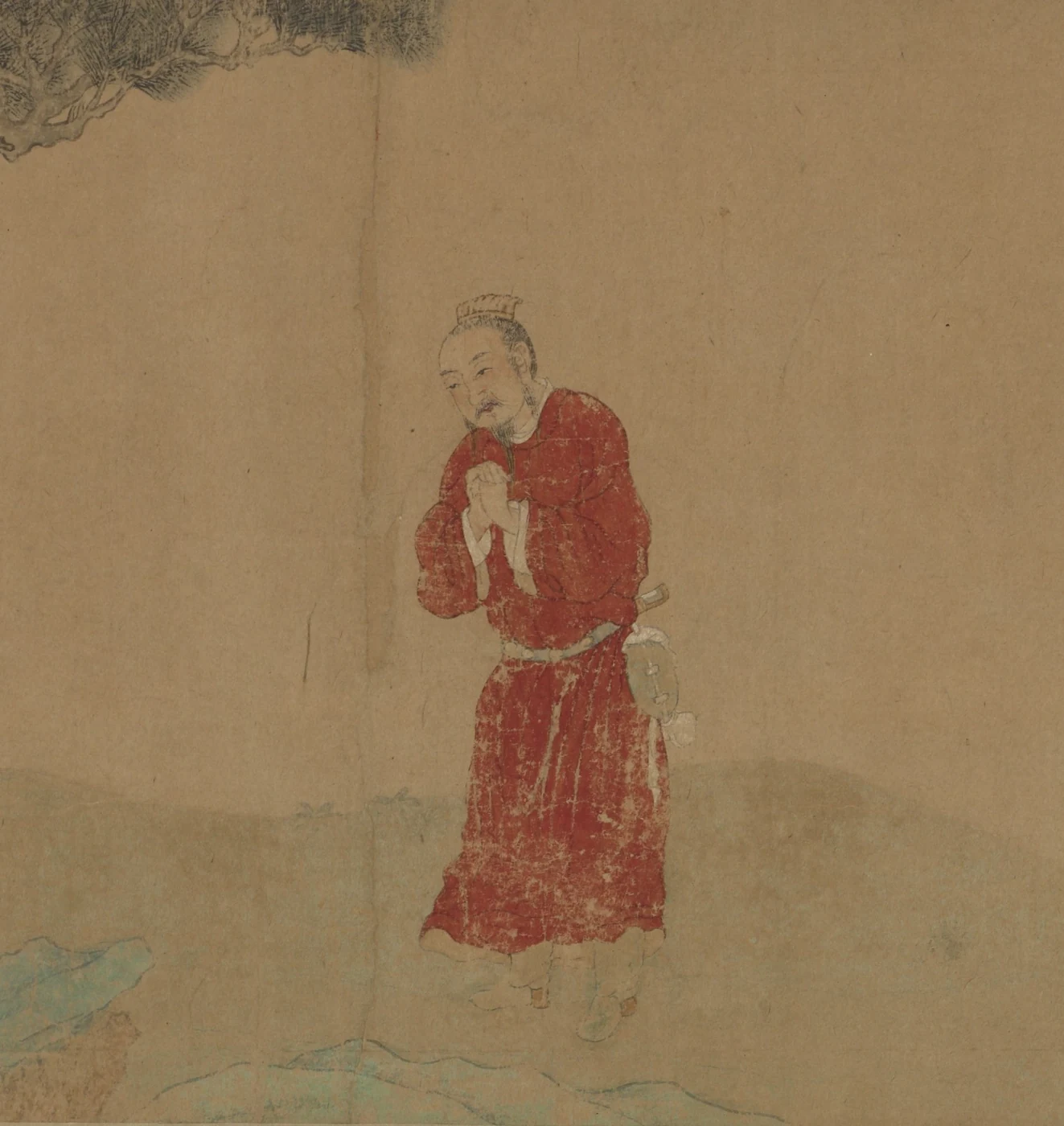
319 CE–333 CE
Emperor
Shi Le
石勒
Shi Le (274–August 17, 333), originally named Beile or Fule and courtesy name Shilong, was a Jie ruler from Wuxiang County, Shangdang Commandery, in present-day Shanxi, though the precise modern location is disputed. He was the founding emperor of Later Zhao as well as a political and military leader. Born into the family of a minor Jie chieftain, Shi Le traded goods in Luoyang as a youth and was later seized and sold into…
319 CE–333 CELater Zhao
PROFILE
Shi Le (274–August 17, 333), originally named Beile or Fule and courtesy name Shilong, was a Jie ruler from Wuxiang County, Shangdang Commandery, in present-day Shanxi, though the precise modern location is disputed. He was the founding emperor of Later Zhao as well as a political and military leader. Born into the family of a minor Jie chieftain, Shi Le traded goods in Luoyang as a youth and was later seized and sold into slavery. He subsequently joined Ji Sang in raising troops and then entered the service of Liu Yuan of Han-Zhao, campaigning throughout Hebei and repeatedly defeating Jin forces. At Ningping, he destroyed a Western Jin force numbering more than one hundred thousand soldiers and civilians and took part in the events that led to the Disaster of Yongjia. After Jin Zhun's rebellion, Shi Le broke with Han-Zhao and established an independent regime. He organized the “Gentlemen's Camp,” cooperated with Han Chinese literati, and relied on Zhang Bin as his chief strategist. Following Zhang Bin's advice to secure Hebei before contending for the realm, he moved north, occupied Xiangguo, eliminated Wang Mi, Wang Jun, Liu Kun, Shao Xu, Duan Pidi, and other rivals, and gained control of Bing, You, and Ji provinces. In 319, the second year of the Guangchu era, he assumed the title Prince of Zhao, established his capital at Xiangguo, and founded the polity later known as Later Zhao. He then expanded into Henan, occupied Si, Yu, Xu, and Yan provinces, and confronted Eastern Jin across the Huai River. At the end of the first year of the Taihe era, in early 329, he defeated Former Zhao at Luoyang and captured its emperor Liu Yao, bringing most of northern China under his control. Shi Le also adopted measures to promote education and economic recovery and patronized the Buddhist monk Fotudeng from the Western Regions, contributing to the spread of Buddhism.
- Other name
- Shi Shilong
- Courtesy name
- Shilong
- Period
- Later Zhao
- Dynasty / Polity
- Later Zhao
- Identity
- Emperor
- Ethnicity / People
- Jie
- Ancestral home
- Wuxiang County, Shangdang Commandery (the modern location is disputed; see “Biographical Disputes”)
- Date of birth
- 274
- Place of birth
- Not recorded in historical sources
- Date of death
- August 17, 333
- Reign
- Not recorded in historical sources
- Predecessor
- Not applicable (founding emperor)
- Successor
- Shi Hong, Prince of Haiyang
- Era name
- Not recorded in historical sources
- Temple name
- Gaozu
- Posthumous name
- Emperor Ming
- Major achievement
- Born among the lower strata of the Jie and once enslaved, he later overthrew Former Zhao, founded Later Zhao, and brought much of northern China under his control.
LIFE TIMELINE
Age seven | Traveled with local people to trade in Luoyang and whistled while leaning at the Shangdong Gate; Wang Yan noticed him and found him unusual.
Age twenty | During famine in Bingzhou, seized by troops under Sima Teng, taken east, and sold as a slave to Shi Huan of Chiping.
Age twenty-two | Joined Gongshi Fan with Ji Sang and other herdsmen; Ji Sang then gave him the surname Shi and the name Le.
Age twenty-four | Followed Ji Sang in taking Ye, where Sima Teng was killed; later defeated by Gou Xi.
Age twenty-four | Joined Liu Yuan of Han-Zhao and was appointed General Who Assists Han and Prince Who Pacifies Jin.
Age twenty-five | Led troops east, captured Ye, and after Liu Yuan assumed the imperial title was appointed Bearer of the Imperial Tally and Grand General Who Pacifies the East.
Age twenty-six | Attacked Julu and Changshan; his following grew to more than one hundred thousand. He established the “Gentlemen's Camp” and made Zhang Bin his chief strategist.
Age twenty-eight | Destroyed a Western Jin force of more than one hundred thousand soldiers and civilians at Ningping and took part in the capture of Luoyang and the Disaster of Yongjia.
Age twenty-eight | Killed Wang Mi in a surprise attack and absorbed his troops.
Age twenty-nine | Accepted Zhang Bin's advice to establish a northern base at Xiangguo.
Age thirty-one | Killed Wang Jun in a surprise attack and gained control of Youzhou.
Age thirty-two | Defeated Liu Kun and gained control of Bingzhou.
Age thirty-six | After Jin Zhun's rebellion, broke from Han-Zhao, assumed the title Prince of Zhao, established his capital at Xiangguo, and founded Later Zhao.
Age forty | Destroyed Cao Ni and gained control of Qingzhou.
Age forty-six | Fought Former Zhao at Luoyang and captured its emperor Liu Yao.
Age forty-six | Sent Shi Hu to destroy the remaining forces of Former Zhao and brought most of northern China under Later Zhao control.
Age fifty | Died at the stated age of sixty; posthumously titled Emperor Ming and given the temple name Gaozu.
BIOGRAPHY
Biography
Family Background and Early Life
Shi Le was born into the family of a minor Jie chieftain in Wuxiang County, Shangdang Commandery, Bingzhou, in present-day Shanxi; the precise modern location is disputed. His ancestors were said to descend from the Qiangqu branch of the Xiongnu. His grandfather Shi Ye, also recorded as Shi Yeyiyu, and his father Shi Zhouhezhu, also recorded as Shi Qijijia, were both minor tribal leaders. The origins of the Jie are uncertain. They have sometimes been connected with the Lesser Yuezhi, while historian Chen Yinke suggested a possible origin in Kangju in Central Asia.
Shi Le originally had no Chinese-style name. Both his surname and personal name were given to him by the herdsman leader Ji Sang. As a youth he was strong, courageous, martial, and fond of riding and archery. His father was violent and harsh and was disliked by many of the local non-Han people, so Shi Le often supervised them in his father's place and gained their trust. At the age of fourteen he traveled with people from his home district to trade in Luoyang. While he was whistling at the Shangdong Gate, Wang Yan noticed him and remarked to those around him that the “Hu youth” had an unusual bearing and might one day become a danger to the realm. Wang Yan sent men to seize him, but Shi Le had already left.
Guo Jing of Wu in Taiyuan and Ning Qu of Yangqu believed that Shi Le had great ambitions and prospects and repeatedly assisted him. Shi Le was grateful for their support and worked hard in agriculture. Physiognomists and local elders were also said to have considered his appearance and bearing extraordinary and urged the people of the district to treat him well. Most mocked such predictions, but Guo Jing and Ning Qu believed them and supplied him with resources.
Enslavement and Rising in Rebellion
In 303, the second year of the Taian era, Bingzhou was struck by severe famine and social disorder. Shi Le and other non-Han tenant farmers scattered while fleeing. He returned from Yanmen to seek refuge with Ning Qu. Liu Jian, commandant of Beize, wanted to bind and sell him, but Ning Qu hid him and saved him. Shi Le then secretly headed toward the office of Li Chuan, a commandant responsible for receiving surrenders. On the way he met Guo Jing and tearfully described his hunger and cold. Guo sold the goods he was carrying to buy Shi food and also gave him clothing.
At the time, General Yan Cui persuaded Sima Teng, Inspector of Bingzhou and Duke of Dongying, to seize non-Han people and sell them in the east to finance the army. Sima Teng sent Generals Guo Yang and Zhang Long to round them up and drive them toward Jizhou, chaining two men together in a single large cangue. Shi Le, then in his twenties, was among those seized and was repeatedly beaten and humiliated by Zhang Long. Guo Jing had previously entrusted Shi Le to his clansman Guo Yang and nephew Guo Shi, and their protection made his journey somewhat less harsh. Shi Le was eventually sold to Shi Huan of Chiping as a slave. Shi Huan, however, considered his appearance extraordinary and freed him.
Shi Huan's household was near a horse pasture, and he had frequent dealings with the herdsman leader Ji Sang. Shi Le used his skill in judging horses to become acquainted with Ji Sang and began gathering talented followers and building strength. He first recruited eight riders: Wang Yang, Kui An, Zhi Xiong, Ji Bao, Wu Yu, Liu Ying, Tao Bao, and Lu Ming. Another ten men—Guo Ao, Liu Zheng, Liu Bao, Zhang Yipu, Huyan Mo, Guo Heilüe, Zhang Yue, Kong Tun, Zhao Lu, and Zhi Qu-liu—then joined him, together becoming known as the Eighteen Riders. Using this small band as his core, Shi raided horse parks east of the Chiping pastures, seized horses, and used them to plunder silk, valuables, and other goods with which he strengthened his relationship with Ji Sang.
Campaigns across Hebei
In 305, after Sima Ying, Prince of Chengdu, had been stripped by Sima Yong, Prince of Hejian, of his offices and position as imperial heir, many people in Hebei sympathized with him because he had previously been based at Ye. His former subordinate Gongshi Fan therefore raised tens of thousands of troops in the Zhao and Wei regions in Sima Ying's name. Ji Sang and Shi Le joined him with several hundred cavalry. It was at this point that Ji Sang gave Shi the surname Shi and the name Le. Gongshi Fan appointed him vanguard commander and joined him in attacking Sima Mo, Duke of Pingchang, who held Ye, but they were defeated by Gou Xi, Ding Shao, and Sima Mo's general Feng Song. The following year Gongshi Fan attempted to cross the Yellow River at Baima County and was killed by Gou Xi.
After Gongshi Fan's death, Shi Le and Ji Sang fled back to the Chiping pasture. Ji Sang appointed Shi as a night-guard commander, and Shi led herdsmen in freeing prisoners from local jails and recruiting fugitives hiding in the mountains. In 307, Ji Sang proclaimed himself Grand General and announced that he would avenge Sima Ying. Shi Le served as his vanguard and repeatedly won victories, after which Ji appointed him General Who Attacks the Caitiffs and Marquis of Zhongmingting. Shi then followed Ji Sang in attacking Ye as vanguard commander, defeated Feng Song, and captured the city in the fifth month. Ji Sang killed Sima Teng and more than ten thousand soldiers and civilians at Ye, burned the palace buildings, and looted women and valuables before withdrawing.
Shi later joined Ji Sang in attacking Shi Xian, Inspector of Youzhou. At Leling, Shi Le killed Shi Xian and then defeated a Qihuo army of fifty thousand led by Tian Yin that had come to relieve him. Shi and Ji Sang fought Gou Xi between Pingyuan and Yangping for several months in more than thirty engagements with mixed results, forcing Grand Tutor Sima Yue to move to Guandu in support of Gou Xi. In the ninth month Shi Le and Ji Sang suffered a major defeat. They gathered the survivors and attempted to join Liu Yuan's Han regime but were again defeated at Chiqiao by Ding Shao, Inspector of Jizhou. Shi escaped to Leping, while Ji Sang was later killed by Jin troops at Leling.
Entering Han-Zhao Service
After joining Han, Shi Le persuaded Zhang Beidu and Feng Motu, who held Shangdang, to submit to Liu Yuan. Liu Yuan appointed him General Who Assists Han and Prince Who Pacifies Jin. When the Wuhuan leader Zhang Fulidu, based at Leping, refused to join Han, Shi Le pretended that he had offended Liu Yuan and defected to Zhang. He became Zhang's sworn brother and joined his non-Han followers in raiding the commanderies and counties, winning their fear and respect. Once the men had become attached to him, Shi seized Zhang Fulidu during a banquet and had the troops choose himself as leader. He later released Zhang and led the latter's followers into Han service. Liu Yuan appointed Shi supervisor of military operations for the conquest of the regions east of the mountains and placed the newly acquired troops under his command.
With the forces of both Zhang Beidu and Zhang Fulidu, Shi Le now possessed a comparatively independent army under Liu Yuan's Han regime. This was very different from his earlier position as Ji Sang's subordinate, and his strength continued to grow.
Raids into the Central Plains
As Liu Yuan expanded outward, he sent Shi Le east in 308. Shi captured Ye in the ninth month, forcing General Who Conquers the North He Yu to flee. When Liu Yuan assumed the imperial title in the tenth month, Shi was appointed Bearer of the Imperial Tally and Grand General Who Pacifies the East. He soon led thirty thousand troops against Wei, Ji, and Dunqiu commanderies. More than fifty fortified settlements organized by local people submitted without resistance, and Shi granted their leaders seals appointing them as generals and commandants. He later killed Wang Cui, Administrator of Wei Commandery, Feng Chong, Western Commandant of Jizhou, and the Qihuo leaders She Ting and Tian Yin. Liu Yuan then appointed him Grand General Who Pacifies the East and authorized him to establish his own administrative staff.
In 309, Shi attacked Julu and Changshan. His following grew beyond one hundred thousand, and educated men joined him. He organized them into the “Gentlemen's Camp,” made the Han scholar Zhang Bin his principal strategist, and relied on Diao Ying and Zhang Jing as leading aides. As his military strength increased, many Hu and Jie in Bingzhou also joined him after being persuaded by his envoy Zhang Si. Liu Yuan later launched an attack on Huguan and appointed Shi Le vanguard commander. Shi defeated Jin reinforcements sent by Liu Kun and helped Han capture Huguan. In the ninth month, Wang Jun, Inspector of Youzhou, sent Qi Hong and Duan Wuwuchen to attack Shi at Feilong Mountain. Shi suffered a major defeat and withdrew to Liyang, but he continued to dispatch generals against communities that had not yet defected, accepting the surrender of more than thirty fortified settlements and appointing local administrators to pacify them. In the eleventh month, Shi attacked Xindu and killed Wang Bin, Inspector of Jizhou. Wang Jun then sent Pei Zheng and Wang Kan to campaign against him, prompting Shi to turn back immediately. When Shi reached Liyang, Pei Xian abandoned his army and fled to Huainan, while Wang Kan retreated to Cangyuan. Liu Yuan appointed Shi Grand General Who Guards the East and Duke of Ji Commandery, although Shi declined the noble title.
In 310, Shi crossed the Yellow River southward, captured Baima, and joined Wang Mi in attacks across Xu, Yu, and Yan provinces. He soon captured Juancheng and Cangyuan, then crossed north again to attack Jin forces in Jizhou. More than ninety thousand civilians submitted to him. He next assisted Liu Cong and others in attacking Henei and attacked General Liang Ju when Emperor Huai of Jin sent reinforcements. After Liang Ju was defeated he asked to surrender, but Shi refused, eventually burying alive more than ten thousand surrendered soldiers and killing Liang. The relief troops withdrew. The scale of the victory alarmed fortified communities throughout Hebei, many of which sent hostages to Shi. That year Liu Yuan died and Liu Cong killed his elder brother Liu He and took the throne. Liu Cong appointed Shi Grand General Who Conquers the East, Inspector of Bingzhou, and Duke of Ji Commandery. Shi declined the grand generalship. He later joined Liu Can, Liu Yao, and Wang Mi in attacking Luoyang and advanced directly into the Luo River region. His subsequent attack on Cangyuan was defeated by the defender Wang Zan.
Turning toward Jingzhou
Shi Le then shifted his operations toward Nanyang. Wang Ru, Hou Tuo, Yan Yi, and other Yongzhou refugees who had rebelled in Jingzhou became alarmed and sent ten thousand troops to Xiangcheng to resist him. Shi defeated the force and encamped north of Wan. Hou Tuo held Wan while Wang Ru held Rang. Fearing Shi's attack, Wang Ru bribed him with valuables and became his sworn brother. Because Wang Ru was also hostile to Hou Tuo, he urged Shi to attack Hou. Yan Yi learned that Shi was attacking Wan and led troops to its relief, but Shi captured the city in twelve days. Yan arrived too late and surrendered directly. Shi executed Hou Tuo, imprisoned Yan Yi, and absorbed their forces, further increasing his strength.
Shi then pushed south, attacked Xiangyang, and moved along the Han River, capturing more than thirty fortified settlements west of the river. Leaving Diao Ying to hold Xiangyang, he led thirty thousand elite cavalry back against Wang Ru, but, fearing Wang's strength, diverted to Xiangcheng. Wang Ru sent his younger brother Wang Li with troops under the pretense of rewarding Shi's army, intending a surprise attack, but Shi destroyed the force. At this stage Shi hoped to establish power in the Yangtze and Han River regions. Zhang Bin repeatedly opposed the plan and urged him to return north, but Shi did not listen.
In 311, Sima Rui, Prince of Langya, who was based at Jiankang, sent Wang Dao with troops against Shi's southern advance. Shi's army was running short of food and lost more than half its men to disease. He finally accepted Zhang Bin's advice, burned his heavy baggage, secured his remaining grain, rolled up his armor, crossed the Mian River with light troops, attacked Jiangxia, and then withdrew north. He first captured Xincai and killed Sima Que, Prince of Xincai, and later captured Xuchang.
The Disaster of Yongjia
In the third month of 311, Sima Yue, who had led a mobile court administration and more than two hundred thousand Jin troops against Shi Le, died at Xiang County. Wang Yan and Sima Fan, Prince of Xiangyang, then led the army east while escorting Sima Yue's coffin back to his principality. In the fourth month Shi Le pursued with light cavalry and caught the Jin army at Ningping near Ku County. He defeated the force sent against him under General Qian Duan. After Qian's death, the Jin formation collapsed. Shi surrounded the army and shot down its soldiers, while men trampled one another in the disorder. The force was annihilated. Shi killed many officials traveling with the army, including Wang Yan, as well as members of the Western Jin imperial clan. Soon afterward, at Weicang, he caught the group led east from Luoyang by Sima Pi, Sima Yue's heir, and killed Sima Pi and other members of the imperial family.
Liu Cong then sent Huyan Yan with a major army against Luoyang. Shi Le led thirty thousand cavalry to join the campaign. Luoyang fell and Emperor Huai of Jin was captured. Shi attributed the victory to Wang Mi and Liu Yao and moved out to Xuchang. In the seventh month, he attacked Mengcheng, where Jin Grand General Gou Xi was based, captured him alive, and employed him as Left Major. Liu Cong then appointed Shi Governor of Youzhou.
Consolidating Hebei and Founding Later Zhao
After Gou Xi's capture, Wang Mi sent Shi an obsequious letter of congratulation. Shi also learned that Wang Mi feared him and intended to lure him into Qingzhou and kill him. Following Zhang Bin's advice, Shi decided to eliminate Wang while the latter's forces were weak. Soon afterward, again following Zhang Bin's advice, he first rescued Wang Mi from an inconclusive struggle with Qihuo troops in order to win his confidence. He then killed Wang at a banquet, absorbed his forces, and falsely accused him of rebellion. Liu Cong was enraged when he learned of Wang Mi's death, but feared driving Shi into open defection and did not punish him. Instead, he gave Shi additional titles as Grand General Who Guards the East, Supervisor of Military Affairs of Bingzhou and Youzhou, and Inspector of Bingzhou.
Liu Kun, the Jin Inspector of Bingzhou, later returned to Shi Le the mother and nephew Shi had lost contact with years earlier. Liu Kun also offered him titles including Palace Attendant, Grand General of Chariots and Cavalry, Commander Protecting the Xiongnu, and Duke of Xiangcheng in an attempt to induce his surrender. Shi rejected the offer, though he treated Liu Kun's envoy generously and sent fine horses and valuables in thanks.
In 312, Shi built residences at Gepi, expanded cultivation, and constructed boats with the intention of attacking Jiankang. That year, however, rain continued for three months. Sima Rui learned of Shi's preparations and assembled forces from south of the Yangtze at Shouchun. Shi's army suffered food shortages and epidemic disease, and many soldiers died. Repeated proclamations also arrived announcing Sima Rui's impending campaign. Shi summoned his commanders for discussion and ultimately accepted Zhang Bin's proposal that he abandon the south, occupy the Three Terraces at Ye, and develop Hebei as his power base.
Shi sent his baggage north first and dispatched Shi Hu to attack Shouchun to prevent Jin forces from pursuing it. Although Jin troops defeated Shi Hu, they feared an ambush by Shi Le and remained at Shouchun. On Shi's own northward march, local communities had adopted scorched-earth tactics and fortified themselves, leaving him unable to obtain supplies. His army suffered severe famine and soldiers ate one another. At Dongyan Commandery, Shi lured Xiang Bing, who had fortified himself locally, into action and defeated him at Jijin. The captured supplies restored Shi's army and allowed him to advance rapidly and seize Ye. He then used Ye as a base and gradually gained control over Hebei.
In 314 he killed Wang Jun in a surprise attack and took control of Youzhou. In 315 he defeated Liu Kun and gained control of Bingzhou. In 319, after Jin Zhun's rebellion, Shi broke with Han-Zhao, proclaimed himself Prince of Zhao, established his capital at Xiangguo, and founded Later Zhao. He subsequently expanded into Henan, occupied Si, Yu, Xu, and Yan provinces, and faced Eastern Jin across the Huai River. At the end of the first year of the Taihe era, in early 329, he defeated Former Zhao at Luoyang and captured its emperor Liu Yao. Shi then sent Shi Hu to destroy the remaining Former Zhao forces, bringing most of northern China under his control.
Final Years and Death
Shi Le died in 333, the fourth year of the Jianping era, at the stated age of sixty. He received the posthumous title Emperor Ming and the temple name Gaozu. His son Shi Hong succeeded him, but Shi Hu soon deposed and killed Shi Hong and seized the throne for himself.
Omens of His Youth and His Years as a Slave
By his record in the History of the Jin, "at Shi Le's birth a red light filled the room and a white vapour came down from heaven to the courtyard, and all who saw it marvelled"; at fourteen, peddling through Luoyang with the men of his village, he "leaned and whistled at the Shangdong gate", and Wang Yan, seeing him, was amazed and told those about him that "that barbarian boy — I have listened to his voice and seen that he has strange ambitions; I fear he will be a calamity to the world", and sent to arrest him, but Shi Le had already gone. His father Zhou Hezhu was "fierce and coarse and not beloved by the barbarians", and so often had Shi Le oversee the tribesmen in his place, "and the tribesmen loved and trusted him". The record adds that below the northern plain hill of his village in Wuxiang "the grass and trees all had the appearance of iron cavalry, and in his garden grew ginseng whose flowers and leaves were luxuriant and all in the shape of men", and the elders and physiognomists said that "this barbarian is of strange appearance and uncommon spirit, and his end cannot be measured", advising the villagers to treat him well, though "most laughed at it", and that "only Guo Jing of Wu and Ning Qu of Yangqu believed it and gave him help", so that Shi Le, grateful, "laboured for them". Hearing the sound of bells and drums, he would go home and tell his mother, who said that "toiling and ringing in the ears is no evil omen". In the Tai'an years, when Bingzhou was famine-stricken, Shi Le, scattered from the other young barbarians, came back from Yanmen to Ning Qu; the commandant Liu Jian would have bound and sold him and Ning Qu hid him, and going secretly to the commandant Li Chuan he met Guo Jing on the road and "wept and bowed, telling of hunger and cold", and Guo Jing wept with him, "sold his goods to feed him and gave him clothes". Shi Le told Guo Jing that "in this great famine one cannot cling to poverty; the barbarians are starving and should be drawn into Jizhou for grain and then seized and sold, which would serve both ends", and Guo Jing agreed. When the general Yan Cui persuaded the Zhengdong duke Sima Teng to seize the barbarians in Shandong and sell them to fill the army's needs, Teng sent Guo Yang and Zhang Long to drive the barbarians to Jizhou "two barbarians to one cangue", and Shi Le, then over twenty, was among them and was often beaten and insulted by Zhang Long, escaping worse only because Guo Jing had commended him to Guo Yang and Yang's nephew Guo Shi, so that "on the road, hungry and sick, he was saved by Yang and Shi". Sold as a slave to Shi Huan of Chiping, he was told by an old man that "four lines are already formed on your hairline, fish and dragon; you shall be honoured as a ruler of men; in the year Jiaxu, Wang Pengzu may be plotted against", and Shi Le answered that "if it be as you say, I shall not forget your kindness", whereupon the old man vanished. Working in the fields he "often heard the sound of drums and horns", and telling the other slaves, they too heard it, and when they told Shi Huan "he too marvelled at his appearance and freed him". Shi Huan's house stood by a horse pasture and he dealt with the herdsman Ji Sang, and Shi Le "relying on his skill with horses attached himself to Sang". Once, hired out at Linshui in Wu'an, he was imprisoned by a roving troop, and when a herd of deer passed and the soldiers raced after them, "Shi Le escaped", and presently the old man appeared again and said that "the deer were I; you are to be lord of the Central Plain, and so I saved you", and Shi Le bowed and accepted the charge. He then gathered eight riders, Wang Yang, Kui An, Zhi Xiong, Ji Bao, Wu Yu, Liu Ying, Tao Bao and Lu Ming, and afterwards ten more, Guo Ao, Liu Zheng, Liu Bao, Zhang Yipu, Huyan Mo, Guo Heilue, Zhang Yue, Kong Tun, Zhao Lu and Zhi Quliu, "called the eighteen riders", and going east into the Chi Long and Ji parks took the park horses and raided far for silk and treasure with which to win over Ji Sang.
Submission to Han and Raids on the Central Plain
After their defeat Shi Le and Ji Sang fled back to the pasture at Chiping, where Shi Le was made doorkeeper of the night watch, leading the herdsmen to plunder the prisoners of the counties and gathering outlaws from the hills, until Ji Sang in the first year of Yongjia styled himself grand general in the name of avenging Sima Ying and advanced on Ye with Shi Le as vanguard, taking the city in the fifth month and killing Sima Teng with more than ten thousand soldiers and people, burning the palaces and plundering the women before leaving. Afterwards Shi Le killed the governor of Youzhou, Shi Xian, at Leling, beat Tian Yin who came with fifty thousand to save him, and held his own against Gou Xi for months between Pingyuan and Yangping in more than thirty engagements, until in the ninth month they were beaten by Gou Xi and fled, intending to join Liu Yuan, only to be beaten again by Ding Shao at Red Bridge, so that Shi Le fled to Leping while Ji Sang was killed at Pingyuan. By his record, the barbarian chieftains Zhang Didu and Feng Motu with several thousand men were then walled at Shangdang, and Shi Le joined them and "was deeply favoured by them", persuading Zhang Didu that "Liu the Shanyu has raised troops to punish Jin, and if you resist and do not follow him, can you stand alone?", and that "if you cannot, then your troops must belong to someone; now your tribes have all been rewarded and recruited by the Shanyu and often gather to plot defection to him, so take thought early", whereupon Zhang Didu, "having no wisdom of his own and fearing the treachery of his men, secretly followed Shi Le alone to join Liu Yuan", who made him king of Qin-Han and Feng Motu commander, with Shi Le as general supporting Han and prince of Pacifying Jin over them; and Shi Le then made Zhang Didu his elder brother, gave him the surname Shi and named him Hui, "to signify that he had met with him". The Wuhuan Zhang Fulidu with two thousand more was walled at Leping, and Liu Yuan could not win him, so Shi Le "feigning to have offended Liu Yuan fled to Fulidu", who was delighted, swore brotherhood with him and had him lead the barbarians to raid, "unopposed wherever he went, so that the barbarians feared and submitted to him"; and Shi Le, knowing that men's hearts were with him, seized Fulidu at a feast, put to them the question of who should be master, and was chosen by all, whereupon he released Fulidu and led his host to Liu Yuan, who made him commander of the campaigns east of the mountains. Sent by Liu Yuan to attack Huguan as vanguard with seven thousand men, he beat Liu Kun's protector Huang Xiu at Baitian, and Huang Xiu died, and so took Huguan; and ordered with six other generals to raid Wei and Dunqiu with thirty thousand men, he "took many of the stockades, gave their heads the titles of general and commandant, picked fifty thousand of the strong for soldiers and left the old and weak undisturbed, so that the army plundered nothing and the people loved him". Then he took Ye, captured the governor Wang Cui at the Three Terraces, killed the western defender of Jizhou, Feng Chong, and slew the Qihuo leaders Shenting and Tian Yin at Zhongqiu; and Liu Yuan made him grand general of the east with a staff and opened a secretariat for him, after which he took Julu and Changshan, killing the two defenders, "reducing more than a hundred stockades in Jizhou until his host reached over a hundred thousand, and gathering the men of cap and gown into the Camp of Gentlemen", taking Zhang Bin as his chief adviser, Diao Ying and Zhang Jing as his arms, Kui An and Kong Chang as his claws, and Zhi Xiong, Huyan Mo, Wang Yang, Tao Bao and the rest as commanders, and sending Zhang Si with horse to persuade the barbarians of the northern commanderies of Bingzhou, "who feared his name and mostly joined him".
When Wang Jun sent Qi Hong with more than a hundred thousand horse of the Xianbei Duan Wuchen against him, Shi Le was beaten at Feilong hill with more than ten thousand dead, and falling back on Liyang he sent his generals against those who had not yet submitted or had turned, "reducing more than thirty stockades and setting officials to soothe them", and then raided Xindu and killed the governor of Jizhou, Wang Bin. When Wang Kan and Pei Xian came from Luoyang against him, he "burned his camp and the grain, turned and met them", and Pei Xian abandoned his army for Huainan while Wang Kan fell back on Cangyuan; the governor of Wei, Liu Ju, submitted his commandery to Shi Le, who made him commander of his stockade men on the left wing. Refusing the dukedom of Jijun that was offered him, he took the two stockades of Zhequan and Yuanshi, and when Yan Pi died of a stray arrow Shi Le took over his men, crossed the river secretly at Shiqiao, took Baima and "buried more than three thousand men, women and children alive", raided Juancheng eastward and killed the governor of Yanzhou, Yuan Fu, took Cangyuan and killed Wang Kan, and crossing the river took Guangzong, Qinghe, Pingyuan and Yangping, "where more than ninety thousand submitted to him".
The Campaigns in Jingzhou and the Trouble of Yongjia
When the refugees Wang Ru, Hou Tuo and Yan Yi rose between the Yangtze and Huai, they feared his coming and sent ten thousand men to hold Xiangcheng, where Shi Le beat them and "took all their men prisoner"; camping north of Wan, he received Wang Ru's gifts of treasure, horses and carriages and swore brotherhood with him, and at Wang Ru's urging attacked Hou Tuo, "ordering the three armies at cockcrow to harness and falling on the Wan gate at dawn, taking it in twelve days", beheading Hou Tuo and sending Yan Yi a prisoner to Pingyang while absorbing their men, "and his army grew stronger". Raiding south to Xiangyang he "took more than thirty stockades west of the river", left Diao Ying to hold Xiangyang, and turned back against Wang Ru with thirty thousand picked horse, but fearing his strength went on to Xiangcheng; Wang Ru sent his brother Wang Li with twenty-five thousand horse "feigning to bring provisions but meaning to surprise him", and Shi Le met and destroyed him, camping again west of the river, "for he had the ambition to hold the Yangtze and Han". Zhang Bin thought it wrong and urged him north, and though he would not hear at first, he made Zhang Bin assistant commander and registrar "to manage affairs from within"; and when Sima Rui, fearing his raid, sent Wang Dao against him, his grain failed and "more than half died of plague", so that on Zhang Bin's plan he "burned his baggage, carried grain, rolled up his armour, crossed the Mian and raided Jiangxia", where the governor Yang Ju abandoned his commandery, and going north he killed the prince of Xincai, Sima Que, at Nandun, and received the submission of He Xi, Chen Zhen, Yang Zong and Shao Zhao, and so took Xuchang and killed the general Wang Kang.
In the fifth year of Yongjia the eastern sea prince Sima Yue led more than two hundred thousand men of Luoyang against him and died in the field, and the host, taking the grand commandant Wang Yan as its head, moved east, where Shi Le with light horse came up with it. Wang Yan sent Qian Duan against him and Qian Duan died, the army broke, and "Shi Le divided his horse to surround and shoot them, so that they fell upon one another like a hill, and not one escaped"; he then took Wang Yan, Sima Fan the prince of Xiangyang, Sima Ji the prince of Rencheng and the rest, "seating them under his tent and questioning them of the affairs of Jin". Wang Yan and Sima Ji, fearing death, spoke much in their own excuse, "but Fan was grave and calm, and looked back and rebuked them, saying 'in today's business why so much talk?'", and Shi Le thought him remarkable; he had the princes and ministers killed outside, "and many died", yet "esteeming Wang Yan's clarity of speech and marvelling at Fan's spirit, he would not put them to the sword, but had men pull down a wall upon them by night". Afterwards he met Sima Pi, son of Sima Yue, at Weicang and destroyed his army, killing him and the princes and ministers; and with thirty thousand picked horse he entered the Chenggao pass, and when Luoyang fell to Liu Yao and Wang Mi he gave them the credit and went out by Huanyuan to camp at Xuchang, refusing the title of general of the east offered by Liu Cong.
The Killing of Wang Mi and the Decision at Gebei
Wang Mi, on Liu Tun's advice, had meant to destroy Shi Le first and take Qingzhou, and Shi Le's scouts, capturing Liu Tun, "got the letter Mi had sent to Cao Yi", and killed him, "secretly resolving to destroy Mi"; and when Xu Miao took his troops away from Wang Mi, the latter grew weak. When Shi Le captured Gou Xi and spared him, Wang Mi, disliking it, "sent him humble words" that "how godlike of you to take Gou Xi and pardon him; let Xi be your left hand and me your right, and the world would soon be settled", and Shi Le told Zhang Bin that "Wang Mi is high in rank and low in words; I fear he will carry out his old dog's intent", and Zhang Bin said that "the sight of Wang's mind on Qingzhou... he has the will to measure you, but has not yet found his chance; if we do not deal with him now, and Cao Yi comes, they will be wings to each other, and repentance will be too late. Let him be drawn and destroyed." Shi Le agreed. When Wang Mi asked help against Liu Rui, Zhang Bin said that "my lord has long feared he could not get at Wang Mi; now Heaven gives us the chance. Chen Wu is a small fellow, but Wang Mi is a hero and will be our ruin", and Shi Le turned and killed Liu Rui, at which Wang Mi was delighted and trusted him wholly. Attacking Chen Wu at Feize, Shi Le was told by Chen Wu's officer Li Tou that "you are divinely martial and should settle the four seas... he who would contend with you for the world you do not strike early, but turn on us refugees", and thinking him right he withdrew at dawn; then "falsely inviting Wang Mi to a feast at Jiwu", though Mi's secretary Zhang Song warned him of a dagger, he went, and "when the wine was warm Shi Le struck off his head with his own hand and took his men", reporting to Liu Cong that Mi had rebelled.
Afterwards Shi Le camped at Gebei, "building houses, encouraging farming and making boats, meaning to raid Jianye", but rain fell for three months without ceasing and Sima Rui gathered the host of Jiangnan at Shouchun, "so that more than half his army died of hunger and plague". He took counsel: the right secretary Diao Ying advised "sending in his submission to the emperor and asking to sweep Hebei" and Shi Le sighed deeply; the general Kui An advised falling back on high ground and Shi Le said "how timid is the general?"; and Kong Chang, Zhi Xiong and more than thirty generals offered that "before the Wu army gathers, each of us will take three hundred foot, cross by thirty boat-roads by night, mount the wall, cut the heads of the Wu generals, take their city and eat their granaries, and this year we shall surely break Danyang and settle Jiangnan, and bring back the sons of the Sima house alive", at which Shi Le laughed and said that "this is a brave general's plan", giving each a suit of armour and a horse. Then he asked Zhang Bin, who answered that "you took the imperial capital, imprisoned the Son of Heaven, killed princes and seized their consorts — the hairs of your head are not enough to count your crimes; how should you return to serve them? After you killed Wang Mi last year you should not have built your camp here. Heaven's unending rain over several hundred li shows that you should not stay. Ye has the strength of the Three Terraces, joins Pingyang on the west, and is a land of mountains and rivers and closed passes, a position of the throat; you should move north and hold it. Punish the rebellious and win the obedient, and once Hebei is settled none will stand above you." Shi Le, "tucking up his sleeves and bristling his beard", said that "Bin's plan is right", reproached Diao Ying that "you should advise me to achieve merit, and how is it that you counseled surrender?" adding that "for your cowardly nature I spare you", and demoted him, promoting Zhang Bin to right secretary with the title of the marquis of the right. On the return march he sent Shi Hu with two thousand horse against Shouchun, and Shi Hu, his men quarrelling over the grain boats from Jiangnan and taking no precautions, was beaten by an ambush at Julingkou with "more than five hundred drowned"; and since all they passed was "walled and cleared, so that plunder found nothing", there was famine in the army and "the soldiers ate one another". At Dongyan, hearing that Xiang Bing of Jijun had several thousand walled at Fangtou, and fearing to cross at Jijin while he resisted, he took Zhang Bin's advice to send "a thousand chosen men secretly by another road to seize his boats", and so crossing by rafts at Wenshi with Zhi Xiong and Kong Chang, Xiang Bing came out in anger and "the three ambushes burst at once", so that his stores were taken and "the army was filled and its spirit raised"; then he marched to Ye and its general Liu Yan's officers Lin Shen and Mu Mu surrendered with tens of thousands.
Holding Xiangguo, Settling Hebei and Striking Youzhou
When his officers wished to take the Three Terraces, Zhang Bin said that "Liu Yan still has thousands and the Three Terraces are strong; leaving them, they will fall of themselves. Wang Pengzu and Liu Yueshi are the great enemies, and while they are unprepared you should secretly move to hold Xiangguo, gather grain, and report to Pingyang, and then sweep Bing and Ji, and the work of a Huan or Wen may be accomplished... for he who gains land flourishes and he who loses it perishes; Handan and Xiangguo, the old capitals of Zhao, with hills and strong passes, are lands of natural strength, and one of them should be made your capital". Shi Le said that "the right marquis's plan is right" and moved to Xiangguo, and at Zhang Bin's further advice had his generals gather the autumn grain and sent envoys to Pingyang, and Liu Cong made him commissioner of the four barbarian provinces of Ji, You, Bing and Ying with the governorship of Jizhou. When the Guangping men You Lun and Zhang Chai with tens of thousands held Yuanxiang under Wang Jun's authority, Shi Le sent seven generals who broke their outer rampart, and Wang Jun sent his protector Wang Chang with more than fifty thousand horse of the Xianbei Duan Jiuliuquan, Duan Mopei and Duan Pidi against him; the city walls being unfinished, Shi Le "built inner walls and double palisades and set screens to await him". Jiuliuquan camped at Zhuyang, and Shi Le's repeated challenges were beaten back until he asked Zhang Bin and Kong Chang, who said that "we hear Jiuliuquan means to give battle by the north wall in the first decade of next month; his host is from afar and has fought day and night, and thinking us few and weak he will be careless... cut twenty or more sally-ports in the north rampart, and when the enemy's ranks are not yet set, strike straight for Mopei's tent, and it will be as thunder that leaves no time for ears", which Shi Le laughing accepted, making Kong Chang commander of the assault; and when the Xianbei camped at the north wall and their order was not yet made, he "led officers up the wall with drums and shouts" and Kong Chang's ambushers burst from all the sally-ports and "took Mopei alive, so that Jiuliuquan's host scattered", the pursuit leaving "corpses lying thirty li deep" and taking five thousand armoured horses. Jiuliuquan sued for peace with armour, horses, gold and silver and the three brothers of Mopei as hostages for Mopei's return, and when his officers urged killing Mopei, Shi Le said that "the Xianbei of Liaoxi are a strong state and have no old quarrel with me, being only used by Wang Jun; to kill one man and incur the feud of a whole state is no plan; free him and he will be pleased and will not serve Wang Jun again", and so received the hostages and had Shi Hu swear brotherhood with Jiuliuquan at Zhuyang. Afterwards he took Yuanxiang and You Lun, killed Li Yun of the Qihuo at Shangbai, and being about to bury the surrendered alive, saw Guo Jing and asked "are you not Guo Jizi?", and when Guo Jing bowed and said he was, Shi Le dismounted, took his hand and wept that "to meet today — is it not Heaven?", gave him clothes, horses and the title of general, and freed all the prisoners to serve under him. He established a grand academy, "choosing clerks who knew the classics and wrote well to be literary assistants and three hundred sons of officers to be taught", and when his mother the Lady Wang died he "buried her secretly in the hills, no man knowing where", afterwards performing the nine-bestowal rites and burying an empty coffin south of Xiangguo. To build the Ye palace he summoned the former Jin governor of Donglai, Zhao Peng, as governor of Wei, and Zhao Peng came and wept, declining, saying that "I once took service under the Jin house and ate its bread... to receive a man's honour and serve a second house is what my will refuses", and Shi Le was silent until Zhang Bin said that "since your divine banner passed, no man of cap and gown has failed to change his allegiance, and none has refused on the ground of great righteousness; such a worthy as this, taking you for a Gao and himself for the four ministers, is a case of ruler and minister understanding each other, and is enough to complete your unrivalled eminence", at which Shi Le was delighted and said that "the right marquis's words have found my heart", giving him a carriage and four horses, a minister's stipend and his son a place on the staff, while making Shi Hu governor of Wei to hold the Ye terraces, "and Shi Hu's usurpation had its omen here".
The strike at Wang Jun best shows his guile. Wang Jun set up officials of his own and was extravagant and cruel, and Shi Le, wishing to swallow him, sent envoys first to observe him; Zhang Bin then being ill, Shi Le went to his bedside to plan, and sent Wang Zichun, Dong Zhao and others with treasures and a memorial praising Wang Jun as Son of Heaven. Wang Jun asked Wang Zichun how it could be believed that "Shi the duke, a hero of the age, holding the old capital of Zhao and forming a tripod, should call himself my vassal", and Wang Zichun answered that "Shi the general is a man of outstanding talent and his troops are strong... of old, did Chen Ying refuse to be king out of contempt, or Han Xin decline the throne? They knew that the empire is not won by cleverness... and from ancient times there have indeed been barbarians who became famous ministers, but never an emperor", at which Wang Jun was delighted and made them marquises. When Wang Jun's own officer You Tong secretly rebelled and sent to submit, Shi Le killed his envoy and sent him to Wang Jun "to show his honesty", and Wang Jun trusted him wholly. Shi Le then "hid his best troops and armour and showed him empty treasuries and lean soldiers, bowing north to receive his letters"; given Wang Jun's fly-whisk he "feared to hold it, hung it on the wall and bowed to it morning and evening", saying that "I cannot see the duke; seeing his gift is seeing him". When he would strike, he asked Wang Zichun, who said that "Youzhou has suffered floods since last year and men do not eat grain, while Jun has a million piculs saved and gives no relief; his punishments are cruel, his levies heavy, he has injured the good and driven out the remonstrating, so that the people cannot bear him and have mostly fled... yet he sets up offices and ranges his officials and says that Han Gaozu and Wei Wudi cannot be compared with him", and Shi Le, striking the table, laughed that "Wang Pengzu can truly be taken". Fearing Liu Kun and the Xianbei behind him he hesitated, and Zhang Bin said that "in attacking an enemy state one must take it unawares... Pengzu holds Youzhou on three tribes alone, and all have rebelled and become his enemies, so that he has no succour abroad; Youzhou is famine-stricken and its people eat vegetables, his host is weak, so that he has no strong army within; bring your army to the suburbs and it will crumble... and Liu Kun and Wang Jun, though both are Jin vassals, are in truth enemies; write to Kun and send hostages for peace, and he will be glad to have me and glad that Jun is destroyed, and will not save him", to which Shi Le said that "what I could not see the right marquis has seen; why doubt?" and so went by light horse against Youzhou, "travelling by night with torches". At Boren he killed the secretary You Lun lest his brother at Fanyang reveal the plan, and sent Zhang Lü with a letter to Liu Kun professing his past faults and asking to attack Wang Jun in proof of loyalty, and Liu Kun, who hated Wang Jun, proclaimed to the provinces that "Shi Le knows the mandate and repents, and asks to uproot Youdu", and allowed his request. Reaching the Yi river, Wang Jun's officers begged to attack him but Wang Jun was angry and said that "Shi the duke comes to support me; whoever speaks of attacking him shall be beheaded", and had a feast prepared; and Shi Le, arriving at Ji at dawn, "bade the gatekeepers open", and first "drove several thousand head of cattle and sheep, claiming them as gifts but in truth to fill the streets so that troops could not move", then ascended the hall, had Wang Jun seized, and let Xu Guang reproach him with "you stand above the prime ministers and rank with the dukes... you held strong troops and watched the capital fall, and did not save the Son of Heaven, but wished to exalt yourself; you have employed the wicked and cruel and killed the loyal and good, and spread your lusts over the soil of Yan", and sent him by post to be beheaded in the market of Xiangguo. He then "sent the refugees back to their homes, raised Xun Chao and Pei Xian and gave them carriages and robes", executed Zhu Shuo, Zao Song and Tian Qiao for corrupt misgovernment and You Tong for treason to his lord, burned Wang Jun's palaces, and left the Jin secretary Liu Han to hold Ji, setting officials and returning; and Xiangguo was then in such famine that "two pints of grain cost two catties of silver and a catty of meat an ounce".
Major Activities
Military Campaigns
Shi Le spent much of his life at war. Beginning with the Eighteen Riders, he gradually built a large force. He first joined Gongshi Fan and then Liu Yuan, winning repeated victories under the Han-Zhao regime. In 311, at Ningping, he destroyed a Western Jin force of more than one hundred thousand soldiers and civilians and joined Liu Cong and Liu Yao in the campaign that produced the Disaster of Yongjia and massive civilian displacement. Afterward, Shi broke from Han-Zhao and eliminated Wang Mi, Wang Jun, Liu Kun, Shao Xu, Duan Pidi, and other rivals, gaining control of Bing, You, and Ji provinces. At the end of the first year of the Taihe era, in early 329, he defeated Former Zhao at Luoyang and captured Liu Yao, bringing most of northern China under his rule. His military ability was regarded as outstanding, and he repeatedly won victories against stronger forces.
Political Measures
After founding Later Zhao, Shi adopted a series of measures intended to revive education and the economy. He organized the “Gentlemen's Camp,” cooperated with Han Chinese literati, and made Zhang Bin his principal strategist. He emphasized agricultural production, accumulated grain, and built reserves. He also implemented separate administrative approaches for non-Han and Han populations, employing Han literati in local government while preserving the military predominance of the Jie. Shi patronized Fotudeng, a Buddhist monk from the Western Regions, and thereby contributed to the spread of Buddhism at the time.
Travels and Areas of Activity
Shi's movements covered much of northern China. Born in Wuxiang County, Shangdang Commandery, Bingzhou, he traded in Luoyang as a youth and was later seized and sold into slavery in the east. After taking up arms, he campaigned across Hebei, Henan, Shandong, Shanxi, Shaanxi, and surrounding regions. He established his capital at Xiangguo, present-day Xingtai in Hebei, and used Ye as a secondary political and military center of Later Zhao.
Relations with Contemporaries
Shi rose in rebellion alongside Ji Sang and later served Liu Yuan and Liu Cong. He cooperated and competed with Wang Mi and Liu Yao, ultimately killing Wang Mi and defeating and capturing Liu Yao. He relied on Han Chinese advisers including Zhang Bin, Diao Ying, and Zhang Jing and organized the “Gentlemen's Camp.” Liu Kun corresponded with him and returned his mother and nephew Shi Hu, but Shi rejected Liu Kun's attempt to induce him to surrender. Shi also confronted the Eastern Jin general Zu Ti and helped block Jin attempts to recover the north.
His Choice of Talent and the Institutions of His State
When Hebei was nearly settled, Shi Le had the commanderies "check the households in earnest, two bolts of cloth per household and two piculs of rent". He gave weight to learning and ritual: besides the grand academy he "built the Bright Hall, the Circular Moat and the Spirit Terrace west of Xiangguo"; and he made Shi Hong his heir, who "was open-hearted and loved scholars and given to verse, and all his intimates were men of plain learning", so that Shi Le told Xu Guang that "Dayan is so mild he does not seem a general's son", and Xu Guang answered that "the Han founder took the world on horseback and Emperor Wen kept it in silence; after a sage the age must be overcome, and this is the way of Heaven", at which Shi Le was delighted. After taking the title king of Zhao he "followed the practice of the Spring and Autumn states and the early Han princes, reckoning each reign anew", beginning the first year of the king of Zhao, "established the altars of soil and grain, set up the ancestral temple and built the eastern and western palaces", appointing Pei Xian, Fu Chang and Du Gu as libationers for the classics, Xu Xian and Yu Jing for law and Ren Bo and Cui Jun for history, with Zhi Xiong and Wang Yang as libationers for the retainers "to decide barbarian litigation", and Zhang Li, Zhang Liang, Liu Qun and Liu Mo as clerks "to supervise the coming and going of barbarians and to enforce the law that men of cap and gown be not insulted", "calling the barbarians the people of the state"; Zhang Bin was made grand judge "with sole charge of government, first among the ministers", Shi Hu commander of the guards as first support of the Shanyu, and Li Han was set to "teach the sons of the state the arts of thrusting, fighting and shooting"; and he ordered Ming Kai and Cheng Ji to compile the Records of the State of Shangdang, Fu Biao, Jia Pu and Jiang Gui the Diary of the Grand General, and Shi Tai, Shi Tong, Shi Qian and Kong Long the Record of the Great Shanyu; court gatherings were thereafter held with the music and ceremony of a Son of Heaven, so that "the dignity of crown and robe was calm and admirable". Rewarding merit he said that "sixteen years have passed since I raised my army, and none of the officers who followed me have failed to face arrows and stones and taste hardship, and in the Gebei campaign their merit was greatest, and they should be rewarded first". He also decreed that "the people of the state may not take a dead brother's wife nor marry in mourning", and that burnt burial should follow the old custom.
Taking Advice, and the Decisive Battle at Luoyang
His willingness to take advice appears in the matter of the Ye palace. When he would build it, the commandant of justice Xu Xian remonstrated sharply and Shi Le was angry, saying that "unless this old minister is beheaded the palace cannot be finished", and ordered the censors to arrest him; but the secretary Xu Guang said that "Your Majesty is by nature wise and surpasses Tang and Yu, yet will not hear the words of loyal ministers — is that like Jie of Xia or Xin of Shang? If his words can be used, use them; if not, then tolerate them; how can you behead a minister for plain speaking at a moment's notice?", and Shi Le sighed that "a ruler cannot have his own way like this! Do I not know these words to be loyal? I was jesting... a man with a hundred bolts will still buy a second house, how much more the lord of all under heaven", and so gave Xu Xian a hundred bolts of silk and a hundred piculs of rice and ordered that the ministers should each year recommend men "wise and good, upright and outspoken, outstanding and unusual, supremely filial and incorruptibly clean", those answering best becoming court gentlemen. When heavy rain floated a million great logs down to Tangyang, Shi Le said gladly to his ministers that "this is no calamity but Heaven's wish that I build the Ye palace", and had Ren Wang and Zhang Jian supervise it, marking out the plan himself.
Before the battle of Luoyang Liu Yao had beaten Shi Hu at Gaohou and besieged Luoyang, and Shi Le's governors of Yingyang and Yewang had surrendered to him, so that Xiangguo was shaken. Shi Le would go himself to the rescue and Guo Ao and Cheng Xia remonstrated that "Liu Yao is at the height of his strength and must not be met head on... do not stir in person, for no action of yours admits of anything less than certainty", at which Shi Le was angry and "cried out at them with his hand on his sword" and drove them out, then pardoned Xu Guang and asked him, who answered that "Liu Yao, having the advantage of Gaohou, could not come to Xiangguo and instead guards Jinyong, which shows he can do nothing; with the awe of your majesty upon him he will flee at the sight of your banners, and the settling of the world lies in this one stroke". Shi Le laughed and said that "Guang's words are right", and Fotu Cheng also said that "if the great army goes out it will surely take Liu Yao", at which he was yet more pleased, "forbade all remonstrance on pain of death", had Shi Kan, Shi Cong and Tao Bao gather the armies at Yingyang and Shi Hu hold Shimen, and went himself with forty thousand horse and foot to Jinyong, crossing at Daye; as they crossed, "the ice broke and the water grew calm, and after the crossing the ice came down in masses", which Shi Le took for divine aid and named the Lingchang ford. He told Xu Guang that "for Yao to mass his army at the Chenggao pass is his best course; to hold the Luo river is second; to sit in Luoyang is to be taken", and when the armies gathered at Chenggao, "sixty thousand foot and twenty-seven thousand horse", and he saw that Liu Yao had no guards, he "raised his hand to heaven and then to his forehead, saying 'Heaven!'", and "rolled up his armour and gagged his men, marching by hidden roads between Gong and Zi". Learning that Liu Yao had arrayed more than a hundred thousand west of the city, he was yet more pleased and told those about him that "you may congratulate me", and led forty thousand horse and foot in by the Xuanyang gate to the old Taiji hall, while Shi Hu with thirty thousand foot went south of the north city against his centre and Shi Kan and Shi Cong with eight thousand picked horse each went north of the west city against his vanguard, "fighting a great battle at the Xiyang gate", and Shi Le, "in armour himself, came out of the Changhe gate and struck from both sides", so that Yao's army broke utterly and Shi Kan took Liu Yao and carried him through the army, "beheading more than fifty thousand and piling the dead at Jingu". Shi Le ordered that "the man I wished to take was one alone, and he is now taken; let the officers stay their arms and leave the road of surrender open", and returned. Liu Yao was lodged "in the small town of Yongfeng with women for his service and troops to guard him strictly", and when Liu Yue and Liu Zhen came to him in full dress he said that "I thought you long since dust, and the king of Shi's goodness has kept you whole to this day! I killed Shi Tuo and am much ashamed of it; the disaster of today is my own due", and feasted all day before leaving; and when Shi Le had him write to his heir Liu Xi urging surrender, Liu Yao only charged Liu Xi and the ministers to "uphold the altars of state and not change your mind for me", which Shi Le hated and after long had him killed. Afterwards Shi Hu broke the former Zhao at Yiqu and pursued to Shanggui, took Liu Xi, Liu Yun and more than three thousand officers and killed them, "moving nine thousand of the officials, refugees and great families of Qin and Yong to Xiangguo", buried five thousand Tuge alive in Luoyang, received the submission of the Di king Pu Hong and the Qiang chief Yao Yizhong, and moved a hundred and fifty thousand tents of Di and Qiang into Si and Ji. When his ministers asked him to take the imperial title he first styled himself heavenly king of Great Zhao "performing the acts of an emperor", making the Lady Liu his queen and Shi Hong his heir, and in the ninth month took the throne, "with a general amnesty and the reign-title Jianping". Of the succession, Xu Guang and Cheng Xia both said that "the prince of Zhongshan is fierce and treacherous, and if anything happens to Your Majesty the altars of state will be in danger", and Cheng Xia wept that "though the prince of Zhongshan was reared by the empress dowager he is not Your Majesty's own kin... if you do not remove him I can already see the sacrifices ended", but Shi Le would not hear, answering that "Dayan is young and needs a strong helper; the prince of Zhongshan is a meritorious servant of the founding, as close as a brother, and to him the charge of Yi and Huo may be given"; and when Xu Guang pressed him again, calling Liu Yao and the Li "light ailments of the limbs" but the prince of Zhongshan a "grave disease of the heart", Shi Le "was silent, and in the end did not follow him".
Personal Relations
- Grandfather: Shi Ye, also recorded as Shi Yeyiyu, a minor tribal leader.
- Father: Shi Zhouhezhu, also recorded as Shi Qijijia, a minor tribal leader.
- Mother: Lady Wang, who was later returned to him by Liu Kun.
- Son: Shi Hong, Later Zhao emperor who was deposed and killed by Shi Hu.
- Nephew: Shi Hu, later Emperor Wu of Later Zhao and Shi Le's cousin-nephew.
- Guo Jing: native of Wu in Taiyuan who supported Shi in his youth.
- Ning Qu: native of Yangqu who supported Shi in his youth.
- Shi Huan: resident of Chiping who owned Shi when he was enslaved and later freed him.
- Ji Sang: herdsman leader and early ally who gave Shi his Chinese surname and personal name.
- Zhang Bin: Han Chinese scholar and Shi's chief strategist.
- Fotudeng: Buddhist monk from the Western Regions patronized by Shi.
- Liu Yuan: founding emperor of Han-Zhao, under whom Shi Le served.
- Liu Cong: emperor of Han-Zhao, under whom Shi Le served.
- Liu Yao: emperor of Former Zhao and Shi Le's opponent, ultimately captured by Shi.
- Wang Mi: former ally later killed by Shi in a surprise attack.
- Wang Jun: Western Jin Inspector of Youzhou, killed by Shi.
- Liu Kun: Western Jin Inspector of Bingzhou, defeated by Shi.
- Zu Ti: Eastern Jin general who confronted Shi.
Historical Assessment
Jin / Contemporary Period
- The biographical records in the Book of Jin state that Shi Le “was naturally fond of literature; even while in the army he often had Confucian scholars read historical works to him, and he would discuss the merits and faults of ancient emperors according to his own views. Worthies and scholars who heard him could not but praise him.”
- Liu Kun was recorded as saying of Shi Le: “Le is but a small Hu, yet he can accomplish this. Is it not Heaven that has granted it?”
- Zhang Bin was recorded as praising him as possessing “divine martial prowess and heroic strategy, together with both civil and military abilities,” beyond even Han Xin and Bai Qi of antiquity.
Northern and Southern Dynasties
- Northern Wei historian Cui Hong wrote in the Spring and Autumn Annals of the Sixteen Kingdoms that Shi Le, though born in humble circumstances, took advantage of Jin's decline, campaigned amid war, and eventually founded an imperial regime, making him a dominant figure of his age.
- Southern Dynasties historian Pei Songzhi compared Shi Le's martial prowess to Xiang Yu's but considered Shi superior in his ability to employ talented people.
- Northern Wei statesman Cui Hao was recorded as noting that Shi rose from slavery and cleared the Central Plains, something that could not have been achieved without extraordinary ability.
Tang and Song Periods
- Emperor Taizong of Tang was recorded as describing Shi Le as a non-Han slave who rose in a chaotic age and ultimately established an imperial regime, calling him an outstanding man.
- Tang historian Fang Xuanling's Book of Jin presents Shi as cruel but also receptive to remonstrance and able to employ worthy men.
- Song historian Sima Guang, in the Comprehensive Mirror in Aid of Governance, likewise described Shi as having risen from slavery in a time of disorder and, despite his brutality, as capable of employing men and becoming a dominant figure of his age.
Modern Period
- Historian Chen Yinke characterized Shi as a non-Han ruler who nevertheless made extensive use of Han Chinese elites and promoted education.
- Historian Lü Simian emphasized both Shi's remarkable rise from slavery and his skill in using talented men, while also criticizing his cruelty and killing.
- Historian Fan Wenlan regarded Shi as one of the most important rulers of the Sixteen Kingdoms period and credited him with unifying much of the north and encouraging education and stability.
FIGURES ASSOCIATED WITH THIS DYNASTY
Bibliography
- Book of Jin, juan 104, “Record of Shi Le, Part One,” and juan 105, “Record of Shi Le, Part Two.”
- Cui Hong, Spring and Autumn Annals of the Sixteen Kingdoms.
- Lü Simian, History of the Jin and the Northern and Southern Dynasties.
- Fan Wenlan, Concise General History of China.