Ordination in Central India
Born into a prominent Brahmin family in Central India; took monastic vows and mastered Mahayana and Hinayana scriptures.
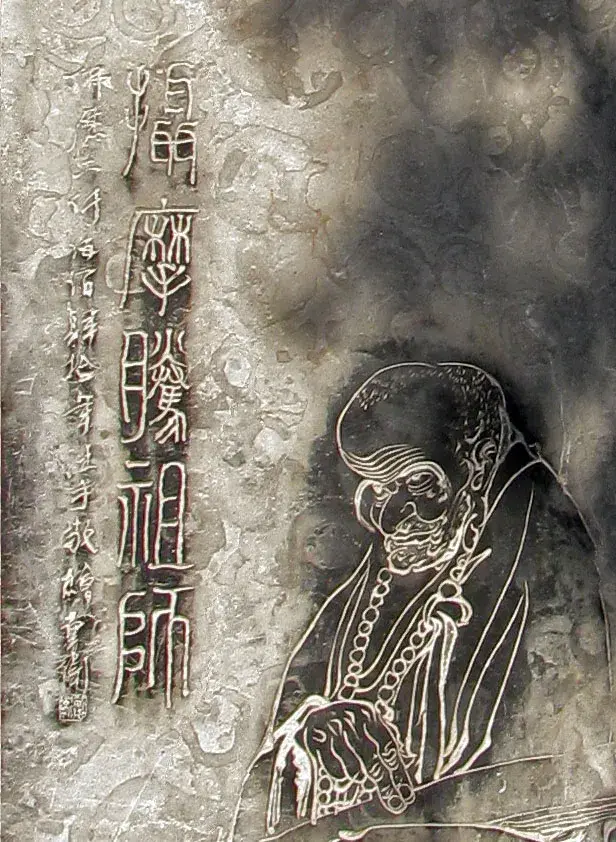
摄摩腾
She Moteng (died 73 CE), Sanskrit name Kasyapamatanga (also transliterated as Jiaye Moteng or Zhuye Moteng), was a native of Central India. He was an eminent Buddhist master, the foundational pioneer who introduced Buddhism to the central plains of China during the Eastern Han dynasty, the co-founder of the historic White Horse Temple in Luoyang, and the primary translator of the Sutra of Forty-Two Chapters (*Sishi'er Zhang…
She Moteng (died 73 CE), Sanskrit name Kasyapamatanga (also transliterated as Jiaye Moteng or Zhuye Moteng), was a native of Central India. He was an eminent Buddhist master, the foundational pioneer who introduced Buddhism to the central plains of China during the Eastern Han dynasty, the co-founder of the historic White Horse Temple in Luoyang, and the primary translator of the Sutra of Forty-Two Chapters (Sishi'er Zhang Jing), the very first Buddhist scripture translated into Chinese. Entering monastic life in his youth, She Moteng mastered the Tripiṭaka of both the Mahayana and Hinayana traditions. Strict in monastic discipline and renowned for oratorical eloquence, he dedicated his life to traveling and propagating the Dharma. During the Yongping era of Emperor Ming of Han, the emperor experienced an auspicious nocturnal dream of a radiant golden deity hovering above the palace courtyards. In response, an imperial delegation led by Gentleman-of-the-Palace Cai Yin and Erudite Disciple Qin Jing was dispatched westward to search for the Buddhist Dharma. In the territory of the Great Yuezhi, the envoys encountered She Moteng and his companion Dharmaratna (Zhu Falan), earnestly entreating them to journey east to the Han capital. In 67 CE (the tenth year of the Yongping era), She Moteng and Dharmaratna arrived in Luoyang with sacred Sanskrit palm-leaf manuscripts and sandalwood Buddha statues borne upon white horses. Emperor Ming received the Indian masters with state honors, decreeing in 68 CE the construction of the White Horse Temple outside the Yongmen Gate of Luoyang, establishing the first official state-sponsored Buddhist monastery in Chinese history. Residing at the temple's Qingliang Terrace, She Moteng directed the translation bureau, working with Dharmaratna to render essential Buddhist teachings into Chinese, producing the landmark Sutra of Forty-Two Chapters, which laid the doctrinal and ethical foundation for Chinese Buddhism. Furthermore, She Moteng memorialized the throne to establish Dafu Lingjiu Temple (modern Xiantong Temple) on Mount Qingliang (Mount Wutai), inaugurating the history of Mount Wutai as a preeminent Buddhist sanctuary. In 73 CE, She Moteng passed into parinirvana at White Horse Temple and was buried within the western precinct of the monastery, revered alongside Dharmaratna as the foundational patriarchs of Chinese Buddhism.
Born into a prominent Brahmin family in Central India; took monastic vows and mastered Mahayana and Hinayana scriptures.
Met the imperial delegation led by Cai Yin and Qin Jing in the territory of the Great Yuezhi, accepting their invitation to travel east.
Arrived in the imperial capital of Luoyang with Dharmaratna, carrying Sanskrit texts and sacred statues upon white horses.
Emperor Ming decreed the construction of White Horse Temple west of Luoyang, establishing the first official Buddhist monastery in China.
Translated the Sutra of Forty-Two Chapters at Qingliang Terrace; the imperial court preserved the text in the Orchid Terrace Stone Chamber.
Proposed the construction of Dafu Lingjiu Temple on Mount Qingliang, founding the earliest Buddhist establishment on Mount Wutai.
Passed away at White Horse Temple; entombed within the temple grounds, where his stupa tomb has been venerated across centuries.
| Field | Content |
|---|---|
| Name | She Moteng |
| Sanskrit Name | Kasyapamatanga |
| Alternative Names | Jiaye Moteng, Zhuve Moteng |
| Dynasty | Eastern Han |
| Origin | Central India |
| Date of Death | 73 CE (16th Year of the Yongping Era of Emperor Ming) |
| Historical Identity | Founding pioneer of Chinese Buddhism, eminent Central Indian monk, co-founder of White Horse Temple, primary translator of the Sutra of Forty-Two Chapters |
She Moteng was born into a distinguished Brahmin household in Central India during the early first century CE. Gifted with extraordinary intellect and a dignified spiritual presence from childhood, he renounced worldly wealth upon coming of age to enter the Buddhist sangha as a sramana.
Within the vibrant monastic culture of ancient India, She Moteng immersed himself deeply in the Tripiṭaka. He mastered the foundational Vinaya and Abhidharma of the Hinayana lineages while attaining profound comprehension of Mahayana emptiness doctrines and the Bodhisattva path. Strict in monastic deportment, he possessed exceptional gifts for scriptural exegesis. He gained widespread renown across the Gangetic plains after expounding the Suvarnaprabhasa Sutra (Golden Light Sutra) in an Indian dependency, which successfully mediated and averted border warfare. She Moteng continually harbored the compassionate aspiration to propagate the Dharma, vowing to carry Buddhist teachings to distant lands where the sacred law remained unheard.
Following Emperor Ming's ascension in the Eastern Han, intercultural contact between the central plains and the Western Regions expanded rapidly. According to the Biographies of Eminent Monks (Gaoseng Zhuan), Emperor Ming (Liu Zhuang) dreamed of a golden giant radiating brilliant light flying above the imperial palaces. The following morning, the emperor assembled court ministers to interpret the omen. Grand Astrologer Fu Yi stated that he had heard of an enlightened spiritual being in the Western Regions known as the Buddha, capable of flight, and that the emperor's dream surely portended his presence. Deeply inspired, Emperor Ming commissioned a mission in 65 CE headed by Gentleman-of-the-Palace Cai Yin, Erudite Disciple Qin Jing, and Wang Zun to journey past Yumen Pass into the Western Regions in search of Buddhist teachings. After traversing thousands of miles, the mission reached the territory of the Great Yuezhi, where they encountered She Moteng and Dharmaratna conducting seasonal retreat and teaching. Struck by She Moteng's serene wisdom and majestic aura, the Han envoys prostrated themselves, earnestly pleading with the Indian masters to travel eastward to teach in the Han empire.
Perceiving that the spiritual conditions of the eastern realm were ripe, She Moteng accepted the invitation despite the perils of traveling tens of thousands of miles across rugged terrain. Accompanied by Dharmaratna, he loaded extensive Sanskrit palm-leaf manuscripts, sandalwood sculptures of Shakyamuni Buddha, and holy relics onto white horses, following the Han delegation through the Pamir mountains and across vast desert expanses.
In the final month of 67 CE (the tenth year of the Yongping era), She Moteng and his companions arrived in the imperial capital of Luoyang. Emperor Ming was overjoyed and received the two Indian masters in the Southern Palace with highest honors, initially lodging them in the Honglu Si, the court ministry responsible for foreign dignitaries.
As sacred relics were displayed and courtiers flocked to pay reverence, the diplomatic lodge proved inadequate to accommodate the expanding crowds. In the first month of 68 CE, Emperor Ming issued an imperial decree ordering the construction of a large-scale monastic complex along the imperial highway three li outside the Yongmen Gate of western Luoyang. To commemorate the endurance of the white steeds that transported the scriptures, the emperor officially named the establishment "White Horse Temple" (Baima Si). White Horse Temple thereby became the earliest official Buddhist monastery in Chinese history, revered across East Asia as the "Cradle and Ancestral Source of Chinese Buddhism."
Settled at White Horse Temple, She Moteng promptly initiated the immense labor of translating Buddhist scriptures into Chinese. Because the scholar-officials of the central plains were wholly unfamiliar with Sanskrit and Buddhist conceptual vocabulary, She Moteng recognized the necessity of employing an elegant, accessible, and concise literary style.
At Qingliang Terrace in the rear courtyard of White Horse Temple, She Moteng presided as chief translator, with Dharmaratna assisting in oral transmission and court scribes refining the classical Chinese phrasing. Selecting core teachings from the vast Sanskrit corpus, She Moteng organized the texts into forty-two thematic sections using an aphoristic dialogue style, elucidating the renunciation of craving, mental purification, the law of karmic cause and effect, and the attainment of nirvana. Named the Sutra of Forty-Two Chapters (Sishi'er Zhang Jing), this landmark work became the very first Buddhist scripture translated into the Chinese language. Upon its completion, Emperor Ming commanded court scribes to produce calligraphic copies and deposited the sacred manuscript in the fourteenth chamber of the Orchid Terrace Stone Chamber, the imperial archives.
In 69 CE (the twelfth year of the Yongping era), She Moteng traveled through the northern commanderies and visited Mount Qingliang (modern Mount Wutai in Shanxi). Ascending the heights, he observed five elevated peaks resembling flat terraces, bearing a striking resemblance to Vulture Peak (Gridhrakuta) in Rajgir where the Buddha had expounded the Dharma. Upon discovering the ancient traces of an Ashokan relic stupa within the ravines, She Moteng memorialized Emperor Ming to request the foundation of a monastery on the mountain. Emperor Ming granted imperial funds to construct Dafu Lingjiu Temple (the precursor to modern Xiantong Temple). Through this initiative, She Moteng inaugurated the historic establishment of Mount Wutai as the sacred earthly bodhimanda of Manjushri Bodhisattva.
During his residence in Luoyang, She Moteng not only advanced translation and doctrine, but also established institutional Buddhist charitable practices in the central plains. He created sickwards and dispensing stations outside Luoyang, where the sangha distributed warm rice porridge and medicinal broths to impoverished refugees, exemplifying the compassionate ethos of the Mahayana and embedding Buddhism deeply within Chinese society.
In 73 CE (the sixteenth year of the Yongping era), She Moteng passed into parinirvana at Qingliang Terrace in White Horse Temple at an advanced age. Profoundly grieved, Emperor Ming provided generous funerary grants and decreed that his physical remains be entombed in the western precinct within the temple gates. His stupa tomb remains standing within White Horse Temple today, shaded by ancient cypresses and venerated by pilgrims worldwide.
As an Indian sage who journeyed across central Asian sands to introduce the Dharma, She Moteng illuminated the ancient civilizational dawn of Buddhism in China. His Sutra of Forty-Two Chapters served as the foundational primer for monastic and lay practitioners across two millennia, while White Horse Temple and Dafu Lingjiu Temple endure as paramount spiritual monuments. His pioneer translation and organizational leadership facilitated the profound synthesis of Buddhism with indigenous Confucian and Daoist traditions, permanently enriching Chinese civilization with boundless spiritual depth.
In 67 CE, at the invitation of Han envoy Cai Yin, She Moteng traveled with Dharmaratna to Luoyang bearing Sanskrit scriptures and Buddha statues upon white horses, formally inaugurating the transmission of Buddhism to China.
In 68 CE, Emperor Ming decreed the establishment of White Horse Temple in the western suburbs of Luoyang for She Moteng, creating the first official Buddhist monastery in China and establishing the monastic sangha system.
Presiding over the translation bureau at White Horse Temple, She Moteng rendered the Sutra of Forty-Two Chapters into Chinese, completing the first Chinese Buddhist translation, which was enshrined in the imperial Orchid Terrace Stone Chamber.
In 69 CE, recognizing that Mount Qingliang mirrored Vulture Peak, She Moteng secured imperial sanction to build Dafu Lingjiu Temple (modern Xiantong Temple), establishing Mount Wutai as a premier Buddhist sacred sanctuary.
FIGURES ASSOCIATED WITH THIS DYNASTY