Born into the prestigious Fucha clan of the Bordered Yellow Banner | Daughter of Lirongbao, raised in high Manchu nobility
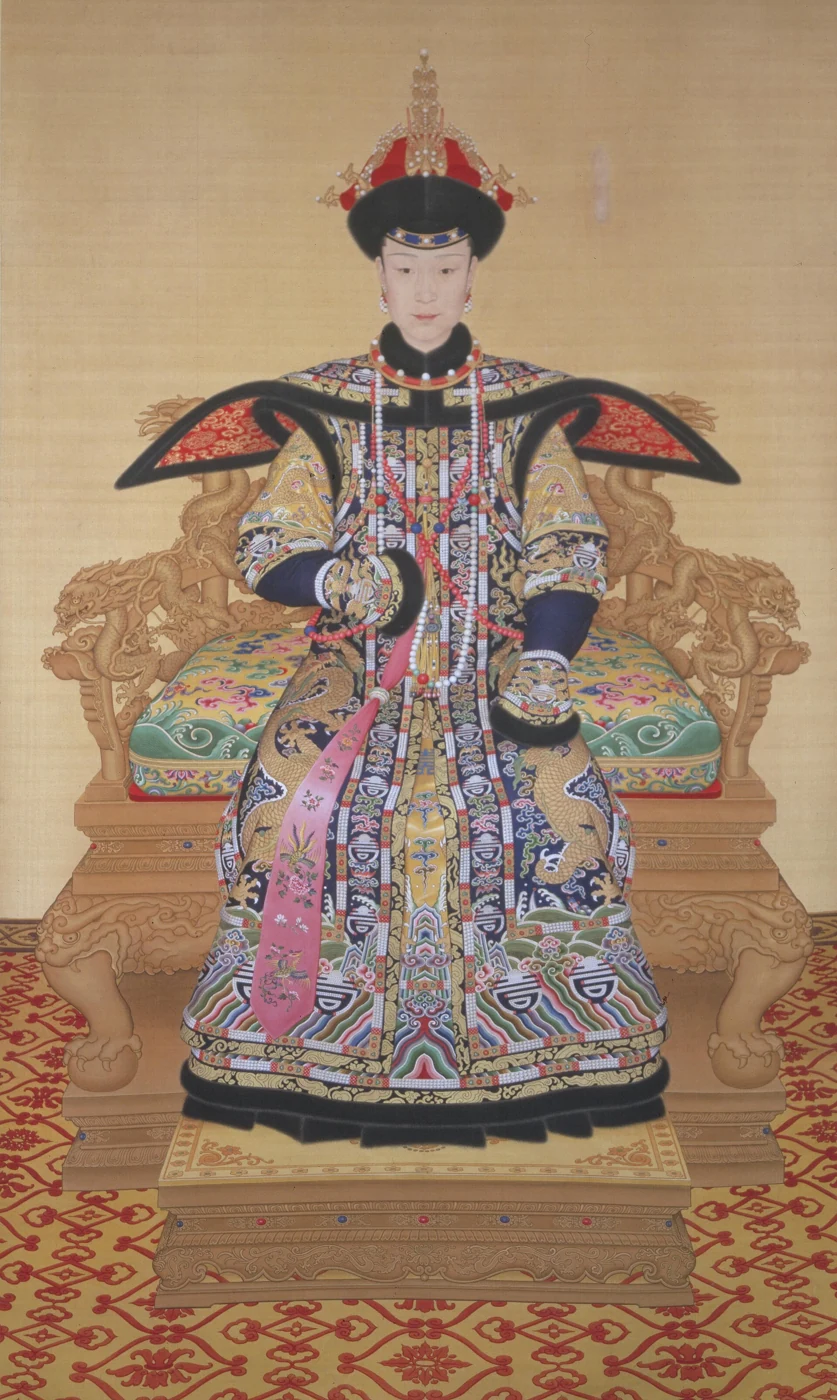
1712 CE–1748 CE
Historical figure
Empress Xiaoxianchun
富察氏(孝贤纯皇后)
Empress Xiaoxianchun (1712–1748), of the Manchu Bordered Yellow Banner Fucha clan, was the beloved primary empress consort of the Qianlong Emperor (Hongli) of the Qing dynasty. She was the daughter of Lirongbao, Supervisor of Chahar, and elder sister of Grand Secretary Fuheng. In 1727, Emperor Yongzheng betrothed her to Prince Hongli as his primary consort. Upon Qianlong's accession, she was installed as Empress in the…
1712 CE–1748 CEQing Dynasty
PROFILE
Empress Xiaoxianchun (1712–1748), of the Manchu Bordered Yellow Banner Fucha clan, was the beloved primary empress consort of the Qianlong Emperor (Hongli) of the Qing dynasty. She was the daughter of Lirongbao, Supervisor of Chahar, and elder sister of Grand Secretary Fuheng. In 1727, Emperor Yongzheng betrothed her to Prince Hongli as his primary consort. Upon Qianlong's accession, she was installed as Empress in the Changchun Palace. Celebrated for modesty, frugality, and consummate Confucian virtue, she avoided lavish jewelry, wearing simple velvet flowers and crafting pouches of deer pelt to commemorate ancestral hardships. She served Empress Dowager Chongqing with deep filial piety and governed the imperial harem with gentle equity. Devastated by the premature deaths of her two infant sons—Crown Prince Yonglian and Prince Yongcong—she fell ill during an imperial tour of Shandong and died aboard the royal barge in Dezhou in April 1748 at the age of thirty-seven. The Qianlong Emperor was inconsolable, composing the renowned Rhapsody on Expressing Grief (Shu Bei Fu) and mourning her devotion for the rest of his life.
- Courtesy / Art Name
- Not recorded
- Era
- Qing dynasty
- Dynasty
- Qing Dynasty
- Identity
- Historical figure
- Date of Birth
- Not recorded in historical sources
- Date of Death
- Not recorded in historical sources
- Ethnicity
- Manchu Bordered Yellow Banner
- Ancestral Home
- Unknown
- Place of Birth
- Place of birth unknown
- Place of Death
- Place of death unknown
- Lifespan
- 1712–1748
- Highest Office
- See Biography below
- Major Offices
- See Biography below
- Peerage
- Count of the second rank
- Posthumous Name
- Empress Xiaoxian
- Posthumous Honors
- Commandery prince
- Major Achievements
- Governed the imperial harem with modesty and frugality, fostered ancestral Manchu heritage, served Empress Dowager with supreme filial piety
LIFE TIMELINE
Betrothed by Emperor Yongzheng as Primary Consort to Prince Hongli | Wed in the Forbidden City, residing in the Chonghua Palace
Gave birth to the eldest imperial daughter | Shared deep matrimonial affection with Prince Hongli
Gave birth to second son Yonglian (Crown Prince Duanhui) | Secretly designated heir to the throne by Emperor Yongzheng
Gave birth to Princess Gulun Hejing | Brought joy to the imperial household
Qianlong ascended the throne; invested as Empress | Proclaimed Empress of the Qing Empire, residing in the Changchun Palace
Grand empress investiture ceremony held | Instituted frugality and reformed inner court decorum
Crown Prince Yonglian passed away prematurely | Plunged Empress Fucha into profound grief and chronic illness
Gave birth to seventh son Yongcong | Reignited imperial hopes for a direct legitimate succession
Prince Yongcong died of smallpox in infancy | Devastated Empress Fucha's physical and mental constitution
Accompanied the Emperor on eastern pilgrimage to Mount Tai | Died aboard imperial vessel at Dezhou, aged thirty-seven
Formally entombed in the Yuling Mausoleum | Qianlong composed the Rhapsody on Expressing Grief and mourned her for life
Tragic Demise on the Grand Canal and Eternal Mourning In the spring of 1748 | ### Tragic Demise on the Grand Canal and Eternal Mourning In the spring of 1748, seeking to console the grieving empress, Qianlong invited her to accompany him on an imperial inspection tour to Shandong, visiting Qufu to worship Confucius and ascending Mount Tai.
Final interment | Emperor Qianlong attended the offerings in person and wrote the "Rhapsody Recounting Grief" to express his mourning.
BIOGRAPHY
Biography
Noble Pedigree and Imperial Marriage
Empress Xiaoxianchun hailed from the illustrious Shaji Fucha clan of the Manchu Bordered Yellow Banner, one of the most prominent noble houses of the Qing Empire. Her great-grandfather Hashitun, grandfather Mishan, and grand-uncles Maci and Mawu served as grand ministers of state across the Kangxi and Yongzheng eras. Her father, Lirongbao, served as Supervisor of Chahar, while her younger brother, Fuheng, rose to become Grand Secretary of the Baohe Palace and Duke of Zhongyong. In 1727, during the imperial court selection, Emperor Yongzheng was deeply impressed by Lady Fucha's poise, refined intellect, and impeccable classical upbringing, immediately designating her as the primary consort for his secret heir, the fourth prince Hongli. The marriage was celebrated with imperial pomp in the Forbidden City. Residing in the Chonghua Palace, Prince Hongli and Lady Fucha formed an exceptionally intimate union anchored in mutual intellectual respect and genuine affection. ### Sovereign Consort and Frugal Administration Following the ascension of the Qianlong Emperor in 1735, Lady Fucha was proclaimed Empress of the Great Qing. In 1737, the grand formal investiture took place. As Empress, Lady Fucha presided over the imperial harem from the Changchun Palace with exemplary benevolence, modesty, and administrative fairness. In contrast to court extravagance, she deliberately avoided wearing precious pearls, jade, and gold filigree, opting instead for simple hair ornaments made of velvet and medicinal rush flowers (tongcao). Mindful of early Manchu struggles on the frontier, she personally stitched a pouch made of coarse deer pelt and presented it to the Qianlong Emperor, symbolizing dedication to ancestral martial simplicity. Deeply moved, Qianlong carried the pouch on his person and ordered imperial descendants to emulate her frugality. ### Exemplary Filial Piety toward the Empress Dowager Empress Fucha served Qianlong's mother, Empress Dowager Chongqing (Lady Niohuru), with legendary devotion. Whether residing in the Forbidden City, the Old Summer Palace (Yuanmingyuan), or traveling on imperial tours to Rehe, she attended the Dowager morning and night. Whenever the Dowager caught a mild cold or indisposition, Empress Fucha personally supervised medicinal preparations, spending sleepless nights at the bedside. The Empress Dowager treasured her deeply, treating her with unrestrained maternal affection. ### The Agony of Lost Heirs Despite imperial splendor, Empress Fucha's life was shadowed by maternal tragedy. In 1730, she gave birth to Prince Yonglian. Recognizing the boy's extraordinary intelligence, Qianlong secretly wrote his name and placed it behind the tablet 'Fair and Upright' in the Palace of Heavenly Purity, designating him as secret heir apparent. Tragically, in 1738, the nine-year-old Yonglian succumbed to severe illness. The Empress was shattered by grief, suffering long-term deterioration in health. In 1746, she gave birth to another legitimate son, Prince Yongcong, whom Qianlong again regarded as the natural dynastic successor. However, on New Year's Eve of 1747, Yongcong tragically died of smallpox before reaching two years of age. Having lost both legitimate princes, Empress Fucha's constitution broke entirely. ### Tragic Demise on the Grand Canal and Eternal Mourning In the spring of 1748, seeking to console the grieving empress, Qianlong invited her to accompany him on an imperial inspection tour to Shandong, visiting Qufu to worship Confucius and ascending Mount Tai. During the return journey along the Grand Canal, Empress Fucha caught severe chills. On April 8, 1748 (11th Day of the 3rd Month), her condition deteriorated precipitously, and she passed away aboard the imperial barge at Dezhou at the age of thirty-seven. The Qianlong Emperor was convulsed with grief. He personally escorted her barge back to Beijing, ordering state mourning of unprecedented scale. He preserved her residence, the Changchun Palace, in its exact original state for fifty years, commanding that nothing be moved. He authored the famous Rhapsody on Expressing Grief (Shu Bei Fu) and composed over a hundred poignant elegies, visiting her tomb in the Yuling Mausoleum on countless anniversaries until his own passing in 1799.
Major Activities
Championing Imperial Frugality and Manchu Heritage
Empress Fucha rejected lavish jewel ornamentation, choosing velvet floral hairpieces and sewing deer-pelt pouches to remind Emperor Qianlong and the banner nobility of ancestral martial simplicity. ### Devoted Filial Service to Empress Dowager Chongqing Serving as the foremost daughter-in-law of the empire, she attended the Empress Dowager daily with exemplary care, mediating court disputes and maintaining absolute harmony in the imperial household. ### Bearing and Mourning Direct Imperial Heirs Empress Fucha bore two brilliant princes—Crown Prince Yonglian and Prince Yongcong—whose premature deaths she endured with tragic fortitude while continuing to direct palace governance. ### Inspiring Qianlong's Greatest Elegiac Poetry Her premature passing inspired the Qianlong Emperor to compose the classic Rhapsody on Expressing Grief (Shu Bei Fu) and hundreds of mourning verses, creating an enduring monument of imperial love.
Personal Relations
- Husband: Emperor Qianlong of Qing (Hongli)
- Father: Lirongbao (Supervisor of Chahar, Duke of First Class Chengen)
- Younger Brother: Fuheng (Grand Secretary of Baohe Palace, Duke of Zhongyong)
- Nephews: Fuk'anggan (Prince of Jiayong, Grand Secretary), Fulong'an
- Sons: Yonglian (Crown Prince Duanhui), Yongcong (Prince of Zhe / Daomin)
- Daughter: Princess Gulun Hejing
- Mother-in-Law: Empress Dowager Chongqing (Empress Xiaoshengxian, Lady Niohuru)
Historical Assessment
- Qianlong Emperor: 'Surveying the virtuous empresses of antiquity, none surpassed her! Since my accession, I governed external affairs while she ordered internal virtue. Her loss leaves my soul in inconsolable darkness.'
- Draft History of Qing (Qing Shi Gao): 'Empress Xiaoxianchun was frugal and reverent, adorning herself only with velvet flowers and offering deer pelt to honor ancestral heritage. The Emperor held her in supreme reverence.'
- Historical consensus: Celebrated as the epitome of the virtuous Manchu empress consort, whose maternal benevolence defined the cultural pinnacle of the High Qing.
FIGURES ASSOCIATED WITH THIS DYNASTY
Bibliography
- Veritable Records of Emperor Gaozong of Qing (Qing Gaozong Shilu)
- Draft History of Qing, Volume 214, Biographies of Empresses and Consorts, Biography of Empress Xiaoxianchun