Birth into a Prominent House
Born into a respected clan in Xiangyang, Nanjun; immersed himself in classical literature, Daoist metaphysics, and moral philosophy.
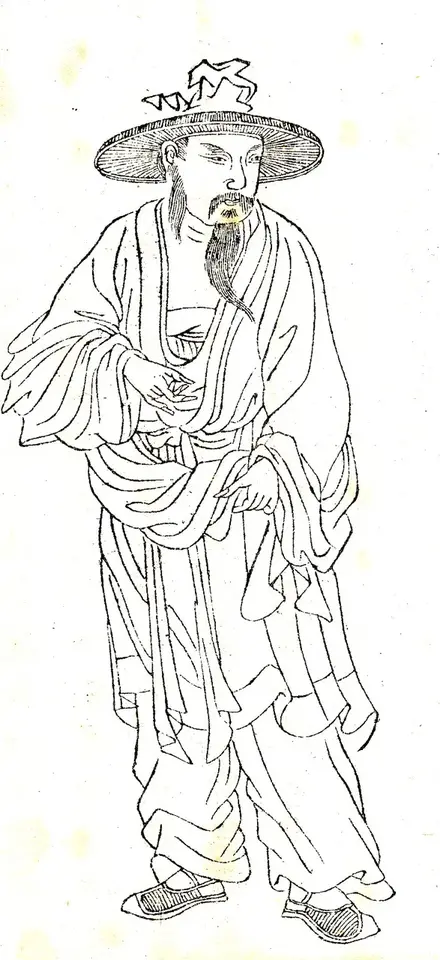
庞德公
Pang Degong (c. 150–c. 220 CE) was a native of Xiangyang County, Nanjun Commandery, Jingzhou (modern Xiangyang, Hubei). He was a renowned high-minded scholar, hermit, and premier connoisseur of human character during the turbulent transition from the late Eastern Han dynasty to the Three Kingdoms era. In his youth and mature years, Pang Degong secluded himself on Yuliang Island in the Mian River, south of Mount Xian in…
Pang Degong (c. 150–c. 220 CE) was a native of Xiangyang County, Nanjun Commandery, Jingzhou (modern Xiangyang, Hubei). He was a renowned high-minded scholar, hermit, and premier connoisseur of human character during the turbulent transition from the late Eastern Han dynasty to the Three Kingdoms era. In his youth and mature years, Pang Degong secluded himself on Yuliang Island in the Mian River, south of Mount Xian in Xiangyang, finding tranquility in tilling the soil, playing the zither, and reading poetry, having "never set foot in magistrate palaces or urban seats of government." He lived with transcendent grace and magnanimous detachment, farming alongside his wife and treating her with mutual reverence like an honored guest. Amid the rising chaos of warlords contending for supremacy in the late Han, Pang Degong exercised penetrating insight into human character, serving as an intellectual mentor to the literati of the Jingxiang region. He famously characterized Zhuge Liang as the "Crouching Dragon" (Wolong), his nephew Pang Tong as the "Fledgling Phoenix" (Fengchu), and Sima Hui of Yingchuan as the "Water Mirror" (Shuijing), profound appraisals that shaped the flow of talent and geopolitical landscape of the Three Kingdoms, earning the enduring veneration of contemporaries such as Zhuge Liang and Sima Hui. During Liu Biao's governorship over Jingzhou, Liu Biao sought to recruit Pang Degong to assist his administration, repeatedly sending envoys with lavish gifts, all of which Pang Degong courteously declined. Liu Biao eventually traveled in person to the furrows to persuade him, asking why he would preserve merely his own person rather than all under heaven, and what legacy he would leave his descendants. Pang Degong replied with effortless philosophical clarity, using the analogies of wild swans nesting in high forests and turtles dwelling in deep waters, explaining that worldly men leave their offspring danger through competitive pursuit of power and wealth, whereas he left his descendants peace and self-sufficiency. Deeply humbled, Liu Biao departed with a sigh. Prior to Cao Cao's massive southern expedition into Jingzhou, Pang Degong took his wife and children to Mount Lumen to gather medicinal herbs, retreating into the mists and never returning to worldly society. Later poets and literati—including Meng Haoran, Li Bai, Du Fu, and Su Shi—celebrated Pang Degong's unblemished moral nobility, and his hermitage on Mount Lumen became an enduring sanctuary of Chinese literati culture.
Born into a respected clan in Xiangyang, Nanjun; immersed himself in classical literature, Daoist metaphysics, and moral philosophy.
Erected a thatched lodge on Yuliang Island in the Mian River, tilling the fields and vowing never to enter government administrative seats.
Welcomed scholars fleeing the central plains; designated Zhuge Liang as Crouching Dragon, Pang Tong as Fledgling Phoenix, and Sima Hui as Water Mirror.
Recognizing the latent genius of his young nephew Pang Tong, directed him to visit Sima Hui, establishing Pang Tong's fame across southern China.
Refused Governor Liu Biao's personal recruitment in the fields, discoursing on leaving peace rather than danger to posterity.
Foreseeing impending military devastation, led his family deep into Mount Lumen to gather herbs, passing beyond worldly knowledge.
| Field | Content |
|---|---|
| Name | Pang Degong |
| Alternative Name | Pang Gong |
| Dynasty | Eastern Han |
| Ancestral Home | Xiangyang County, Nanjun Commandery, Jingzhou (modern Xiangyang, Hubei) |
| Historical Identity | Late Eastern Han prominent recluse, hermit, celebrated connoisseur of talent |
Pang Degong was born into an established gentry lineage in Xiangyang, Nanjun Commandery, during the transition between the reigns of Emperor Huan and Emperor Ling. In the twilight of the Eastern Han dynasty, court eunuchs and consort factions monopolized state power, instigating the Disasters of the Partisan Prohibitions and driving imperial politics into terminal decay. Observing the moral compromises and bloody fates of court grandees, Pang Degong grew disillusioned with worldly office in his youth, renouncing the conventional path of civil examination to dwell among the scenic waters and mountains of Xiangyang.
Pang Degong made his home on Yuliang Island in the Mian River, situated south of Mount Xian outside Xiangyang. Surrounded by clear waters and wild river banks, the island provided an idyllic sanctuary far removed from mundane strife. Pang Degong cultivated several acres of paddy fields, guiding his household in manual agriculture. Dignified and self-disciplined, though dwelling in rustic simplicity, he strictly adhered to his personal vow never to cross into the city or enter government administrative offices.
In daily domestic life, Pang Degong and his wife treated each other with consummate courtesy and mutual respect, conversing with formal elegance and never engaging in domestic friction. When agricultural labor ceased, Pang Degong would straighten his robes and headgear, sit upright in his hall, and delight in playing the ancient zither and reciting classical texts. Visitors who came to pay homage were profoundly struck by his austere solemnity and untrammeled spiritual serenity.
During the late Eastern Han, Dong Zhuo's destructive seizure of Luoyang and the rise of contending warlords devastated northern China. Under the stable governance of Liu Biao, the Jingzhou region remained comparatively peaceful, attracting a massive southward migration of prominent northern lineages and refugee literati to Xiangyang. Possessing unparalleled moral stature, Pang Degong became the venerated patriarch of this intellectual community.
Among his fellows, prominent scholars such as Sima Hui and Xu Shu of Yingchuan, along with the young Zhuge Liang residing in Longzhong, established intimate intellectual bonds with Pang Degong. Sima Hui resided on the northern bank of the Mian River, directly facing Yuliang Island. The two scholars frequently crossed the waters in small boats to visit each other, conversing on poetry and philosophical principles without worldly restraint. Sima Hui, ten years Pang Degong's junior, treated him with the deference due to an elder brother, addressing him affectionately as "Lord Pang" (Pang Gong), which became his universal honorific. On one occasion, when Sima Hui visited the estate while Pang Degong was across the river paying respects at ancestral tombs, Sima Hui walked directly into the inner quarters and instructed Pang Degong's wife and children to quickly prepare millet meals for arriving guests. The household served him with great reverence, and when Pang Degong returned, host and guest conversed seamlessly as if they were of one flesh, devoid of formal protocol.
Pang Degong possessed a legendary gift for assessing human character. At a time when Zhuge Liang lived in agrarian obscurity, comparing himself to Guan Zhong and Yue Yi while contemporaries scoffed at his apparent conceit, Pang Degong alone recognized his peerless statecraft, bestowing upon him the moniker "Crouching Dragon" (Wolong). His paternal nephew Pang Tong was unpolished and unassuming in youth, dismissed by local peers; Pang Degong alone perceived his brilliance, designating him the "Fledgling Phoenix" (Fengchu) and sending him to confer with Sima Hui. For the pure, insightful, and erudite Sima Hui, Pang Degong conferred the title "Water Mirror" (Shuijing). Thereafter, the labels of Crouching Dragon, Fledgling Phoenix, and Water Mirror reverberated throughout the realm, defining the three preeminent figures of the era. Zhuge Liang held Pang Degong in supreme veneration; whenever he visited Yuliang Island, he knelt reverently before Pang Degong's couch, and the master received his homage with quiet grace.
Liu Biao, Governor of Jingzhou, took pride in welcoming scholars and sought to augment his prestige by enlisting eminent regional luminaries. Liu Biao repeatedly dispatched high messengers bearing gold, silks, and official credentials to Yuliang Island, imploring Pang Degong to accept ministerial office, but the master calmly declined every offer.
Undeterred by previous refusals, Liu Biao decided to travel in person with a modest retinue to Yuliang Island. Arriving in late spring, Liu Biao found Pang Degong wearing a woven bamboo hat and working the furrows with an iron hoe, while his wife and sons weeded the fields ahead of him. Stepping onto the ridge, Liu Biao addressed him, asking how preserving one's solitary body could compare with preserving the entire empire, and questioning what legacy he would leave his children by laboring in the mud. Pang Degong rested on his hoe and smiled, explaining that wild swans nest in the high forest canopy to sleep, and water reptiles bore into deep riverbeds for shelter; human choices in career and retreat are merely their respective nests, where each creature seeks its own rest, and the welfare of the realm was not something he could presumptuously guarantee.
Liu Biao pointed to Pang Degong's family toiling in the earth and asked what heritage his descendants would inherit if he refused state emoluments. Pang Degong serenely replied that worldly men pursue high office and wealth, ultimately bequeathing danger and lethal rivalry to their children, whereas he bequeathed peace, contentment, and honest labor. When Liu Biao pressed for an explanation, Pang Degong expounded historical lessons: Yao and Shun abdicated the empire to worthy ministers and allowed their sons to live among common reeds, enabling Danzhu and Shangjun to live out their natural lives unharmed; by contrast, Yu and Tang privatized dynastic succession, leading eventually to Jie being exiled to Nanchao and Zhou's severed head hanging from the Zhou battle standard, their entire royal lineages annihilated. Even the Duke of Zhou had executed his brothers during his regency; had the royal brothers subsisted on wild broth beneath thatched huts, such fratricidal horrors would never have unfolded. Overcome by Pang Degong's moral depth and historical wisdom, Liu Biao sighed deeply and departed without pressing his recruitment further.
In 208 CE (the thirteenth year of the Jian'an era), Cao Cao mobilized a massive northern host to descend southward upon Jingzhou, his vanguard pressing toward Wancheng. With Liu Biao terminally ill, the Xiangyang region was poised to become a bloody battleground.
Pang Degong understood that the tranquil sanctuary of Jingzhou was about to be shattered, and that Yuliang Island, situated along major transit waterways, could no longer shield his family from war. Refusing to embroil himself in the tripartite bloodshed between Cao Cao, Liu Bei, and Sun Quan, he resolved upon ultimate withdrawal. Gathering his wife and children with modest scrolls, zithers, and medicine pouches, Pang Degong climbed deep into Mount Lumen, located tens of li southeast of Xiangyang.
Mount Lumen was draped in layered peaks and secluded ravines, secluded from the turmoil of human history. Under the pretext of gathering wild lingzhi herbs and medicinal roots, Pang Degong ascended into the misty precipices and never returned, merging into the cloud-shrouded wilderness beyond mortal sight. Although he vanished from history, his profound legacy lived on. His son Pang Shanmin later served Cao Wei as a Gentleman of the Ministry of Personnel and married Zhuge Liang's second sister; his nephew Pang Tong accompanied Liu Bei to conquer Sichuan as Military Advisor Leader of Court Gentlemen; and his grandson Pang Huan served the Jin dynasty as Governor of Zangke. The enduring flourishment of the Pang lineage validated Pang Degong's prophetic wisdom of leaving peace rather than peril to his heirs. For subsequent centuries, statesmen and recluses journeying past Mount Lumen gazed toward its peaks in deep veneration, immortalizing Pang Degong as the quintessential exemplar of high-minded reclusion.
Pang Degong established his hermitage on Yuliang Island in the Mian River, maintaining a lifelong principle of never entering municipal government seats, farming with his wife in mutual reverence, and setting an unmatched ethical standard for literati autonomy.
With piercing connoisseurship, Pang Degong designated Zhuge Liang as the "Crouching Dragon," Pang Tong as the "Fledgling Phoenix," and Sima Hui as the "Water Mirror," defining the enduring historical reputations of the three foremost figures of the late Han era.
When Governor Liu Biao personally visited his fields to offer high office, Pang Degong declined with philosophical grace, articulating the immortal maxim of leaving descendants peace rather than danger through worldly ambition.
Confronted with the encroaching devastation of the Three Kingdoms wars, Pang Degong led his entire family into Mount Lumen, passing into eternal reclusion and establishing the mountain as a sacred cultural sanctuary for recluses across Chinese history.
FIGURES ASSOCIATED WITH THIS DYNASTY