Birth in Pingyuan
Born in Ban County, displaying prodigious literary and oratorical talents from an early age.
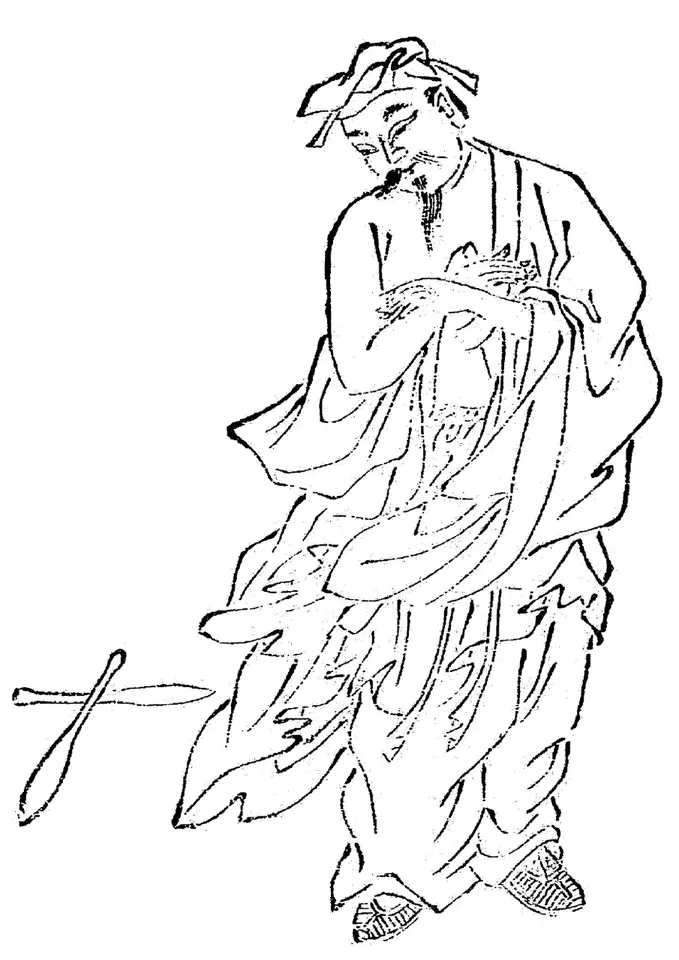
祢衡
Mi Heng was an eminent literary figure, celebrated rhapsodist, and scholar of the late Eastern Han Dynasty. Endowed with extraordinary literary talent, photographic memory, and razor-sharp eloquence, he was notorious for his uncompromising arrogance, fierce disdain for political opportunism, and harsh satirical appraisals of contemporary elites. In intellectual circles, he recognized only Kong Rong and Yang Xiu as peers. Upon…
Mi Heng was an eminent literary figure, celebrated rhapsodist, and scholar of the late Eastern Han Dynasty. Endowed with extraordinary literary talent, photographic memory, and razor-sharp eloquence, he was notorious for his uncompromising arrogance, fierce disdain for political opportunism, and harsh satirical appraisals of contemporary elites. In intellectual circles, he recognized only Kong Rong and Yang Xiu as peers. Upon arriving at the newly established capital of Xu, he refused to curry favor with the powerful, keeping his calling card concealed in his robe until the ink rubbed away. Recommended to Emperor Xian through Kong Rong's famous memorial Petition Recommending Mi Heng, Mi was summoned by Cao Cao. Detesting Cao's autocratic ambitions, Mi feigned illness and voiced defiant insults. Seeking to humiliate him, Cao Cao assigned him as a palace drum clerk; during a state banquet, Mi performed a stirring rendition of the Three Beats of Yuyang before stripping off his clothing to publicly humiliate Cao Cao in return. Sparing his life to avoid the infamy of executing a renowned scholar, Cao sent Mi south to Liu Biao in Jingzhou. Initially respected for his drafted state papers, Mi's unbridled irreverence led to his reassignment to Huang Zu, Administrator of Jiangxia. While Huang Zu initially admired his literary gifts, an exchange of insults during a military boat banquet incited Huang's violent rage, resulting in Mi's execution at age twenty-six. Mi's masterpiece, Ode to the Parrot, remains a lyrical landmark of late Han literature.
Born in Ban County, displaying prodigious literary and oratorical talents from an early age.
Fled the devastating civil wars of the Central Plains, finding temporary refuge in Jingzhou.
Arrived in Cao Cao's new capital; refused to court ministers, forging an enduring bond with Kong Rong and Yang Xiu.
Refused Cao Cao's summons; stripped naked while performing the Three Beats of Yuyang to satirize the chancellor; banished to Jingzhou.
Composed the Ode to the Parrot at Jiangxia; strangled to death after insulting Huang Zu during a banquet; buried on Parrot Island.
Mi Heng was born in Ban County, Pingyuan Commandery. Gifted with intellect and caustic wit, he absorbed classical canons effortlessly, possessing the ability to recite texts after a single reading. However, his unbending temperament made him contemptuous of societal conventions and impatient with mediocrity. During the Xingping era, as warfare engulfed northern China, Mi fled his homeland, taking refuge south of the Han River in Jingzhou.
Following the transfer of Emperor Xian to Xu County under Cao Cao's hegemony, ambitious scholars from across the empire flocked to the new seat of government seeking patronage. In early Jian'an, Mi traveled to Xu. Despite the throngs of aspiring courtiers, Mi found no patron worthy of his respect. Carrying a wooden calling card inscribed with his name and lineage inside his robe, he wandered the capital for months without delivering it, giving rise to the literary idiom of "carrying the card until the characters fade."
When acquaintances urged him to seek audience with influential ministers like Chen Qun or Sima Lang, Mi retorted: "Do you expect me to associate with butchers and tavern keepers?" Asked whom he considered worthy in the entire empire, Mi sneered: "The elder talent is Kong Wenju (Kong Rong), and the younger prodigy is Yang Dezu (Yang Xiu). As for the rest of the flock, they are common drudges unworthy of mention." Questioned about the paramount leaders of the state—Chancellor Cao Cao, Imperial Secretariat Director Xun Yu, and General Zhao Rong—Mi remarked: "Xun Yu possesses a handsome face suitable for attending funerals to lend gravity, while Zhao Rong has a vast stomach suited to managing food and drink in the imperial kitchens." Such cutting remarks provoked bitter fury throughout the capital bureaucracy.
Among the capital elite, only Kong Rong, Minister of the Household, recognized Mi's extraordinary gifts. Though Kong was past forty and Mi was barely twenty, the two formed an intimate cross-generational friendship. In 197 (Jian'an 2), Kong submitted his celebrated Petition Recommending Mi Heng to Emperor Xian, describing the young scholar as a noble eagle whose soaring talent outshone a hundred common birds, capable of resolving diplomatic crises and enriching the state.
Following Kong's appeals, Cao Cao granted Mi an audience. However, Mi despised Cao's tyrannical manipulation of the court, feigned mental illness, and spread biting satires throughout the markets. Enraged yet reluctant to execute a celebrity intellectual, Cao Cao appointed Mi as a palace drummer to humiliate him during state receptions.
In August 197, Cao Cao hosted a gala for his civil and military officials, reviewing performances by imperial drummers. Sumptuary regulations required drummers to wear special uniform tunics and short caps. When his turn arrived, Mi strode forward wearing common scholar's attire. Gripping the drumsticks, he performed the martial suite Three Beats of Yuyang. His rhythm resonated with tragic grandeur and righteous sorrow, mesmerizing the gathered assembly.
When a supervising bailiff yelled at him for failing to change into the official uniform, Mi agreed calmly. Standing before the assembly and Cao Cao himself, Mi deliberately undressed until completely naked, casually picking up the drummer garments, donning them slowly, and completing his drum suite without the slightest trace of embarrassment. The banquet hall was stunned; Cao Cao chuckled bitterly, conceding: "I intended to humiliate Mi Heng, yet he has thoroughly humiliated me!"
Afterward, Kong Rong reprimanded Mi for his shocking insolence, persuading him to apologize. Mi consented, but when Cao Cao waited late into the night at the camp gates, Mi arrived dressed in a coarse single robe, sitting on the ground outside with a three-foot wooden staff, pounding the earth while hurling curses at Cao Cao and his ancestral lineage. Furious, Cao Cao remarked to Kong Rong: "Killing this boy would be as trivial as crushing a bird or rat. Yet he possesses an undeserved literary fame across the realm. If I put him to death, the world will say I cannot tolerate talent. I shall dispatch him to Liu Biao in Jingzhou, and we shall see how he fares."
Prior to his departure, courtiers gathered south of the city to offer a farewell banquet, agreeing to remain seated without greeting Mi to retaliate against his past slights. Arriving at the pavilion, Mi observed the silent gathering and burst into theatrical wailing. When asked the reason for his tears, Mi laughed bitterly: "Those seated resemble tombstones, and those lying down are like corpses. Walking alone amidst tombs and corpses, how can I not weep?" The assembly was silenced in embarrassment.
Upon reaching Xiangyang, Mi was welcomed by Governor Liu Biao, who treated him as an honored guest. For months, no major diplomatic declaration or memorial was finalized by Liu's secretariat without Mi's editorial review.
On one occasion, Liu Biao and his senior scribes spent days drafting an urgent memorial to the imperial court. Returning from an excursion, Mi glanced at the draft, denounced its prose as amateurish, and tore the document to shreds before Liu's eyes. Terrified by the youth's audacity, the court was astonished when Mi demanded brush and paper, dashing off an eloquent and tightly reasoned replacement in a single sitting. Delighted, Liu lavished greater honors upon him. Over time, however, Mi's chronic insolence re-emerged: he openly mocked Liu's indecisiveness and insulted his senior councilors. Reluctant to incur the blame for executing a literatus, Liu Biao leveraged the volatile temper of Huang Zu, Administrator of Jiangxia, transferring Mi to Huang's headquarters.
Huang Zu was stationed at Xiakou, where his eldest son Huang She had long admired Mi's genius. Welcomed into the commandery, Mi was assigned charge of administrative records and military dispatches. Mi handled sensitive archives with precision, prompting Huang Zu to grasp his hands in admiration: "Master, your writings express the very thoughts of my heart!"
During an outing, Huang She marveled at an ancient stele composed by Cai Yong, lamenting that he lacked the means to copy it. Mi remarked: "Though I have glanced upon it but once, I retain the entire text, save for two eroded characters." Mi wrote down the thousand-character inscription from memory; a verification team sent to examine the stone confirmed that Mi's transcription matched the original down to the last character.
At a river banquet on an armored warship, a guest presented Huang She with a rare parrot. Huang raised a goblet to Mi: "Master, please compose a rhapsody upon this clever bird to delight our guests." Taking up the brush, Mi composed the immortal Ode to the Parrot without pausing to erase a single character. The rhapsody depicted a gifted, luminous bird imprisoned within a gilded cage, its wings clipped by lesser men—a transparent metaphor for a brilliant scholar trapped in an era of despotic mediocrity.
Tragedy struck in October 198 (Jian'an 3). During a fleet banquet, attendants served hot millet soup to the guests. Served first, Mi consumed the food greedily without sharing, afterward idly tossing the grains across the table. When guest Zhang Boyun questioned his breach of ritual manners, Mi ignored him. Huang Zu attempted to intervene, asking gently: "Master, will you not answer him?" Mi glared at Huang Zu, yelling: "How can a true gentleman listen to the foul noise of a draught horse? You insolent old tinsmith slave!"
Born a common soldier, Huang Zu was incensed by the public insult. He ordered guards to drag Mi out and beat him. Mi continued to shout obscenities from the deck. Seizing the opportunity, Huang Zu's chief clerk—who had endured Mi's biting disdain for months—strangled Mi with a bowstring before orders could be countermanded. Huang She ran barefoot to intervene, but arrived only to find his friend lifeless. Grief-stricken, Huang She wept over the corpse, prompting Huang Zu to regret his hasty wrath. The administrator accorded Mi an honorable burial on Parrot Island in the Yangtze River. Mi Heng was twenty-six years old.
Kong Rong praised Mi in his memorial: "Endowed with pure and upright virtues, his extraordinary talents tower above the mundane. What his eye beholds, his mouth can recite; what his ear catches, his heart never forgets. Better one noble eagle than a hundred common birds."
Fan Ye observed in the Book of the Later Han: "Mi Heng prided himself upon his towering intellect, yet failed to navigate mundane realities. Venting fleeting indignation, he ultimately invited destruction—how tragic!"
Literary theorist Liu Xie remarked in The Literary Mind and the Carving of Dragons: "Mi Heng's Elegy for Zhang Heng is luxuriant and lucid; his Ode to the Parrot lodges profound grief within physical description, standing as an enduring standard of Han-Wei literature."
Ming philosopher Wang Fuzhi offered a critical view: "Endowed with high talent yet unruly ambition, his wild arrogance invited doom. A true gentleman never allows cleverness to obscure virtue; Mi Heng's destruction at the hands of petty men was ultimately of his own making."
FIGURES ASSOCIATED WITH THIS DYNASTY