Birth in Maoling
Born into the illustrious Ma clan of Fufeng, grandson of Ma Yu and son of Chamberlain for Palace Buildings Ma Yan.
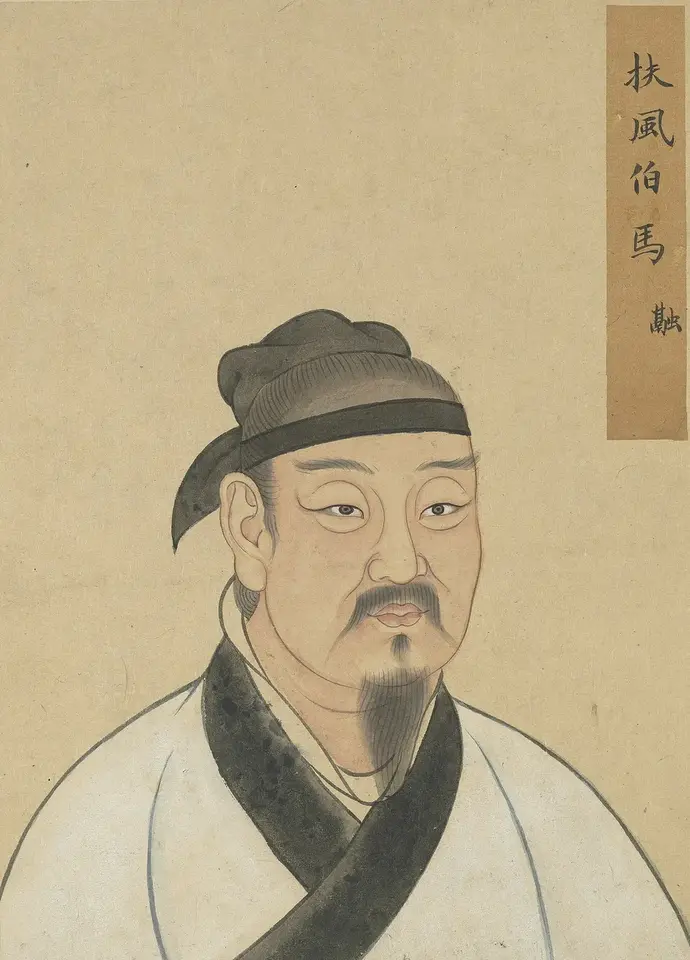
马融
Ma Rong, 79–166 (马融), courtesy name Jichang, was an illustrious Confucian master, literary stylist, and imperial statesman of the Eastern Han dynasty, native to Maoling in Right Fufeng. A grand-nephew of the renowned founding general Ma Yuan and son of Chamberlain for Palace Buildings Ma Yan, Ma Rong is historically recognized as the principal pioneer who guided Old Text classical studies toward intellectual maturity. Endowed…
Ma Rong, 79–166 (马融), courtesy name Jichang, was an illustrious Confucian master, literary stylist, and imperial statesman of the Eastern Han dynasty, native to Maoling in Right Fufeng. A grand-nephew of the renowned founding general Ma Yuan and son of Chamberlain for Palace Buildings Ma Yan, Ma Rong is historically recognized as the principal pioneer who guided Old Text classical studies toward intellectual maturity. Endowed with brilliant rhetorical eloquence and handsome bearing, he studied under hermit scholar Zhi Xun in his youth before prostrating himself beneath the chamber of Ban Zhao to study the Book of Han. He served as Collator of Texts in the Eastern Tower, where he collated secret imperial archives. After presenting the satirical Rhapsody on Guangcheng to caution against royal extravagance, he offended Empress Dowager Deng and remained unpromoted for a decade. Under Emperor An and Emperor Shun, he served as Court Gentleman, Major of the Army, and Grand Administrator of Wudu, correctly forecasting northwestern Qiang insurrections and Xianbei inroads. Rising to Grand Administrator of Nanjun under Emperor Huan, he defied overbearing General-in-Chief Liang Ji, resulting in false corruption charges, head shaving, and banishment to Shuofang. Following an aborted suicide attempt, he was pardoned, reappointed Gentleman Consultant, and directed the compilation of Han Records of the Eastern Tower. Later coerced into drafting Liang Ji's impeachment of Li Gu, his moral reputation suffered criticism. Ma Rong integrated disparate traditions to annotate the Spring and Autumn Annals, Book of Changes, Book of Documents, Mao Odes, and Three Rites, establishing a renowned school behind red silk curtains that educated over a thousand disciples, including Zheng Xuan and Lu Zhi. Passing away at eighty-eight, he was posthumously enshrined in the Confucian Temple during the Tang dynasty and created Count of Fufeng during the Song dynasty.
Born into the illustrious Ma clan of Fufeng, grandson of Ma Yu and son of Chamberlain for Palace Buildings Ma Yan.
Traveled to the Zhongnan Mountains to master classical learning under hermit Zhi Xun, who wedded his daughter to him.
Faced starvation in Liangzhou during Qiang revolts; reassessed the primacy of physical survival and accepted Deng Zhi's summons.
Appointed Collator of Texts; studied the Book of Han under Ban Zhao and organized classical holdings at the Eastern Tower.
Submitted Rhapsody on Guangcheng to criticize imperial hunting extravagances; incurred Empress Dowager Deng's wrath and suffered a ten-year political stall.
Following Empress Dowager Deng's death, presented Rhapsody on the Eastern Tour to Emperor An and was appointed Court Gentleman.
Recommended for imperial service on account of sincerity; served as Gentleman Consultant and Major under Liang Shang before becoming Grand Administrator of Wudu.
Promoted to Grand Administrator of Nanjun; framed on fabricated embezzlement charges after resisting General-in-Chief Liang Ji.
Sentenced to head-shaving and exile to Shuofang; survived a suicide leap and received imperial pardon to resume editorial work at the Eastern Tower.
Passed away at his ancestral home at the venerable age of eighty-eight, instructing his family to conduct a frugal burial.
Ma Rong was born into one of the most prominent noble families of the Eastern Han dynasty. His grand-uncle was Ma Yuan, the General Who Calms the Waves, while his father Ma Yan served as Chamberlain for Palace Buildings. Gifted with natural eloquence, graceful deportment, and penetrating intellect, Ma Rong in his youth sought instruction from Zhi Xun, an eminent scholar living in seclusion in the Zhongnan Mountains who refused imperial appointments. Under Zhi Xun's mentorship, Ma Rong attained comprehensive mastery over ancient classics, prompting Zhi Xun to marry his daughter to him.
In 108, General-in-Chief Deng Zhi sought to enlist him as private secretary, but Ma Rong declined and journeyed west into Wudu and Hanyang in Liangzhou. When fierce Qiang uprisings erupted across the frontiers, famine spread and corpses lined the roads. Experiencing severe hunger, Ma Rong reconsidered the futility of sacrificing life for hollow reputations, observing that even simpletons would not harm themselves for empty acclaim. He returned east to accept Deng Zhi's summons. In 110, he was commissioned as Collator of Texts at the imperial archives in the Eastern Tower. When historian Ban Zhao completed the Book of Han, Ma Rong reverently knelt at her chamber steps to receive instruction on its archaic terminology and phonetics.
During his tenure at the Eastern Tower, Empress Dowager Deng held sovereign authority while her kinsmen managed state administration. Contemporary courtiers promoted civil virtue over martial prowess, abandoning military training exercises and leaving the realm vulnerable to bandits and frontier incursions. Ma Rong staunchly maintained that both civil and military arts were essential pillars of statecraft, arguing that neglecting defense invited disaster.
In 115, Empress Dowager Deng conducted a massive royal hunt at Guangcheng Park, squandering enormous public revenues. Ma Rong seized the opportunity to present Rhapsody on Guangcheng, employing magnificent diction to allegorize the perils of unchecked luxury and military neglect. Perceptive of the rebuke, the Empress Dowager was deeply offended, freezing Ma Rong's rank at Collator of Texts for a full decade. When Ma Rong took unapproved leave to attend his deceased nephew's funeral, the Empress Dowager interpreted his absence as defiance and officially stripped him of bureaucratic standing.
In 121, Emperor An assumed personal rule following Empress Dowager Deng's demise. Learning of Ma Rong's talents, Emperor An recalled him to the lecture halls. When the sovereign toured Mount Tai, Ma Rong presented the elaborate Rhapsody on the Eastern Tour, earning imperial appointment as Court Gentleman. In 133, recommended under Emperor Shun as a man of profound sincerity, Ma Rong passed court examinations to become Gentleman Consultant, subsequently joining General-in-Chief Liang Shang's staff before advancing to Grand Administrator of Wudu.
While governing Wudu, the western Qiang revolted once more, and imperial generals Ma Xian and Hu Chou hesitated to advance. Ma Rong analyzed the terrain and correctly predicted Ma Xian's defeat, petitioning the court to let him lead five thousand troops to crush the rebellion, though his request was rejected. He further warned that northern Wuhuan and Xianbei horsemen would strike the frontier. Shortly thereafter, Ma Xian fell in battle and Wuhuan raiders pillaged Shang Commandery exactly as Ma Rong had anticipated, establishing his reputation as a military strategist.
Under Emperor Huan, Ma Rong rose to Grand Administrator of Nanjun. Unwilling to demean himself before the arrogant and corrupt General-in-Chief Liang Ji, Ma Rong became the target of Liang Ji's vengeance. Corrupt officials framed him for embezzling commandery funds, resulting in dismissal, public shaving of his hair, and banishment to the barren northern wastes of Shuofang. Deeply humiliated, Ma Rong attempted suicide by drowning on the road but was rescued, subsequently receiving an imperial pardon that allowed him to return to Luoyang.
Chastened by severe political trauma, Ma Rong returned to the Eastern Tower as Gentleman Consultant, collaborating with Bian Shao and Cui Shi on the official dynastic record Han Records of the Eastern Tower. Nevertheless, under Liang Ji's relentless pressure, Ma Rong compromised his integrity by drafting the legal indictment that condemned upright statesman Li Gu to death, and later authored Rhapsody on the Western Residence celebrating Liang Ji's opulent mansion. Upright official Wu You publicly rebuked him for betraying righteous men, casting a lasting shadow across his final years. In 166, Ma Rong passed away peacefully at home at the age of eighty-eight, requesting a simple interment.
Ma Rong's primary contribution to intellectual history was establishing the systematic maturity and structural independence of Eastern Han Old Text classical studies. For generations, Han scholarship had been bogged down in dogmatic factionalism and superstitious omenology. Capitalizing on his prolonged access to imperial archival treasures in the Eastern Tower, Ma Rong approached classical texts with empirical rigor and broad synthetic vision.
When studying the Spring and Autumn Annals, he examined commentaries by Jia Kui and Zheng Zhong, observing that Jia was precise but narrow, while Zheng was comprehensive but imprecise. Synthesizing their strengths, he composed Differences and Similarities in the Three Commentaries of the Spring and Autumn Annals, creating a model of commentary that combined philological accuracy with broad contextual knowledge. Ma Rong authored standard commentaries on the Book of Changes, Book of Documents, Mao Odes, Three Rites, Laozi, Huainanzi, Classic of Filial Piety, Analects, Lisao, and Biographies of Exemplary Women, clearing away esoteric prophecies and providing the immediate textual foundation for Zheng Xuan's canonical synthesis.
As a renowned master of learning, Ma Rong maintained a bustling private academy for over two decades, often teaching more than a thousand pupils at a time. Free from pedantic asceticism, he embraced an expansive and aesthetically refined lifestyle. He sat upon a high dais enclosed by crimson silk curtains, teaching disciples in the front chamber while female musicians performed behind the curtains.
This distinctive instructional arrangement departed from rigid ritual strictures, directly influencing the intellectual ethos of the Wei-Jin period that privileged natural impulse over puritanical formalism. Crucially, his broad pedagogical vision nurtured extraordinary disciples such as Zheng Xuan, who unified classical commentaries, and Lu Zhi, who achieved military and political eminence during the turbulent twilight of the Han dynasty.
Beyond his classical scholarship, Ma Rong was a celebrated rhapsodist and military theorist who vehemently opposed the prevailing scholarly tendency to abandon martial readiness. His frontier memorials set forth compelling counter-insurgency plans that won high praise from later military historians.
In belles-lettres, Ma Rong was an accomplished musician who played the zither and transverse flute. He composed twenty-one literary works spanning rhapsodies, panegyrics, and stele inscriptions. Among these, Rhapsody on the Long Flute (Changdi Fu) combined musical theory with vivid descriptions of natural bamboo, employing musical timbre to allegorize high moral virtues. Selected by Xiao Tong for the prestigious Selections of Refined Literature (Wen Xuan), the work remains a timeless classic of Han rhapsodic poetry.
FIGURES ASSOCIATED WITH THIS DYNASTY