Birth | Born in Puyang, state of Wey (present-day Hua County, Henan), though one account gives Yangdi (present-day Yuzhou, Henan).
292 BCE–235 BCE
Chancellor of Qinpoliticianmerchant
Lü Buwei
吕不韦
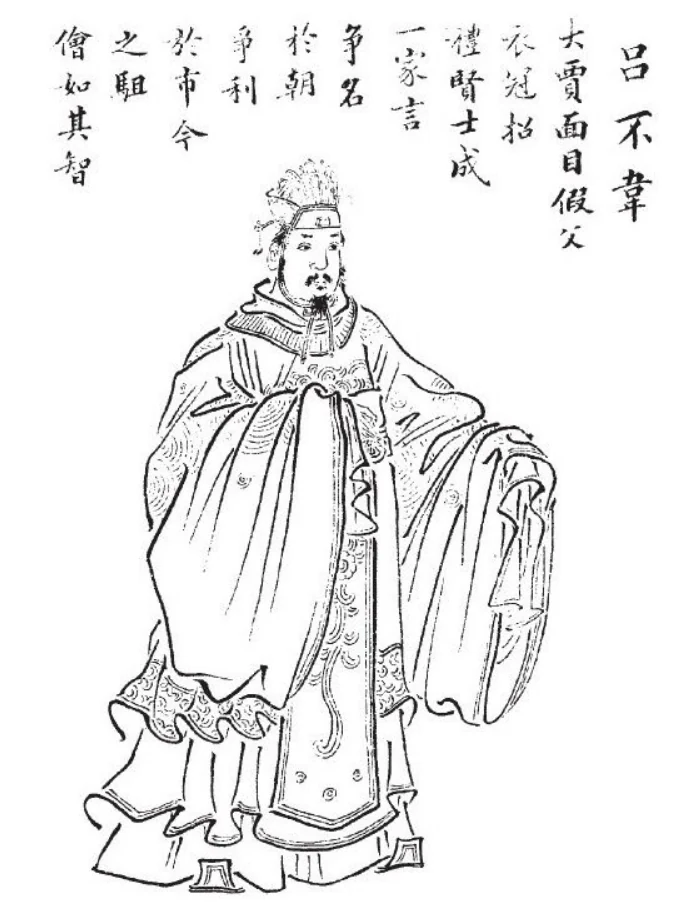
Lü Buwei (c. 292–235 BCE), of the Lü lineage of the Jiang surname, was a native of Puyang in the state of Wey (present-day Hua County, Anyang, Henan), though another tradition gives Yangdi, present-day Yuzhou in Henan. A merchant from Wey in the late Warring States period, he later became chief minister in Qin, was enfeoffed as Marquis Wenxin, and received the revenues of one hundred thousand households around Luoyang in…
292 BCE–235 BCEQin Dynasty
PROFILE
Lü Buwei (c. 292–235 BCE), of the Lü lineage of the Jiang surname, was a native of Puyang in the state of Wey (present-day Hua County, Anyang, Henan), though another tradition gives Yangdi, present-day Yuzhou in Henan. A merchant from Wey in the late Warring States period, he later became chief minister in Qin, was enfeoffed as Marquis Wenxin, and received the revenues of one hundred thousand households around Luoyang in Henan. He sponsored the compilation of The Annals of Lü Buwei and became a representative figure of the pre-Qin Syncretist school. Applying what the sources portray as a merchant's eye for opportunity, he invested his wealth and political skill in Yiren, a Qin hostage prince later known as Zichu, helping him gain the Qin throne and thereby entering the center of Qin politics. When the young King Zheng succeeded, Lü Buwei served as Xiangbang and regent-like chief minister and was called "Second Father." During thirteen years in government, Qin expanded into territories of Zhou, Zhao, and Wey and established Sanchuan, Taiyuan, and Dong commanderies, helping prepare the strategic basis for the later conquest of the Six States. After becoming implicated in the Lao Ai affair, Lü was dismissed and ordered into exile. He ultimately killed himself by drinking poison.
- Alternate Names
- Chancellor Lü; Marquis Wenxin; associated with the saying "a rare commodity worth hoarding"
- Period
- Qin
- Dynasty/Regime
- Qin
- Identity
- Chancellor of Qin; politician; merchant
- Ethnicity/Ethnic Affiliation
- Not reliably confirmed in historical sources
- Native Place
- Puyang, state of Wey (present-day Hua County, Anyang, Henan)
- Date of Birth
- 292 BCE
- Place of Birth
- Puyang, state of Wey (present-day Hua County, Henan)
- Date of Death
- 235 BCE
- Place of Death
- Unknown
- Highest Office
- See Biography and Major Deeds
- Major Achievements
- Xiangbang of Qin; merchant-politician associated with the phrase "a rare commodity worth hoarding"; sponsored the compilation of The Annals of Lü Buwei.
LIFE TIMELINE
About age 27 | While trading in Handan, met the Qin hostage prince Yiren and judged him a "rare commodity worth hoarding."
About age 30 | Traveled west to Xianyang and lobbied Lady Huayang, helping establish Yiren as heir.
About age 35 | In the fiftieth year of King Zhaoxiang of Qin, Qin forces besieged Handan; Yiren escaped back to Qin with Lü Buwei.
About age 41 | King Zhaoxiang died; Lord Anguo succeeded as King Xiaowen, and Yiren became crown prince.
About age 42 | King Xiaowen died three days after formally taking the throne, and Yiren succeeded as King Zhuangxiang of Qin.
About age 43 | In the first year of King Zhuangxiang, appointed chancellor and enfeoffed as Marquis Wenxin with revenues from one hundred thousand households at Luoyang in Henan; Eastern Zhou was destroyed the same year.
About age 45 | King Zhuangxiang died and Crown Prince Ying Zheng succeeded; Lü Buwei was retained as Xiangbang and called "Second Father."
About age 52 | Ordered his retainers to compile The Annals of Lü Buwei and displayed it at the market gate of Xianyang with a reward of one thousand pieces of gold for anyone who could improve a single character.
About age 55 | In King Zheng's tenth year, Lao Ai's rebellion was suppressed and Lü Buwei, implicated in the affair, was removed from the office of Xiangbang.
About age 56 | Went to live on his Henan estate, where visitors and envoys from the regional states continued to arrive in large numbers.
About age 57 | King Zheng sent a rebuking letter and ordered Lü and his family moved to Shu. Lü Buwei killed himself by drinking poison in Sanchuan Commandery.
BIOGRAPHY
Biography
Family Background and Early Life
Lü Buwei was said to be a native of Puyang in Wey, of the Lü lineage of the Jiang surname, and was traditionally claimed as a twenty-third-generation descendant of Jiang Ziya. By the late Warring States period, Wey had become a small and weakened state caught among Zhao, Wei, and Qi. Rather than pursue a conventional official career, Lü became a merchant and traded around Yangdi in Han. By buying cheaply and selling at a profit, he accumulated wealth said to amount to a thousand jin of gold. Yangdi lay on major transport routes and was an important commercial city in Han, allowing Lü to acquire substantial wealth and practical business experience.
No contemporary source gives Lü Buwei's exact year of birth. The "Biography of Lü Buwei" in the Records of the Grand Historian does not record it, and later scholars have inferred a date roughly between the fifteenth and twentieth years of King Zhaoxiang of Qin, around 292–287 BCE. When Lü was trading in Handan, approximately between King Zhaoxiang's fortieth and fiftieth years (267–257 BCE), he would therefore have been in his thirties or forties.
"A Rare Commodity Worth Hoarding": Investing in Yiren
While trading in Handan, the capital of Zhao, Lü Buwei met Yiren, a Qin prince held as a hostage. Yiren was a younger son of Crown Prince Lord Anguo, and his mother Lady Xia was not favored. Qin and Zhao were long-standing enemies, and repeated Qin attacks meant that Zhao treated Yiren poorly. His carriages, money, and supplies were limited, and his circumstances were difficult.
On seeing Yiren, Lü Buwei uttered the phrase later rendered as "a rare commodity worth hoarding," one of the most famous commercial metaphors in Chinese historiography. A well-known story has him returning home and asking his father how many times one's capital could be multiplied by farming, by trading pearls and jade, and by establishing a ruler of a state. The answers were tenfold, a hundredfold, and immeasurable. Lü therefore decided to pursue the political investment he believed could yield an immeasurable return.
Lü first gave Yiren five hundred jin of gold to support his life in Zhao and cultivate guests, then spent another five hundred on rare goods and traveled west to Xianyang to lobby on his behalf. He first approached Lord Yangquan, a younger brother of Lady Huayang, and explained the political advantages involved. He then worked through Lady Huayang's elder sister to persuade Lady Huayang. The argument was that a woman who depended on beauty for favor risked losing affection when beauty faded; because Lady Huayang was favored by Lord Anguo but had no son, she should establish ties with a capable and filial son while her influence remained strong and have him recognized as heir. Yiren, who actively sought her support, was presented as the ideal candidate. Lady Huayang was persuaded and spoke to Lord Anguo, who agreed and formally established Yiren as heir through a jade tally.
Lü Buwei also gave Yiren his own concubine Zhao Ji. According to the Records of the Grand Historian, Yiren saw her at Lü's residence and asked that she be given to him. Lü was initially angry but, having already spent heavily on Yiren, consented. The same account says that Zhao Ji concealed a pregnancy and later gave birth at full term to a son named Zheng, the future Qin Shi Huang. The text's wording has long produced debate. The statement that she gave birth at full term is also used to argue that Ying Zheng was Yiren's son. The paternity of Qin Shi Huang has therefore remained disputed, and no conclusive evidence establishes Lü Buwei as his biological father.
Becoming Chief Minister in Qin
In 257 BCE, King Zhaoxiang sent Wang Yi to besiege Handan, and Zhao considered killing Yiren. Yiren and Lü Buwei plotted an escape and used six hundred jin of gold to bribe a gate official, allowing Yiren to reach the Qin army and return home. Zhao Ji and Ying Zheng survived in hiding because Zhao Ji came from a wealthy Zhao family.
After Yiren returned to Qin, Lü Buwei had him dress in Chu clothing when meeting Lady Huayang, who was from Chu. Delighted, she accepted him as her son, and he took the name Zichu. In 251 BCE King Zhaoxiang died, Lord Anguo became King Xiaowen, Lady Huayang became queen, and Zichu was made crown prince. In 250 BCE King Xiaowen died only three days after formally taking the throne, according to the Basic Annals of Qin in the Records of the Grand Historian, though another tradition gives a longer reign. Zichu then became King Zhuangxiang of Qin.
In 249 BCE, the first year of King Zhuangxiang, Lü Buwei was appointed chancellor, enfeoffed as Marquis Wenxin, and granted the revenues of one hundred thousand households at Luoyang in Henan. That year, the ruler of Eastern Zhou and other lords were said to plot against Qin; Lü was ordered to suppress Eastern Zhou, bringing that state to an end. King Zhuangxiang died after three years, and the thirteen-year-old Crown Prince Ying Zheng succeeded. Ying Zheng retained Lü Buwei as Xiangbang and addressed him as "Second Father."
Governing Qin
During Lü Buwei's years in power, Qin continued to expand. He dispatched generals such as Meng Ao and Wang Yi to take numerous cities from Han, Zhao, and Wei and established Sanchuan, Taiyuan, and Dong commanderies. These gains divided the eastern states strategically into northern and southern sectors and helped shape the conditions for Qin's later wars of unification. The destruction of Eastern Zhou in 249 BCE also marked the final end of the Zhou royal house.
Proud of Qin's growing power, Lü Buwei imitated the famous Four Lords of the Warring States by recruiting talented men from across the realm. His household was said to include as many as three thousand retainers. Since scholars in the regional states were writing and debating competing doctrines, Lü ordered his retainers to record what they knew and combined the resulting material into eight "Examinations," six "Discourses," and twelve "Almanacs," totaling more than two hundred thousand characters, under the title The Annals of Lü Buwei. He claimed that the work encompassed the affairs of heaven and earth, the myriad things, and past and present. It was displayed at the gate of Xianyang's market with a thousand pieces of gold offered to any visiting scholar who could add or remove a single character, giving rise to the saying "one character worth a thousand pieces of gold."
The source also attributes to Lü Buwei attention to the recruitment of talented people and to hydraulic projects such as the Zhengguo Canal, which supported Qin agriculture. The intellectual program represented by The Annals of Lü Buwei sought to combine elements of Confucian, Mohist, Names, and Legalist thought and to introduce multiple philosophical traditions into a political environment otherwise strongly shaped by Legalist statecraft.
The Lao Ai Rebellion and Loss of Power
When King Zheng was young, his mother Zhao Ji continued a sexual relationship with Lü Buwei. As the king grew older, Lü feared exposure and sought a man named Lao Ai, described in the source as unusually endowed. He arranged for Lao Ai to undergo a false castration and sent him into the palace to serve the queen dowager. Zhao Ji and Lao Ai had two sons, and Lao Ai was enfeoffed as Marquis of Changxin and became increasingly powerful.
In 238 BCE, King Zheng's ninth year, Lao Ai was exposed as not being a eunuch and as having a sexual relationship with the queen dowager. Fearing punishment, Lao Ai forged royal seals and launched a rebellion. King Zheng sent Lord Changping and Lord Changwen to suppress it. Lao Ai was executed by being torn apart by chariots and his three clans were exterminated. The two sons born to Zhao Ji and Lao Ai were killed, and the queen dowager was confined at Yong.
Although Lü Buwei had not directly participated in the rebellion, his role in placing Lao Ai in the palace was exposed. The Records of the Grand Historian says that King Zheng wished to execute the Xiangguo, but because Lü had rendered service to the former king and because numerous retainers and persuaders spoke on his behalf, the king could not bring himself to impose the full law. In the tenth month of 237 BCE, Lü Buwei was removed as Xiangbang and sent to live on his estate in Henan.
Exile and Suicide
Even after Lü moved to his Henan estate, his reputation remained considerable, and guests and envoys from the regional states continued to visit in a steady stream. King Zheng feared that Lü might become a source of political danger. In 235 BCE he sent a letter asking what merit Lü had earned in Qin that he held one hundred thousand households in Henan, and what kinship he had with Qin that he was called "Second Father," before ordering Lü and his family to move to Shu. Alarmed that the king would not spare him, Lü Buwei drank poison and killed himself in Sanchuan Commandery, around present-day Luoyang in Henan.
After his death, Lü's retainers secretly buried him at Beimang, north of Luoyang. King Zheng then took severe measures against Lü's former associates. Retainers originating from the Six States were expelled from Qin; Qin officials who attended the funeral and held salaries of six hundred shi or more were stripped of rank and exiled to Fangling, while those with salaries below five hundred shi were also exiled to Fangling but kept their rank.
Major Activities
"A Rare Commodity Worth Hoarding" and the Advancement of Yiren
Lü Buwei's intervention in Qin succession politics as a merchant became one of the most dramatic examples of political investment in Warring States historiography. From his judgment in Handan that Yiren was a "rare commodity worth hoarding," through his lobbying of Lady Huayang in Xianyang, to his assistance in Yiren's escape back to Qin, the process is presented as a chain of calculated decisions displaying unusual political insight and persuasive skill. Yiren eventually became King Zhuangxiang, while Lü Buwei became chancellor and marquis, completing his transformation from merchant to central political actor.
Destruction of Eastern Zhou and Territorial Expansion
In 249 BCE, the first year of King Zhuangxiang, Lü Buwei was ordered to suppress the ruler of Eastern Zhou and brought Eastern Zhou to an end, closing more than eight centuries of Zhou history. During his period in government, Qin took Chenggao and Xingyang from Han and established Sanchuan Commandery; seized Taiyuan, Langmeng, and dozens of other cities from Zhao and established Taiyuan Commandery; and took Ji County and other cities from Wei and established Dong Commandery. These advances pushed Qin's frontier eastward toward Daliang and disrupted the north–south routes on which anti-Qin alliances depended.
Compilation of The Annals of Lü Buwei
The Annals of Lü Buwei, compiled under Lü Buwei's patronage, is a major representative work of the pre-Qin Syncretist tradition. Organized into eight Examinations, six Discourses, and twelve Almanacs and totaling more than two hundred thousand characters, it covers philosophy, government, ethics, astronomy, geography, agriculture, and other fields. Four chapters on agriculture, including discussions of encouraging agriculture, the use of land, soils, and seasonal timing, systematically describe agricultural techniques and are important sources for the study of pre-Qin farming. Lü had the work displayed at a market gate in Xianyang and offered a thousand pieces of gold for anyone who could alter one character, the origin of the phrase "one character worth a thousand pieces of gold."
The work seeks to combine elements of Confucian, Mohist, Names, and Legalist thought into an integrated body of political and philosophical ideas. Its collection of historical examples and arguments about government has been interpreted as providing an intellectual program relevant to Qin's process of unification.
Recruitment of Talent
Lü Buwei imitated the Four Lords of the Warring States by recruiting talented men from across the realm and was said to maintain as many as three thousand retainers. Unlike the retainers of the Four Lords, many of Lü's followers were employed not only in political strategy but also in collective scholarly writing, with The Annals of Lü Buwei emerging from that effort. Lü also recommended people to the Qin court; Li Si, later chancellor under the Qin dynasty, had once been among his retainers.
Personal Relations
Family
- Jiang Ziya: Remote ancestor in traditional genealogy and ancestral figure of the Lü lineage.
- Lü Buwei's father: Name unknown; a merchant at Yangdi.
- Zhao Ji: Concubine later given to Yiren; mother of Ying Zheng.
- Ying Zheng: Son of Zhao Ji, later Qin Shi Huang. His paternity is disputed in later tradition, with Yiren and Lü Buwei both proposed; the source emphasizes that no conclusive proof establishes Lü as the father.
Rulers and Subjects
- Yiren (Zichu): King Zhuangxiang of Qin, whom Lü Buwei supported and helped to succeed to the throne.
- Ying Zheng: King Zheng of Qin, who retained Lü as Xiangbang and called him "Second Father," but later ordered him into exile, leading to his suicide.
- Lord Anguo: King Xiaowen of Qin and father of Yiren, who accepted the succession arrangement promoted through Lü's lobbying.
- Lady Huayang: Principal wife of Lord Anguo, whom Lü Buwei persuaded to adopt Yiren as heir.
Associates and Retainers
- Li Si: Retainer of Lü Buwei who later became chancellor of the Qin dynasty.
- Lao Ai: Introduced by Lü Buwei into the palace to serve the queen dowager; later led a rebellion.
- Lord Yangquan: Younger brother of Lady Huayang and one of Lü Buwei's lobbying targets.
- Xun Qing: Contemporary scholar; the source associates the broader environment of scholarly writing with Lü's decision to have his retainers compile a work.
Conflicts
- Ying Zheng: After the Lao Ai affair implicated Lü Buwei, he was dismissed and ordered into exile, ultimately leading to his suicide.
- Lao Ai: Lü introduced him into the palace, and Lao Ai's later rebellion implicated Lü politically.
Historical Assessment
Han Period
- Sima Qian's "Biography of Lü Buwei" in the Records of the Grand Historian records Lü's career and the rise of Lao Ai. Sima Qian's narrative is cautious about Lü's use of commercial calculation in politics, but the work also describes The Annals of Lü Buwei positively as covering the affairs of heaven and earth, the myriad things, and past and present.
- Ban Gu's "Treatise on Literature" in the Book of Han classified The Annals of Lü Buwei under the Syncretist school and praised that tradition for combining Confucian and Mohist teachings with those of the Names and Legalist schools and for understanding that a state's government could draw on all of them.
Tang and Song Periods
- Liu Zhiji in the Shitong discussed Lü's offer of a thousand pieces of gold for anyone who could alter the book, arguing that no one dared make a change because of Lü's political power rather than because the writing was flawless.
- Sima Guang's Comprehensive Mirror in Aid of Governance records that Lü Buwei, as chief minister, recruited scholars and wandering persuaders and maintained as many as three thousand retainers, presenting his political activity in a comparatively factual manner.
- The Song scholar Huang Zhen, in the Huangshi Richao, described The Annals of Lü Buwei as primarily concerned with governance while also incorporating the teachings of multiple philosophical masters, recognizing its synthetic political thought.
Ming and Qing Periods
- The Ming scholar Jiao Hong, in the Jiaoshi Bicheng, wrote that Lü Buwei, though a merchant, used persuasive skill to establish King Zhuangxiang and displayed extraordinary strategic intelligence, but ultimately failed through sexual and political disorder.
- The Qing scholar Bi Yuan, in his annotated edition of The Annals of Lü Buwei, described the book as a Syncretist work that collected many traditions. Although not all of its views were necessarily correct, he emphasized its value in preserving elements of pre-Qin intellectual thought.
Modern Period
- Guo Moruo, in Ten Critical Essays, described Lü Buwei as an important figure in the Qin unification process and treated The Annals of Lü Buwei as a systematic political work and major synthesis of Syncretist thought.
- Qian Mu, in Chronological Studies of the Pre-Qin Masters, examined Lü Buwei's birth and career and argued that his death occurred in King Zheng's twelfth year, while emphasizing the contribution of Qin's expansion under his government to later unification.
- Yang Kuan's History of the Warring States assesses Lü Buwei as having governed Qin for thirteen years and implemented policies favorable to unification, laying groundwork for Qin's final conquest of the other states.
FIGURES ASSOCIATED WITH THIS DYNASTY
Bibliography
- Sima Qian, Records of the Grand Historian, "Biography of Lü Buwei," Zhonghua Book Company collated edition
- Sima Qian, Records of the Grand Historian, "Basic Annals of Qin," Zhonghua Book Company collated edition
- Sima Guang, Comprehensive Mirror in Aid of Governance, juan 5–6, Zhonghua Book Company collated edition
- Chen Qiyou, Collated and Annotated Edition of The Annals of Lü Buwei, Xuelin Press
- Qian Mu, Chronological Studies of the Pre-Qin Masters, Commercial Press
- Yang Kuan, History of the Warring States, Shanghai People's Publishing House