Birth | Born in Yiwu, Wuzhou, Tang (present-day Zhejiang).
619 CE–684 CE
Writerpoetand official
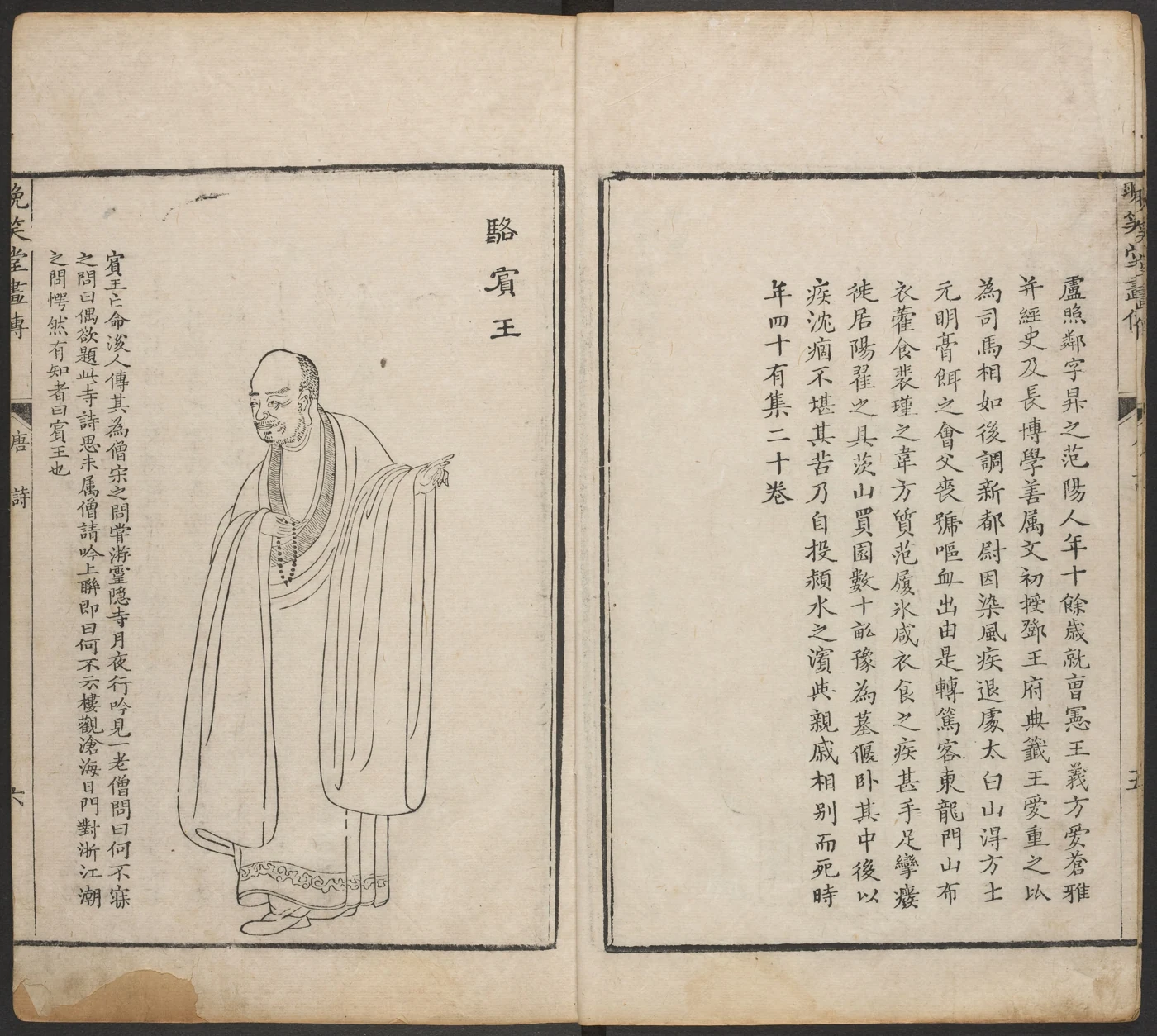
Luo Binwang
骆宾王
Luo Binwang (c. 640 – c. 684), courtesy name Guanguang and also known as Luo Linhai and Luo Si, was a native of Yiwu in Wuzhou under the Tang (present-day Zhejiang). He was an official, writer, and poet of the early Tang and, together with Wang Bo, Yang Jiong, and Lu Zhaolin, was known as one of the Four Literary Eminences of the Early Tang. Born into a poor family, Luo was reputedly able to compose poetry at age seven and…
619 CE–684 CETang Dynasty
PROFILE
Luo Binwang (c. 640 – c. 684), courtesy name Guanguang and also known as Luo Linhai and Luo Si, was a native of Yiwu in Wuzhou under the Tang (present-day Zhejiang). He was an official, writer, and poet of the early Tang and, together with Wang Bo, Yang Jiong, and Lu Zhaolin, was known as one of the Four Literary Eminences of the Early Tang. Born into a poor family, Luo was reputedly able to compose poetry at age seven and was called a child prodigy; tradition attributes the poem "Ode to the Goose" to him at that age. His official career was difficult. He served in the household of Prince Dao, as registrar of Wugong and Chang'an, and as Investigating Censor, was later imprisoned, and after an amnesty became assistant magistrate of Linhai County before resigning in frustration. In 684, the first year of the Guangzhai era, Luo joined Xu Jingye's uprising at Yangzhou against Wu Zetian and drafted the famous "Proclamation on Behalf of Xu Jingye Denouncing Wu Zhao." After Xu Jingye's defeat, Luo's fate became uncertain: one account says he was killed, while another says he escaped and became a monk. As one of the Four Eminences, Luo was an important transitional figure between the literature of the Qi and Liang dynasties and that of the High Tang. He contributed to the rejection of the ornate and decadent tendencies associated with Six Dynasties writing and to the renewal of early Tang poetry. His seven-character songs and parallel prose were particularly influential. More than a hundred poems and several dozen prose pieces survive under his name.
- Alternate Name
- Luo Guanguang
- Courtesy Name
- Guanguang
- Epithet
- Called a child prodigy
- Period
- Tang
- Dynasty/Regime
- Tang
- Identity
- Writer, poet, and official
- Ethnicity/Ethnic Affiliation
- Not reliably confirmed in historical sources
- Native Place
- Yiwu, Wuzhou (present-day Yiwu, Zhejiang)
- Date of Birth
- c. 640
- Place of Birth
- Yiwu, Wuzhou, Tang (present-day Zhejiang)
- Date of Death
- c. 684
- Place of Death
- Unknown
- Highest Office
- See Biography and Major Deeds
- Major Achievements
- One of the Four Literary Eminences of the Early Tang; author of "The Cicada Heard in Prison" and the proclamation against Wu Zhao; traditionally said to have composed "Ode to the Goose" at age seven.
LIFE TIMELINE
Age seven | Traditionally said to have composed "Ode to the Goose" and to have been known as a child prodigy.
About his teens | Served in the household of Li Yuanqing, Prince Dao. Asked to describe his own abilities, he considered self-promotion shameful and declined.
About age twenty | Appointed Court Gentleman for Ceremonies and served as a scholar in the Eastern Terrace.
In his twenties | Demoted for an offense, entered military service in the Western Regions, and spent an extended period on the frontier.
About age twenty-five | Entered Sichuan and joined the staff of Li Yi, commander of the Yaozhou Circuit; many proclamations issued during the suppression of local rebellions were drafted by him.
About age thirty-eight | Transferred to registrar of Wugong, then registrar of Chang'an, and later entered the central court as Investigating Censor.
About age thirty-eight | Imprisoned after repeatedly submitting memorials satirizing Wu Zetian; wrote "The Cicada Heard in Prison."
About age thirty-nine | Released in an amnesty.
About age forty | Appointed assistant magistrate of Linhai County, hence the later name Luo Linhai.
About age forty-four | After resigning, traveled in Guangling; in the ninth month joined Xu Jingye's uprising at Yangzhou, served as literary secretary, and drafted the proclamation against Wu Zhao.
About age forty-four | Xu Jingye was defeated and killed; Luo Binwang's fate is unknown.
BIOGRAPHY
Biography
Family Background and Early Life
Luo Binwang came from a poor family. His given name Binwang and courtesy name Guanguang derive from the Guan hexagram of the Book of Changes, from the phrase about "observing the glory of the state" and being "fit to be a guest of the king." According to the Luo Clan Genealogy, the Luo clan traced itself to a Jiang-line descendant of the Flame Emperor and ultimately to a son named Luo Gu of Jiang Taigong. The genealogy says that during the Jianchu era of Emperor Zhang of the Eastern Han, Luo Yonglin offended the powerful Dou Xian and moved with his family from Luo Valley in Shaanxi to Wushang, present-day Yiwu in Zhejiang. The Yiwu Luo clan regarded him as its founding migrant ancestor.
Luo Binwang's grandfather Luo Xuezhuang had served as Right Army Chief Clerk under the Sui. His father Luo Lüyuan, courtesy name Shenyou and art name Meisuo, rose to magistrate of Bochang County in Qingzhou. Luo was exceptionally talented as a child, could reportedly compose poetry at age seven, and was called a child prodigy; tradition identifies "Ode to the Goose" as a poem from this period. His father, however, died while serving as magistrate of Bochang, and the family's circumstances declined. Luo then lived for a time around Boshan and later moved to Xiaqu County in Yanzhou, spending his early years in poverty and frustration. These experiences strongly shaped the upright, uncompromising, and ambitious personality attributed to him in later accounts.
Fluctuating Official Career
During Emperor Gaozong's Yonghui era, Luo Binwang served in the household of Li Yuanqing, Prince Dao. When the prince asked him to state his own talents, Luo considered self-praise dishonorable and declined. He later became Court Gentleman for Ceremonies and a scholar in the Eastern Terrace but was demoted for an offense and sent into military service in the Western Regions, where he spent a long period guarding the frontier. This experience made him one of the relatively few early Tang poets with direct knowledge of frontier life. His frontier poems describe western landscapes and personal experiences and express the ambitious spirit of early Tang scholar-officials.
Luo later entered Sichuan and joined the military staff of Li Yi, commander of the Yaozhou Circuit. Many proclamations used in suppressing local rebellions were drafted by him. While in Sichuan he exchanged poems with Lu Zhaolin and formed a close friendship. In 678, the third year of Yifeng, Luo was transferred to registrar of Wugong, then registrar of Chang'an, and from there entered court as Investigating Censor. Wu Zetian was then politically dominant. Luo repeatedly submitted memorials criticizing her and was consequently imprisoned, where he wrote "The Cicada Heard in Prison" as an allegorical expression of his circumstances. He was released in an amnesty in 679, the first year of Tiaolu.
Linhai and Resignation
In 680, the second year of Tiaolu, Luo Binwang became assistant magistrate of Linhai County, which led later generations to call him Luo Linhai. The Old Book of Tang records that after Wu Zetian began exercising regency, Luo was demoted from registrar of Chang'an to assistant magistrate of Linhai. He remained frustrated and dissatisfied in the post and eventually resigned. After leaving office he traveled in Guangling and wrote verses declaring his political resolve, including lines about preserving Chu with a treasured sword and repaying Han with a golden mallet. The poem expresses loyalty to the former Tang political order and the wish to restore it, foreshadowing his later participation in Xu Jingye's uprising.
The Yangzhou Uprising and His Fate
In 684, the first year of Sisheng, Wu Zetian deposed Emperor Zhongzong. In the ninth month Xu Jingye, also known as Li Jingye and a grandson of Li Ji, raised troops at Yangzhou against her. Luo Binwang joined Xu's staff, was appointed literary secretary in charge of important documents, and drafted the famous "Proclamation on Behalf of Xu Jingye Denouncing Wu Zhao." The proclamation is forceful and emotionally charged. Its famous lines lamenting that the soil over the late emperor's grave was not yet dry and asking to whom the orphaned heir could turn were intended to stir former Tang officials' loyalty to the old ruler. According to the Biographies of Talented Men of Tang, when Wu Zetian reached those lines she asked who had written them. On being told it was Luo Binwang, she reportedly remarked that allowing such talent to remain frustrated was the chancellor's fault.
In the eleventh month of 684, Xu Jingye was defeated and killed, and Luo Binwang's fate became uncertain. The Old Book of Tang and the Comprehensive Mirror in Aid of Governance say that Luo was killed; the New Book of Tang states that he fled and his destination was unknown; the Chaoye Qianzai says he drowned himself; Xi Yunqing's preface to Luo's collected writings states that after plotting the uprising at Guangling and failing militarily, Luo escaped. Meng Qi's Stories behind Poems says that Luo survived, shaved his head, became a monk, traveled among famous mountains, and died after a year at Lingyin. Another tradition places his hiding place in the area of present-day Nantong, Jiangsu. Zhu Guozhen's Yongchuang Xiaopin, juan 6, records that in 1514 a farmer surnamed Cao east of Nantong supposedly discovered Luo Binwang's tomb, and that in 1748 Liu Mingfang, a Fujian official serving in Nantong, organized a search and recovered several old bones, which were transferred to the southeast foot of Langshan. This site is identified with the Luo Binwang tomb preserved in Nantong today.
Major Activities
Literary Contributions
As one of the Four Literary Eminences of the Early Tang, Luo Binwang was a prolific writer whose work contributed to moving literature away from the perceived decline of Six Dynasties styles and toward the literary flourishing of the Tang. Among the Four Eminences, he left the largest body of poetry and was especially accomplished in long seven-character songs. His "Rhapsody on the Imperial Capital" was unusually long for the early Tang and was celebrated in its own time. Other works such as "Chouxi Pian," "Written for Lady Guo in Reply to Lu Zhaolin," and "On Behalf of the Daoist Nun Wang Lingfei, Presented to the Daoist Li Rong" were likewise regarded as representative. These pieces combine rich and ornate diction with a bold, uneven energy, move flexibly between lyric and narrative, and make extensive use of the seven-character song form. Later critics such as He Jingming observed that the works of the Four Eminences often had a musical cadence. Subsequent long-form song poetry by Liu Xiyi, Zhang Ruoxu, Li Qi, Wang Wei, Gao Shi, Yuan Zhen, Bai Juyi, Zheng Gu, Wei Zhuang, and even the Qing poet Wu Weiye was seen as developing along this line.
Luo also wrote notable regulated verse in five characters. "The Cicada Heard in Prison," which uses the cicada as an allegorical object to express personal feeling, became one of his best-known poems. "Seeing Magistrate Zheng Off to Liao" expresses an optimistic martial desire to serve the state and combines elevated tone with polished diction. Short poems such as "Seeing Someone Off at the Yi River" and "Climbing the City Tower in the Army" compress ambition and heroic feeling into only a few lines and are distinctive among early Tang quatrains.
In content, Luo's object poems use external things to convey personal moral and emotional meaning rather than treating the subject as a purely verbal exercise in the style associated with Qi and Liang court poetry. His long service on the frontier allowed his border poems to describe the Western Regions and direct military experience, giving them an energetic and aspirational tone that differed from more conventional Southern Dynasties literary settings and helped influence High Tang frontier poetry. Formally, his long songs also expanded inherited themes such as the imperial capital and romantic sentiment by using them to express reflections on rise and decline or indignation on behalf of vulnerable figures, creating a broader and more vigorous spirit.
Luo's parallel prose was likewise highly regarded. It is forceful, sonorous, vigorous in imagery, emotionally direct, and more concise than much earlier courtly parallel prose. His letters and petitions were praised for sincerity and compression, modifying the elaborate allusive style associated with Qi and Liang while inheriting elements from Yu Xin. The proclamation against Wu Zhao is a representative example. Framed in the moral language of loyalty and righteousness, it called on people to oppose the emerging Zhou regime and combines political accusation with rhetorical force.
Political Activity
Luo Binwang's political life was closely intertwined with his writing. Early in his career he refused to promote himself when serving Prince Dao, an action later interpreted as evidence of an independent character. He later served as Court Gentleman for Ceremonies and as a scholar in the Eastern Terrace but was demoted and sent to the Western Regions. In Sichuan he joined Li Yi's military staff and drafted many official proclamations used in suppressing local rebellions. In 678 he served as registrar of Wugong and Chang'an and then as Investigating Censor. During Wu Zetian's dominance of court politics, Luo submitted repeated memorials satirizing her and was imprisoned, illustrating the uncompromising political character later attributed to him.
After his release, Luo became assistant magistrate of Linhai but resigned in frustration. In 684, after Wu Zetian deposed Emperor Zhongzong, he joined Xu Jingye's uprising at Yangzhou, served as literary secretary, and drafted the proclamation against Wu Zhao. This was both the high point and the end of his political career. His fate after the uprising remains unknown, but his political image and literary reputation became closely associated with this proclamation.
Travels and Movements
Luo Binwang traveled widely across China. In his youth he lived around Boshan and later Xiaqu County in Yanzhou. After entering office, he was demoted to military service in the Western Regions and spent a long period on the frontier. He later entered Sichuan and joined Li Yi's staff during campaigns against local rebellions, where he maintained literary exchanges with Lu Zhaolin. He then served at Wugong, Chang'an, and the central court in the Guanzhong region. After prison he became assistant magistrate of Linhai, later resigned and traveled in Guangling. According to later traditions, after Xu Jingye's defeat he escaped, became a monk, traveled among famous mountains, and eventually reached Lingyin Temple.
Relations with Contemporaries
Luo Binwang was grouped with Wang Bo, Yang Jiong, and Lu Zhaolin as one of the Four Literary Eminences of the Early Tang, collectively known as "Wang, Yang, Lu, and Luo." He was especially close to Lu Zhaolin, exchanging poems with him while in Sichuan and even composing "Written for Lady Guo in Reply to Lu Zhaolin" on behalf of a woman associated with Lu. Luo also appears in later traditions involving Song Zhiwen. One story says that Song Zhiwen encountered an old monk at Lingyin Temple in Hangzhou who supplied the lines about a tower overlooking the sunrise over the sea and a gate hearing the tide of the Zhejiang; the monk was later said to have been Luo Binwang in hiding after the failed uprising.
Personal Relations
Family
- Grandfather: Luo Xuezhuang, Right Army Chief Clerk under the Sui.
- Father: Luo Lüyuan, courtesy name Shenyou and art name Meisuo, magistrate of Bochang County in Qingzhou under the Tang.
- Mother: Lady Liu, daughter of a chief clerk surnamed Liu.
Friends and Literary Associates
- Lu Zhaolin: One of the Four Literary Eminences; exchanged poetry with Luo in Sichuan and had a close friendship with him.
- Wang Bo: One of the Four Eminences and Luo's literary peer.
- Yang Jiong: One of the Four Eminences and Luo's literary peer.
- Song Zhiwen: Early Tang poet; according to later tradition, Luo assisted him with a poem at Lingyin Temple.
Rulers and Patrons
- Li Yuanqing: Prince Dao, in whose household Luo once served.
- Wu Zetian: Empress of Emperor Gaozong and later ruler; Luo repeatedly satirized her in memorials and later drafted a proclamation attacking her.
- Xu Jingye: Grandson of Li Ji, leader of the Yangzhou uprising against Wu Zetian, under whom Luo served.
Conflicts
- Wu Zetian: Luo was imprisoned after criticizing her and later drafted the proclamation denouncing her.
Historical Assessment
Tang Period / Contemporary
- According to the Biographies of Talented Men of Tang, after reading Luo's proclamation Wu Zetian remarked that it was the chancellor's fault that a man of such talent had been left frustrated and without proper employment.
- Ouyang Xiu noted that Wang Bo, Yang Jiong, Lu Zhaolin, and Luo Binwang were equally famous for their writing and were known throughout the realm as the Four Eminences.
- Ji Yougong's Chronicles of Tang Poetry records contemporary jokes about the writing habits of the Four Eminences: Yang Jiong's frequent strings of ancient names earned the label "ghost-register," while Luo Binwang's fondness for numerical antithesis earned him the nickname "calculating scholar."
Song and Yuan Periods
- Wei Qingzhi's Poets' Jade Chips praised Luo's poetry as lofty in form and distant in conception, evoking an otherworldly and transcendent spirit.
- Song Yuren's Three Tang Poetry Grades regarded Luo's poetry as ultimately deriving from Yin Keng and He Xun, but praised its clarity, distance, and strength, while noting that the surviving corpus was small.
Ming and Qing Periods
- Zhang Xunye's preface to Luo Binwang's collected works praised his five-character regulated verse as exquisitely polished and called the "Rhapsody on the Imperial Capital" an unsurpassed masterpiece of its age.
- Wang Shizhen, in Yiyuan Zhiyan, noted that although the Four Eminences inherited ornate tendencies from Chen and Sui writing, their imagery had a more transcendent quality and helped establish regulated five-character verse; he treated Luo's long songs as sometimes excessively ornate but still magnificent and enduring.
- Hu Yinglin, in Shisou, judged the five-character verse of Lu and Luo strong in structure but somewhat lacking in elegance, while praising Luo's extensive and often powerful regulated sequences.
- Hu Zhenheng's Tangyin Guijian praised Luo's abundant talent and careful organization, while asking whether the very fullness of his technique also revealed a distinctive strength of spirit.
- Ding Yi's Shixue Yuanyuan argued that Luo's poetry did not fall below Qi and Liang writers and that works such as "Northern View" and "Summer Day" anticipated later High Tang regulated verse.
Modern Period
- Lu Xun, in "The Esoteric Art of Making Mischief" in Nanqiang Beidiao Ji, discussed the rhetorical craft of Luo's proclamation against Wu Zhao, arguing that explicit public accusations could sometimes have less force than ambiguous insinuation.
- Modern scholarship commonly regards Luo Binwang as an important transitional writer in the movement from Qi-Liang literature toward High Tang literature. His life is often interpreted as marked by conflict between ideals and reality and between talent and frustration, producing a forceful sense of personality and emotional intensity in his poetry and prose and helping create the qualities later described as vigor and moral backbone.
FIGURES ASSOCIATED WITH THIS DYNASTY
Bibliography
- Old Book of Tang, "Biographies of Literary Men"
- New Book of Tang, "Biographies of Literature and the Arts"