Birth |
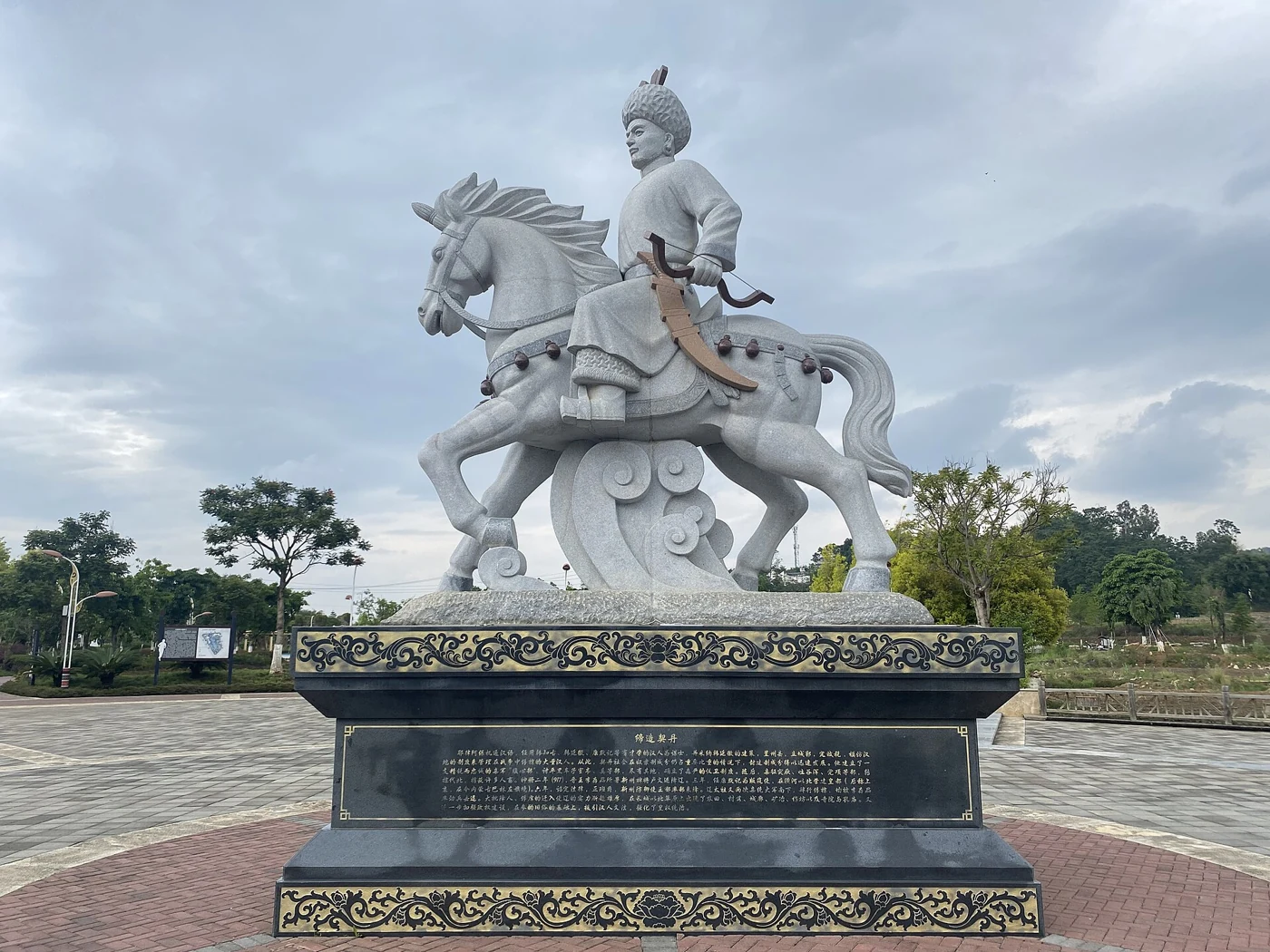
867 CE–926 CE
Emperor
Emperor Taizu of Liao
辽太祖
Yelü Abaoji (872–September 6, 926), of the Yelü clan, had the sinicized name Yi, the name Abaoji, and the childhood name Chulizhi. He came from Yelü Mili in the Xialaiyi shilie locality of the Khitan Diela tribe, in the area of present-day Chifeng, Inner Mongolia. He was the founder of the Liao dynasty, initially the Khitan state, and reigned from March 17, 916 to September 6, 926. He was the son of Yelü Saladi, later honored…
867 CE–926 CELiao dynasty
PROFILE
Yelü Abaoji (872–September 6, 926), of the Yelü clan, had the sinicized name Yi, the name Abaoji, and the childhood name Chulizhi. He came from Yelü Mili in the Xialaiyi shilie locality of the Khitan Diela tribe, in the area of present-day Chifeng, Inner Mongolia. He was the founder of the Liao dynasty, initially the Khitan state, and reigned from March 17, 916 to September 6, 926. He was the son of Yelü Saladi, later honored as Emperor Dezu of Liao, a leader of the Diela tribe.
- Other Names
- Yelü Yi; Emperor Taizu of Liao, Yelü Abaoji
- Courtesy Name
- Abaoji
- Period
- Liao
- Dynasty/Regime
- Liao
- Identity
- Emperor
- Ethnicity
- Not recorded in historical sources
- Ancestral Home
- Not recorded in historical sources
- Date of Birth
- 872
- Place of Birth
- Not recorded in historical sources
- Date of Death
- September 6, 926
- Reign
- March 17, 916–September 6, 926
- Predecessor
- Not applicable (founding emperor)
- Successor
- Emperor Taizong of Liao (Yelu Deguang)
- Era Names
- Not recorded in historical sources
- Temple Name
- Not recorded in historical sources
- Posthumous Name
- Not recorded in historical sources
- Major Achievements
- A noble of the Khitan Diela tribe who founded the Khitan state and proclaimed himself emperor in 916; later known as Emperor Taizu of Liao; unified the Khitan tribes and promoted the creation of the Khitan writing system
LIFE TIMELINE
Age 30 |
Age 31 |
Age 32 |
Age 33 |
Age 34 |
Age 35 |
Age 36 |
Age 37 |
Age 38 |
Age 39 |
Age 40 |
Age 41 |
Age 42 |
Age 43 |
Age 45 |
Age 47 |
Age 49 |
Age 54 |
Age 55 |
BIOGRAPHY
Biography
Family Background and Early Life
Yelü Abaoji was born in 872, the thirteenth year of Xiantong under the Tang, into the aristocracy of the Khitan Diela tribe. His family had long provided chiefs and military leaders for the tribe. His seventh-generation ancestor Yelü Nieli killed Li Guozhe, military governor of the Songmo Protectorate, in 735, the twenty-third year of Kaiyuan, and installed Dinian Zuli as Zuwu Khan, after which the Yelü lineage dominated the Yaonian clan-led confederation. Later ancestors likewise led the Diela tribe. His great-great-grandfather Yelü Noulisi, later honored as Emperor Suzu of Liao, was said to have defeated An Lushan's forces at the Huang River. His great-grandfather Yelü Salade, later Emperor Yizu, repeatedly fought the Shiwei. His grandfather Yelü Yundeshi, later Emperor Xuanzu, promoted farming and animal husbandry and helped make the Diela tribe prosperous. His father Yelü Saladi, later Emperor Dezu, was credited with establishing ironworking and teaching metal casting.
When Abaoji was born, Khitan aristocrats were engaged in intense struggles over control of the tribal confederation. His grandfather Yelü Yundeshi was killed in political conflict, and Abaoji's father and uncles fled their home tribe and hid with nobles of a neighboring tribe. His grandmother, Empress Jianxian of the Xiao clan, was deeply attached to the infant and, fearing that enemies might kill him, reportedly hid him in a separate tent and darkened his face so outsiders could not identify him. The History of Liao records miraculous stories that he could walk at three months, speak at one hundred days, foresee events, and felt protected by divine beings. The Chinese source notes that such accounts are legendary but presents him as exceptionally intelligent from childhood.
As he grew older, Abaoji was described as physically powerful and ambitious. The History of Liao states that he was nine chi tall, broad above and narrow below, with a penetrating gaze, and could draw a three-hundred-jin bow. His uncle Yelü Shilu then held the senior office of yuyue, second only to the khagan, and wielded power within the Khitan confederation. Abaoji won his uncle's trust and served as a commander of the personal guard, building an elite retinue. With this force he successively subdued groups including the Lesser Yellow Shiwei and defeated the Yuewu, Wugu, and Six Xi. His people called him “Azhushali”; the Chinese source explains shali as a Khitan term meaning “young lord.”
Rise to Power
In the later period of the Yaonian clan-led confederation, the khagan's family declined while the Yelü clan increasingly controlled real power. In 901, the first year of Tianfu, Hendejin Qaghan came to power. Around this time Yelü Shilu was killed in a Diela power struggle involving his son Yelü Huage and others, throwing the tribe into disorder. Abaoji, already known for military achievements, was selected as military leader of the Diela tribe and given responsibility for campaigning. He defeated Shiwei, Yujue, and the Xi commander Xialage, and in the tenth month advanced to military leader of the Dadielie Office.
Although Abaoji had become the effective Diela leader, his position remained insecure and was threatened by the faction associated with Yelü Huage. Rather than confront it immediately, he expanded his military power through outside campaigns. In 902 he attacked Hedong and Daibei, captured nine commanderies or counties, seized large numbers of people and livestock, and built Longhua Prefecture south of the Huang River to settle captured Han Chinese. In 903 he attacked the Jurchens, then Hedong and Huaiyuan Army, and later Jibei in northern Hebei, returning with population and goods. His victories brought promotion to yuyue and overall responsibility for military and state affairs, making him the effective controller of the confederation.
In 904, Abaoji campaigned against the Black-Cart Shiwei and ambushed reinforcements sent by Liu Rengong, the Tang military governor of Lulong, capturing Liu's adopted son Zhao Ba. In 905 he again attacked the Black-Cart Shiwei and accepted an invitation to ally with Li Keyong, military governor of Hedong and Prince of Jin. In the tenth month, Abaoji led seventy thousand cavalry to meet Li Keyong east of Yunzhou. After drinking together, Li asked for troops against Liu Rengong and Zhu Wen, Prince of Liang. Abaoji agreed, and the two exchanged robes and horses and pledged brotherhood. Abaoji then attacked Liu Rengong, took several prefectures, and carried off their inhabitants.
Accession as Khagan and the Rebellions of His Brothers
In the twelfth month of 906, Hendejin Qaghan died. According to one account, his final instructions named Abaoji as successor; another account recorded in the Chinese source says that tribal leaders, dissatisfied with Hendejin Qaghan's concessions to Liu Rengong, removed him and jointly elected Abaoji. Yelü Helü and other members of Abaoji's clan repeatedly urged him to take the position. Abaoji hesitated because of traditional procedures and at one point tested the situation by offering the position to his kinsman Yelü Xiadi, who lacked sufficient power and instead supported Abaoji. With the firm backing of Yelü Helü and others, Abaoji accepted.
In the first month of 907, Abaoji became the supreme Khitan leader and khagan. He did not confine his ambitions to the steppe. Influenced by captured and immigrant Han Chinese and by contacts with Chinese regional powers, he resisted the constraints of the traditional system under which khagans were selected by the tribal aristocracy. From the start of his khaganate he prepared for kingship and empire: he continued external campaigns, strengthened internal institutions, weakened conservative aristocrats, and built a personal following. After the Later Liang was founded, he abandoned his earlier alliance with Li Keyong and sent envoys to Zhu Wen seeking investiture to reinforce his own position.
To present the rise of the Yelü family as legitimate, Abaoji ordered his lineage to form a “tenth tent” after the nine Yaonian khagan lineages. He appointed his younger brother to a senior tribal military office and organized his own personal guard forces. As his following expanded, he strengthened the elite household guard, successively placing Yelü Helü, Xiao Dilu, and Xiao Aguzhi in command. In 908 he created the office of Tiyin to administer imperial-clan affairs and appointed his younger brother Yelü Sala. In 910 he raised the status of his wife's Shulü family by appointing her elder brother Xiao Dilu as Northern Chancellor. Once control of military and political power had become more secure, Abaoji ignored the traditional practice of changing the khagan every three years and held the office continuously for nine years.
Competition nevertheless remained strong within the Yelü clan, whose adult men retained claims under the older elective system. Beginning in the fifth year of Abaoji's leadership, his younger brothers challenged him in three successive rebellions, supported by their kinsman Yelü Xiadi and cousin Yelü Huage.
The first rebellion came in May 911. His brothers Yelü Lage, Yelü Diela, Yelü Yindishi, and Yelü Anduan plotted against him, but Anduan's wife Zhanmugu informed Abaoji in advance. The plot failed. Abaoji and his brothers climbed a mountain, sacrificed an animal, and swore before Heaven; he then pardoned them, while demoting Lagé and honoring Zhanmugu.
In 912, the brothers rebelled again with support from Yelü Xiadi and Yelü Huage. While Abaoji was campaigning against the Zubu, Lagé was sent against Pingzhou. After taking the city, Lagé blocked Abaoji's return and attempted to force him into a new khagan election. Abaoji avoided a direct clash, moved south, and performed the traditional firewood-burning rite before his rivals could do so, thereby creating a ritual fait accompli for his continued rule. The next day the brothers sought forgiveness, and Abaoji again ordered them to reform rather than punishing them severely.
In March 913, the brothers launched a third rebellion, now planning to make Yelü Lage the new khagan. Yelü Diela and Yelü Anduan pretended to visit Abaoji and intended to seize him. Abaoji discovered the conspiracy, neutralized them, incorporated their thousand cavalry, and personally pursued Lagé. A rebel force led by Yelü Yindishi attacked Abaoji's traveling camp, burned baggage and tents, and seized symbols of khagan authority, including banners, drums, and the ancestral sacred tent. Abaoji's wife Shulü Ping defended the main camp with troops until reinforcements arrived. In April, Abaoji pursued Lagé northward, using advance ambushes and attacks from front and rear. Lagé was defeated and abandoned the sacred tent. Abaoji paused rather than continue immediately, expecting the rebel troops to lose morale and long for home. In May he attacked again and captured Lagé, decisively defeating the old Diela aristocratic opposition and clearing a major obstacle to imperial state-building.
In 914 Abaoji reappointed the principal Diela and clan offices and sentenced more than three hundred participants to death. The principal rebel brothers Lagé and Diela were beaten, while Yindi, Anduan, and other followers were pardoned. The cost of the civil conflict was severe: the Chinese source cites the History of Liao as saying that seven or eight tenths of the livestock died on the road and prices rose tenfold. Abaoji later lamented that where ordinary people had once possessed thousands of horses, they now had to travel on foot.
Proclamation as Emperor and Territorial Expansion
After suppressing his brothers, Abaoji held uncontested military and political power. On March 17, 916, the eleventh day of the second month in the first year of Shence, he proclaimed himself emperor, established the state of Khitan, adopted the era name Shence, and took the title Great Sage and Great Enlightened Heavenly Emperor. Shulü Ping received the title Responding-to-Heaven Great Enlightened Earth Empress. The Chinese source notes a long-standing historiographical debate over whether the state should be dated from 907 or 916. It states that modern Liao historians have broadly converged on the interpretation that Abaoji became khagan in 907 and proclaimed the imperial state in 916.
After founding the state, Abaoji continued campaigns against neighboring peoples and regimes. He adopted elements of Chinese government while preserving steppe structures of mobile rule. His administration differentiated between Khitan and Han populations, and he employed Han Chinese advisers such as Han Yanhui, reformed ceremonies and customs, built walled settlements, sponsored writing, and encouraged farming and commerce. In 918 he built the imperial capital, later Shangjing Linhuang Prefecture. In 920 he ordered Yelü Tulübu and others to create the Khitan large script.
Abaoji expanded south into Daibei and parts of Hebei and west against steppe peoples. In 925 he launched an eastern campaign against Balhae. In 926 he forced King Dae Inseon to surrender, created the Dongdan Kingdom on former Balhae territory, and installed his eldest son Yelü Bei as Human King. Abaoji died at Fuyu City on September 6, 926, aged fifty-five by traditional reckoning.
The Legends of His Birth, His Early Years, and His Post as Bodyguard Officer
Abaoji was of the Yelü clan, his personal name Yi, his courtesy name Abaoji, his childhood name Chuolizhi; he was a man of the Yelü Mili district of the Xialaiyi shilie of the Diela tribe of the Qidan, eldest son of Emperor Dezu, his mother being the empress Xuanjian, lady Xiao, and he was born in the thirteenth year of Xiantong of the Tang. It is said that his mother dreamed that the sun fell into her bosom and so conceived; and that at his birth the chamber was filled with a divine light and a strange fragrance, and his body was as that of a three-year-old child while he could already crawl. His grandmother, the empress Jianxian, was very fond of the child but feared he might be murdered by enemies, and so kept him hidden in another tent, smearing his face and letting no outsider see him. He could walk at three months and speak at a hundred days, "knowing things before they came," and said of himself that there seemed to be spirits guarding him on either hand; even in childhood whatever he said touched on the business of the world, and his uncle, then holding the government, would consult him whenever in doubt. When grown he was nine feet tall, broad above and narrow below, with eyes that shone on a man, and could draw a bow of three hundred catties; and he was made a bodyguard officer of the Yaonian tribal league. In that office he formed a guard of his own household troops and with these picked forces subdued the northern tribes one after another: when the Lesser Yellow Shiwei would not submit he brought them down by stratagem, and he attacked the Yuewu and the Wugu, the Six Xi and the Bishaxie and overcame them, so that the people of the state called him Ashali.
As Chief of His Own Tribe and His Years of Campaign
In 901, when the khan Hende came to the throne, Abaoji was made chief of his own tribe with sole charge of campaigns, and broke the Shiwei, the Yujue and the Xi chieftain Xialage one after another, taking many prisoners, and in the tenth month was given the post of chief of the great Dielie administration. Thereafter he made rewards and punishments clear, repaired his armour and weapons, rested the people, increased his herds, "his business being to put away arms"; and he led four hundred thousand against Daibei, taking nine commanderies and ninety-five thousand prisoners. In the autumn of the following year he marched with four hundred thousand against Hedong and Daibei, took nine commanderies and ninety-five thousand prisoners with camels, horses, cattle and sheep beyond counting; and in the ninth month he walled the prefecture of Longhua south of the Huang river and there first built the Kaijiao temple. He afterwards attacked and subdued the Nüzhen, taking three hundred households, and again took the Huaijuanchen and other posts of Hedong, and in the tenth month raided to the north of Ji and came back with spoil. Earlier Dezu had taken seven thousand Xi households and moved them to Qinghe in Raole, and now these were formed into the Xi Diela division of thirteen counties, and Abaoji was made Yuyue with general charge of military and state affairs. Later, when he attacked the Black-cart Shiwei, Liu Rengong of Youzhou sent his adopted son Zhao Ba with a host to their help, and Yelü Helü laid an ambush at Taoshan and fell on Zhao Ba when half his men had passed, and joining with Abaoji cut down and took many, so that the Shiwei submitted. In the seventh month he attacked the Black-cart Shiwei again, and Li Keyong, military commissioner of Hedong under the Tang, sent the interpreter Kang Lingde to ask a league; and in the tenth month Abaoji met Li Keyong at Yunzhou with seventy thousand cavalry, and while they feasted Li Keyong asked troops to avenge his defeat by Liu Rengong at Mugajian, which Abaoji granted, exchanging robes and horses and swearing brotherhood; and marching against Liu Rengong he took several prefectures and moved all their people away.
His Taking the Place of the Yaonian as Head of the Eight Tribes
In the twelfth month the khan Hendejin died, and he is said to have named Abaoji as khan in his testament, while another account has it that the chiefs of the tribes, ashamed of Hendejin's concessions to Liu Rengong, deposed him and jointly raised Abaoji. By the New History of the Five Dynasties, Liu Rengong then held Youzhou and repeatedly sent troops against them over Zhaixing ridge, and every year when the autumn frost fell he burned their grass so that many of the Qidan horses starved, and they had to bribe him with good horses for pasture and beg to keep the treaty most humbly; "and the men of the eight tribes, thinking the Yaonian unfit for the business, chose from among them and put Abaoji in his place." As khan, the highest ruler of a steppe pastoral power, he did not confine his view to the steppe: under the influence of his captives and of the Chinese who came to him and of the separatist powers of the central plain who allied with him, he was unwilling to be bound by the tribal nobles and the rule of elective succession, and from the day he became khan of the league he prepared actively to found a state and take the imperial title. On the one hand he went on subduing the surrounding regions and peoples, continuing to conquer the Black-cart Shiwei, the Tuyuhun, the Wuwan, the Xi and the Wugu, and campaigning actively in Liaodong and Daibei, Hedong, Pingzhou and Youzhou; on the other he strengthened the building of internal organs of government, adjusted relations within the ruling group, weakened the conservative elements among the Qidan nobles and built up his personal following. After the Later Liang was founded he broke his league with Li Keyong and sent envoys to Zhu Wen asking investiture, to strengthen his own position. He also built towns and temples on the steppe to settle captured Chinese and monks and nuns, and set up many inscriptions to magnify his merit and establish his personal authority. Within the Qidan nobility, to clothe his supersession of the Yaonian in legitimacy, he made his own clan the tenth camp after the clans of the nine Yaonian khans; in 910 he made his wife's brother Xiao Dilu chancellor of the northern bureau; and after his victory over his brothers, to guard against the Diela, he made Helü director of military and state affairs and chief of the Diela tribe, stripping the old Yelü nobility of control over that strong and unruly tribe. Having firmly grasped military and political power, he disregarded the league's rule of electing a khan every three years and held the office nine years together, refusing to hand it on.
The Three Suppressions of His Brothers' Risings
As he drew near the imperial seat, his brothers, with Lhage at their head, plotted rebellion; but Antuan's wife Nianmugu learned of it and told Abaoji, so that he was prepared and the plot failed. He and his brothers went up a hill, killed a beast and swore an oath to Heaven, and he pardoned them, only demoting Lhage to chief of the Diela tribe and enfeoffing Nianmugu as lady of Jinguo. In 912 the unrepentant brothers, supported and urged on by Xiadi and Huage, rebelled a second time: in the seventh month of that year Abaoji campaigned against the Zubu and had Lhage lead troops against them, and in the tenth month Lhage took Pingzhou and blocked Abaoji's road home, meaning to force him to attend the assembly for the election of a khan. Abaoji did not fight it out but led his troops south and, by the old custom, held the ceremony of announcing to Heaven before them, creating the accomplished fact of a second term and removing the brothers' ground for rebellion; and the next day the brothers sent men one after another to beg pardon, and Abaoji pursued the matter no further but ordered them to reform. Less than half a year after this second rising, in the third month of 913, the brothers rebelled a third time: they agreed first to set up Lhage as the new khan and then sent Diela and Antuan pretending to come to court, to seize Abaoji by surprise and take him to the election assembly they had prepared, the nobles of the Yishi tribe joining in besides. Abaoji discovered the plot, dealt with Diela and Antuan and took their thousand cavalry into his own service, and then led troops himself against Lhage; and another force under Yindishi drove straight at Abaoji's travelling palace, burning his baggage and tents and carrying off the drums and banners that were the symbols of the khan's power. Abaoji then set ambushes in front and attacked from both sides, the household guard playing an important part, and at last beat Lhage, who left the sacred tent he had taken on the road; but he did not pursue at once, resting his troops first, since he knew that Lhage's men would soon long for home and that when their spirit fell and they had no heart to fight he could win without fighting. In the fifth month he advanced and took Lhage, winning a complete victory over the old nobility of the Diela and clearing a great obstacle from the way to the throne. In 914 he reappointed the chief of the Diela and the tiyin and other officers, condemned more than three hundred who had joined the rebellion to death, and of his brothers who had taken part in the struggle for power had lhage and Diela, the ringleaders, beaten with rods while Yindishi, Antuan and the rest who had followed were pardoned. The cost was heavy: the annals say that "of the breeding beasts seven or eight in ten died by the road and prices rose tenfold," and Abaoji himself said afterwards that the people had once had ten thousand horses and now walked on foot, his edict of execution saying that to put men to death was not what he wished, that had they only offended against himself they might have been spared, but that they had run riot, harmed the loyal and good, ruined the people and plundered property, and that where once there had been ten thousand horses the people now walked, which had not been seen since the state began — so that he had put them to death because he must.
The Feast at the Salt Pool and the Unification of the Qidan
Though the rising within his own tribe was put down, the opposition among the other seven Qidan tribes was still strong, and in 915, taking the chance of his return from a campaign and under the banner of restoring the old elective rule, they seized him and took from him the power of khan, that is, of head of the eight tribes. Abaoji had to hand over the drums and banners and agree to retire, and then, by retreating, advanced: he told the assembled chiefs that he had held the khan's place nine years and had gained many Chinese, and that he wished to govern a tribe of his own to manage the Chinese city, and asked whether he might; and all agreed. By the New History of the Five Dynasties, the Chinese city lay on the Luan river southeast of Tanshan, had the profit of salt and iron, and its land could grow the five grains; and Abaoji led the Chinese there in farming, built walls, houses, shops and markets after the system of Youzhou, so that "the Chinese were content and no longer thought of going home." Knowing that the people could be used, he took his wife Shulü's plan and sent men to tell the chiefs of the tribes that he had a salt pool which all the tribes ate from, yet the tribes knew the profit of eating salt and did not know that the salt had an owner, and that they should come and feast him. The tribes agreed and came with oxen and wine to the salt pool; and Abaoji had ambushed troops beside them, and when they were heated with wine the ambush rose and killed all the chiefs of the tribes, "and he stood, and there was no more succession." Thus, having crushed the hostile elements of the Diela, he forced the chiefs of the eight Qidan tribes by a stratagem to confirm his power once more, and cleared the way for founding a state and taking the imperial title.
The Founding of the State, His Institutions, and the Supreme Capital
In the second month of the first year of Shence, 916, Abaoji being at Longhua, Yelü Helü, chief of the Dielie tribe, and the hundred officers asked him to take the honorific, and only at the third petition did he consent; and on the day bingshen the ministers and the subject states built an altar east of the prefecture and gave him the honorific of the great sage, great brightness and heavenly emperor, and his consort that of the empress Yingtian Damingdi, with a general pardon and the era name Shence. It is recorded that when the ground was cleared for the altar a golden bell was found, so that the place was called Golden Bell ridge, and the wood beside the altar the Grove of the Invested Sage. In the first month of 921 he made his brother Su chancellor of the southern bureau, that office having long been vacant because so many of the great clans of the bureau had perished in his brothers' disorders; and when the bureau repeatedly asked that a member of the imperial house be appointed, he held that the old rule should not lightly be changed, and only when the requests would not cease did he announce it in the ancestral temple before conferring it, "and a member of the imperial house became chancellor of the southern bureau from that time." He also employed the Chinese Han Yanhui and others: by his biography, "in the attacks on the Tangut and the Shiwei and the subduing of the tribes Yanhui's plans had the greater part," and he asked to build walls and lay out the markets to settle the Chinese who surrendered, and to find them wives and teach them to plough, so that few fled; and it is said that "in the first years of Taizu, when all things were newly made, the building of the capital, the raising of palaces and halls, the ordering of ruler and subject and the fixing of names and ranks, with statutes well ordered, was Yanhui's work." At the beginning of his reign he formed palace guards and commandery and tribal troops, which became the chief elements of the Qidan army, and established a picked and loyal household force, the "heart and belly division," with a strict ceremonial guard. The institutions he created and the scale he founded laid the basis for the later development of the Qidan.
As to the supreme capital: in the second month of 918 he decreed that a capital be built on the site of the Longmei palace, appointing the Chinese officer Kang Moji as master of works, and began with the place where the arrow fell as its centre. He had long meant to put the capital in the country of the Western Tower, since it lay between the Wolf river and the Huang water, hidden among great mountains, "with hills at its back and the sea before it, natural fastness enough for security," with good water and grass for herding and fertile soil for farming; and more important still, it was the birthplace of the Yelü family and their hereditary domain, where several generations of his ancestors had been born and buried. But building the capital within his own clan's base, he feared the chiefs of the Qidan tribes would not accept it, and so he devised a plan: one day he announced to his ministers and the tribal chiefs that he would divine the site "by the golden arrow," that is, he would ride at the gallop and shoot an arrow, and where it fell the capital would stand. This announced, he sprang on his horse and galloped out with the civil and military officers riding after him; and not far from the Western Tower, at full gallop, he raised his great iron bow, set the golden arrow and shot with all his strength, and the arrow fell exactly on the spot where he meant to build, the country of the Western Tower. The site fixed, he decreed the appointment of the Chinese minister Kang Moji as master of works and began the city about the place where the arrow fell. Though the supreme capital stood at the centre of Qidan activity, it was a city combining steppe and farming culture: it was divided into north and south, the north being the imperial city with palaces, offices and temples, its northwestern quarter, apart from temples and kilns, being the open ground where the Qidan nobles pitched their tents; and the south city was the dwelling place of Chinese, Bohai and Uighurs, with a few offices and temples but chiefly houses and workshops, and with hostels for resident envoys and a Uighur camp for Uighur merchants. This design reflects from one side Abaoji's readiness to take in the cultures of the Chinese, the Bohai and the Uighurs alike.
The Reorganization of Tribes, the Making of Writing, and His Choice of Teaching
Years of campaigning had taken great numbers of people, herds and wealth, so that the Qidan range of rule kept widening, the population under their control grew sharply and the number of Qidan tribal units increased. To rule the newly conquered pastoralists effectively, strengthen the emperor's control over the Qidan tribes and secure the new regime, Abaoji carried out a large-scale reorganization of the Qidan tribes. It was done on the basis of the old Yaonian tribes, the eight Yaonian being kept among the twenty; and the peoples taken in war were successively formed into new Qidan tribes with Qidan nobles appointed as their chiefs to govern the newly submitted pastoralists. By this new ordering he both drew in and controlled the old Qidan nobility and set the strong tribes to check one another, strengthening the emperor's control over the whole Qidan society; and following the Tang practice of conferring the imperial surname on the chiefs of neighbouring peoples, he gave the surname Yelü to the Dahe and the Yaonian, families that had once produced heads of the tribal league, so forming the "three Yelü" of the Liao Qidan; while to limit the power and influence of the imperial kindred he raised the status of the two families of consort kin who intermarried with the imperial house, taking them out of the Qidan tribes to form the two camps of consort kin, so that they might act as a counterweight. The Diela being a strong Qidan tribe whose chiefs were his cousins or clansmen and a great threat to the throne, he divided it in 922 into the two of the Five Courts and the Six Courts. Moreover, Chinese had long been flowing into the Qidan steppe, bringing with them advanced farming, handicrafts and techniques, which did much for Qidan society and was one of the chief reasons for his rapid success against his rivals; and he set the greatest store by settling the Chinese, taking the advice of Chinese scholars to "build walls and lay out markets" for them so that they went on farming, whereby they were well settled and the pastoral society gained new economic and cultural content.
In writing and ritual, to spread the steppe pastoral culture and carry out government orders, and to raise the national spirit and culture of the Qidan, he had Yelü Tuli and Yelü Lubugu and others make several thousand characters after the shapes of Chinese characters, "to replace the tying of knots in wood," and also regulated marriage and established official titles. By the Qidan Guozhi, the Qidan tribes had originally no surnames but were called each after the place where they lived, and marriage was not restricted by locality; but "after Abaoji changed the family into a state, he took the imperial clan as the transverse camp and gave it the surname Shi li after the place where they lived," Shi li being a place two hundred li east of the supreme capital, rendered in Chinese as the Yelü clan, and the consort clan was given the surname Xiao. Of the meaning of "Yelü" there is another account: it is recorded that Abaoji asked his ministers which emperor since antiquity had been most martial and was told none surpassed the founder of Han, and then asked which of the ministers and meritorious officers was the best and was told Xiao He, "and so the heavenly king took the surname Yelü, which is rendered 'Liu,' and afterwards gave the surname Xiao as well"; but later scholars hold that "Liu" in Chinese has no meaning beyond that of a surname, so that this account cannot stand. On another occasion he discussed with his ministers which teaching the Qidan state should honour, asking which man of great merit and lofty virtue should be worshipped first, to which all said that the Buddha should come first; and Abaoji held that the Buddha was not a Chinese teaching, whereupon Yelü Bei said that Confucius was the great sage revered for ten thousand generations and should come first, at which Abaoji was greatly pleased and "at once built a temple to Confucius and ordered the heir apparent to sacrifice there in spring and autumn."
His Management of the Northeast, the Fall of Bohai, and His Settlement of Dongdan
In the depths of the northeast Abaoji advanced step by step, using the strategy of swallowing and nibbling and of distant alliances and near attacks. In the second month of 906, on his way back from attacking Liu Rengong, he fell on the Xi of Shanbei and beat them, and in the eleventh month sent a detached force against the Xi and the Nie and the northeastern Nüzhen tribes that had not yet submitted, breaking and subduing them all. Through repeated campaigns the Xi were much weakened; in 911 he went in person against the western Xi, who trusted in their distant and difficult country and were always rebelling and submitting, and who would not listen to his repeated offers of pardon, and in that campaign all before him fell, so that he divided his forces against the eastern Xi and pacified them too. The Wugu, a strong pastoral and hunting people living east of the Argun river and Hulunbuir, rebelled in the first month of 915 and were subdued, and rebelled again in the third month of 917, when he sent Shilu against them, for they rebelled again and again and were a stubborn enemy of Qidan unification. In the tenth month of 919 he led a great army in person to surround the Wugu and sent the heir apparent Yelü Bei with the vanguard, breaking them utterly and taking "fourteen thousand two hundred, with more than two hundred thousand cattle, horses, carts, tents and implements," whereupon the whole Wugu tribe submitted. This campaign destroyed the effective strength of the Wugu; and with the Liaodong sea and the Greater Khingan brought within the Qidan realm, he accomplished the envelopment of Bohai on both flanks. Since his campaigns against the Chinese lands went less well, he settled great numbers of captured Chinese in the middle reaches of the Liao river, which again brought him into conflict with Bohai; and having long coveted Bohai, he feared each time he marched south that it would strike him in the rear. In 925 he campaigned east against Bohai, and in the following year forced its king to submit. For the six months after, he remained in Dongdan, on the one hand pursuing the Bohai remnants who would not submit or who rebelled again after submitting, and on the other examining on the spot how to govern the newly conquered land; and by his decision Dongdan kept the old Bohai structure of government and its feudal order, "using the Chinese law throughout." He set up offices of government throughout the river basin and exercised real administration, thus ending the division of the northeast since the end of the Tang, which was of the utmost importance for the economy and culture of the region and for the intercourse of its peoples.
His Death and Burial
In the second month of the first year of Tianxian, 926, the officers of Anbian, Jie, Nanhai and Dingli and the military commissioners and prefects of the several circuits came to court, and he gave the troops the vessels and silks taken; on the day renchen he sacrificed to Heaven and Earth with a black ox and a white horse, proclaimed a pardon and changed the era name to Tianxian, and sent envoys to Tang to report the pacification of Bohai. On the day jiawu he went again to the Huhan city, inspected the treasures of the treasury and gave them to his attendants in varying degrees, and rewarded richly the Xi chief Boluen and Wang Yu and the rest who had served in the campaign from among the Uighurs, Silla, Tibet, Tangut, Shiwei, Shatuo and Wugu. On the day bingwu he changed the state of Bohai into Dongdan and the Huhan city into Tianfu, and invested the heir apparent Bei as king of men to rule it, with his brother Diela as grand chancellor of the left, an old Bohai chancellor as grand chancellor of the right, the Bohai minister of education Su Xian as second chancellor of the left and Yelü Yuzhi as second chancellor of the right, proclaiming a pardon for all below the death penalty in that land. After that, reaching the FuYu prefecture on the day jiaxu, "the emperor was unwell," and that night a great star fell before his tent; at dawn on the day xinsi a yellow dragon was seen coiling above the inner city, a li long, of blinding brightness, entering the travelling palace, and a purple-black vapour covered the sky until the sun dispersed it; and on that day the emperor died at fifty-five. By the Old History of the Five Dynasties, the Mingzong of the Later Tang sent the court attendant Yao Kun to announce his own accession, and Yao Kun, after a journey of ten thousand li, came to see Abaoji, who was nine feet tall, in a brocade robe with a great girdle hanging behind, and received him on the same couch as his wife. Before Yao Kun could deliver his message Abaoji asked him whether it was true that in the Chinese lands both Henan and Hebei had a son of Heaven, and Yao Kun answered that the son of Heaven in Henan had met with a mutiny at Luoyang on the first day of the fourth month and that the news of his death had come, and that the lord of Hebei, after the mutiny at Weizhou, had been ordered by the late emperor to punish it, and that with the capital masterless, high and low had firmly set him up and begged him to take the altars, so that he had now taken the throne in answer to men's hopes; at which Abaoji wept aloud with tears and voice together, saying that he and the house of Hedong had sworn brotherhood and that the son of Heaven of Henan was his son, that hearing lately of the disorder in the Chinese lands he had mustered fifty thousand horse and intended to go himself to Luoyang to rescue his son, but that Bohai not being yet subdued his son had come to this — a wrong indeed. Abaoji also knew Chinese, and told Yao Kun that he understood it but had never dared to speak it for fear his people should imitate him and so make his soldiers timid. Yao Kun had been there three days when Abaoji fell ill of a cold sickness; and one night a great star fell before his tent, and presently he died at the FuYu city. His wife the lady Shulü led the host in person to bring his body back to the Western Tower, and afterwards set up his second son Deguang as their leader with charge of the state, presently sending envoys to announce the death, at which Mingzong suspended court. In the first month of the following year Abaoji was buried at Muye mountain with the posthumous title of the Great Sage Emperor. In the ninth month the coffin reached the imperial capital and was laid provisionally northwest of the inner city, and on the day jisi he was given the posthumous name of the emperor ascended to Heaven and the temple name Taizu; in the eighth month of the second year he was buried at the Zuling, with a military commission at Zuzhou to keep the tomb; in the seventh month of the twenty-sixth year of Tonghe his posthumous name was advanced to the great sage, great brightness and heavenly emperor, and in the ninth month of the twenty-first year of Chongxi to the great sage, great brightness, divinely martial and heavenly emperor.
Major Activities
Unification of the Khitan Tribes
When Abaoji first became leader, the Khitan still functioned as a tribal confederation in which individual tribal leaders retained substantial autonomy and the khagan was traditionally selected anew every three years. After Abaoji held power for nine years without stepping down, other leaders became increasingly dissatisfied. The Chinese source states that in 915 he returned victorious from a campaign against the Shiwei but was compelled to surrender the khaganate. He then constructed a Han-style walled settlement near the Luan River and later invited the leaders of seven tribes to a banquet at a salt lake, where he ambushed and killed them and absorbed their followers, completing the unification of the Khitan tribes. The source also notes that the historicity and scale of this “salt-lake banquet” account remain disputed among scholars.
Creation of Khitan Writing
In 920, the fifth year of Shence, Abaoji ordered Yelü Tulübu and others to create the Khitan large script, the first writing system developed for Khitan under his rule. The Chinese source states that it was modeled on components of Chinese characters and that the Khitan small script was developed later. The creation of Khitan writing is presented as an important milestone in the cultural development of Khitan society.
Dual Administration for Khitan and Han Populations
During the state-building process Abaoji absorbed many Han Chinese scholars and artisans and employed figures including Han Yanhui, Han Zhigu, and Kang Moji. He adopted advice to build cities, develop agriculture and handicrafts, and reform ceremonies and customs. Politically, the Chinese source describes a dual arrangement under which Khitan subjects were governed according to Khitan institutions and Han subjects through Chinese-style institutions. This arrangement later developed into the Northern Administration and Southern Administration associated with Liao government.
Eastern Conquest of Balhae
In 925, the fourth year of Tianzan, Abaoji personally led an expedition against Balhae. In 926 he forced King Dae Inseon to surrender and destroyed the Balhae state. On former Balhae territory he established the Dongdan Kingdom, or Eastern Khitan Kingdom, and made Yelü Bei Human King, with the era name Ganlu. Dongdan became subordinate to Liao and greatly expanded the geographic reach and political influence of Abaoji's state.
Western Campaigns and Southern Expansion
Abaoji repeatedly launched campaigns beyond Khitan territory. He campaigned west against the Zubu, Tuyuhun, Wuhuan, Xi, Wugu, and other peoples, bringing them within his sphere of rule. To the south he attacked Daibei and prefectures of Hebei and fought Chinese regimes including Later Liang and Later Tang, taking population and property. These wars expanded the territory of the Liao state and helped lay the basis for its later strength.
His Separate Rule over Chinese and Qidan, His Military Thought, and the Two Readings of His "Prophecy"
In institutions Abaoji governed Chinese and Qidan separately in politics, law and economy, running the Chinese system and the steppe travelling-government system side by side; and for the Chinese and Bohai who fled to him or were taken, he did not force them to change their old modes of production and life, setting up commanderies and counties for them and at the same time an office at court to manage Chinese affairs. In military matters he prized the recruitment of talent from the central plain and employed Chinese counsellors and generals, insisting on strict discipline with clear rewards and punishments; in the direction of operations he stressed avoiding the solid and striking the weak and passing by cities, winning by raids and harassment; he broke the small enemies first and dealt with the others in turn, avoiding war on two fronts; he devised from his own people's old manner of fighting wild beasts the cavalry tactic of flanking envelopment, and took note of Chinese methods of fire attack and of mining under city walls. His ancestor's tomb in the northwest was built in 926 and destroyed in 1120 when the Jin took the place, having been an important political site where Liao emperors and the envoys of the several states paid their respects, the last Liao emperor to sacrifice there being Tianzuo in 1110; its gate makes clever use of a natural valley, an ingenious device, and its original buildings, once magnificent, are now destroyed, leaving bricks, tiles and stone inscriptions from which the Qidan character of plain strength and natural grace may still be seen. As to his "prophecy" of his own death, there are two readings: one is that in his edict of the third year of Tianzan he said that "three years hence, in the year bingxu, at the beginning of autumn, there must be a place of return," and that he died in the autumn of exactly that year bingxu, 926, so that he foretold the time of his death exactly; the other examines the political tradition shared by the pastoral peoples of Inner Asia, in which at the setting up of a khan a silk band was drawn about the new khan's neck until he lost consciousness and he was then asked, while not in his right mind, how many years he could be khan, and if he reigned beyond that number he had to die. On this reading Abaoji, at his accession as khan in 907, likewise underwent the ceremony and answered "nine years"; when the first nine years ended he gave himself another nine by taking the Chinese imperial title, and as the second nine drew to its close in 924 he asked the empress and the heir apparent to extend the term by three years so that he might finish the conquest of Bohai and other unfinished work — so that the words were "in fact not a prophecy but a promise, a pledge," and his death in the early autumn of the bingxu year was not a natural one. The two readings stand together, and which to prefer must await more material on Inner Asian political tradition and Liao ritual.
Personal Relations
- Seventh-generation ancestor: Yelü Nieli, a mid-Tang leader of the Khitan Diela tribe who killed Li Guozhe, military governor of the Songmo Protectorate, and installed Dinian Zuli as Zuwu Khan.
- Great-great-grandfather: Yelü Noulisi, posthumously honored as Emperor Suzu of Liao, said to have defeated An Lushan's forces at the Huang River.
- Great-grandfather: Yelü Salade, posthumously honored as Emperor Yizu of Liao, who repeatedly fought the Shiwei.
- Grandfather: Yelü Yundeshi, posthumously honored as Emperor Xuanzu of Liao, who promoted farming and animal husbandry and helped make the Diela tribe prosperous.
- Father: Yelü Saladi, posthumously honored as Emperor Dezu of Liao, associated in the source with the establishment of ironworking and metal casting.
- Mother: Xiao Yanmujin, posthumously Empress Xuanjian.
- Grandmother: Lady Xiao, posthumously Empress Jianxian.
- Wife: Shulü Ping, Empress Chunqin, later granted the surname Xiao.
- Eldest son: Yelü Bei, Human King of the Dongdan Kingdom, with the sinicized name Liu Bei.
- Second son: Yelü Deguang, later Emperor Taizong of Liao.
- Third son: Yelü Lihu, posthumously Emperor Zhangsu in the Chinese source.
- Fourth son: Yelü Yaliguo.
- Daughter: Yelü Zhigu.
- Yelü Helü: kinsman and one of Abaoji's closest supporters, repeatedly urged him to take supreme power, commanded the imperial household forces, and later held overall military and state responsibilities.
- Han Yanhui: Han Chinese adviser who helped regularize ruler–minister relations, reform rituals, and build walled settlements.
- Xiao Dilu: elder brother of Shulü Ping and Northern Chancellor.
- Xiao Aguzhi: relative of Shulü Ping and commander in the ruler's personal forces.
- Yelü Lage: younger brother and principal leader in the brothers' rebellions.
- Yelü Diela: younger brother who participated in the rebellions.
- Yelü Yindishi: younger brother who participated in the rebellions.
- Yelü Anduan: younger brother who participated in the rebellions.
- Yelü Xiadi: elder kinsman who supported the brothers' opposition.
- Yelü Huage: cousin and son of Yelü Shilu who supported the rebellions.
- Li Keyong: Tang military governor of Hedong; once pledged brotherhood with Abaoji, but their relationship later broke down after Abaoji aligned with Later Liang.
- Liu Rengong: Tang military governor of Lulong who fought the Khitan repeatedly.
Historical Assessment
Liao and Contemporary Assessments
- The History of Liao describes Abaoji as exceptionally tall and powerful, with a penetrating gaze and the strength to draw a very heavy bow, presenting an image of martial vigor.
- Liao officials conferred on him the title Great Sage and Great Enlightened Heavenly Emperor, while Shulü Ping received a corresponding imperial title, reflecting the reverence accorded to him by the Khitan court.
- After his death his posthumous title was elevated to Great Sage, Great Enlightened, Divine and Martial Heavenly Emperor, and his temple name was Taizu, reflecting the dynasty's commemoration of him as its founder.
Song and Yuan Assessments
- The Yuan-compiled History of Liao praised Abaoji's state-building, military conquests, and clemency toward rebellious relatives, comparing his handling of family rebellion with famous precedents from antiquity.
- The Record of the Khitan State and other historical works recorded his rise and the founding of the state; although they also preserved accounts such as the salt-lake banquet, they broadly recognized his role as founder.
Ming and Qing Assessments
- The Ming scholar Wang Qi, in Continuation of the Comprehensive Examination of Literature, praised Abaoji for unifying the Khitan, constructing cities, and creating writing, regarding his achievements as substantial.
- The Qing scholar Li E compiled extensive materials about Abaoji in Supplements to the History of Liao and examined issues such as the creation of writing and institutional development.
- The Qianlong Emperor characterized Abaoji as a ruler whose founding arrangements were broad and far-reaching, crediting him with laying the foundation for two centuries of Liao rule.
Modern Assessments
- Chen Shu's Draft Political History of the Khitan treats Abaoji as an outstanding Khitan leader whose founding of a state marked the transition from tribal confederation to state structure.
- Cai Meibiao's General History of China credits him with unifying the Khitan, establishing a state, creating writing, and developing production, thereby contributing to Khitan social development and the development of northern regions.
- Li Xihou and Bai Bin's history of Liao, Jin, and Western Xia emphasizes the innovative character of Abaoji's differentiated administration of Khitan and Han populations.
- Modern scholarship commonly regards Abaoji as one of the most important figures in Khitan history and compares his state-building role with other founders of northern dynasties.
FIGURES ASSOCIATED WITH THIS DYNASTY
Bibliography
- History of Liao*, vol. 1, “Annals of Taizu, Part One”; vol. 34, “Military Guards, Part One”; vol. 41, “Geography, Part Five”; vol. 73, “Biography of Yelü Helü.”
- New History of the Five Dynasties*, vol. 72, “Appendix on the Four Barbarians, Part One.”
- Toqto'a et al., History of Liao, officially compiled in the Yuan dynasty.
- Chen Shu, Draft Political History of the Khitan, People's Publishing House.
- Cai Meibiao, General History of China, People's Publishing House.
- Li Xihou and Bai Bin, History of Liao, Jin, and Western Xia, Shanghai People's Publishing House.
- Geng Tao, “Power Struggles in the Diela Tribe and the Founding of the State by Yelü Abaoji,” China's Borderland History and Geography Studies, 2017, no. 4.