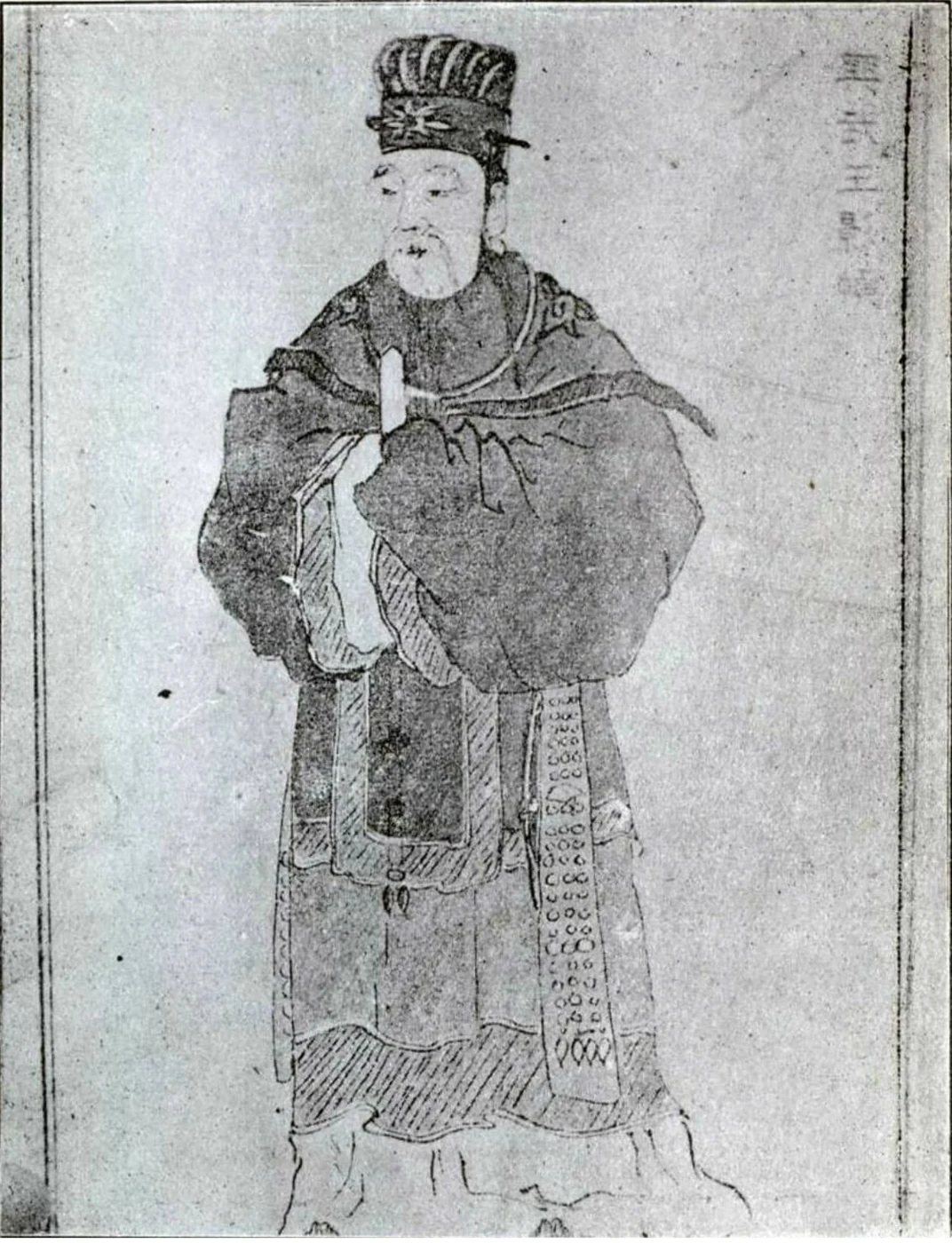
Biography
Family Background and Early Years
Kim Yu-sin's great-grandfather was King Guhyeong, the final ruler of Geumgwan Gaya, also known in the source by variant names. After Geumgwan Gaya surrendered to Silla in 532, Silla incorporated its royal house into the true-bone aristocracy, later called the "new Kim clan" and associated with the Gimhae Kim lineage. Kim Yu-sin's grandfather Kim Muryeok entered Silla service and in 554 played a decisive role in the Battle of Gwansan Fortress, where Baekje was defeated and King Seong of Baekje was killed; the source gives a figure of more than ten thousand enemy dead.
His father Kim Seohyeon formed a relationship outside formal marriage with Lady Manmyeong, granddaughter of Galmunwang Ipjong, brother of King Beopheung and father of King Jinheung. The source states that after a pregnancy lasting twenty months she gave birth to Kim Yu-sin. His name was said to reflect both a dream in which Kim Seohyeon saw Mars and Saturn descend to him and his admiration for the Chinese writer Yu Xin: the character Yu resembled the cyclical sign *geng*, while Xin resembled the sound of *chen*.
At fifteen Kim Yu-sin became a Hwarang follower and impressed the others with his military and organizational ability; his group was called the "Yonghwa Hyangdo." Growing up while Baekje and Goguryeo repeatedly attacked Silla, he reportedly entered a mountain cave alone and swore to Heaven that he would destroy the two enemy states. Legend says that he then encountered an immortal named Nanseung who taught him secret methods.
Early Military Distinction
In 629, Kim Yu-sin joined his father Kim Seohyeon in an attack on Goguryeo's Nangbi Fortress. Serving as a central-banner commander, he charged the enemy at a moment when the situation was unfavorable and Silla morale was low, killed an opposing commander, reversed the battle, and helped capture the fortress, with the source reporting more than five thousand enemy dead. This was his first major display of battlefield courage and decisiveness.
In 642, after Baekje captured Daeya Fortress, an important western gateway of Silla, Queen Seondeok appointed Kim Yu-sin military governor of Amnyang Province. He successfully blocked further Baekje advances. In 644 he was promoted to *sopan*, the third-ranked office, and repeatedly defeated Baekje. In 645, when Baekje attacked Ipo Fortress, Kim Yu-sin led Silla troops to victory and the source records two thousand enemy dead.
Regency and Suppression of Rebellion
In 647 Bidam's rebellion broke out and Queen Seondeok died during the crisis. Kim Yu-sin suppressed the rebellion and, together with his brother-in-law Kim Chunchu, assisted Queen Jindeok in state affairs. In the tenth lunar month, Baekje forces besieged Musan, Gammul, and Dongjam forts. Kim Yu-sin led ten thousand troops against them and defeated the Baekje army, with more than three thousand killed according to the source.
In 648, Kim Yu-sin used a feigned defeat at Daeryang Fortress to lure and defeat Baekje forces, captured eight Baekje generals, and took one thousand heads according to the source. He then advanced into Baekje territory, captured twelve fortresses including Akseong, and the source reports more than twenty thousand enemy dead. He later took nine additional towns including Jinrye, with nine thousand more killed and six hundred captured. He also killed Baekje officials including Jwapyeong Eunsang and Dalsol Jagyeon and 8,980 soldiers according to the source. He was promoted to *ichan*, the second-ranked office.
Wars of Conquest
In 660, Kim Chunchu appointed Kim Yu-sin *sangdaedeung*, described in the source as the highest office in Silla. Tang forces crossed the sea at Silla's request to attack Baekje. Kim Yu-sin led fifty thousand Silla troops in coordination with the Tang expedition and, on the way, fought Gyebaek's five thousand Baekje troops at Hwangsanbeol. He defeated them, joined the Tang forces, and participated in the destruction of Baekje.
The source also records an anecdote in which Tang commander Su Dingfang intended to execute Silla supervisor Kim Munyeong because the Silla army had arrived late. Kim Yu-sin threatened battle with the Tang forces. Su Dingfang's subordinate Dong Baoliang stepped on Su's foot to warn that the Silla troops were preparing to resist, after which Su spared Kim Munyeong.
Later Years and Final Advice
In 661, after Queen Jindeok's death, Kim Yu-sin's nephew Kim Beop-min ascended the throne as King Munmu. The new ruler continued to rely on him and promoted him to Great General. In 662 Kim Yu-sin led a difficult supply mission deep into Goguryeo territory to provision Tang forces besieging Pyongyang and defeated Goguryeo pursuers on his return. In 664 he joined King Munmu in suppressing Baekje remnant forces, defeating them at Dusol Fortress; the source says both Baekje people and Japanese forces surrendered, after which the Silla king allowed the Japanese to return home.
In 667 Tang and Silla launched another campaign against Goguryeo, which fell the following year. Because of advanced age, Kim Yu-sin could no longer personally command in the field, but the principal commanders Kim Heumsun, his younger brother, and Kim Inmun, his nephew, consulted him before departure. Kim Yu-sin advised that a general was the shield of the state and the ruler's claws and teeth; success required alignment with Heaven, terrain, and popular support. He argued that Silla had survived through loyalty and trust, Baekje had fallen through arrogance, and Goguryeo stood in danger through pride, so Silla's upright position could prevail with the aid of a powerful allied emperor.
After Goguryeo's fall, King Munmu rewarded Kim Yu-sin with the extraordinary rank Taedaegakgan, an estate of five hundred households, a carriage and staff, and permission not to hurry when approaching the throne. The source states that Emperor Gaozong of Tang also issued an edict praising him and considered summoning him to the Tang court, although the visit did not occur.
After the destruction of Baekje and Goguryeo, conflict developed between Tang and Silla in the Silla–Tang War. Kim Yu-sin had long argued that Silla should protect its national interests within the alliance and remain wary of Tang, using the analogy that even a dog will bite its master if its foot is stepped on. He therefore had his son Kim Wonsul participate in aiding Goguryeo remnants against Tang. When the Silla army was defeated and Wonsul fled, King Munmu asked Kim Yu-sin what should be done. Kim Yu-sin replied that Tang intentions were difficult to predict and strategic positions should be defended, but that Wonsul had both disgraced the royal command and violated family discipline and should be executed. King Munmu did not accept his recommendation.
Kim Yu-sin died on the first day of the seventh lunar month in 673. In his final advice to King Munmu, he modestly denied personal merit and credited the ruler's unwavering trust for whatever service he had rendered. He said that the Three Han had become one family and the people had become united, but warned that rulers often began well and failed to preserve their achievements. He urged King Munmu to remember how difficult success had been, recognize the equal difficulty of preserving it, distance petty men, keep worthy men close, maintain harmony at court, and ensure peace among the people.
After his death, King Munmu granted one thousand bolts of silk, two thousand *seok* of grain, and one hundred military musicians and drummers for the funeral. Kim Yu-sin was buried at Geumsan Plain, a commemorative stele was erected, and households were assigned to guard the tomb. During the reign of King Heungdeok, he was posthumously elevated to the title Great King Heungmu.