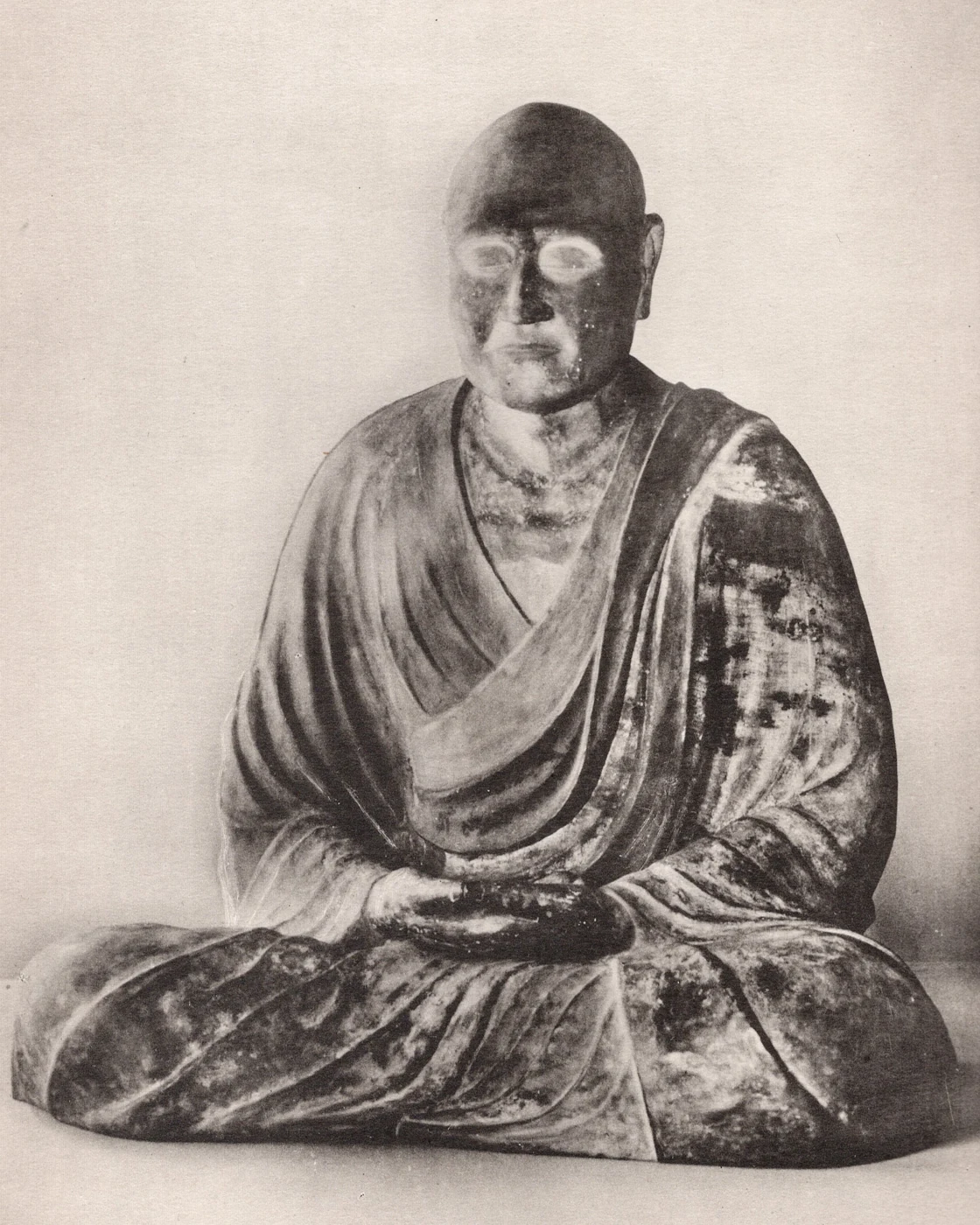
Historical seated statue of Jianzhen at Toshodaiji.
688 CE–763 CE
Buddhist monkVinaya master
Jian Zhen
鉴真
Jian Zhen (688–763), secular surname Chunyu, native to Jiangyang County in Yangzhou, was an eminent Tang dynasty Buddhist master of the Vinaya (Ritsu) school. Ordained in his youth, he studied monastic discipline in Chang'an and Luoyang before returning to Daming Temple in Yangzhou, becoming the most revered Vinaya preceptor of the Jianghuai region. In 742, he accepted an earnest petition from Japanese scholar-monks Yōei and…
688 CE–763 CETang Dynasty
PROFILE
Jian Zhen (688–763), secular surname Chunyu, native to Jiangyang County in Yangzhou, was an eminent Tang dynasty Buddhist master of the Vinaya (Ritsu) school. Ordained in his youth, he studied monastic discipline in Chang'an and Luoyang before returning to Daming Temple in Yangzhou, becoming the most revered Vinaya preceptor of the Jianghuai region. In 742, he accepted an earnest petition from Japanese scholar-monks Yōei and Fushō to introduce authentic Buddhist monastic ordinations to Japan. Over the course of twelve years, he undertook five grueling attempts that ended in shipwrecks, official impoundment, and personal tragedy, losing his sight entirely. In 753, on his sixth attempt, he successfully reached Kyushu alongside a returning Japanese diplomatic mission. At Tōdai-ji in Nara, he erected an imperial ordination platform, administering precepts to Retired Emperor Shōmu, the Empress, and hundreds of clerics, thus establishing the Ritsu sect of Japanese Buddhism. In 759, he founded Tōshōdai-ji. He brought extensive knowledge of Tang pharmacopeia, architecture, sculpture, and calligraphy that profoundly influenced Nara culture. He passed away at Tōshōdai-ji in 763.
Secular surname
Chunyu
Birth Date
688 CE(the 4th year of Chuigong)
Death Date
763 CE(the 1st year of Guangde)
Native place
Jiangyang County, Yangzhou
Identity
Buddhist monk, Vinaya master
Historical period
Tang dynasty
Dynasty / Regime
Tang dynasty
LIFE TIMELINE
Birth | Born in Jiangyang County, Yangzhou; secular surname Chunyu.Open
Birth | Born in Jiangyang County, Yangzhou; secular surname Chunyu.
Monastic Ordination | Entered monastic life at Dayun Temple in YangzhoOpen
Monastic Ordination | Entered monastic life at Dayun Temple in Yangzhou.
Full Ordination | Received full monastic ordination at Shiji Temple inOpen
Full Ordination | Received full monastic ordination at Shiji Temple in Chang'an, studying the Vinaya.
Accepting Invitation | Accepted the invitation from Japanese monks YōeOpen
Accepting Invitation | Accepted the invitation from Japanese monks Yōei and Fushō to transmit the precepts.
Drift to Hainan | Fifth voyage driven ashore on Hainan Island; lost eyOpen
Drift to Hainan | Fifth voyage driven ashore on Hainan Island; lost eyesight on the return journey.
Successful Crossing | Successfully reached southern Kyushu aboard a reOpen
Successful Crossing | Successfully reached southern Kyushu aboard a returning Japanese embassy fleet.
Ordinations at Tōdai-ji | Arrived in Nara and established an ordinatioOpen
Ordinations at Tōdai-ji | Arrived in Nara and established an ordination platform at Tōdai-ji.
Founding Tōshōdai-ji | Established Tōshōdai-ji on imperial estate landOpen
Founding Tōshōdai-ji | Established Tōshōdai-ji on imperial estate land, creating the center of Japanese Ritsu Buddhism.
Passing | Passed away peacefully at Tōshōdai-ji at age seventy-six.Open
Passing | Passed away peacefully at Tōshōdai-ji at age seventy-six.
BIOGRAPHY
Biography
Vinaya Training and Teaching in Yangzhou
Jian Zhen was raised in Yangzhou, the bustling commercial and cultural metropolis of the Tang empire. Following his entry into the monastic order, he traveled to the imperial capitals of Luoyang and Chang'an, studying under prominent masters such as Hongjing and mastering the complex Vinaya disciplinary codes.
Returning to Yangzhou's Daming Temple, he assumed leadership as a foremost preceptor, lecturing on the Dharmaguptaka Vinaya, ordaining thousands of monks, building temples and statuary, and organizing charitable apothecary dispensaries. His monastic retinue developed sophisticated multidisciplinary skills spanning Buddhist theology, pharmacology, and architecture.
Twelve Years of Tribulation and Five Failed Crossings
During the Nara period, although Buddhism was fostered as a state religion, Japan lacked properly ordained preceptors qualified to administer the orthodox full precepts (*upasampadā*). In 742, Japanese pilgrimage monks Yōei and Fushō arrived in Yangzhou to plead for his assistance. When Jian Zhen surveyed his disciples, none dared brave the treacherous sea, prompting his famous proclamation: "For the sake of the Dharma, why should one cherish life?"
Over the subsequent decade, five successive eastward voyages met disaster:
The first attempt in 743 was aborted due to false accusations and bureaucratic interference.
The second attempt encountered destructive storms near the mouth of the Yangtze.
The third attempt ran aground in Zhoushan waters.
The fourth attempt was blocked by provincial magistrates responding to anxious pleas from Yangzhou disciples.
In 748, on his fifth attempt, violent gales swept the ship southward across thousands of miles to Hainan Island. Jian Zhen spent a year ministering in Hainan before returning overland across southern China. During this ordeal, Yōei died of disease, and Jian Zhen suffered eye infections that left him completely blind.
Arrival in Nara and the Tōdai-ji Ordinations
In 753, the Japanese imperial envoy Fujiwara no Kiyokawa prepared to depart Tang China. Jian Zhen and his loyal entourage secretly boarded the embassy fleet. Sailing through turbulent seas, Jian Zhen's ship made landfall in southern Kyushu in December 753.
In early 754, the delegation arrived in the capital of Heijō-kyō (Nara), greeted by imperial ministers and thousands of celebrating monks. Before the Great Buddha Hall at Tōdai-ji, Jian Zhen erected Japan's first formal ordination platform (*kaidan*). He administered the Bodhisattva precepts to Retired Emperor Shōmu and Empress Kōmyō, followed by full monastic ordinations to over four hundred monks, officially establishing canonical lineage transmissions in Japan.
Founding of Tōshōdai-ji and Later Years
Honored with the supreme ecclesiastical title of Great Master of Transmitted Light, Jian Zhen received the estate of the late Prince Niitabe in 759. There he planned and supervised the construction of Tōshōdai-ji according to classical Tang architectural principles.
Beyond religious leadership, Jian Zhen introduced essential medical expertise, accurately categorizing medicinal herbs by scent and taste despite his blindness, which led to his veneration as a patron of Japanese pharmacology. On June 25, 763, Jian Zhen passed away peacefully in the lotus position at Tōshōdai-ji at the age of seventy-six. Shortly before his death, his disciples fashioned a dry-lacquer seated statue of him, which remains preserved as one of Japan's most precious National Treasures.
Major Activities
Tenacious Cross-Cultural Voyage
Jian Zhen's twelve-year perseverance across six perilous maritime expeditions remains an extraordinary testament to religious devotion and cultural exchange between Tang China and ancient Japan.
Institutionalization of Japanese Monastic Discipline
By establishing authentic ordination platforms at Tōdai-ji and founding Tōshōdai-ji, Jian Zhen regularized the Japanese monastic order, founding the Ritsu school as one of the Six Nara Buddhist Schools.
Dissemination of Tang Medicine and Arts
Jian Zhen's mission represented a comprehensive cultural transfer, enriching early Japanese civilization with advanced Tang medical knowledge, master architectural design, refined lacquer sculptures, and calligraphy.
Personal Relations
Yōei: Japanese monk who extended the original invitation; died during the fifth voyage.
Fushō: Japanese monk who faithfully accompanied Jian Zhen throughout the mission.
Retired Emperor Shōmu: Japanese sovereign who received ordination from Jian Zhen.
Empress Kōmyō: Imperial patron who supported the propagation of the precepts.
Shitaku: Senior disciple who assisted in administering ordinations and chronicling the voyage.
Historical Assessment
Japanese Historiography and Reverence
Ancient chronicles including *Shoku Nihongi* and the contemporary biography *Tō Daiwajō Tōseiden* celebrate Jian Zhen as a founding benefactor of Tenpyō culture. He has been revered for over a millennium as the "Great Tang Master."
Landmark in Sino-Japanese Relations
Historians consistently regard Jian Zhen as the supreme exemplar of civilizational dialogue, symbolizing peaceful collaboration and enduring cultural affinity between China and Japan.
Modern Academic Assessment
Contemporary researchers highlight the collective nature of Jian Zhen's mission, characterizing it as a multifaceted transmission of Tang material culture, scientific knowledge, and spiritual traditions that profoundly shaped classical Japanese institutions.