Joining Liu Xiu
Recommended to Liu Xiu upon his crossing into Hebei; appointed Master of Records and promoted to Lieutenant-General.
50 CE
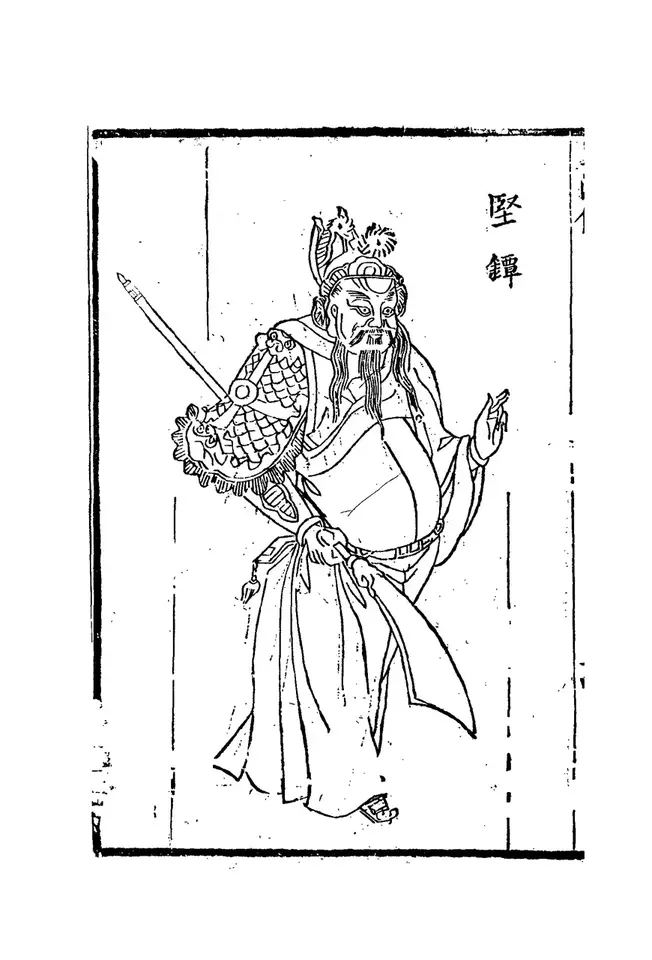
坚镡
Jian Tan (坚镡, ?–50 CE), courtesy name Ziji (子伋), was a native of Xiangcheng County in Yingchuan Commandery (modern Xiangcheng, Henan). He was a founding general of the Eastern Han dynasty, ranked twenty-second among the celebrated Yuntai Twenty-Eight Generals. In his early years, Jian Tan served as a local commandery clerk, earning praise for his administrative acumen and mastery of statutory regulations. In the winter of 23…
Jian Tan (坚镡, ?–50 CE), courtesy name Ziji (子伋), was a native of Xiangcheng County in Yingchuan Commandery (modern Xiangcheng, Henan). He was a founding general of the Eastern Han dynasty, ranked twenty-second among the celebrated Yuntai Twenty-Eight Generals. In his early years, Jian Tan served as a local commandery clerk, earning praise for his administrative acumen and mastery of statutory regulations. In the winter of 23 CE (first year of Gengshi), Liu Xiu crossed the Yellow River with imperial credentials to pacify Hebei. Recommended for his practical competence, Jian Tan was granted an audience, appointed Master of Records, and quickly promoted to Lieutenant-General. He accompanied Liu Xiu through numerous campaigns, defeating Wang Lang at Handan and crushing insurgent armies including the Tongma, Daqiang, Youlai, and Wufan forces across Hebei. In 25 CE (first year of Jianwu), Emperor Guangwu ascended the imperial throne and commissioned Jian Tan as General of Propagating Transformation, ennobling him as Marquis of Yinqiang. During the prolonged siege of Luoyang, Jian Tan made secret contact with a defending commander of Chu Wei, breached the East Gate at dawn, and stormed the imperial armory, demoralizing the garrison and compelling Chu Wei to surrender. In 26 CE, Jian Tan marched into Nanyang alongside Right General Wan Xiu. When local warlords Dong Xin and Deng Feng rebelled and Wan Xiu died of illness, Jian Tan found himself isolated within Wancheng. Cut off from all supply lines for over a year, he subsisted on wild herbs alongside his men, sustained three severe wounds at the front lines, and successfully defended the isolated stronghold until Emperor Guangwu arrived to extinguish the rebellion. He was subsequently appointed Master of the Left and later had his fief reconfirmed as the Marquis of Hefei in 30 CE. Jian Tan passed away in 50 CE.
Recommended to Liu Xiu upon his crossing into Hebei; appointed Master of Records and promoted to Lieutenant-General.
Crushed the Tongma, Gaohu, and Chonglian insurgents; routed the Daqiang peasant army at Lunu.
Pursued rebel remnants alongside thirteen generals to Pinggu, Wuzhong, and Tuyen in Youzhou.
Appointed General of Propagating Transformation; breached Luoyang's East Gate to attack the armory, forcing Chu Wei's surrender.
Led daring night climbers to capture Wancheng; became besieged and held out in total isolation for a full year.
Coordinated with Emperor Guangwu's relieving army to eradicate Dong Xin and Deng Feng; appointed Master of the Left.
Awarded the strategic fief of Hefei during the imperial re-evaluation of founding merits.
Passed away peacefully; his noble title was inherited by his son Jian Hong.
Jian Tan began his public career as a local administrative functionary in Xiangcheng County, Yingchuan Commandery. He was recognized for his steadfast resolution, familiarity with legal statutes, and natural talent for battlefield tactical command. In 23 CE, following the collapse of Wang Mang's Xin regime, Emperor Gengshi (Liu Xuan) established his capital at Luoyang. Because commanderies north of the Yellow River remained uncommitted, Emperor Gengshi dispatched Liu Xiu holding imperial tallies to pacify Hebei. As Liu Xiu actively enlisted capable men, local associates recommended Jian Tan. Recognizing his administrative efficiency and calm judgment, Liu Xiu immediately commissioned him as Master of Records and soon elevated him to Lieutenant-General, attaching him to the mobile expeditionary staff.
At this time, Wang Lang declared himself emperor at Handan, while dozens of peasant insurgent factions dominated northern territories. Jian Tan campaigned vigorously alongside Liu Xiu. After destroying Wang Lang's regime, he joined the ongoing operations against regional armed bands. In the autumn of 24 CE, Jian Tan followed Liu Xiu in engagements against several hundred thousand Tongma fighters around Gaocheng and Qingyang, defeating them in a decisive clash at Puyang. In the first lunar month of 25 CE, when the Youlai, Daqiang, and Wufan forces regrouped across Changshan and Zhongshan, Jian Tan was entrusted with an independent strike division. Intercepting the Daqiang army at Lunu, he shattered their lines through disciplined tactical maneuvers. Subsequently, alongside Geng Yan, Wu Han, Jing Dan, and ten other senior commanders, he pursued retreating insurgent forces through Pinggu and into Wuzhong, Tuyen, and Junmi in Youzhou, securing Hebei as Liu Xiu's permanent base.
In the sixth lunar month of 25 CE, Liu Xiu declared himself emperor at Hao, inaugurating the Eastern Han dynasty. For his battlefield service in Hebei, Emperor Guangwu appointed Jian Tan as General of Propagating Transformation and ennobled him as Marquis of Yinqiang. At that moment, Chu Wei, Grand Minister of War under the Gengshi regime, held the critical imperial capital of Luoyang with formidable forces. Having participated in the execution of Liu Xiu's elder brother Liu Yan, Chu Wei feared harsh retribution and resolved to defend the city to the last. In the seventh month, Guangwu designated Wu Han as Grand Minister of War, marshaling eleven generals including Jian Tan, Cen Peng, and Zhu You to invest Luoyang.
As the siege dragged on through months of attrition, supplies dwindled and cracks formed among the defenders. A subordinate officer guarding the eastern city wall secretly contacted Jian Tan, offering to open the East Gate at dawn. Recognizing an irreplaceable opportunity, Jian Tan assembled shock troops alongside General of Established Righteousness Zhu You. In the mist of daybreak, the Han vanguard charged through the opened gate and dashed straight for the central military armory. Chu Wei led his personal guards to contest the position, resulting in fierce close-quarters combat beneath the armory walls. Although Han troops temporarily withdrew due to a lack of immediate external reinforcements, the audacious intrusion permanently shattered Chu Wei's resolve. Convinced that his subordinates were disloyal, Chu Wei accepted Cen Peng's guarantees and surrendered, yielding Luoyang to the Eastern Han court. Following this triumph, Jian Tan led detached forces to reduce Neihuang.
In 26 CE, southern commanderies erupted into rebellion. Emperor Guangwu ordered Jian Tan and Right General Wan Xiu to pacify Nanyang Commandery. Suddenly, Dong Xin of Duxiang revolted at Wancheng, capturing Grand Administrator Liu Lin. Apprised of the emergency, Jian Tan marched without delay to Wancheng. He hand-picked dozens of daredevil commandos, scaled the city battlements under cover of darkness, and hacked through the gate chains, allowing the main body to storm inside. Dong Xin fled in panic back to his stronghold in Duxiang.
However, the military situation deteriorated rapidly. Grand Minister of War Wu Han allowed his troops to plunder Xinye, provoking the powerful local Deng clan to revolt under Deng Feng, who routed Wu Han's army. Concurrently, Right General Wan Xiu succumbed to illness. Deprived of operational support, Jian Tan found himself encircled within Wancheng. Deng Feng threatened him from the south, while Dong Xin rallied his forces to attack from the north. The roads connecting Nanyang to Luoyang were completely severed. For over an entire year, Jian Tan and his garrison endured absolute isolation without external rations. Jian Tan shared every hardship with his men, digging roots and foraging wild herbs for sustenance. Whenever rebel assaults surged up the ramparts, he fought at the forefront, suffering three grievous wounds from arrows and stones. His unyielding grit held Wancheng intact, keeping the entire garrison from destruction.
In 27 CE, Emperor Guangwu took personal command of an expeditionary army to relieve Nanyang. When the imperial divisions reached the outskirts of Wancheng, Jian Tan threw open the gates and coordinated a pincer attack alongside Cen Peng's relieving forces. This decisive strike obliterated the combined armies of Dong Xin and Deng Feng. When Emperor Guangwu entered Wancheng, he was profoundly moved by Jian Tan's severe wounds and the disciplined posture of the exhausted defenders. The emperor appointed him Master of the Left, keeping him close to the imperial headquarters for strategic planning.
In 30 CE, when the court settled the permanent fiefs of founding heroes, Jian Tan was granted the noble title Marquis of Hefei, taking possession of an economically vital estate in the Huai River basin. In his marquisate, Jian Tan implemented sound civil governance, constructing water conservancy works, pacifying displaced populations, and encouraging agriculture, reflecting his early administrative training. In 50 CE, Jian Tan passed away in office. He was buried with the ceremonial honors of a high dignitary, and his noble rank was inherited by his son Jian Hong.
During the foundational period of Liu Xiu's northern enterprise, vast peasant armies swept unchecked across Hebei. Serving as Master of Records and Lieutenant-General, Jian Tan managed essential administrative paperwork while personally leading shock troops in the field.
In the pivotal battle against the Daqiang army at Lunu, Jian Tan spearheaded a devastating penetration of the enemy core, routing their best divisions. He subsequently pursued insurgent remnants across hundreds of miles into Youzhou, demonstrating remarkable cavalry mobility and field command.
The conquest of Luoyang was the decisive urban engagement that established the Eastern Han capital. With Chu Wei entrenched behind massive fortifications, standard assaults yielded little progress.
Jian Tan utilized intelligence and internal subversion, orchestrating a dawn raid through the East Gate that directly threatened the realm's foremost weaponry depot. While tactical limitations prevented an immediate collapse of the fortress, this strike destroyed Chu Wei's confidence in his defense network, providing the psychological breakthrough needed for Cen Peng to secure a peaceful surrender.
The zenith of Jian Tan's martial career occurred during the defense of Wancheng in 26 CE. Stripped of his fellow general Wan Xiu, deprived of supplies, and surrounded by overwhelming rebel forces, he displayed extraordinary resilience.
Submitting to famine, he ate wild herbs alongside his soldiers; facing intense assaults, he received three serious combat wounds without retreating an inch. Jian Tan's iron resolve preserved Wancheng as an unbroken Han outpost deep within rebel territory, pinning down enemy forces and laying the operational foundation for Emperor Guangwu's final victory.
FIGURES ASSOCIATED WITH THIS DYNASTY