韩康
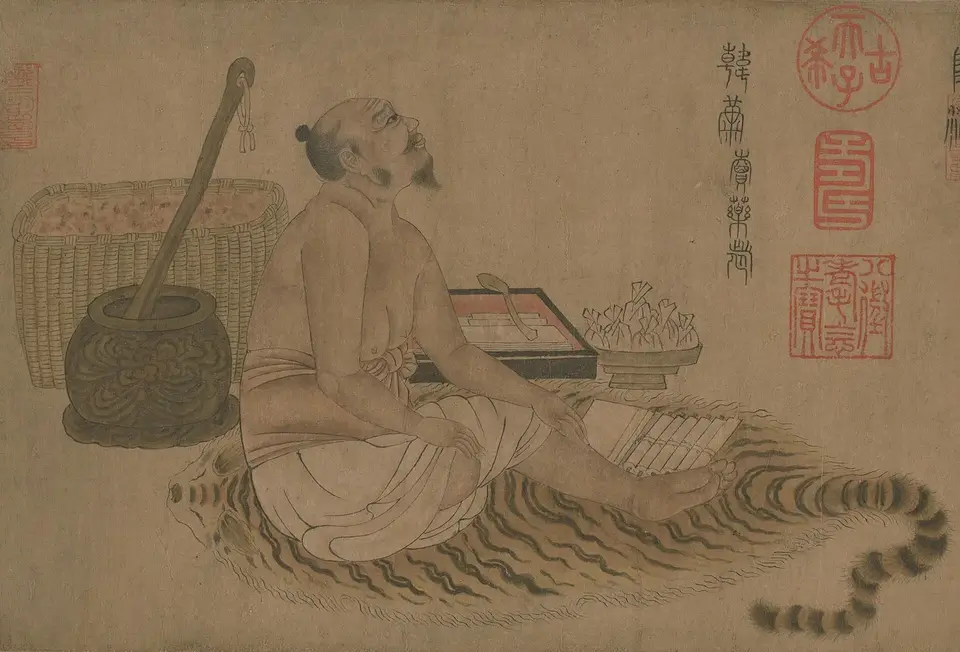
Historical portrait of Han Kang
Image creditsLu Yao (陆曜) · Public domainImage source

Historical figure

Han Kang (韩康)

韩康

Han Kang (dates unknown), courtesy name Boxiu and also known as Tianxiu, was a native of Baling County in Jingzhao Commandery (present-day Baqiao District, Xi'an, Shaanxi). He was a celebrated hermit, physician, and herbalist of the Eastern Han dynasty, universally revered in Chinese history as a paradigm of unwavering commercial honesty and high-minded reclusion. For over thirty years, Han Kang traveled through famous…

Eastern Han Dynasty (东汉)

PROFILE

Han Kang (dates unknown), courtesy name Boxiu and also known as Tianxiu, was a native of Baling County in Jingzhao Commandery (present-day Baqiao District, Xi'an, Shaanxi). He was a celebrated hermit, physician, and herbalist of the Eastern Han dynasty, universally revered in Chinese history as a paradigm of unwavering commercial honesty and high-minded reclusion. For over thirty years, Han Kang traveled through famous mountain ranges gathering wild medicinal herbs and transporting them to the marketplaces of Chang'an. In an era when merchants routinely haggled and altered prices based on customers' wealth, Han Kang adhered strictly to the rule of a single, fixed price with no bargaining, treating commoners and nobility with equal fairness. Eventually, a local woman recognized him by his refusal to negotiate, exclaiming his name in astonishment. Realizing that his desire to lead an anonymous life had been compromised, Han Kang immediately abandoned his trade and retreated deep into the untamed wilderness of Mount Baling. During the reign of Emperor Huan, the court repeatedly dispatched imperial summons seeking his counsel, all of which Han Kang declined. Emperor Huan subsequently dispatched an emissary bearing ritual black and crimson silks along with a cushioned carriage to bring him to the imperial capital. Unable to defy the imperial decree openly, Han Kang feigned compliance but declined the luxurious carriage, opting to depart before dawn in a plain wooden ox cart. At a postal relay station, the local station master mistook him for an ordinary peasant and seized his ox to repair roads for the approaching "Eminent Recluse Han." Han Kang unhitched the ox and yielded it without protest. When the imperial envoy arrived and threatened to execute the station master for the insult, Han Kang intervened to spare the official's life. Seizing the confusion, Han Kang slipped away into the mountains, living in profound obscurity and dying peacefully at an advanced age. Recorded in Huangfu Mi's Biographies of High-Minded Recluses, Han Kang's name became a lasting cultural symbol for integrity in Chinese medicine and trade.

Courtesy Name
Boxiu (also known as Tianxiu)
Native Place
Baling County, Jingzhao Commandery (Modern Baqiao District, Xi'an, Shaanxi)
Dynasty
Eastern Han
Historical Identity
Renowned Eastern Han Recluse, Herbalist and Physician, Historical Exemplar of Commercial Integrity

LIFE TIMELINE

Relationship graph

BIOGRAPHY

Chronology

  • c. 110 AD (4th year of the Yongchu era) | Foraging in Famous Mountains | Lived in the Guanzhong region, frequently ascending the Qinling Mountains to gather medicinal herbs and study pharmacology.
  • c. 120 AD (1st year of the Yongning era) | Practicing in Chang'an | Opened a modest apothecary stall in Chang'an, establishing the principle of never bargaining on prices.
  • c. 150 AD (1st year of the Heping era) | Discovered by a Customer | A woman recognized his identity through his refusal to haggle; startled by his fame, he fled into the Baling mountains.
  • c. 153 AD (3rd year of the Yuanjia era) | Rejecting Court Summons | Imperial couriers repeatedly ventured into the wilderness to summon him to office, but he remained in deep hiding.
  • c. 158 AD (1st year of the Yanxi era) | Imperial Carriage Recruitment | Emperor Huan dispatched an emissary with ceremonial silks and a cushioned chariot to summon him; Han Kang feigned compliance.
  • c. 158 AD (1st year of the Yanxi era) | Yielding the Ox | Traveled ahead in a humble cart; when a station head commandeered his ox, Han Kang calmly surrendered the draft animal.
  • c. 159 AD (2nd year of the Yanxi era) | Disappearance and Longevity | Dissuaded the envoy from executing the station head, used the opportunity to flee into remote forests, and lived to a natural old age.

Life and Career

Gathering Herbs and Fixed Prices in Chang'an

Han Kang was born into an upright family in Baling, Jingzhao Commandery. From his youth, he possessed an untamed, contemplative temperament, harboring deep aversion toward the political corruption and artificial ambitions of the metropolitan aristocracy. Rejecting an official career, he dedicated himself to the study of traditional pharmacology and the natural properties of native plants. For decades, he wandered through the rugged Qinling mountain chains, personally foraging for rare botanicals and therapeutic roots.

Having harvested and refined these medicinal substances, Han Kang brought them to the bustling commercial quarters of Chang'an. The marketplaces of the ancient capital were rife with deceitful price manipulation, where unscrupulous apothecaries demanded exorbitant fees from the rich and sold substandard remedies to the desperate. Disturbed by these abuses, Han Kang instituted an uncompromising policy: all medicine was genuine, accurately priced according to cost, and sold at a single, unchanging price. For more than thirty years, he steadfastly refused to haggle with any customer, irrespective of their social standing or insistence.

Over time, the sick and impoverished of Chang'an realized that the herbs purchased from the taciturn herbalist never failed to cure ailments, and that his prices were uncorrupted by greed. The phrase "Han Boxiu does not haggle" spread throughout Guanzhong as a symbol of commercial reliability.

Renouncing the Market and Withdrawing to Baling

Han Kang had originally adopted the identity of an itinerant apothecary to blend into urban obscurity and live free from bureaucratic entanglement. He never anticipated that thirty years of unwavering honesty would instead elevate him into a celebrated cultural figure.

One afternoon, a local woman approached his stall to purchase medicine. Following customary marketplace practice, she repeatedly pressed for a discount. Han Kang remained serene but refused to lower the price by even a single coin. Frustrated by his stubbornness, the woman angrily exclaimed: "Are you Han Boxiu, that you refuse to bargain?"

Han Kang was profoundly shaken. He sighed in dismay: "I originally sought to escape fame by mingling with the common crowd; yet today even a cloistered woman knows my name! When renown has spread so broadly, what purpose remains in selling herbs?" That very day, Han Kang packed up his wares, closed his stall forever, and retreated alone into the remote forests and peaks of Mount Baling, severing all contact with the outside world.

Feigned Compliance and Escape via Forfeited Ox

Despite his self-imposed exile, Han Kang's moral standing only grew in public esteem. During the reign of Emperor Huan, the court was plagued by consort-clan dominance and eunuch corruption; to polish its tarnished prestige, the throne frequently sought to recruit revered recluses. Imperial messengers repeatedly brought official decrees into the mountains, but Han Kang continuously evaded them.

Determined to secure his attendance, Emperor Huan prepared a special retinue equipped with black and crimson ceremonial silks, jade tokens, and a luxurious cushioned carriage, ordering an imperial envoy to seek out Han Kang's mountain hermitage. Confronted with an imperial mandate that could bring punishment upon his neighbors if defied, Han Kang outwardly consented to travel to Luoyang.

When departing, however, Han Kang flatly refused to ride in the imperial carriage. Instead, he hitched an ox to a dilapidated wooden cart, dressed in peasant attire with a plain cloth headband, and set out alone before daybreak. Reaching a roadside postal station, he encountered the local station master, who was frantically conscripting laborers and draft animals to pave roads and build bridges for the impending passage of the imperial guest "Eminent Recluse Han." Seeing an unpretentious peasant cart emerging from the morning mist, the station master assumed Han Kang was a recalcitrant farmer and forcibly confiscated his ox. Han Kang exhibited no anger; without speaking a word, he unharnessed the animal and handed the reins to the official.

Shortly thereafter, the imperial envoy arrived with banners and armed escorts, only to discover the revered sage sitting serenely on the roadside without his ox. Terrified, the station master prostrated himself and pleaded for death. The furious imperial envoy drew his sword and prepared to execute the official for treasonous insolence. Han Kang stepped forward and calmly intervened: "I gave the ox to him of my own free will. The station master was simply striving to fulfill his official duties on behalf of the throne; what crime has he committed?" Moved by his magnanimity, the envoy spared the man's life.

Taking advantage of the administrative chaos and distraction among the traveling party, Han Kang quietly departed the post road and vanished into the dense primeval forests of the western wilderness. He was never seen again by imperial officials, living in untroubled reclusion and passing away naturally at an advanced age.

Major Achievements

Selling Medicine for Three Decades Without Price Fluctuations

Practiced medicine and sold herbal remedies in the Chang'an markets for over thirty years with strict adherence to truth in quality and a single unchanging price, establishing an enduring benchmark of ethical trade in Chinese history.

Abandoning Commerce upon Recognition to Guard Reclusion

When an ordinary customer recognized him by his steadfast adherence to fair pricing, he recognized that his quiet obscurity had ended, promptly giving up his thriving trade to retreat into the mountains of Baling.

Saving the Station Head and Escaping into the Wilderness

When summoned by Emperor Huan, he calmly surrendered his draft ox to an overzealous station master, intervened to save the official from execution, and successfully slipped away into mountain seclusion to preserve his moral independence.
Personal Relationships

  • Sovereign / Inviting Monarch: Emperor Huan of Han (dispatched ceremonial silks and a carriage to summon Han Kang to court)
  • Market Customer: Anonymous Chang'an woman (recognized Han Kang by his non-negotiable prices, prompting his retreat into the mountains)
  • Imperial Emissary: Court messenger sent by Emperor Huan (attempted to execute the station master for seizing Han Kang's ox)
  • Station Master: Local postal head (confiscated Han Kang's draft ox for road repairs, spared from execution through Han Kang's intervention)
  • Biographer: Huangfu Mi (Western Jin physician and scholar who canonized Han Kang's life in the Biographies of High-Minded Recluses)

Historical Evaluations

  • Huangfu Mi, Biographies of High-Minded Recluses, Volume 3: "Han Kang, courtesy name Boxiu and also known as Tianxiu, was a native of Baling in Jingzhao. He gathered herbs in famous mountains and sold them in the Chang'an market, never changing his price for over thirty years... Han sighed and said: 'I originally desired to flee fame, yet now even a young girl knows of me. Why continue selling medicine?' Thereupon he withdrew into the mountains of Baling... He subsequently fled mid-journey and reached a ripe old age."
  • Fan Ye, Book of the Later Han, Volume 83: "Han Kang, courtesy name Boxiu, was a native of Baling in Jingzhao. He gathered herbs in famous mountains and sold them in the markets of Chang'an, never altering his price for over thirty years... Emperor Huan prepared ceremonial silks and a carriage to recruit him. Unable to avoid the summons, Han feigned agreement... He escaped along the way, and his ultimate whereabouts remain unknown."
  • Xu Ling, The Way of Chang'an: "Han Kang sells efficacious medicine, while Dong Yan peddles brilliant pearls."
  • Bai Juyi, Responding to Mengde's Poem on Living in Poverty: "Sickness adds bitterness to the groans of Zhuang Xi; poverty leaves behind many debts to Han Kang's pharmacy."
  • Gu Yanwu, Presented to Recluse Wu Jisi: "In the midst of the bustling city, one inquires after Han Kang, asking where his medicine shop might be."
  • Traditional Historical Commentary: Common men scramble frantically for worldly profit and pursue prestige like moths to a flame. Yet Han Kang dwelled amidst the clamor of the marketplace for three decades, upholding an unchanging price to illuminate the highest integrity. When his name reached the ears of cloistered women, he retreated into the wild hills, knowing when to stop to preserve his inner purity. While ordinary mortals perished competing for the glory of cushioned carriages and imperial silks, Han Kang discarded them like worn straw sandals. Giving away his ox to save a petty official exemplified benevolence; shedding worldly ties to elude the net of office demonstrated supreme wisdom. Uncompromising in his principles and unbowed in dignity, he was truly a paragon among Han dynasty recluses!

Related Entries

  • Huangfu Mi
  • Biographies of High-Minded Recluses
  • Emperor Huan of Han
  • Recluse
  • Commercial Integrity

FIGURES ASSOCIATED WITH THIS DYNASTY

Bibliography

  • Huangfu Mi, Biographies of High-Minded Recluses, Volume 3, "Biography of Han Kang"
  • Book of the Later Han, Volume 83, "Biographies of Recluses"
  • Sima Guang, Zizhi Tongjian, Volume 54, "Han Annals 46"
  • Fang Xuanling et al., Book of Jin, Volume 51, "Biography of Huangfu Mi"