Birth | Born as a son of Darmabala and Dagi during the reign of Kublai Khan.
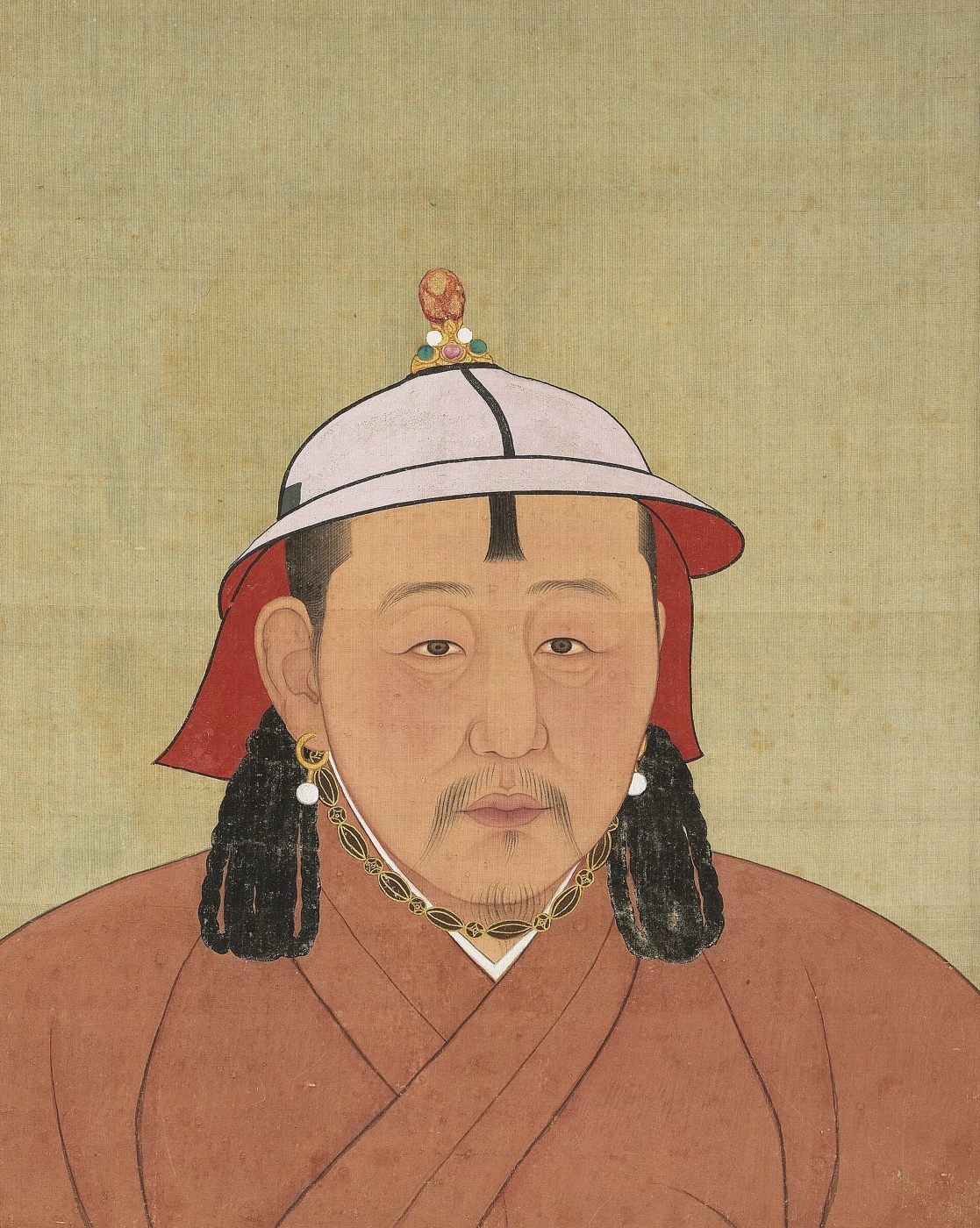
1281 CE–1311 CE
Emperor of the Yuan DynastyGreat Khan of the Mongol Empire
Borjigin Khaishan
孛儿只斤·海山
Borjigin Khaishan (1281-1311), son of Darmabala and Dagi and nephew of Emperor Chengzong Temür, was the third emperor of the Yuan Dynasty and bore the Mongol title Külüg Khan. From 1299(3rd year of Dade), he was stationed on the northern frontier and fought Kaidu and other northwestern princes, receiving the title Prince of Huaining for his military service. After Chengzong died in 1307(11th year of Dade) without a surviving…
1281 CE–1311 CEYuan Dynasty
PROFILE
Borjigin Khaishan (1281-1311), son of Darmabala and Dagi and nephew of Emperor Chengzong Temür, was the third emperor of the Yuan Dynasty and bore the Mongol title Külüg Khan. From 1299(3rd year of Dade), he was stationed on the northern frontier and fought Kaidu and other northwestern princes, receiving the title Prince of Huaining for his military service. After Chengzong died in 1307(11th year of Dade) without a surviving heir, Khaishan marched south from the northern frontier with the support of his mother Dagi, his younger brother Ayurbarwada, and senior officials. He ascended the throne at Shangdu, made Ayurbarwada crown prince, and agreed that his younger brother would succeed him. During a reign of less than four years, Khaishan established the Department of State Affairs, issued Zhida silver notes and copper coins, reorganized maritime transport, provided relief for Karakorum, made extensive grants and ennoblements, began construction of Yuan Zhongdu, and patronized several religions. His fiscal and administrative reforms drew criticism from officials, and after Emperor Renzong's accession the Department of State Affairs and many of the new policies were abolished. Khaishan's long military service in the northwest and his adherence to the agreed succession arrangement form another major part of later assessments of his reign.
- Other names
- Emperor Wuzong of Yuan; Külüg Khan (Mongol title)
- Period
- Middle Yuan Dynasty
- Date of Birth
- August 4, 1281 CE(18th year of the Zhi era, Yuan, 7th month, 19th day)
- Date of Death
- January 27, 1311 CE(4th year of the Zhida era, Yuan)
- Dynasty/polity
- Yuan Dynasty; Mongol Empire
- Identity
- Emperor of the Yuan Dynasty; Great Khan of the Mongol Empire
- Place of birth
- Not clearly recorded in the available sources
- Place of death
- Yude Hall, Dadu
- Ethnicity
- Mongol
- Clan/tribe
- Borjigin clan
- Parents
- Father: Darmabala; mother: Dagi
- Reign
- June 1307-January 1311
- Era name
- Zhida
- Temple name
- Wuzong
- Posthumous name
- Emperor Renhuixuanxiao
- Honorific title
- Emperor Tongtian Jisheng Qinwen Yingwu Dazhangxiao
- Khan title
- Külüg Khan
- Tomb
- Qinian Valley (as the sources record)
- Predecessor
- Borjigin Temür (Emperor Chengzong of Yuan)
- Successor
- Borjigin Ayurbarwada (Emperor Renzong of Yuan)
- Major achievements
- Commanded armies on the northern frontier for many years and weakened the forces of Kaidu and Chapar; launched reforms through the Department of State Affairs and changes to the currency system; expanded maritime grain transport and relief for Karakorum; began construction of Yuan Zhongdu; made and maintained an agreement for succession from elder brother to younger brother
LIFE TIMELINE
Stationed on the northern frontier | Chengzong ordered Khaishan to replace Kökechü as commander of the northwestern armies; he reached the area called Chenghai in the Chinese sources and reorganized troops and agricultural colonies.
Battle with Kaidu's forces | Khaishan defeated a Kaidu force at Köbeli and continued strengthening the northern defenses.
Continued northern warfare | Khaishan repeatedly fought forces associated with Kaidu; Kaidu was defeated and died, although Chapar and other remnants had not yet submitted.
Enfeoffed as Prince of Huaining | Received the princely title for his northern military service and continued to command frontier forces.
Pursuit of Kaidu's remaining forces | Led troops across the Altai Mountains in pursuit of Chapar and related forces.
Succession struggle after Chengzong's death | Dagi, Ayurbarwada, Harahasun, and others took control of the situation in Dadu and summoned Khaishan south.
Accession as emperor | Khaishan ascended the throne at Shangdu, made Ayurbarwada crown prince, and confirmed the arrangement that the throne would pass from elder brother to younger brother.
Construction of Yuan Zhongdu | Ordered construction of a new central capital at Onggachatu; work was later halted after his death.
New honor for Confucius | Issued an edict granting Confucius the title “Dacheng Zhisheng Wenxuan Wang.”
First establishment of the Department of State Affairs | Created the department to carry out reforms, but abolished it after opposition from officials of the Secretariat and Censorate.
Restrictions on White Lotus activities | Prohibited gatherings of the White Lotus sect; the ban was lifted under Emperor Renzong.
Received an exalted honorific | The crown prince, princes, and officials presented the title “Emperor Tongtian Jisheng Qinwen Yingwu Dazhangxiao.”
Reestablishment of the Department of State Affairs and currency reform | Recreated the department, issued Zhida silver notes and copper coins, and adopted fiscal measures involving maritime transport and salt revenue.
Submission of Chapar | Kaidu's son Chapar came to court and submitted; the Yuan government treated this as an important turning point in the northwestern situation.
Death | Khaishan died in Yude Hall at Dadu, and his younger brother Ayurbarwada succeeded him.
The brothers agreed on a succession arrangement summarized as “elder brother followed by y | The brothers agreed on a succession arrangement summarized as “elder brother followed by younger brother, then uncle followed by nephew.” On February 17, 1309(7th day of the 1st lunar month, 2nd year of Zhida), the crown prince, princes, and officials presented Khaishan with an exalted honorific title.
The brothers agreed on a succession arrangement summarized as “elder brother followed by y | The brothers agreed on a succession arrangement summarized as “elder brother followed by younger brother, then uncle followed by nephew.” On February 17, 1309(7th day of the 1st lunar month, 2nd year of Zhida), the crown prince, princes, and officials presented Khaishan with an exalted honorific title.
In 1310(3rd year of Zhida) | In 1310(3rd year of Zhida), close attendants including Sanbaonu urged Khaishan to replace his brother as heir with his own son Kusala.
Death | Khaishan died in Yude Hall at Dadu on January 27, 1311(8th day of the 1st lunar month, 4th year of Zhida), and his younger brother Ayurbarwada succeeded him as Emperor Renzong of Yuan.
BIOGRAPHY
Biography
Imperial-Clan Education and Command on the Northern Frontier Khaishan was the elder son of Darmabala and Dagi; his younger full brother Ayurbarwada was born several years later. In childhood the brothers were cared for by the keshig attendant Qitaipuji and received some education in the Confucian classics. After Emperor Chengzong came to the throne, Empress Dowager Kökejin employed Confucian scholars including Li Meng to continue their education. By the time Chengzong died, Khaishan had already acquired political standing through long military command and service on the northern frontier, experience that later became an important basis for his claim to the throne. In 1298(2nd year of Dade), Yuan forces suffered a defeat in the northwest and Körgüz was captured. The following year, Chengzong ordered Khaishan to replace Kökechü in command of the northwestern armies. After reaching the frontier area called Chenghai in the Chinese sources, Khaishan, assisted by Qitaipuji, trained the army, reorganized military agricultural colonies, and prepared against Kaidu, Duwa, and other northwestern princes. In the eighth lunar month of 1300(4th year of Dade), he defeated Kaidu's forces at Köbeli. In 1301(5th year of Dade), the two sides fought repeatedly on the Mongolian plateau. Kaidu was defeated and died, but his son Chapar and related forces remained active around the Altai and Irtysh regions, and Khaishan continued to serve on the northern frontier. In 1304(8th year of Dade), Khaishan was enfeoffed as Prince of Huaining and received a gold seal and assigned revenues. In 1306(10th year of Dade), he crossed the Altai Mountains in pursuit of Chapar and other remaining Kaidu forces. By this point Khaishan was not merely a frontier commander but a prince capable of shaping Yuan succession politics. His northwestern military record gave him troops and political resources far beyond those of an ordinary imperial prince. ### Succession Crisis after Chengzong and Accession In the first lunar month of 1307(11th year of Dade), Emperor Chengzong Temür died in Dadu after Crown Prince Deshou had already died young. Empress Bulughan and Left Chancellor Aqutai prepared to enthrone Ananda, Prince of Anxi, while Right Chancellor Harahasun supported Khaishan and his younger brother. Dagi and Ayurbarwada reached Dadu first, and Harahasun secretly sent a messenger north to inform Khaishan. Bulughan attempted to block the postal routes, but officials of the Court of Transmission helped the messenger alter the date on his documents, allowing the news to reach Khaishan. In the third lunar month, Khaishan arrived from the northern frontier at Karakorum, where princes urged him to take the throne. He delayed, saying that his mother and younger brother were still in Dadu. Ayurbarwada and Harahasun then took control of the palace, secured the seals of the central offices, closed the treasuries, and arrested Bulughan, Ananda, and their supporters. After Khaishan marched south with troops, he convened a quriltai at Shangdu and ascended the throne there on June 21, 1307(21st day of the 5th lunar month, 11th year of Dade). Bulughan, Ananda, and others were executed, and the succession crisis following Chengzong's death ended with Khaishan's accession. On the ninth day after his accession, Khaishan made Ayurbarwada crown prince. The brothers agreed on a succession arrangement summarized as “elder brother followed by younger brother, then uncle followed by nephew.” On February 17, 1309(7th day of the 1st lunar month, 2nd year of Zhida), the crown prince, princes, and officials presented Khaishan with an exalted honorific title. During Wuzong's reign, the three principal centers of authority—the emperor, Empress Dowager Dagi, and the crown prince—each had their own supporters, and their political relations were not always harmonious. In 1310(3rd year of Zhida), close attendants including Sanbaonu urged Khaishan to replace his brother as heir with his own son Kusala. Kangli Toghto and others opposed this by citing the existing agreement, and Khaishan ultimately left the succession arrangement unchanged. ### Administrative, Fiscal, and Government Reform Khaishan came to the throne amid depreciation of Zhiyuan paper currency, rising prices, excessive numbers of officials, and growing state expenditure. In 1307(11th year of Dade), he established the Department of State Affairs for the first time, seeking a central institution that could carry out reforms directly. Officials of the Secretariat and Censorate strongly opposed the arrangement, and the department was abolished within several months. In the eighth lunar month of 1309(2nd year of Zhida), Khaishan established it again and appointed trusted associates including Qitaipuji, Toghto, and Sanbaonu. The following year he ordered that many affairs of the central offices be submitted through the Department of State Affairs, reducing the authority of the Secretariat. After Emperor Renzong took the throne, the department was abolished and officials connected with it were punished. Khaishan adopted a political posture summarized in the phrase “broadly following a policy of generosity.” He greatly expanded grants of noble titles, offices, and rewards, continuing the Mongol tradition of annual gifts to princes while also rewarding military service on the northern frontier and consolidating support for the new reign. Expenditure on rewards quickly increased pressure on the treasury, and the expansion of appointments disrupted bureaucratic selection. Investigating Censor Zhang Yanghao criticized excessive rewards, indiscriminate titles, extensive building, and weakened censorial discipline in his Memorial on Current Government. The History of Yuan likewise described the reign as one of excessive ennoblement and overly lavish rewards. ### Currency, Grain Transport, and Frontier Settlement In 1309(2nd year of Zhida), the Department of State Affairs introduced Zhida silver notes, using silver as the unit of account, and issued copper coins including Dayuan Tongbao and Zhida Tongbao. The new currency was intended to address the depreciation of Zhiyuan notes and provide a medium for smaller transactions. Official exchange arrangements also altered the value of older paper notes, imposing adjustment costs on commoners and merchants. The Department of State Affairs also raised the price of salt certificates, levied taxes on alcohol, pursued tax arrears, and increased taxation in some regions in an effort to cover military and administrative expenditure. These currency and fiscal policies were abolished after Khaishan's death under Emperor Renzong and did not develop into stable long-term institutions. The court also increased the shipment of grain by sea to the north to improve supplies for Dadu and the surrounding region. Maritime grain shipments continued to rise in the second and third years of Zhida and helped ease food-supply pressure in the north, although fiscal goals remained in tension with grants, construction, and frontier military spending. Northwestern warfare had also displaced large populations who needed resettlement in the Karakorum region. Khaishan elevated the Karakorum-area pacification administration to a branch secretariat, distributed agricultural implements, seed, fishing nets, money, and grain, and continued to organize military agricultural colonies. Under Emperor Renzong, this institution was later reorganized as the Lingbei branch secretariat. ### Construction, Religion, and External Relations After his accession, Khaishan ordered the construction of Yuan Zhongdu at Onggachatu and established the Zhongdu Directorate together with the Kaining Route administration. The project was connected with an imperial residence, transport, and the political organization of the northern frontier, and also reflected Khaishan's effort to strengthen his own rule through a new capital. Construction stopped after his death, and Yuan Zhongdu did not become a continuously operating capital. The court also built Buddhist temples, developed Imperial Ancestral Temple rites, and in 1307(11th year of Dade) conferred the title “Dacheng Zhisheng Wenxuan Wang” on Confucius. In 1309(2nd year of Zhida), it exempted some registered Confucian households from corvée service. Khaishan patronized Tibetan Buddhism and also treated Daoism favorably. A punitive order intended to protect lamas prompted remonstrance from the crown prince. In 1308(1st year of Zhida), the court also prohibited White Lotus gatherings out of concern that the movement's assemblies might create social disorder; Emperor Renzong lifted the ban after taking the throne. Religious policy therefore combined privileges for certain religious groups with restrictions on organizations regarded as social risks and cannot be summarized simply as a policy of religious freedom. On the frontier, Chapar submitted at court in 1310(3rd year of Zhida). The Yuan court treated the submission of Kaidu's remaining forces as a major change in frontier conditions and granted Chapar the Five-House Silk revenues that Kaidu had withheld for many years. Khaishan also enfeoffed Tokhta of the Golden Horde as Prince of Suning, adjusting the tributary relationship with the Golden Horde. He agreed to withdraw most officials of the Branch Secretariat for the Eastern Campaign stationed in Goryeo, reducing the burden of supporting them there. The Yuan Dynasty also continued diplomatic exchanges with Annam. Together with the northern military victories, these arrangements show that his reign extended beyond central fiscal and administrative reform. Khaishan died in Yude Hall at Dadu on January 27, 1311(8th day of the 1st lunar month, 4th year of Zhida), and his younger brother Ayurbarwada succeeded him as Emperor Renzong of Yuan. Accounts of Khaishan's exact cause of death differ. another account attributes it to heavy drinking and sexual excess, while the and the History of Yuan do not provide enough evidence to support a single definitive diagnosis. This article therefore records only that he died after illness and does not treat later explanations as established fact. Emperor Renzong subsequently abolished the Department of State Affairs, discontinued Zhida silver notes, and reversed several other reforms. He nevertheless honored the succession agreement with Khaishan. Khaishan's two sons Kusala and Tugh Temür later both became emperors.
His Name, His Education, and the Setting
The name Haisan came from Kublai's own command: according to the stele written by Zhao Mengfu, when Wuzong and Renzong were born the emperor had a certain Master Zhang propose names, and when Renzong was five the name was rendered into Sanskrit; the two brothers were at first named Haisan and Shoushan. In 1292, after the early death of Zhenjin, Kublai gave the seal of the heir apparent to Zhenjin's youngest son, and the arrangement of the imperial house changed accordingly. Haisan and his brother were cared for in childhood by the kesig guard Qitai Puji and received a Confucian education; the ancestral stele by Yao Sui records that "the emperor and the heir were entrusted to him to rear and watch over; whenever the emperor summoned them he would carry one on each side into his presence; and when they were old enough to study he was ordered to teach them the classics, giving his own legitimate son Yerjini as their reading companion, and whenever they played and neglected their recitation he would beat his own son to warn them, so that they finished their studies." After Emperor Chengzong came to the throne the empress Huiren Yusheng, Kökejin, again sought famous scholars as tutors, and someone recommended Li Meng as a man of chancellery talent and fit to be tutor to the heir; and so Li Meng and other Confucian ministers came to serve. At Chengzong's death Haisan already had the political prestige of long command at the frontier and of military merit in the north, and these experiences afterwards became an important basis of his claim to the succession.
His Command in the North and the Campaigns in the North-west
In the winter of 1298 the Jin commander in the north-west, the prince of Ningyuan, Kökechü, was captured by the rebels, and Chengzong decreed that Haisan should take his place in command of the north-western armies. Haisan reached the front at Chengkai in 1299 and, with Qitai Puji's help, strengthened the military farms and trained the troops against invasion; in the eighth month of 1300 he heavily defeated Haidu's army at Kuohelie, and the next year again led his troops against Haidu several times. Haidu died of his defeat, but his son Chapar and his followers still moved about the Altai and the Irtysh, and Haisan kept guard in the north; in 1304 he was enfeoffed prince of Huaining with a golden seal and appanage, and in 1306 he crossed the Altai in pursuit of Chapar and the remnant of Haidu's people. He was now not merely a frontier general but a prince able to influence the succession, his military merit having given him an army and political resources far beyond those of an ordinary imperial kinsman.
The Succession Crisis after Chengzong and His Accession
Chengzong having no son and the heir apparent Deshou having died young, the throne, by Mongol custom, was temporarily held by the senior empress, so that Bulugan could plan with the chancellor of the left, Ahutai, and others to raise Ananda, prince of Anxi, to it. The chancellor of the right, Harghasun, supported Haisan and his brother and, at Chengzong's death, secretly sent word at once to Haisan in the north and to Dagi and Ayurbarwada at Huaimeng to come to the capital quickly. Bulugan, to prevent Haisan from seizing the throne, sent a secret order cutting the post road to the north; but Ashahbuhua, sent north by Harghasun to carry the news, took counsel with Chana of the post office and "made out the travel warrant with an earlier date," so that it preceded the day of Bulugan's order and he could ride post to Haisan. Meanwhile Harghasun "took up all the seals of the hundred offices in the capital, sealed the treasuries and lay ill outside the palace," refusing Bulugan's repeated orders and handling no documents; and this both checked Bulugan from using the resources of the administrative centre to issue orders and plan a regency, and prevented her party from putting the chancellor of the left, Ahutai, in his place and controlling the Secretariat. He kept the watch for three months "and never once went home to rest." Haisan, far in the north, on hearing of Chengzong's death, meant to return at once, but Qitai Puji dissuaded him on the ground that affairs south of the desert "could not be judged from a distance," and he delayed to watch how things went. In the third month he came from the Altai to Karakorum, where the princes and meritorious kinsmen all assembled and urged him to take the throne, alleging that Ananda and Mingli Temür were confusing the palace with disaffection; but Haisan declined, saying that his mother and brother were in the capital and that he would wait for a full assembly of the princes. Dagi, thinking the "filial and friendly" Ayurbarwada easier to control, resorted to the yin-yang masters, had a hexagram cast showing long duration of the throne, and sent it north to Haisan to hint that he should give up the succession; and Haisan, who had been waiting only for the capital to send for him, was indignant and said that he had guarded the frontier and laboured ten years, that by order of age he was the eldest, and that where the sacred vessel should go was plain beyond doubt; that his mother now spoke of the fortunes of the stars, but the way of heaven was dark and who could foreknow it; that if after his accession his measures should accord above with heaven's mind and below with the people's hopes, then though he reigned but a day he would leave a name for ten thousand years, and how could he, for words of yin and yang, betray the charge of his ancestors; and that this was the scheme of ministers lately in office, who had seized power and killed at will and feared he would one day punish them, and so devised this wicked plot to shake the foundation. He then had envoys return at speed to the capital to show that he was resolved on the succession, and himself came south with thirty thousand men in three columns. Faced with this military weight his mother and brother and the ministers of the capital were forced to change their minds and declare for him; in the fifth month of 1307 Haisan reached the capital, put Bulugan and Ananda to death and had his claim to the throne confirmed, and on the twenty-first day of the fifth month took the throne at Shangdu as Wuzong, posthumously honouring his father.
His Reforms of Government, Finance and Administration, and His Building Works
Wuzong took over an empire outwardly strong and settled but inwardly full of ills. The problems left by his predecessor included excessive gifts and enfeoffments to kinsmen and ministers, a swollen and costly bureaucracy with low efficiency, growing corruption, and above all a collapsing paper currency, the Zhiyuan notes having greatly depreciated so that prices soared and revenue suffered, with frequent natural disasters besides; and he was therefore obliged to revise the policy of "keeping to the old" and adjust the government. Faced with the depreciation, the rising prices, the surplus of officials and the growth of expenditure, he set up the Secretariat of State in 1307 to create a centre able to drive reform directly, but the Grand Secretariat and the Censorate opposed it strongly and it was abolished within months; in the eighth month of 1309 he set it up again, employing Qitai Puji, Toghto and Sanbaonu and other confidants, and the next year ordered that the business of the hundred offices should mostly be memorialized through it, so that the Grand Secretariat's power was curtailed. In appointments, almost all the central offices after his accession were filled from the Mongol and Semu officers who had campaigned in the north-west; and Harghasun, who favoured Confucian learning, was kept at first as chancellor of the right but sent out within two months as chancellor of the left of the newly created Karakorum secretariat. Politically he followed a course of "broad leniency," conferring rank and office and increasing rewards on a wide scale while promoting reviews of officials and preparing the suburban sacrifices. In finance he reformed the currency, issuing the Zhida silver notes together with copper coins of the Da Yuan Tong Bao and Zhida Tong Bao, allowed to circulate with the coins of earlier dynasties, so that small-denomination metal coinage of steadier credit might smooth the excessive fluctuations of retail prices; the secretariat of state also raised the price of salt certificates, levied a wine tax, called in arrears of grain and money and increased taxes in some regions to meet military and administrative costs. The official conversion changed the value of the old notes, so that the people and the merchants bore the shock of the change; and these measures were abolished by Renzong after his death and never became a stable institution. The court also enlarged the sea transport of grain to the capital and its region, the volume rising in the second and third years of Zhida, which eased the pressure on northern supply, though the general fiscal aim still conflicted with the gifts, building works and frontier costs. Wuzong also built on a great scale, ordering within a month of his accession the building of a Central Capital at Wangwuchadu with a garrison office and a general commandery, a work connected with the travelling palace, the roads and the politics of the north but also expressing his plan to strengthen his personal rule by a new capital; and it was stopped after his death and never became a working capital. His measures, above all his lavish enfeoffments and gifts and his financial policy, drew much criticism from Chinese Confucian ministers, most notably the censorial censor Zhang Yanghao, whose Memorial on the Government of the Time in 1310 listed ten abuses: excessive rewards, lax prohibitions, cheapened titles, a weak censorate, too much building, too many empty orders, too many avenues of favour, too luxurious customs, too rampant heterodoxy, and too loose a method of choosing ministers.
The Frontier, Religion, the Succession, and His Death
On the frontier and in religion, Wuzong raised the pacification office of Karakorum to a branch secretariat, issuing farm tools, seed, fishing nets, paper money and grain and continuing to organize military farms to settle the population displaced by the north-western wars; the body later became, under Renzong, the Lingbei branch secretariat. Chapar came to court and submitted in 1310, the court treating the submission of Haidu's remnant as a major change on the frontier and giving Chapar the five-household silk long withheld from Haidu; Wuzong also enfeoffed Toqta, khan of the Kipchaks, as prince of Suning, adjusting the suzerain relation with the Kipchak khanate, and agreed to withdraw most of the officials of the Secretariat for the Eastern Expedition from Koryo to lighten the burden of their maintenance, while envoys continued to pass between the Yuan and Annam. In religion he honoured Tibetan Buddhism and was courteous to Daoism; a punitive order for the protection of lamas drew the heir apparent's remonstrance; and in 1308 the court, fearing that the gatherings of the White Lotus sect might cause social disorder, ordered it suppressed, the ban being lifted under Renzong — so that his religious policy combined preferential treatment of particular religious bodies with the suppression of associations thought dangerous, and was no simple policy of religious freedom. In the same period the court built Buddhist temples, promoted the ritual of the ancestral temple, honoured Confucius in 1307 as the "Great Completing, Most Holy, Cultured and Illustrious King," and in 1309 exempted some Confucian households from labour service. As to the succession, Haisan set up Ayurbarwada as heir apparent on the ninth day after his accession, the two agreeing that "the brother should succeed the brother, and the nephew the uncle"; on the seventeenth day of the second month of 1309 the heir apparent, the princes and the hundred officials offered him an honorific title; and during his reign the emperor, the empress dowager Dagi and the heir apparent each had supporters, so that relations among the three palaces were not always harmonious. In 1310 Sanbaonu and other close ministers urged him to replace the heir with his own son Khoshila, and Küreltü and others objected on the ground of the existing agreement, nor did Haisan change the arrangement. On the eighth day of the first month of 1311 Haisan died in the Yude hall at Daidu, and his brother Ayurbarwada came to the throne as Renzong.
Major Activities
Northern Command and the End of Kaidu's Power From 1299, Khaishan commanded northwestern armies, reorganized military agricultural colonies, trained troops, and participated in repeated campaigns on the Mongolian frontier. After Kaidu was defeated and died, Khaishan continued pursuing Chapar and other remaining forces. Chapar's submission in 1310 marked a major change in the long northwestern war. Khaishan's military record was a key reason for his enfeoffment as Prince of Huaining and an important political resource in his accession after Chengzong's death. ### Changes to the Central Government, Currency, and Finance Khaishan established the Department of State Affairs twice. On the second occasion, he transferred part of the Secretariat's authority to trusted officials in an effort to strengthen reform implementation and imperial control over the central government. Zhida silver notes, copper coinage, maritime transport, salt revenue, and collection of tax arrears were all part of his fiscal program. These measures sought to stabilize supplies and make up for revenue shortfalls but operated alongside large grants, expansion of offices, and construction expenditure. Emperor Renzong rapidly abolished the Department of State Affairs and the new currency after Khaishan's death, reflecting both the controversy surrounding the reforms and their limited continuity. ### Succession Agreement and Transfer of the Throne Khaishan obtained the throne with the help of Ayurbarwada and his supporters and then made his younger brother crown prince, agreeing that the throne would pass from elder brother to younger brother. When close attendants urged him to designate his own son instead, Khaishan maintained the original arrangement. After his death, Ayurbarwada succeeded as Emperor Renzong in accordance with the agreement. This transfer later affected succession claims involving the lines of Khaishan's sons Kusala and Tugh Temür. ### Capital Construction, Ritual, and Frontier Governance Khaishan promoted construction of Yuan Zhongdu, granted new honors to Confucius, and expanded relief and agricultural colonies around Karakorum. He also adjusted relations with Goryeo, the Golden Horde, and Annam. Yuan Zhongdu ceased construction after his death, while some frontier and relief arrangements had longer institutional effects. These activities show that his reign also encompassed northern resettlement, ritual institutions, and tributary relations.
The Direction of His Reforms, Their Short Life, and His Historical Place
Seen in the middle politics of the Yuan, Wuzong's measures are marked by driving reform through a central organ. He set up the Secretariat of State twice, the second time transferring part of the Grand Secretariat's authority to his confidants, intending to strengthen the execution of reform and the emperor's control of the centre; and the Zhida silver notes, the copper coins, the sea transport, the salt monopoly and the calling-in of arrears were all financial measures aimed at steadying supply and making good the shortfall. The difficulty was that these measures coexisted with lavish enfeoffments and gifts, the expansion of offices and building works: the gifts soon strained the treasury and the widened conferring of office disordered appointments, so that the effect of the reforms was offset by institutional laxity. The Yuan History sums up his policy as "too many enfeoffments" and "too rich rewards," while Zhang Yanghao's ten abuses set "excessive rewards" and "cheapened titles" beside "too much building" and "too rampant heterodoxy," which shows that the criticism fastened not on financial management as such but on the imbalance between the treasury and the currency of honours. That Renzong abolished the secretariat of state and the Zhida notes and much of the reform immediately after his accession shows how great the controversy was and how little continuity the policy had.
In the politics of the succession, Haisan owed the throne to his brother Ayurbarwada and his supporters, and he then made his brother heir apparent with the agreement that brother should succeed brother and nephew uncle; and when close ministers urged him to put his own son in the place he kept to the arrangement. That agreement was honoured by Renzong after his death, while his two sons Khoshila and Tugh Temür later came to the throne one after the other, an inheritance that lay behind the later disputes between the two lines. On the frontier, the Central Capital was left unfinished because of his death, while the relief and military farming of the Karakorum secretariat, later the Lingbei secretariat, the settlement of Chapar, and the adjustment of relations with Koryo and the Kipchak khanate left institutional traces. On the whole, in a reign of less than four years most of his reforms failed to last, yet the sequence of ending Haidu's power, adjusting the centre, reforming the currency and building a new capital marks a distinct phase between the consolidation of Chengzong and the retrenchment of Renzong.
Personal Relations
- Borjigin Darmabala: father; grandson of Kublai Khan, Emperor Shizu of Yuan; posthumously honored by Khaishan as Emperor Shunzong of Yuan.
- Dagi: mother; elevated by Khaishan to empress dowager and involved in succession politics.
- Borjigin Zhenjin: grandfather; son and crown prince of Kublai Khan.
- Borjigin Temür: uncle and predecessor, Emperor Chengzong of Yuan.
- Borjigin Ayurbarwada: younger full brother; made crown prince by Khaishan and succeeded him as Emperor Renzong of Yuan.
- Borjigin Kusala: son; later became Emperor Mingzong of Yuan.
- Borjigin Tugh Temür: son; later became Emperor Wenzong of Yuan.
- Bulughan: empress of Emperor Chengzong; supported Ananda's faction during the succession crisis of 1307.
- Borjigin Ananda: Prince of Anxi; competed in the 1307 succession struggle and was later executed.
- Harahasun: Right Chancellor who supported Khaishan and Ayurbarwada and participated in taking control of the political situation in Dadu.
- Borjigin Kaidu: prince of the Ögedei line and Khaishan's main opponent while he was stationed on the northern frontier.
- Borjigin Chapar: son of Kaidu; later submitted to the Yuan court in 1310.
- Qitaipuji: Khaishan's childhood caretaker and an important assistant during his northern military command.
- Li Meng: Confucian scholar who participated in the court education of Khaishan and his brother.
- Zhang Yanghao: Investigating Censor whose Memorial on Current Government criticized problems of the Wuzong reign.
Historical Assessment
The History of Yuan, “Annals of Emperor Wuzong,” describes Khaishan as determined to create a new order through institutional change while also criticizing the excessive distribution of noble titles, honorary offices, and rewards. Zhang Yanghao's Memorial on Current Government listed problems involving rewards, titles, construction, and the censorial system, reflecting contemporary Confucian criticism of the fiscal and bureaucratic order of the Wuzong reign. Wei Yuan's New Compilation of the History of Yuan praised Khaishan's military record in the north and his adherence to the succession agreement with his brother while criticizing the Department of State Affairs and revenue-raising policies. Tu Ji's Historical Records of the Mongols was likewise highly critical of excessive rewards, the new department, and the results of currency reform. These assessments emphasize different issues. Traditional historians often evaluated his reforms through standards of political legitimacy, fiscal discipline, and administrative order, while some modern research analyzes the Department of State Affairs, Zhida silver notes, Yuan Zhongdu, and northern policies in the context of the succession crisis after Chengzong and the redistribution of political resources. What can be confirmed is that Khaishan attempted to change central administrative and fiscal arrangements, but the reform period was short, implementation was controversial, and many measures were rapidly repealed after his death. His northern military command, management of the imperial succession, and short-lived institutional changes therefore need to be assessed separately.
FIGURES ASSOCIATED WITH THIS DYNASTY
Bibliography
- Song Lian et al., History of Yuan, vols. 22-23, “Annals of Emperor Wuzong,” and related biographies. Compared with the locally stored text to check his northern command, accession, Zhida reforms, succession, and historical assessments.
- Wei Yuan, New Compilation of the History of Yuan, vol. 8, “Annals of Emperor Wuzong”; Tu Ji, Historical Records of the Mongols, vol. 10, “Annals of Khaishan Khan.” Used through the records cited in the encyclopedic sources to compare later assessments.