Participation in the suppression of Nayan's rebellion | Kublai ordered Temür to lead forces against the rebel prince Qadan, giving him experience in imperial-clan and military affairs.
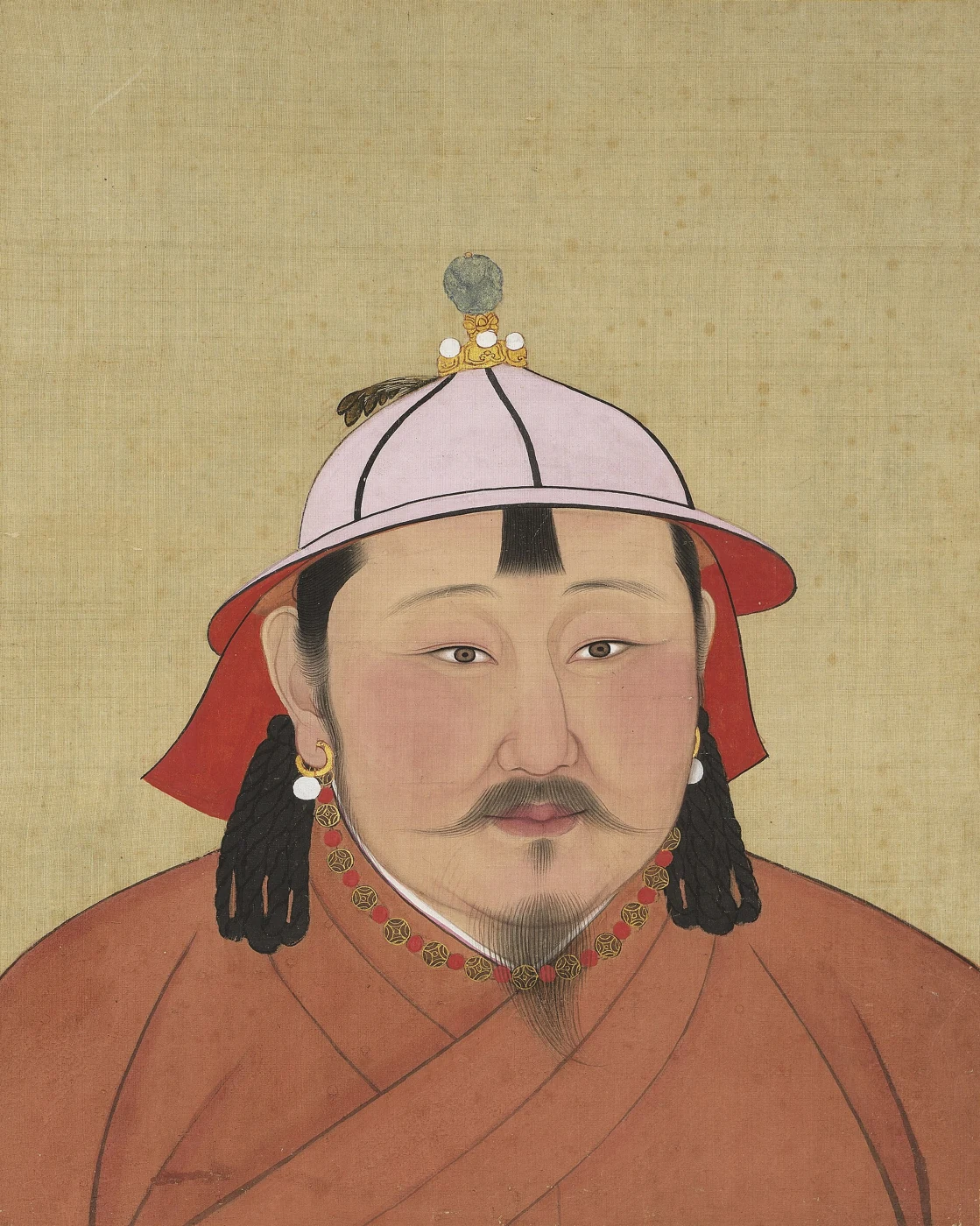
1265 CE–1307 CE
Second emperor of the Yuan DynastyGreat Khan of the Mongol Empire
Borjigin Temür
孛儿只斤·铁穆耳
Borjigin Temür (October 15, 1265-February 10, 1307), a grandson of Kublai Khan and the third son of Crown Prince Zhenjin, was the second emperor of the Yuan Dynasty and Great Khan of the Mongol Empire. After receiving the crown prince's seal in 1293(30th year of Zhiyuan of Yuan), he was ordered to guard the northern frontier. Following Kublai's death, Temür returned from the north and, with the support of his mother Kökejin,…
1265 CE–1307 CEYuan Dynasty
PROFILE
Borjigin Temür (October 15, 1265-February 10, 1307), a grandson of Kublai Khan and the third son of Crown Prince Zhenjin, was the second emperor of the Yuan Dynasty and Great Khan of the Mongol Empire. After receiving the crown prince's seal in 1293(30th year of Zhiyuan of Yuan), he was ordered to guard the northern frontier. Following Kublai's death, Temür returned from the north and, with the support of his mother Kökejin, Bayan, Yushitemür, and others, ascended the throne at Shangdu in 1294(31st year of Zhiyuan). In the early Chengzong reign, the court broadly continued institutions established under Kublai, remitted some taxes, halted several planned foreign campaigns, and adjusted local administration, although military operations still took place against Babai Xifu, Jinchi, and other southwestern regions. After the major northwestern fighting of 1301(5th year of Dade), the Yuan court made peace with Duwa, Chapar, and other princes and restored frontier passes and postal routes, but did not thereby establish direct rule over the other khanates. Large-scale grants and military expenditures intensified fiscal pressure, while southwestern expeditions triggered local resistance. After Crown Prince Deshou died young, Temür did not designate another heir. His death was therefore followed immediately by a new succession crisis at the Yuan court.
- Other names
- Emperor Chengzong of Yuan; Temür; Öljeyitü Khan (Mongol title)
- Period
- Middle Yuan Dynasty
- Date of Birth
- October 15 1265
- Date of Death
- February 10, 1307 CE(11th year of the Dade era, Yuan)
- Dynasty/polity
- Yuan Dynasty; Mongol Empire
- Identity
- Second emperor of the Yuan Dynasty; Great Khan of the Mongol Empire
- Place of birth
- Residence of the Prince of Yan, Dadu, Yuan Dynasty
- Place of death
- Yude Hall, Dadu
- Ethnicity
- Mongol
- Clan/tribe
- Borjigin clan
- Parents
- Father: Borjigin Zhenjin; mother: Kökejin of the Khongirad clan
- Reign
- May 10, 1294-February 10, 1307
- Era names
- Yuanzhen, Dade
- Temple name
- Chengzong
- Posthumous name
- Emperor Qinmingguangxiao
- Khan title
- Öljeyitü Khan
- Predecessor
- Borjigin Kublai Khan
- Successor
- Borjigin Khaishan
- Major achievements
- Continued and adjusted institutions established under Kublai; remitted taxes in some regions; made peace with northwestern Mongol princes and restored postal routes; reorganized parts of the bureaucracy and tax system
LIFE TIMELINE
Received the crown prince's seal | Kublai ordered him to guard the northern frontier and command military affairs in the steppe from Karakorum.
Death of Kublai | Temür returned from the northern frontier to Shangdu and awaited a decision by the imperial clan on the succession.
Accession as emperor | Temür ascended the throne at Da'an Pavilion in Shangdu and became emperor of the Yuan Dynasty.
Tax remissions | Issued an edict exempting parts of the two capitals from certain levies and reducing household and land taxes, grain levies, and arrears in other regions.
Reduction of construction and tax-arrears burdens | Halted non-urgent building projects and remitted some accumulated money and grain arrears incurred before the fifth lunar month of that year.
Tax relief in disaster areas | Reduced or remitted land taxes in regions affected by floods and drought and halted some construction projects.
Reorganization of local officials and further tax reductions | Sent envoys to investigate local hardships and reduced baoyin silver levies, certain salary-note payments, and part of the summer tax in inner regions.
Campaign in Myanmar | Yuan forces besieged Myinsaing and later withdrew; the court accepted the existing political arrangement in the region.
Northwestern battle and war against Babai Xifu | Yuan forces fought the combined armies of Kaidu and Duwa; the southwestern expedition caused military expenditure and personnel losses and widened local resistance.
Turning point in the northwest | Kaidu died, and the Yuan court allied with Tokhta of the Golden Horde and Bayan of the White Horde against Duwa and Chapar.
Peace with northwestern princes | Envoys of Duwa and Chapar came to the Yuan court to negotiate peace, and frontier passes and postal routes were gradually restored; the court executed Liu Shen and abolished the Yunnan branch administration established for the Myanmar campaign.
Completion of peace among the four Mongol khanates | Negotiations among the Yuan court, the northwestern princes, the Golden Horde, and the Ilkhanate produced a peace arrangement among the major Mongol khanates.
Deshou made crown prince | Temür formally designated his son Deshou as heir.
Death of Deshou | The crown prince died of illness, and Temür did not appoint another heir afterward.
Death | Temür died in Yude Hall at Dadu, leaving the imperial succession vacant again.
As the fighting expanded | As the fighting expanded, the court executed Liu Shen in 1303(7th year of Dade), punished related commanders, and abolished the Yunnan branch administration established for the Myanmar campaign.
In 1304(8th year of Dade) | In 1304(8th year of Dade), negotiations among the Yuan court, the northwestern princes, the Golden Horde, and the Ilkhanate produced a broader peace among the Mongol khanates.
On June 27 | On June 27, 1305(5th day of the 6th lunar month, 9th year of Dade), Temür made Deshou crown prince.
Temür authorized construction of a Confucius temple and the Imperial University in the cap | Temür authorized construction of a Confucius temple and the Imperial University in the capital, restored the title Duke Yansheng and households assigned to maintain Confucius's tomb at Qufu, and completed the Confucius temple project in 1306(10th year of Dade).
Death | Temür died in Yude Hall at Dadu on February 10, 1307(8th day of the 1st lunar month, 11th year of Dade), in his forties.
BIOGRAPHY
Biography
Imperial-Clan Background and Succession Arrangements Temür was a grandson of Kublai Khan and the third son of Zhenjin; his mother Kökejin was from the Khongirad clan. After Zhenjin died in 1286(23rd year of Zhiyuan), Kublai considered having Zhenjin's son Darmabala inherit the position of heir, but Darmabala also died young in 1292. Temür's elder brother Gammala was enfeoffed as Prince of Jin and stationed on the northern frontier. Kublai never formally designated an imperial grandson as heir. Instead, in 1293(30th year of Zhiyuan), he gave the crown prince's seal to Temür and ordered him to oversee troops on the northern frontier. Temür had previously participated in the 1287 campaign against Qadan and was familiar with Mongol princes and northern garrisons; this experience gave him a practical military base in the succession competition. Kublai died in Dadu on February 18, 1294(22nd day of the 1st lunar month, 31st year of Zhiyuan). Temür returned from the north to Shangdu, while Gammala did not continue to contest the throne. Kökejin, Bayan, Yushitemür, and a number of princes supported Temür. After an imperial-clan assembly confirmed his succession, he ascended the throne at Da'an Pavilion in Shangdu on May 10, 1294(14th day of the 4th lunar month, 31st year of Zhiyuan). Temür posthumously honored his father Zhenjin as Emperor Yuzong and elevated his mother Kökejin to empress dowager. The new reign initially relied largely on Kublai's administrative institutions and precedents rather than creating a new state system. ### Fiscal and Administrative Measures in the Early Reign Soon after taking the throne, Temür issued tax remissions. In 1294(31st year of Zhiyuan), some areas of the two capitals were exempted from certain levies for a year, while household and land taxes and grain levies in other regions were reduced by specified proportions and some government arrears were cleared. In later years of flood and drought he reduced land taxes in affected regions, halted non-urgent construction, instructed local officials to promote agriculture, and ordered investigation of popular hardship. In 1296(2nd year of Yuanzhen), the court required powerful families to repay concealed land taxes; after disasters in 1298(2nd year of Dade), some severely affected households received tax exemptions lasting several years. These policies applied to specified regions and periods and should not be generalized as permanent empire-wide tax exemption. The Chengzong court also attempted to restrain local officials and intervention by powerful princes. Temür ordered Regional Surveillance Commissions to investigate concealment and misconduct by fiscal officials, prohibited princes from issuing unauthorized orders that interfered with local administration, and required officials to handle taxes and revenue according to law. Personnel changes at the central government remained relatively limited, and many officials from Kublai's reign stayed in office. The court sought to curb corruption and regularize appointments while also using grants and higher salaries to maintain the support of princes, nobles, and meritorious officials. Economy and large-scale rewards therefore operated simultaneously, and fiscal pressure remained persistent. ### Frontier Warfare and Northwestern Peace After taking the throne, Temür halted some planned expeditions against Japan and Annam, released detained Annamese envoys, and tried to ease relations with neighboring states. This did not mean that the Yuan Dynasty ceased foreign warfare during his reign. In 1298(2nd year of Dade), the throne in Pagan changed hands. In 1300(4th year of Dade), amid the resulting political crisis and disputes over the recognized ruler, the Yuan court sent an army that besieged Myinsaing. The forces later withdrew, and the court accepted the local situation. Yuan armies were subsequently sent against Babai Xifu and the Jinchi region, drawing troops from Huguang, Jiangxi, Henan, Shaanxi, Jiangzhe, and elsewhere. Requisitions and abuses by Liu Shen's army along its route contributed to rebellions led by Song Longji, Shejie, and others. As the fighting expanded, the court executed Liu Shen in 1303(7th year of Dade), punished related commanders, and abolished the Yunnan branch administration established for the Myanmar campaign. The southwestern wars failed to produce stable control and instead caused military losses, local unrest, and sustained expenditure. The main northern opponents were Kaidu of the Ögedei line and Duwa of the Chagatai line. In the autumn of 1301(5th year of Dade), Yuan forces fought their combined armies near the Altai Mountains. Both sides engaged repeatedly and suffered losses; Kaidu and Duwa were both wounded, and Kaidu died in 1302(6th year of Dade). Duwa then supported Chapar and promoted negotiations. The Yuan court cooperated militarily with Tokhta of the Golden Horde and Bayan of the White Horde, and in 1303(7th year of Dade) envoys of Duwa and Chapar reached the Yuan court. The parties made peace and restored postal routes and frontier-pass traffic. In 1304(8th year of Dade), negotiations among the Yuan court, the northwestern princes, the Golden Horde, and the Ilkhanate produced a broader peace among the Mongol khanates. The Yuan emperor gained nominal suzerainty, but each khanate retained its own ruler, army, and administrative system and was not incorporated politically into the Yuan Dynasty. Temür's achievement was therefore the ending or easing of a major phase of northwestern warfare and the restoration of cross-regional contacts, not the establishment of direct Yuan administrative control over the other khanates. ### Education, Religion, and Late-Reign Politics The Chengzong court supported the development of Confucian institutions. Temür authorized construction of a Confucius temple and the Imperial University in the capital, restored the title Duke Yansheng and households assigned to maintain Confucius's tomb at Qufu, and completed the Confucius temple project in 1306(10th year of Dade). This development of Confucian institutions went together with the appointment of Confucian officials, although Temür himself showed limited interest in the Confucian classics. On one occasion, when officials cited theories linking Heaven and human affairs, he responded that these were “what the Han Chinese say.” In Tibetan Buddhist affairs, Temür honored the monk Dampa and other clerics, while questions of monastic levies and clerical administration produced disagreement between the Bureau of Buddhist and Tibetan Affairs and the Secretariat. His religious policy therefore combined patronage with administrative restraint rather than representing a single uniform position. At the beginning of his reign Temür made extensive grants to princes, imperial relatives, and officials, and subsequent additional rewards reduced treasury reserves and put pressure on the backing and circulation of paper currency. The court expanded the number of officials, raised salaries, and continued paying military costs, making revenue and expenditure difficult to balance. In 1303(7th year of Dade), the case involving the maritime-transport group of Zhu Qing and Zhang Xuan implicated several leading officials of the Secretariat. Temür dismissed or punished a number of officials. The course of the case and the role of Empress Bulughan are explained differently in the sources cited by the two encyclopedic references, and the text does not treat any single attribution of blame as definitive. On June 27, 1305(5th day of the 6th lunar month, 9th year of Dade), Temür made Deshou crown prince. Deshou died of illness on January 3 of the following year (18th day of the 12th lunar month, 9th year of Dade), and Temür did not designate another crown prince. Chengzong was chronically ill in his later years, and Empress Bulughan and some senior officials became more involved in handling court affairs. Temür died in Yude Hall at Dadu on February 10, 1307(8th day of the 1st lunar month, 11th year of Dade), in his forties. After his death, Bulughan and Ananda attempted to control the succession, but Khaishan ultimately obtained the throne. The transfer of power at the end of the Chengzong reign was therefore not orderly.
His Family, His Birth and the Death of Zhenjin
Temür, posthumously Emperor Chengzong of Yuan, was a grandson of the founder Kublai and third son of the heir apparent Zhenjin, his mother the empress Huiren Yusheng of the Hongjila clan, and was born on the day gengzi of the ninth month of the second year of Zhiyuan, 1265. As to the death of his father, the History of Yuan says that the founder being then advanced in years, one who memorialised as investigating censor of the Jiangnan branch secretly asked that he abdicate in favour of the heir; and the heir, hearing of it, was afraid. The censors suppressed the memorial and dared not report it at once, but a petty man, taking advantage of their concealment, brought it out by a side way; and the founder was greatly angered and the heir the more afraid, and before long he died at forty-three. On Chengzong's accession he was given the posthumous name of the cultured, kind and filial emperor and the temple name Yuzong, and was enshrined in the ancestral temple.
His Campaigns against Nayan and Kadan, and His Receipt of the Heir's Seal
In the twenty-fourth year of Zhiyuan, 1287, the prince Nayan rebelling, the founder went in person and put him down; and when afterwards Kadan rebelled in turn, Temür was sent against him and Kadan was destroyed. On the day yisi of the sixth month of the thirtieth year, 1293, Temür received the heir apparent's seal and was charged with the defence of the north; and Kublai sent him to hold the northern frontier with Yuxi Tiemu'er as his assistant, and at Yuxi Tiemu'er's request gave him the heir's seal that had been Zhenjin's. At Kublai's urging he also gave up drinking. His years in the northeast and at Qaraqorum bound him by a peculiar tie to the picked garrison of the north, and that tie was a chief guarantee that he and his heirs would come to the throne.
His Accession
On the twenty-second day of the first month of the thirty-first year of Zhiyuan, 1294, Kublai died; and in the fourth month Temür with those who had gone out with him hurried back south of the desert, Yuxi Tiemu'er at once becoming one of the ruling group. His strongest rival was his own elder brother, Zhenjin's eldest son, the prince of Jin, Gammala, holding the north of the ridge; and Yuxi Tiemu'er, striking first, privately pressed Gammala before the clan council that the imperial carriage had been empty more than three months, that the sacred vessel could not long stand empty nor the ancestral line lack a lord, and that since the seal of the heir's establishment had found an owner and Gammala was the eldest of the clansmen, why did he delay and not speak. Gammala, though he said grudgingly that he would serve him as sovereign with his face to the north, was not reconciled in his heart. Afterwards, at the suggestion of Zhenjin's consort, the two brothers were made to recite the ancestral words before all, and the victor was to be khan; and Gammala, being a stammerer, lost. On the fourteenth day of the fourth month Temür came from the northeast and all the princes of the left and right divisions gathered at Shangdu; and before this the censor-in-chief Cui Yu, having got the imperial seal from the house of an old minister, its inscription saying that he had received the mandate of heaven and would live long and prosper, presented it to the empress Huiren Yusheng, who now gave it into Temür's hands. He then took the throne and received the congratulations of the princes, the clansmen and the civil and military officials in the Da'an pavilion, as Emperor Chengzong, honouring his late father as emperor and his grandmother as empress dowager; and in the fifth month he gave the late emperor the posthumous name of the holy, virtuous, divine and martial emperor and the temple name Shizu, changed the empress dowager's former residence, the old heir's palace, into the palace of abundant happiness and the household of the heir into the commission of excellent government, with the several offices of the household renamed.
His Conservative Government and His Remission of Taxes and Service
On his accession Chengzong made no great change in the central appointments, still employing the ministers of the secretariat, while on the one hand he gave many gifts to the princes, princesses and imperial sons-in-law and raised the officials' salaries and on the other firmly reformed the administration and restrained the powerful: in the second month of his reign he decreed that the commissioners of the circuits should promptly investigate the deceit of the transport offices' officers, to prevent the officers of finance from growing fat on graft; and in the tenth month he required the ministers to restrain their subordinates, those careless in public business to be flogged. In the seventh month of the first year of Yuanzhen, 1295, he decreed that any official guilty again of corruption should have his punishment increased two degrees, and soon after raised it to three; and in the twelfth month he forbade the princes to interfere in local government at will. In the sixth month of the thirty-first year of Zhiyuan he decreed the remission of the year's silver commutation and salary notes, of the land tax of the inner commanderies and of half the summer tax of the prefectures south of the Yangzi, and of the taxes of the two roads of Dadu and Shangdu for a year, with three tenths of the rest, remitting all arrears to the government and all taxes of households that had fled. Afterwards he remitted taxes many times: in the first year of Yuanzhen he stopped all works not urgently needed and remitted arrears before the fifth month; in the first year of Dade he required the powerful and rich to pay over what they had concealed; in the second year, flood and drought following, he remitted three tenths of the land tax of the afflicted commanderies, all of it where the affliction was grave, and three years' taxes for the old, the crippled and the thinly populated households, and stopped all building works of that year; and in the third year he sent envoys to tour the regions and learn the people's hardships, remitting three tenths of the silver commutation, salary notes and summer tax of the inner commanderies. With the relief of the people he enjoined again and again that the local officers encourage farming and sericulture and develop production. In the eighth year of Dade, 1304, he ordered the officers of the realm to care for the people and lighten punishments, remitting one to three years of taxes for the afflicted, and, the tenant farmers of Jiangnan being overcharged, reduced their rents by a further two tenths on the three tenths already remitted, "for ever as a fixed rule," opening at the same time the hills and waters to the people's gathering and fishing. In the fourth month of the same year he set up a thousand-household office to garrison Dinghai against the Japanese ships, and required monks and Daoists who were merchants to pay taxes. In the fourth month of the ninth year of Dade, 1305, the Yunnan administration asking for more garrison troops, he refused, sending envoys instead to the several routes to see who should be sent. Other matters, such as the merging of poor military households under the privy council, the sending of officers of the secretariat to supervise the appointment of officials below the sixth degree in Yunnan, Sichuan and elsewhere, and the order that the Tanmachi troops and the sailors of Jiangnan drill together against pirates on the southeast coast, are all in the annals of the History of Yuan.
His Foreign Policy and the Peace with the Northwest
In foreign affairs Chengzong refused his ministers' requests for war against Japan: to secure the ordinary working of the economy he decreed at his accession the abandonment of the expedition against Annam, pardoned its disobedience, released the detained envoys of Annam and began to ease relations with the neighbouring states, giving up Kublai's policy of constant war and continued expansion; and he sent the Buddhist commissioner of Jiangzhe, the monk Ning Yishan, to Japan, restoring ordinary trade and cultural exchange between the two. In the northwest, in the middle Dade years, as his conservative government began to show results, Chengzong conceived the ambition of opening the frontier: in the fifth year of Dade the prince of the White Horde of the Kipchak khanate, Guyiluk, seeking the throne, went over to Kaidu and Duwa, and his rival Khan Bayan had sent to the Yuan court asking for joint action, so that the Yuan armies attacked Kaidu and from Qianzhou went deep into the lands of Ibir-Sibir under the Kipchak khanate; and in the seventh year of Dade, 1303, Chabar and Duwa asking for peace, the trouble of Kaidu was at last stilled. Thereafter Khan Tokhta and Khan Bayan of the White Horde sent twenty thousand troops to join the Yuan armies against Duwa and Chabar, and the Kipchak khanate then recognised the Yuan as suzerain and long kept friendly relations with it. In the autumn of the seventh year of Dade the envoys of Duwa and Chabar for peace reached the Yuan court, and the court made peace with the princes of the northwest, who recognised the Yuan's standing, opened post roads and gates — a matter that drew the world's eyes; and the war on the Yuan's northwestern frontier, which had gone on since the struggle for the throne in 1260, was at last broadly stilled, and the Yuan's suzerainty was formally recognised by the four great khanates. They then jointly sent envoys to the courts of the Ilkhanate and the Kipchak khanate, and in the autumn of the eighth year of Dade the Ilkhan Öljaitü met the envoys of the Kipchak khan Tokhta on the Mukan plain, so that the mutual peace of the four great khanates was complete and peace returned to the whole Mongol empire. By the historians, this peace of the Mongol uluses was unlike an ordinary treaty between states, being the result of agreement among the khanates founded by one people descended from one ancestor: though after the troubles of Ariq Böke each ulus had stood nearly half a century as a state, their rulers still held their quarrels to be the internal affairs of the descendants of Genghis and capable of settlement by agreement; and Chengzong succeeded in making peace with Duwa and with Kaidu's son Chabar, so that the long disorder of the northwest was eased and he became in name the suzerain of the other khanates, the four of them all acknowledging the Yuan emperor as great khan.
The Campaigns in Burma and against the Eight Hundred Wives, and the Risings in the Southwest
In the second year of Dade, 1298, the Burmese power growing, the local chief Asang Kaye and his brothers entered the Burmese capital and the next year killed the king, the heir and more than a hundred of the royal kin; and though Asang Kaye and the rest sent tribute and reported the reason for deposing the king, the officers faithful to the king and the fugitive prince denounced them for slighting the Yuan's suzerainty over Burma. In the fourth year of Dade, 1300, the court, holding that Asang Kaye had deposed and set up kings at his own will, sent the vice-president of the Yunnan secretariat Xue Chao Wuer and the assistant Mangwudulu Mishi with twelve thousand troops into Burma by way of Yongchang, the prince Koko being sent with them to oversee the army and "overawe it with the majesty of the troops"; and the Yuan army besieged Mulian city for two months, withdrawing afterwards when it could not be checked. In the autumn of that year Asang Kaye and his brothers came to court to confess, and Chengzong killed Gao Akang and Chahan Buhua but accepted the fact that the Shan chiefs had overthrown the Burmese dynasty of Pagan and ruled Burma. At the end of the fourth year of Dade the assistant of the Yunnan secretariat, greedy and fond of trouble, memorialised that Kublai had united the realm by divine valour and that the emperor, having no martial merit since his accession to show his divine gifts, should let him conquer the Eight Hundred Wives, who had not accepted the Yuan calendar; and Chengzong sent twenty thousand troops against that state, being himself desirous of "opening the frontier" with some great deed. In the first month of the fifth year of Dade, 1301, the court issued nearly a hundred thousand ingots of paper money for the campaign; and because the states of the Golden Teeth had blocked the returning army from Burma he decreed their punishment. In the eighth month he sent Xue Chao Wuer and others against the Golden Teeth, the army returning from Burma having been held up by them with heavy loss, and the Golden Teeth joining with the Eight Hundred Wives and the other barbarian states to refuse taxes and kill officers, so that they were attacked. In the fifth month the local officer of Yunnan, Song Longji, rose in rebellion; in the seventh month Chengzong ordered the Mongol troops of Yunnan against the Eight Hundred Wives; and in the same year he sent Liu Guojie and Yexian Hutulu with ten thousand troops and Bala and Atachi with five thousand against Song Longji. Only when the army against the Eight Hundred Wives had suffered heavy loss did Chengzong resolve to make no more war in the southwest. In the third month of the seventh year of Dade, 1303, because of the losses in that campaign he had Liu Shen executed and He Lada and Zheng You flogged, which led to a great purge of the secretariat, regarded as the mark of the "change of government" of his later years; and the chief minister who conducted it was Harghasun, who had once assisted Wanzhe as assistant of the left of the secretariat and, raised to president of the right, chose prefectural and county officers carefully, fixed twelve articles on the crime of taking bribes and rules on mourning, marriage and robbery, and forbade the offering of households and the profits of hills and waters — though the change in fact accomplished little; and the Yunnan branch for the Burmese campaign was abolished. In the eleventh month of the seventh year of Dade the risings of the Eight Hundred Wives and the Golden Teeth were put down.
The Case of the Transport Officers Zhu Qing and Zhang Xuan, and His Last Years
Another affair that shook the court in the seventh year of Dade, 1303, was the case of the two transport myriads Zhu Qing and Zhang Xuan, in which eight ministers of the secretariat were dismissed at once. Since the opening of the sea route for transporting grain in the twentieth year of Zhiyuan the rice sent by sea to Dagu and Liaoyang had grown year by year, soon bringing about in the north the situation of "open mouths waiting to be fed by the sea"; and Zhu Qing and Zhang Xuan, who had opened the route, grew in power as they were relied on by the court, made friends with the powerful, bought lands and houses and became among the richest in Jiangnan, at the same time making many enemies and rivals. From the last years of Kublai men had informed against them, and in the sixth year of Dade, in the first month, the monk Shi Zusao of Jiangnan accused them of ten unlawful acts; and Chengzong ordered the censorate to try them, and the case being made, Zhu Qing on being taken to the capital killed himself for fear of disgrace and Zhang Xuan was executed. By Wang Feng's preface to the poems of the filial son Zhang, when Chengzong was ill and the empress Bulugan held the government, the privy council judge Cao Shide renewed the old false charge and the empress believing him had them arrested, while the chief minister Wanzhe pleading the late emperor's testament could not save them; the case dragged on until the next year, when in the first month of the seventh year of Dade the families of Zhu and Zhang were sent to the capital, and in trying the wives the bribery of the secretariat's ministers by the two houses came out, at which Chengzong in a rage dismissed on one day the vice-presidents Boyan, Duan Zhen and Alihunsali, the assistant of the right Badumaxin, the assistant of the left Yuegubuhua, and the participants in the government Mi'erhuozhe and Zhang Sili, eight in all. The chief minister Wanzhe too was charged with taking bribes, and though the emperor let him alone it was a heavy blow to him, and he died in the intercalary fifth month of that year, less than half a year after the dismissals. In his last years, being ill year after year and unable to hold court: in the sixth month of the ninth year of Dade, 1305, he made his son Deshou heir apparent; in the tenth month, being ill and unable to hold court, the empress Bulugan took the government and the great affairs were left to the president of the right Harghasun; and in the twelfth month the heir apparent died. On the eighth day of the first month of the eleventh year of Dade, 1307, Chengzong died at forty-two, with the temple name Chengzong and the posthumous name of the reverent, understanding, broad and filial emperor.
Major Activities
Tax Reductions and Continuation of Early Chengzong Policies Early in his reign, Temür reduced or remitted certain levies, household and land taxes, grain taxes, and arrears in specified regions. In years of flood and drought he reduced rents or halted construction, and he required powerful families to pay concealed land taxes. These measures had clearly defined geographic and temporal limits and represented adjustments to the fiscal and social burdens inherited from Kublai's later years. At the same time, Chengzong continued the existing administrative structure and maintained grants to princes and meritorious officials. Ongoing warfare and rewards therefore constrained the fiscal effects of tax relief. ### Southwestern Warfare and Its Consequences Temür approved military operations against Myanmar, Babai Xifu, and the Jinchi region. The court sought to maintain tributary order and expand frontier influence. Requisitions and abuses by commanders such as Liu Shen contributed to resistance led by Song Longji, Shejie, and others, and Yuan losses increased. Chengzong ultimately executed Liu Shen, punished related personnel, and abolished the Yunnan branch administration created for the Myanmar campaign. The conflict shows that the goals of frontier warfare did not align with local social responses and also exposed the limits of Yuan expeditionary warfare and local governance. ### Peace with the Mongol Princes After the northwestern battles of 1301, Kaidu died and Duwa and Chapar moved toward negotiation with the Yuan court. Temür permitted the reopening of frontier passes, postal routes, and diplomatic exchanges and helped bring about peace among the Mongol khanates. The Yuan emperor obtained nominal suzerainty, but the khanates continued to govern themselves. The main achievement of the Chengzong period was the easing of frontier warfare and restoration of contacts, not unified administrative rule. ### Reorganization of Officials and Finance The Chengzong court repeatedly investigated local officials and personnel of the Secretariat. The Zhu Qing-Zhang Xuan case in 1303 implicated senior officials of the Secretariat, and the court dismissed a number of people. Efforts to reorganize administration and recover illicit funds temporarily strengthened court control over fiscal officials, but grants, bureaucratic expansion, and military expenditure in the southwest simultaneously increased spending. The period therefore cannot be characterized as one in which fiscal stability had already been restored.
His Patronage of Learning
In letters, men asked that a temple of Confucius and an imperial college be built at the capital, that the grave-keepers of Qufu be restored, all of which Chengzong granted; and he took Yan Fu's advice to restore the title of the hereditary duke of the Sage, which had not been conferred for more than forty years. But the building of the temple and college made no progress until, in the third year of Dade, 1299, at the chief minister's urging the work was begun, the vice-director of works being in charge, and was finished in the tenth year of Dade, 1306; and the college was then approved and the imperial students moved into it, the work being finished two years after Chengzong's death. Chengzong himself, however, took little interest in Confucian learning, and when in the third year of Dade the secretariat asked leave to resign on the ground of a Confucian's words, the emperor wrote that these were the words of a Chinese and could not all be followed, and that they should but choose the fit men and employ them.
His Policy toward Buddhism and His Employment of Men
Chengzong continued Kublai's policy of honouring the teaching and restraining meditation, though it seems to have been somewhat relaxed; in the taxation of Buddhist temples and the management of monks his policy varied, showing the conflict between the commission for Buddhist and Tibetan affairs, which sought to enlarge the power of Buddhism and win all it could for temples and monks, and the secretariat, which limited them for the state's sake. He made some reforms in the management of Buddhism, but with little result, and some abuses, such as releasing prisoners when rites were performed and holding great Buddhist ceremonies, had a bad effect on later reigns. In his employment of men he still favoured the Semu officials such as Boyan and Ali: the chief minister Wanzhe was "careful and secretive," putting off and evading business and muddling along, and the other members were mostly financiers versed in Muslim law; while the Chinese literati, who then shrank from speaking of profit, hated these financiers as enemies and, using the censorate's peculiar standing as the office of discipline that even a chief minister might not control, sought continually to impeach the "ministers of the time," which earned them the secretariat's hatred, so that the quarrel between the ministers of state and the remonstrating officers was fiercer than in any other reign. Within two months of Chengzong's accession the censorate said that no dignity exceeded a chief minister's and that it should not be lightly given save to men of signal service, and another censor said that the emperor sought good government with an open mind while the ministers would not take responsibility, and that the sovereign's business was to choose one chief minister, and that there were now too many ministers with divided counsels. These words naturally displeased the ministers in power; but in handling such quarrels Chengzong held to Kublai's rule, relying on the ministers for finance and yet tolerating the censors' plain speech, seeking a middle way, so that the putting of remonstrating officers to death never happened in his reign.
Personal Relations
- Borjigin Kublai Khan: grandfather; Emperor Shizu and Temür's predecessor.
- Borjigin Zhenjin: father; crown prince under Kublai, posthumously honored by Temür as Emperor Yuzong.
- Kökejin: mother, of the Khongirad clan; elevated by Temür to empress dowager after his accession.
- Borjigin Gammala: elder brother, Prince of Jin; did not continue to contest the throne after Kublai's death.
- Borjigin Darmabala: elder brother; the Chinese source states that he died before “his father Kublai.”
- Shirindari: empress and mother of Deshou; posthumously titled Empress Zhenci Jingyi.
- Bulughan of the Baya'ut clan: empress; took part in court politics late in Chengzong's reign and supported Ananda during the succession crisis after his death.
- Borjigin Deshou: son and crown prince; died of illness in 1306.
- Borjigin Khaishan: nephew; succeeded Chengzong as Emperor Wuzong of Yuan.
- Kaidu: prince of the Ögedei line and the principal northwestern military opponent during the Chengzong reign.
- Duwa: prince of the Chagatai line who first fought the Yuan court and later participated in peace negotiations.
- Chapar: son of Kaidu who made peace with the Yuan court around 1303.
- Liu Shen: commander in the southwestern campaigns; executed after the expedition failed and after abuses against local populations.
- Harahasun: senior Yuan official and an important political figure late in the Chengzong reign and during the succession dispute.
Historical Assessment
The History of Yuan, “Annals of Emperor Chengzong,” describes Temür as skilled at maintaining what had already been established and separately records his early tax reductions, continuation of Emperor Shizu's precedents, and the delegation of government after his health declined. Later historians have praised his easing of northwestern warfare and reduction of some tax burdens, while others criticized excessive rewards, the unrest caused by the campaign against Babai Xifu, and his failure to secure the succession after Crown Prince Deshou's death. Assessment of Temür therefore needs to distinguish among the early phase of tax relief and reduced foreign warfare, the middle period of southwestern campaigns and frontier peace, and the late phase of illness and succession uncertainty. The political results of the Chengzong reign were mixed. Peace with the northwestern princes expanded the Yuan emperor's nominal suzerainty and restored communications, but did not eliminate the independent rule of the other khanates. Tax reductions and administrative investigations eased some social pressures, while rewards, bureaucratic growth, and military expenditure continued to strain the treasury. Deshou's early death and Temür's failure to name another heir reopened disputes over the succession after his death.
FIGURES ASSOCIATED WITH THIS DYNASTY
Bibliography
- Song Lian et al., History of Yuan, vols. 18-21, “Annals of Emperor Chengzong.” Compared with the locally stored text to check his accession, tax reductions, frontier warfare, the death of the crown prince, and the succession after Chengzong's death.
- Than Tun, “History of Burma: A.D. 1300–1400.” Used to check the 1300 Yuan campaign against Myinsaing.