Campaign in Western Regions
Served as Major under Dou Gu and Geng Bing to subdue Cheshi; commissioned as Colonel of the Military Protectorate at Jinpu.
东汉初
耿恭
Geng Gong (耿恭, dates of birth and death unrecorded), courtesy name Bozong (伯宗), was a native of Maoling County in Fufeng Commandery (northeast of present-day Xingping, Shaanxi). He was an illustrious frontier commander and strategist of the early Eastern Han dynasty who rose to become Colonel of the Changshui Cavalry and Major of Cavalry. Born into the eminent Geng military lineage of Maoling, he was the grandson of founding…
Geng Gong (耿恭, dates of birth and death unrecorded), courtesy name Bozong (伯宗), was a native of Maoling County in Fufeng Commandery (northeast of present-day Xingping, Shaanxi). He was an illustrious frontier commander and strategist of the early Eastern Han dynasty who rose to become Colonel of the Changshui Cavalry and Major of Cavalry. Born into the eminent Geng military lineage of Maoling, he was the grandson of founding general Geng Kuang and nephew of Grand General Geng Yan. Orphaned at a young age, Geng Gong was magnanimous, clear-sighted, and endowed with grand strategic acumen. In 74 CE (seventeenth year of Yongping), Emperor Mingdi launched major operations in the Western Regions. Serving as Army Major, Geng Gong accompanied Dou Gu and his cousin Geng Bing in compelling the submission of the Cheshi kingdoms. When Eastern Han re-established the Protectorate of the Western Regions, Geng Gong was appointed Colonel of the Military Protectorate (Wuji Xiaowei), garrisoning Jinpu City in Rear Cheshi with a few hundred troops and dispatching missives to pacify Wusun, demonstrating the imperial power and virtue of the Han. In 75 CE, tens of thousands of Northern Xiongnu horsemen launched an all-out invasion, besieging Jinpu City. Facing overwhelming odds, Geng Gong coated crossbow bolts with poison and exploited a sudden violent rainstorm to counter-attack and shatter the siege. He subsequently relocated his garrison to Shule City. When the Northern Xiongnu diverted the adjacent mountain stream to cut off water, Geng Gong led his men to dig a well fifteen rods deep without success, prompting the troops to squeeze juice from horse dung to survive. After Geng Gong offered solemn prayers to the heavens, a fresh spring gushed forth, allowing the garrison to splash water from the ramparts and dismay the besiegers. When Emperor Mingdi died in Luoyang, reinforcements failed to arrive, Protector-General Chen Mu was killed, and Cheshi rebelled. Outnumbered and starved, the defenders boiled leather armor and bow sinews for sustenance. When the Northern Xiongnu Chanyu offered to make Geng Gong a king with an imperial bride, Geng Gong lured the envoy onto the wall, executed him, and roasted the corpse before the enemy army. In 76 CE, imperial relieving forces broke through, and Geng Gong fought his way eastward. By the time they reached the Yumen Pass, only thirteen emaciated survivors remained, praised by Court Leader Zheng Zhong as "surpassing Su Wu in steadfast integrity, unequaled in all antiquity." He later served as Colonel of the Changshui Cavalry, pacifying tens of thousands of Western Qiang tribesmen before retiring under slanderous impeachment.
Served as Major under Dou Gu and Geng Bing to subdue Cheshi; commissioned as Colonel of the Military Protectorate at Jinpu.
Besieged by twenty thousand Northern Xiongnu cavalry; repelled the assault using poisoned crossbow bolts and rainstorm counter-attacks.
Moved garrison to Shule City; when water was cut off, dug a fifteen-rod well, prayed for water, and splashed fresh springs to disperse the enemy.
Emperor Mingdi died and relief failed; boiled leather armor for food and executed the Chanyu's envoy on the battlements.
Relieved by Fan Qiang; fought their way east to Yumen Pass where only thirteen survivors arrived, promoted to Major of Cavalry.
Promoted to Colonel of the Changshui Cavalry; appointed deputy commander under Ma Fang to suppress Western Qiang rebellions.
Assumed independent command upon Ma Fang's recall, subduing thirteen Qiang tribes and receiving the submission of tens of thousands of nomads.
Impeached and imprisoned through the machinations of Ma Fang after advocating for Dou Gu; dismissed from office and died at home.
Geng Gong was born into the prestigious Geng lineage of Maoling in Fufeng Commandery, one of the premier military families that established the Eastern Han dynasty. His grandfather Geng Kuang had been the foundational Grand Administrator of Shanggu who supported Emperor Guangwu's restoration, while his uncle Geng Yan ranked fourth among the legendary Yuntai Twenty-Eight Generals. His father Geng Guang died prematurely, leaving Geng Gong an orphan. Despite early adversity, Geng Gong cultivated an expansive spirit and formidable strategic intellect, mastering ancient military treatises, archery, and mounted tactics.
In the winter of 74 CE, during the seventeenth year of Yongping, Emperor Mingdi resolved to launch a massive expedition into the Western Regions to sever the northern trade routes and tributary networks of the Northern Xiongnu. When Cavalry Commandant Liu Zhang was assigned to strike the Cheshi kingdoms, he requested Geng Gong as his Chief of Staff (Major). Collaborating with Chariot and Cavalry General Dou Gu and Geng Gong's cousin Geng Bing, the expedition broke the Cheshi forces, compelling the submission of both Anterior and Posterior Cheshi. Following this victory, the court restored the Protectorate of the Western Regions. Geng Gong was appointed Colonel of the Military Protectorate (Wuji Xiaowei), leading a garrison of several hundred veteran troops to fortify Jinpu City in Posterior Cheshi (between modern Qitai and Jimsar, Xinjiang), while Adjutant Guan Chong held Liuzhong City in Anterior Cheshi to secure the Tian Shan corridors.
Assuming command at Jinpu, Geng Gong executed bold diplomacy. He dispatched official missives across the Tian Shan range to the Wusun Kingdom, expounding the military might and moral benevolence of the Eastern Han court. Impressed by this overture, the Great Kunmi of Wusun dispatched an embassy to Luoyang presenting prized horses and returning gaming boards originally gifted by Emperor Xuan of Han to Princess Jieyou, requesting that royal princes enter imperial service as hostages. Geng Gong rewarded the emissaries with substantial gold and silk, securing the northwest flank of the Silk Road.
In the third month of 75 CE, the Chanyu of the Northern Xiongnu dispatched the Prince of the Left with twenty thousand elite cavalry across the Altai Mountains to re-conquer Cheshi. Geng Gong sent his army major with three hundred vanguard troops to rescue the King of Posterior Cheshi. However, this small force was intercepted by the massive Xiongnu army and annihilated. The nomads killed King Ande and immediately encircled Jinpu City. Facing thousands of mounted invaders with only a few hundred defenders, Geng Gong took personal command atop the ramparts.
To neutralize the enemy's numerical superiority, Geng Gong ordered his men to smear potent poison onto their crossbow bolts. Calling out to the besiegers, he announced: "These are Han divine arrows; whoever is struck will suffer unprecedented horrors!" Volleys of heavy crossbow bolts tore into the advancing cavalry. Wherever bolts pierced flesh, the wounds boiled and bubbled with necrotic venom. Terrified by the grotesque deaths, the nomads hesitated. At that moment, a ferocious rainstorm broke over the mountains. Geng Gong ordered the city gates thrown open, launching an aggressive counter-attack under cover of the storm that routed the bewildered Xiongnu lines. Convinced that the Han forces wielded divine powers, the nomads lifted the siege and withdrew.
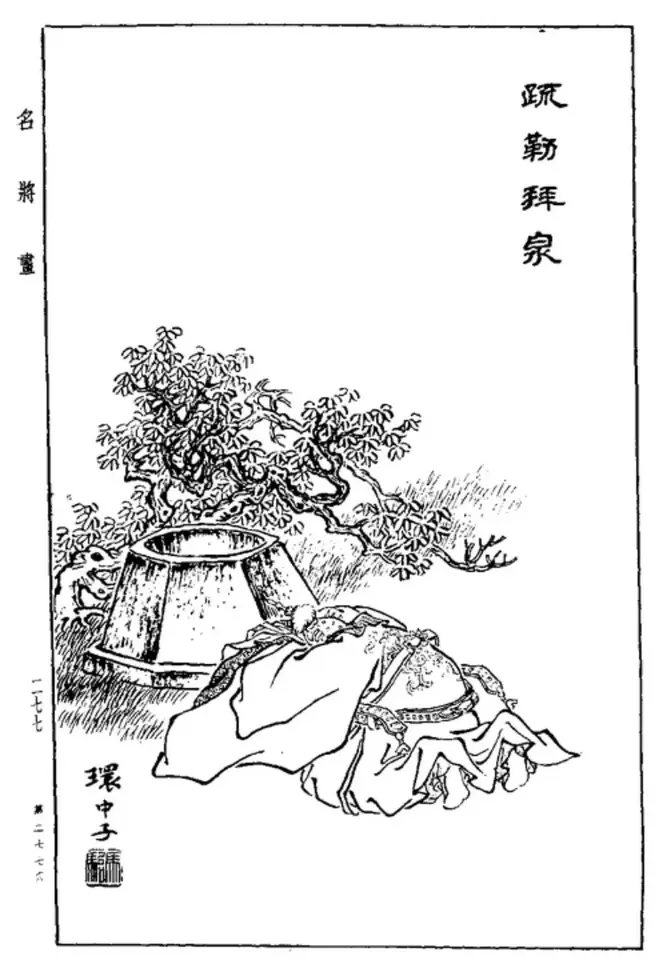
Anticipating that the nomads would return in greater force, Geng Gong evaluated the terrain and decided to relocate his garrison in the fifth month to Shule City (near modern Banjiégou, Qitai). Situated on a high mountain terrace with an adjacent ravine and perennial mountain brook, Shule offered superior natural fortifications. In the seventh month, the Northern Xiongnu returned in overwhelming numbers. Geng Gong led a commando sortie that disrupted their advance, prompting the enemy to dam and divert the mountain brook outside the walls. Cut off from water under scorching summer heat, the defenders dug a well within the fortress. Reaching a depth of fifteen rods (approximately 35 meters), the shaft remained bone-dry. Suffering extreme dehydration, soldiers squeezed moisture from fresh horse dung to moisten their throats. Undaunted, Geng Gong straightened his robes, bowed toward the well, and prayed to heaven for his men. Moments later, fresh spring water burst from the bottom of the well. The troops shouted praises of ten thousand years. Geng Gong ordered buckets of clear water splashed from the battlements, convincing the astonished nomads that heaven was aiding the garrison and compelling another retreat.
In the sixth month of 75 CE, the strategic landscape in the Western Regions collapsed. Incited by the Northern Xiongnu, the kingdoms of Yanqi and Qiuci rebelled, wiping out Protector-General Chen Mu and his headquarters, while another Xiongnu army trapped Colonel Guan Chong within Liuzhong. In the eighth month, Emperor Mingdi passed away in Luoyang. Engulfed in state mourning, the imperial court was paralyzed, leaving the frontier garrisons isolated without communications or relief. Sensing Han vulnerability, the Cheshi tribes revolted again, joining the Northern Xiongnu to lay siege to Shule City. Geng Gong rallied his troops to fight with unyielding resolve. Fortunately, the queen mother of Posterior Cheshi, a woman of Chinese descent, maintained secret sympathies for the garrison, surreptitiously smuggling intelligence and food parcels into the fortress.
However, as the siege dragged on through autumn and winter, supplies were exhausted. Facing starvation, Geng Gong and his men took their boiled leather armor and crossbow sinews, chewing the boiled hides for basic sustenance. Geng Gong shared every scrap of misery with his soldiers, forging an unbreakable bond of mutual trust where not a single defender deserted. Yet wounds, sickness, and famine took a heavy toll, reducing the garrison to a few dozen survivors. Recognizing that the fortress was on the brink of collapse, the Northern Xiongnu Chanyu sought to turn Geng Gong's legendary prestige to his own advantage. He sent a high envoy offering terms: "If the general surrenders, the Chanyu will appoint you King of the White House and grant you an imperial princess in marriage!" Geng Gong feigned agreement, lured the envoy onto the battlements, drew his sword, and decapitated him on the spot. Before the horrified eyes of the Xiongnu army below, he roasted the envoy's corpse over a fire. Weeping in grief and rage, the Xiongnu officers withdrew. Infuriated, the Chanyu reinforced the siege with tens of thousands of riders, bombarding the stronghold day and night, yet Geng Gong held the battered walls against every assault.
In Luoyang, Guan Chong's urgent plea for relief had arrived before his death. With Emperor Zhangdi newly enthroned, imperial ministers held an emergency council. While Minister of Works Diwu Lun opposed sending an expedition, Minister over the Masses Bao Yu passionately argued: "If we abandon men dispatched into perilous lands at the first sign of danger, we will indulge the cruelty of barbarians while betraying loyal martyrs." Emperor Zhangdi agreed, dispatching Qin Peng, Wang Meng, and Huangfu Yuan with seven thousand troops from Dunhuang, Jiuquan, Zhangye, and Shanshan. In the first month of 76 CE, the relieving army crushed the rebel forces at Cheshi and relieved Liuzhong (where Guan Chong had already fallen). The commanding generals prepared to withdraw, but Geng Gong's junior officer Fan Qiang wept and pleaded to rescue his commander. Granted two thousand troops, Fan Qiang braved blinding blizzards to traverse the high snow passes of the Tian Shan range to reach Shule City. Hearing galloping horses in the dead of night, the exhausted defenders prepared for a final fight. Fan Qiang shouted through the dark: "I am Fan Qiang! The Han court has sent an army to welcome our Colonel home!" The gates were thrown open, and the men collapsed into each other's arms, weeping bitterly.
Only twenty-six emaciated survivors marched out of Shule City alongside Fan Qiang. Northern Xiongnu cavalry pursued them across the wasteland, forcing the retreat into a running battle through blizzards. By the time they reached the Yumen Pass, thirteen men had succumbed to cold and wounds. The thirteen survivors who staggered through the pass were emaciated and clothed in tattered rags. Court Leader Zheng Zhong personally met them outside the pass, bathed them, and memorialized the throne: "Geng Gong defended an isolated fortress against tens of thousands of Xiongnu for over a year... boiling bowstrings for food and facing death without hope of survival. His steadfast loyalty surpasses Su Wu and stands unrivaled in antiquity." Emperor Zhangdi was profoundly moved, commissioning Geng Gong as Major of Cavalry and Fan Qiang as Army Major.
In 77 CE, Geng Gong was promoted to Colonel of the Changshui Cavalry. When the Western Qiang revolted in Jincheng and Longxi, Geng Gong was appointed deputy commander under Acting Chariot and Cavalry General Ma Fang, leading thirty thousand troops to pacify the frontier. Stationed at Baohan, Geng Gong repeatedly drove off enemy assaults. In 78 CE, after Ma Fang returned to court, Geng Gong remained to reduce holdout tribes, capturing over one thousand prisoners and accepting the surrender of thirteen Qiang tribes totaling tens of thousands of nomads, securing forty thousand livestock. Earlier, Geng Gong had memorialized the throne recommending that Grand Herald Dou Gu take command of Liangzhou, which provoked Ma Fang's intense jealousy. Following Ma Fang's return, an inspector clerk carried out Ma Fang's instructions, falsely accusing Geng Gong of neglecting military duties and harboring resentment. Geng Gong was recalled, imprisoned, stripped of office, and banished to his home commandery, where he died of old age.
During the defense of Jinpu City in 75 CE, facing twenty thousand Northern Xiongnu horsemen with only several hundred defenders, Geng Gong displayed extraordinary psychological and tactical mastery.
By utilizing poisoned crossbow bolts and exploiting a sudden mountain rainstorm to launch a ferocious counter-charge, he broke the siege against overwhelming numbers, establishing a textbook masterpiece of asymmetric fortress defense.
Confronted with the diversion of the mountain stream at Shule City and a dry shaft fifteen rods deep, Geng Gong maintained absolute composure and spiritual leadership.
His prayers and the subsequent gushing of the mountain spring not only saved the garrison from dehydration, but his defiant act of splashing water from the walls destroyed the besiegers' morale and forced their retreat, creating the immortal historical legend of "Geng Gong Praying at the Well."
Besieged for months without relief following the fall of the Western Regions Protectorate, Geng Gong and his men survived on boiled leather armor and bowstrings, refusing all compromise.
When offered a royal title and an imperial bride, Geng Gong lured the Chanyu's envoy onto the walls, executed him, and roasted the corpse before the enemy army, demonstrating an unyielding devotion to the Han Empire that struck terror into the nomadic host.
Leading twenty-six starving survivors from Shule City across blizzard-swept glaciers under relentless enemy pursuit, Geng Gong brought thirteen survivors safely through the Yumen Pass.
This legendary trek embodied the Eastern Han Empire's moral commitment to its frontier garrisons, earning universal veneration from the court and setting an immortal benchmark of soldierly fidelity in Chinese history.
Assuming independent field command during the Western Qiang campaigns, Geng Gong led decisive sweeps from his base at Baohan.
He subdued thirteen major Qiang tribes, accepted the surrender of tens of thousands of nomadic pastoralists, and captured massive livestock herds, restoring security to the western approaches of the empire.
FIGURES ASSOCIATED WITH THIS DYNASTY