高诱
Historical route / campaign map (Gao You)
Image creditsSY · CC BY-SA 4.0Image source

Historical figure

Gao You (高诱)

高诱

Gao You (dates unknown) was a native of Zhuo County, Zhuo Commandery in You Province (present-day Zhuozhou, Hebei). He was a distinguished classical scholar, philologist, and textual critic of the late Eastern Han dynasty, universally celebrated as the foremost annotator and preserver of pre-Qin and Western Han philosophical literature. In his youth, Gao You studied under the renowned Confucian master and Palace Attendant Lu…

Eastern Han Dynasty (东汉)

PROFILE

Gao You (dates unknown) was a native of Zhuo County, Zhuo Commandery in You Province (present-day Zhuozhou, Hebei). He was a distinguished classical scholar, philologist, and textual critic of the late Eastern Han dynasty, universally celebrated as the foremost annotator and preserver of pre-Qin and Western Han philosophical literature. In his youth, Gao You studied under the renowned Confucian master and Palace Attendant Lu Zhi, acquiring the rigorous Old Text traditions of syntactic parsing, phonology, and exegetical analysis. Amid the devastating wars of the late Han warlord era, Gao You was displaced for more than twenty years, suffering the loss of his private library. In 205 AD (the tenth year of the Jian'an era), Cao Cao, then serving as Excellency of Works, appointed Gao You to his secretarial staff, subsequently appointing him Magistrate of Puyang in Dong Commandery. Pained by the post-war neglect of ancient philosophical treatises, Gao You dedicated his leisure hours after administrative duties to annotating foundational texts, systematically compiling commentaries on Huainanzi, Lüshi Chunqiu, and Stratagems of the Warring States. Promoted to Overseer of Hedong in 212 AD, Gao You painstakingly reconstructed portions of his commentary that had been borrowed and lost in military upheavals, bringing his monumental life work to completion. In addition to his three extant masterpieces, he authored lost commentaries on Mencius and the Classic of Filial Piety. Gao You's annotations are celebrated for their meticulous collation, lucid phonological readings, and comprehensive citations of pre-Qin institutions and geography. Serving as an indispensable bridge for understanding classical Chinese thought, his commentaries occupy an exalted position in the history of Chinese bibliography and historical linguistics.

Native Place
Zhuo County, Zhuo Commandery, You Province (Modern Zhuozhou, Hebei)
Dynasty
Eastern Han
Highest Office
Magistrate of Puyang, Overseer of Hedong, Clerk in the Excellency of Works Bureau
Historical Identity
Celebrated Late Eastern Han Classical Scholar, Philologist, Exegete and Bibliographer

LIFE TIMELINE

Relationship graph

BIOGRAPHY

Chronology

  • c. 160 AD (3rd year of the Yanxi era) | Birth in You Province | Born into a scholarly family in Zhuo County, cultivating early classical literacy.
  • c. 175 AD (4th year of the Xiping era) | Tutelage Under Lu Zhi | Studied under the eminent Confucian master Lu Zhi, mastering textual punctuation and Old Text scholarship.
  • 184 AD (1st year of the Zhongping era) | Wartime Wanderings | Yellow Turban Rebellion erupted; northern China descended into warlord strife, halting his research for two decades.
  • 205 AD (10th year of the Jian'an era) | Magistrate of Puyang | Recruited by Cao Cao as a secretarial clerk and named Magistrate of Puyang; commenced his commentary on Huainanzi.
  • 208 AD (13th year of the Jian'an era) | Annotating Lüshi Chunqiu | Completed his twenty-six-volume commentary on Lüshi Chunqiu, explicating pre-Qin diverse thought and astronomy.
  • 212 AD (17th year of the Jian'an era) | Overseer of Hedong | Promoted to Overseer of Hedong; reconstructed eight lost chapters of Huainanzi, finalizing the authoritative edition.
  • c. 220 AD (End of the Jian'an era) | Enduring Scholarship | Completed his commentary on Stratagems of the Warring States, living out his final years as a venerable scholar.

Life and Career

Tutelage Under Lu Zhi and Wartime Dispersal

Gao You was born in Zhuo County, Zhuo Commandery, You Province. During the late Eastern Han dynasty, Zhuo Commandery was renowned for intellectual vitality, being the ancestral home of Lu Zhi, the preeminent Confucian savant who served as Palace Attendant and General of the Household.

In his youth, Gao You joined Lu Zhi's academy, studying alongside fellow northern scholars including Liu Bei and Gongsun Zan. Lu Zhi was a master of Old Text Confucianism, emphasizing philological rigor, structural syntax, and historical fidelity over speculative metaphysical debates. Under Lu Zhi's personal instruction, Gao You immersed himself in the Confucian classics and diverse schools of thought, mastering ancient phonological recitations and textual criticism.

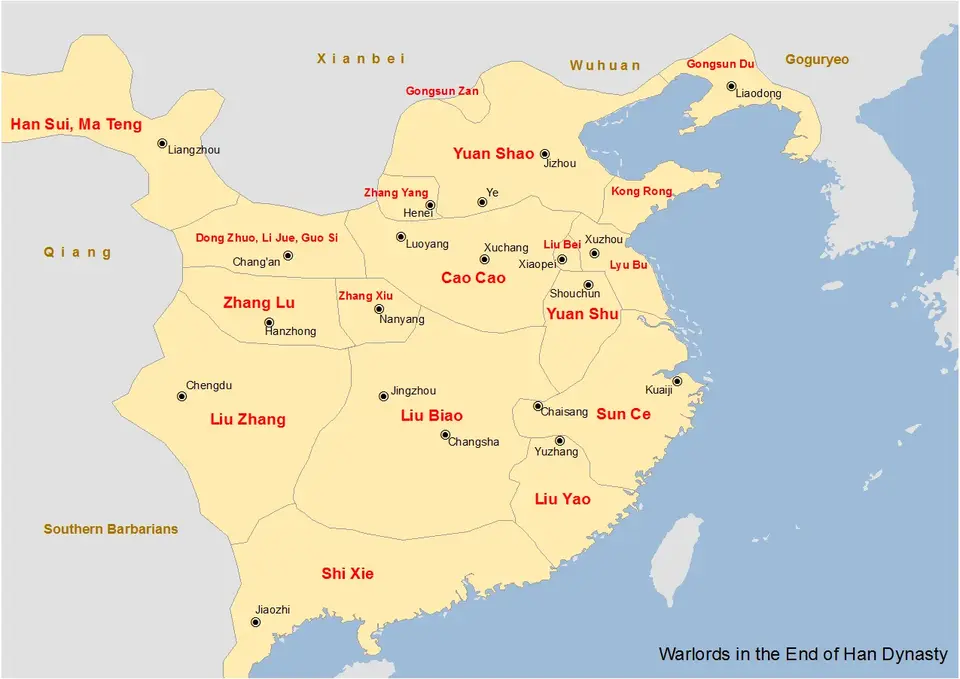
The outbreak of the Yellow Turban Rebellion in 184 AD and the subsequent tyranny of Dong Zhuo fractured the Han empire into warring domains. Northern China was transformed into a battlefield; cities were incinerated, populations dispersed, and centuries of imperial and private libraries were reduced to ashes. During these decades of dislocation, Gao You became a refugee, wandering across war-torn regions to preserve his life. His books and notes were largely scattered and destroyed, forcing him to suspend systematic scholarly endeavors for over twenty years.

Service in Puyang and Annotating the Masters

Stability gradually returned to northern China after Cao Cao unified the Central Plains. In 205 AD, while serving as Excellency of Works, Cao Cao sought out learned scholars to staff the imperial administration, selecting Gao You as a secretarial aide. Shortly thereafter, Gao You was transferred to local administration as Magistrate of Puyang in Dong Commandery.

While executing judicial and agricultural duties in Puyang, Gao You lamented the near-total collapse of classical learning. He observed with alarm that ancient philosophical treatises of the pre-Qin and early Han dynasties were falling into oblivion; in particular, Huainanzi (the philosophical compendium compiled under Liu An, King of Huainan) was rarely studied, and its ancient allusions and terminology faced permanent extinction.

Motivated by a profound sense of cultural duty, Gao You resolved to annotate the text. In the early mornings and late evenings after finishing official administration, he worked by lamplight. Drawing upon Lu Zhi's pedagogical principles, he harmonized Confucian ethical teachings with Daoist metaphysical concepts, verifying archaic customs, dynastic rituals, and pre-Qin phonetics. Gao You transcribed the complete text of Huainanzi, supplying comprehensive definitions and explicit phonetic guides for rare characters, creating an authoritative standard for future readers.

Overseeing Hedong and Academic Culmination

Gao You encountered significant hardship during the compilation of his Huainanzi commentary. Agricultural General of the Household Bian Yi, deeply impressed by Gao You's erudition, borrowed eight freshly completed manuscript scrolls to study in his military camp. Before he could return them, Bian Yi died suddenly, and the manuscripts vanished amidst military movements, dealing a heavy blow to Gao You.

In 212 AD, Gao You was promoted to Overseer of Hedong in recognition of his governance. Refusing to succumb to despair, he relied on his formidable memory and cross-referenced remaining texts to completely rewrite and restore the eight lost volumes, finalizing the monumental Explication of Huainan Honglie. In his preface, Gao You observed with exemplary modesty: "Possessing limited learning and shallow vision, I could not comprehend all matters fully. Wherever meaning remained elusive, I noted it as 'unheard of.' I leave this work to encyclopedic gentlemen of broad learning to examine and refine, hoping only to encourage future scholars."

Beyond Huainanzi, Gao You authored an extensive twenty-six-volume commentary on Lüshi Chunqiu, illuminating its integration of Confucian, Daoist, Mohist, and Legalist thought. He then produced an indispensable thirty-three-volume commentary on Stratagems of the Warring States, clarifying the historical diplomacy, battle sites, and geopolitical strategies of the contending kingdoms.

Adhering strictly to empirical objectivity, Gao You never fabricated forced interpretations, openly acknowledging textual ambiguities. His preservation of archaic pronunciations and semantic nuances shielded these irreplaceable pre-Qin treasures from destruction during the Han-Wei transition. Passing away naturally at an advanced age, Gao You remains immortalized as a monumental pillar of traditional Chinese philology.

Major Achievements

Inheriting Classical Exegesis Under Master Lu Zhi

Studied in youth under the venerable master Lu Zhi, mastering the foundational principles of Old Text textual criticism and preserving classical lineages throughout decades of civil warfare.

Annotating Huainanzi and Lüshi Chunqiu

While serving as Magistrate of Puyang and Overseer of Hedong, he painstakingly compiled the definitive commentaries on Huainanzi and Lüshi Chunqiu, establishing the gold standard for Han dynasty exegesis of ancient philosophical texts.

Explicating Stratagems of the Warring States for Posterity

Authored the primary ancient commentary on Stratagems of the Warring States, reconstructing the political geography, military tactics, and rhetoric of the Warring States period.
Personal Relationships

  • Mentor: Lu Zhi (courtesy name Zijian, celebrated Eastern Han Confucian master and military leader, Gao You's revered teacher)
  • Fellow Disciples: Liu Bei (Emperor Zhaolie of Shu Han), Gongsun Zan (warlord of You Province), both fellow students under Lu Zhi
  • Appointing Superior: Cao Cao (Excellency of Works who recruited Gao You in 205 AD)
  • Colleague: Bian Yi (Agricultural General of the Household who borrowed and lost eight scrolls of Gao You's commentary)
  • Contemporary Annotator: Xu Shen (renowned Han philologist who also commented on Huainanzi, whose work often merged with Gao You's in later recensions)

Historical Evaluations

  • Gao You, Preface to the Explication of Huainan Honglie: "In my youth, I studied under the late Palace Attendant Master Lu of our home commandery, receiving his instruction in sentence divisions and reciting the great principles. Then came the disasters of war, and the empire fragmented like a chessboard. Books and records were lost, and my studies were abandoned for over twenty years. In the tenth year of the Jian'an era, I was appointed to the bureau of the Excellency of Works and made Magistrate of Puyang. Seeing that few contemporaries studied Huainanzi, I feared it would fall into ruin... Having limited learning, where my understanding fell short, I noted it as 'unheard of.' I hope only that gentlemen of wide learning will refine it to instruct posterity."
  • Ji Yun et al., Annotated Catalog of the Complete Imperial Library: "Gao You's commentary on Huainanzi balances refined literary quality with substantive clarity, offering exhaustive phonological and semantic explanations. Among Han and Wei scholars like Zheng Xuan and Fu Qian, classical exegesis possessed definitive precision. Gao You's commentaries on Lüshi Chunqiu and Stratagems of the Warring States are equally revered by scholars."
  • Hong Yixuan, Collected Reading Notes: "Among Han commentaries on philosophical masters, Gao You's are the most comprehensive. His phonetic readings and semantic analyses frequently illuminate Zheng Xuan's commentaries on the Three Ritual Classics."
  • Traditional Historical Commentary: Many Han scholars commented on the Confucian classics, but few devoted their intellects to the diverse masters. Though heterogeneous, the philosophical treatises contain profound fragments of pre-Qin wisdom. As Lu Zhi's distinguished disciple, Gao You preserved cultural heritage across decades of warfare. The administrative burdens of Puyang and the rigors of Hedong could not deter his scholarly devotion. His commentary on Huainan is exhaustive, his reading of Lüshi harmonizes history and thought, and his notes on the Warring States elucidate political intrigue. Resisting speculative invention and marking what was uncertain, he was truly an intellectual pioneer of evidential scholarship!

Related Entries

  • Lu Zhi
  • Huainanzi
  • Lüshi Chunqiu
  • Stratagems of the Warring States
  • Cao Cao
  • Philology

FIGURES ASSOCIATED WITH THIS DYNASTY

Bibliography

  • Book of the Later Han, Volume 64, "Biography of Lu Zhi"