Inheriting Heritage in Lu
Born into a prominent family descended from Qi minister Gao Xi in Lu; studied the Six Classics and immersed himself in three-dynasty rituals.
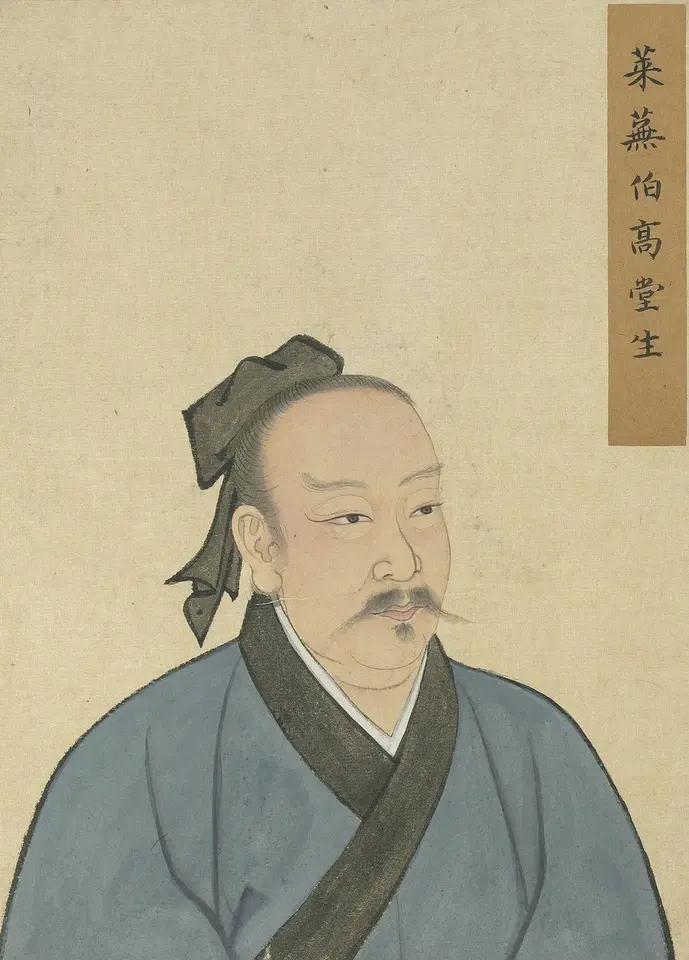
高堂生
Gaotang Sheng, compound surname Gaotang, given name Bo, was a native of the Lu State (modern Longting Town, Xintai, Shandong). He was a descendant of Gao Xi, a senior minister of Qi during the Spring and Autumn period. Active during the reigns of Emperor Wen and Emperor Jing of the Western Han dynasty, he was a preeminent Confucian master, the founding patriarch of Modern Text ritual scholarship, and an Erudite of the Ritual…
Gaotang Sheng, compound surname Gaotang, given name Bo, was a native of the Lu State (modern Longting Town, Xintai, Shandong). He was a descendant of Gao Xi, a senior minister of Qi during the Spring and Autumn period. Active during the reigns of Emperor Wen and Emperor Jing of the Western Han dynasty, he was a preeminent Confucian master, the founding patriarch of Modern Text ritual scholarship, and an Erudite of the Ritual Classics. During the pre-Qin era, the Ritual (Li) occupied the paramount position among the Six Classics, through which Confucius cultivated moral harmony and civil order under heaven. Following the establishment of the Qin dynasty, the imperial state executed the brutal policy of burning books and burying scholars, consigning ancient ritual records to flames and wartime devastation. By the dawn of the Han dynasty, ancient ritual manuscripts had virtually vanished from circulation, and while scholars discussed ritual generalities, they had lost the authentic textual basis. Relying on an extraordinary memory and a lifelong immersion in pre-Qin Zhou liturgies, Gaotang Sheng orally recited and transcribed seventeen chapters of the ancient Officers' Ritual (Shili, transmitted today as the Etiquette and Ceremonial, or Yili), single-handedly resurrecting the three dynasties' institutional liturgies from total extinction. Gaotang Sheng established an academy in Lu, systematically lecturing on the Officers' Ritual and laying the foundational canon for ritual studies across both Han dynasties. He transmitted all seventeen chapters to Xiao Fen of Xiaqiu, who passed them to Meng Qing of Donghai; Meng Qing transmitted them to Hou Cang of Donghai, who subsequently instructed Dai De (Senior Dai), Dai Sheng (Junior Dai), and Qing Pu. During the reigns of Emperor Xuan and Emperor Yuan, the lineages of the Two Dais and Qing Pu were all established as state-sponsored traditions with chairs at the Imperial Academy, and all Han ritualists revered Gaotang Sheng as their intellectual fountainhead. Acclaimed across centuries as the "Father of Modern Text Ritual Classicism," he was posthumously enfeoffed as the Baron of Laiwu in the Tang dynasty and enshrined in the Confucian Temple during the Song dynasty, his preservation of classical learning celebrated as a momentous achievement in Chinese cultural history.
Born into a prominent family descended from Qi minister Gao Xi in Lu; studied the Six Classics and immersed himself in three-dynasty rituals.
Faced with the Qin burning of books and destruction of texts, went into seclusion in Lu, committing the Officers' Ritual entirely to memory.
Following the rise of the Han dynasty, opened a school to orally recite and record seventeen chapters of the Officers' Ritual.
Summoned to the imperial capital for his profound mastery of classical lore and appointed Erudite of the Ritual Classics.
Retired to his native Lu in advanced age and transmitted the complete Officers' Ritual to Xiao Fen of Xiaqiu.
Passed away in Longting, Lu State; revered across subsequent dynasties as the founding patriarch of Modern Text ritual studies.
| Field | Content |
|---|---|
| Name | Gaotang Sheng |
| Given Name | Bo |
| Dynasty | Western Han |
| Ancestral Home | Lu State (modern Longting, Xintai, Shandong) |
| Highest Office | Erudite of the Ritual Classics |
| Historical Identity | Founding patriarch of Western Han Modern Text ritual classicism, Erudite of the Ritual Classics, transmitter of the seventeen chapters of the Yili |
Gaotang Sheng was a descendant of Gao Xi, a prominent grand minister of the state of Qi during the Spring and Autumn period. Having assisted Duke Huan of Qi in achieving hegemony, Gao Xi was enfeoffed with the estate of Gaotang (modern Liaocheng, Shandong), prompting his descendants to adopt the compound surname Gaotang. In the late Warring States period, the clan migrated to the state of Lu (modern Xintai, Shandong), where they immersed themselves in the deep cultural traditions of the cradle of Confucianism.
In the pre-Qin era, the Duke of Zhou instituted rites and music, and Confucius edited the Six Classics, establishing ritual as the supreme foundation for self-cultivation and statecraft. However, when Qin Shihuang annexed the six states, he implemented totalitarian thought control, ordering the universal confiscation and burning of Confucian classics and historical treatises. Liturgical texts held by feudal courts suffered total devastation; bamboo and silk scrolls were turned to ash, and scholars versed in ancient court ceremonies, capping, weddings, and ancestral sacrifices were scattered into hiding, bringing classical liturgies to the brink of complete annihilation.
Having lived through the upheavals of the late Qin, Gaotang Sheng recognized that ritual systems were the civilizational backbone of the realm. Confronted with widespread devastation, he relied upon his immense mnemonic capacity to commit all seventeen chapters of the Officers' Ritual—including phrasing, ceremonial postures, and intricate protocols—flawlessly to memory. Living quietly in rural Lu during the chaos, he recited the scriptures day and night, steadfastly guarding the civilizational heritage of the ancients.
Following Emperor Gaozu's unification of the empire, early Han courtiers, largely drawn from common and military backgrounds, drank excessively, boasted of their battlefield exploits, and struck the palace pillars with swords in open court. Troubled by this disorder, Emperor Gaozu commissioned Shusun Tong to enlist scholars from Lu to devise court ceremonials. While this restored royal dignity and taught courtiers reverence for the emperor, Shusun Tong's statutes focused narrowly on royal majesty and court protocol, leaving private ethics, social etiquette, and familial rites largely uncodified.
Meanwhile, in the Qi and Lu regions, Gaotang Sheng established an academy and formally recited from memory the seventeen chapters of the Officers' Ritual, committing them to writing for the first time since the Qin burnings.
This monumental collection survives today as the Etiquette and Ceremonial (Yili), one of the canonical Thirteen Classics. The corpus encompasses Capping of an Officer, Marriage of an Officer, Visits of an Officer, The District Drinking Feast, The District Archery Meet, The Banquet, The Grand Archery Meet, Diplomatic Missions, Feasting an Envoy, Audiences at Court, Mourning Attire, Mourning Rites of an Officer, Funerary Procession, Sacrifice of Repose, Single Beast Sacrifice, Lesser Herd Sacrifice, and Clearing of the Sacrificial Vessels. It provided a complete blueprint for the fundamental social, diplomatic, and sacrificial ceremonies of classical antiquity. Courtiers and scholars throughout the Western Han were profoundly stirred, universally hailing Gaotang Sheng as the foremost authority on ancient rites.
Upon ascending the throne, Emperor Wen embraced benevolent governance and extensively sought out aging Confucian masters across the empire. Gaotang Sheng's resurrection and teaching of the Officers' Ritual brought him empire-wide prestige, prompting the imperial court to enlist his service.
In the early years of Emperor Wen, an imperial decree summoned Gaotang Sheng to Chang'an, investing him as an Erudite of the Ritual Classics. During his tenure at court, he stood alongside prominent scholars such as Chao Cuo, Shen Gong, and Jia Yi. Whenever delicate questions arose regarding imperial ancestral sacrifices, suburban worship of heaven and earth, diplomatic protocol for tributary states, or court mourning codes, Emperor Wen instructed Gaotang Sheng to consult the ancient standards of the sage kings. Gaotang Sheng cited canonical precedent with profound eloquence, making an enduring contribution to the formalization of early Han institutional civilization.
Lecturing at the Imperial Academy, Gaotang Sheng instructed students without prejudice, personally demonstrating ceremonial movements and dignified comportment. He taught that the true essence of ancient rites lay not in empty ostentation, but in restraining selfish impulses and refining moral character to foster familial devotion, fraternal respect, and harmonious social order. Aspiring students journeyed thousands of miles to learn under his guidance, sparking a vibrant revival of classical studies across the capital.
In his advanced years under Emperor Wen, Gaotang Sheng requested leave to retire and returned to his ancestral home in Longting, Lu, where he devoted his final years to training disciples.
Among his students, Xiao Fen (courtesy name Boqi) of Xiaqiu (modern Yanzhou, Shandong) demonstrated remarkable intellectual diligence and absorbed the master's teachings in their entirety. Gaotang Sheng imparted his full exegesis and the subtle meaning of the seventeen chapters to Xiao Fen. Xiao Fen in turn transmitted the tradition to Meng Qing of Donghai, who passed it to Hou Cang of Peijun. Hou Cang synthesized the classical learning of his era and instructed Dai De (Senior Dai), Dai Sheng (Junior Dai), and Qing Pu.
By the reigns of Emperor Xuan and Emperor Yuan, the Record of Rites compiled by Senior Dai (Da Dai Liji) and Junior Dai (Xiao Dai Liji), along with Qing Pu's tradition, were officially incorporated into the imperial academy as three distinct state-sponsored Erudite traditions. Later Han scholars universally traced their teachings back to him, noting that all Han ritual studies originated from Gaotang Sheng of Lu.
Gaotang Sheng lived to an advanced age and passed away during the early reign of Emperor Jing, being laid to rest in Longting, Lu. Emperors and literati across subsequent dynasties revered him as a civilizational guardian. In the Tang dynasty, he was enshrined among the twenty-two foremost Confucian sages in the Imperial Confucian Temple, and later received the posthumous title of Baron of Laiwu. In subsequent dynasties, regional officials and scholars erected steles and shrines at his tomb, offering perpetual sacrifices in honor of his singular achievement in rescuing the sacred liturgical canon from the ashes of Qin.
When the Qin book burning destroyed the ancient liturgical canon, Gaotang Sheng preserved the texts entirely through memory, transcribing the seventeen chapters of the Officers' Ritual (now the Yili) in early Han and saving classical ritual from total extinction.
Summoned to court as an Erudite of the Ritual Classics under Emperor Wen, Gaotang Sheng advised the throne on ancestral sacrifices, suburban altars, and diplomatic protocol, integrating ancient Zhou liturgies into the foundations of Han imperial statecraft.
Gaotang Sheng instructed Xiao Fen of Xiaqiu, initiating an illustrious lineage through Meng Qing and Hou Cang that culminated in the canonical traditions of Senior Dai, Junior Dai, and Qing Pu, earning universal acclaim as the "Father of Modern Text Ritual Classicism."
FIGURES ASSOCIATED WITH THIS DYNASTY