Birth | Born in Tiao County, Bohai, present-day Jing County, Hebei
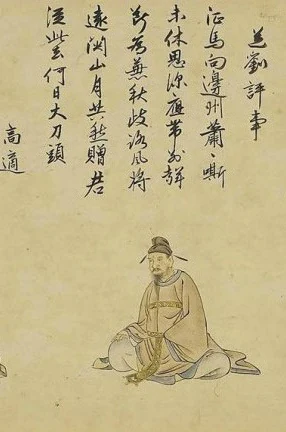
704 CE–765 CE
Poet
Gao Shi
高适
Gao Shi (c. 700–765), courtesy name Dafu and also Zhongwu, was a native of Tiao in Bohai, present-day Jing County, Hebei. He was an important mid-Tang official and frontier poet. He and Cen Shen were jointly known as “Gao and Cen,” and together with Wang Zhihuan and Wang Changling were counted among the four major frontier poets. Gao spent his early life in poverty, farming and studying in the Liang-Song region, and did not…
704 CE–765 CETang Dynasty
PROFILE
Gao Shi (c. 700–765), courtesy name Dafu and also Zhongwu, was a native of Tiao in Bohai, present-day Jing County, Hebei. He was an important mid-Tang official and frontier poet. He and Cen Shen were jointly known as “Gao and Cen,” and together with Wang Zhihuan and Wang Changling were counted among the four major frontier poets. Gao spent his early life in poverty, farming and studying in the Liang-Song region, and did not enter official life until nearly age fifty. He later rose to become Military Commissioner of Huainan and of Jiannan, was enfeoffed as Marquis of Bohai County, and received the posthumous name Zhong. His greatest poetic achievement lay in frontier verse; his representative work “Song of Yan” became famous for its stirring and tragic tone.
- Other name
- Gao Changshi
- Courtesy name
- Dafu
- Period
- Tang
- Date of Birth
- about 700
- Date of Death
- 765
- Dynasty / polity
- Tang
- Identity
- Poet
- Ethnicity / group
- Not recorded in historical sources
- Ancestral home
- Tiao County, Bohai (present-day Jing County, Hebei)
- Place of birth
- Tiao County, Bohai (present-day Jing County, Hebei)
- Place of death
- Not recorded in historical sources
- Highest office
- See Biography and Major Activities
- Major achievements
- Leading representative of High Tang frontier poetry; author of “Song of Yan”; later served as a military commissioner and was enfeoffed as a marquis
LIFE TIMELINE
Age 20 | His father Gao Congwen died at Yangzhou and the family declined
Age 20 | First traveled to Chang'an seeking office, without success
Age 22 | Returned disappointed from Chang'an, settled at Songcheng in Songzhou, present-day Shangqiu, Henan, and supported himself through farming and study
Age 31 | Hearing of war on the northeastern frontier, traveled north through Yan and Zhao seeking military service
Age 32 | Reached Youzhou and Jizhou and wrote frontier poems including “On the Frontier” and “Song of Yingzhou”
Age 33 | Presented poems to the staff of Li Yi, Prince of Xin'an, seeking recommendation, without success
Age 36 | Sat the Wangba examination in Chang'an and failed
Age 39 | Moved by corruption in Zhang Shougui's army, composed “Song of Yan”
Age 40 | Traveled with Du Fu in Wenshang and with Fang Guan
Age 45 | Traveled through Liang and Song with Li Bai and Du Fu, climbing Chuitai and Qintai and composing poetry
Age 50 | Recommended by Zhang Jiugao, prefect of Suiyang, passed the Youdao examination and was appointed commandant of Fengqiu County
Age 51 | Escorted troops to Qingyi Army and made his third visit to northern Ji
Age 53 | Resigned as Fengqiu commandant and joined the staff of Geshu Han, Military Commissioner of Hexi, as secretary
Age 54 | Followed Geshu Han against the Tibetan Empire and recovered the Nine Bends of the Yellow River
Age 56 | The An Lushan Rebellion began; appointed Left Reminder, then Investigating Censor, and assisted Geshu Han in defending Tong Pass
Age 57 | After Tong Pass fell, reached Emperor Xuanzong's traveling court and explained the circumstances of the defeat; promoted to Palace Censor and Remonstrance Grand Master
Age 58 | Appointed Censor-in-chief and concurrently Military Commissioner of Huainan; helped suppress the rebellion of Prince Yong
Age 59 | Demoted through the hostility of powerful eunuch Li Fuguo to Junior Supervisor of the Heir Apparent and assigned to the Eastern Capital
Age 60 | Appointed prefect of Pengzhou
Age 61 | Transferred to prefect of Shuzhou
Age 63 | Replaced Yan Wu as Military Commissioner of Jiannan Xichuan and mayor of Chengdu
Age 65 | Recalled to the capital, appointed Vice Minister of Justice and Left Cavalier in Regular Attendance, and enfeoffed as Marquis of Bohai County
Age 66 | Died on the twenty-third day of the first month; posthumously appointed Minister of Rites and granted the posthumous name Zhong
BIOGRAPHY
Biography
Family Background and Early Life
Gao Shi came from the Bohai Gao clan, a prominent Shandong lineage since the Northern Dynasties. His father Gao Congwen served as chief secretary of Shaozhou, and Gao spent part of his youth with him in Lingnan. Scholars have proposed birth years of 700, 701, 702, and 706; around 700 is now commonly accepted. Historical sources preserve little about Gao's first twenty years. The Old Book of Tang says only that as a youth he was “unrestrained, did not attend to a livelihood, and his family was poor.” His own line, “At twenty I understood books and swordsmanship and traveled west to Chang'an,” suggests serious early study of both literature and martial skills.
In 719 Gao's father died at Yangzhou, and the family fell into poverty. That same year Gao traveled west to Chang'an seeking office but received no recognition. In 721 he returned disappointed, traveled through Liang and Song, and settled at Songcheng in Songzhou, present-day Shangqiu, Henan, supporting himself by farming and study. For more than two decades he lived in straitened circumstances in the Liang-Song region, at one point reportedly reduced to begging. In “Farewell to Assistant Commander Wei,” he described returning to ask after his wife and children while the entire household laughed and clung to his clothes, and himself sitting alone in an empty room with no secure livelihood.
Northern Journey to Yan and Zhao and First Military Experience
In 730, the Khitan strongman Ketugan killed the Khitan ruler Li Shaogu, rebelled against Tang, and submitted to the Türks, bringing renewed conflict with the Khitan and Kumo Xi on the northeastern frontier. Gao traveled north through Yan and Zhao seeking a chance for military service. Passing Weizhou and Julu, he reached the front around Youzhou and Jizhou in winter. In 731 he joined Li Yi, Prince of Xin'an and commander of the Shuofang forces, and accompanied him beyond Lulong Pass against the Khitan. Tang troops heavily defeated the Xi and Khitan and took many captives and heads. During this campaign Gao composed “Song of Yingzhou,” “On the Frontier,” “Five Poems at Jimen,” and “Poem from the Staff of the Prince of Xin'an,” marking the beginning of his frontier poetry.
Gao nevertheless received no important appointment. In 733, after exchanging poems at Jimen with old friends such as Wang Zhihuan and Guo Mizhi, he returned south disappointed. Although the northern journey brought him no office, direct experience of frontier military life supplied material for later masterpieces such as “Song of Yan.”
Years in Liang and Song and Association with Famous Writers
From 734 to 748 Gao was based mainly in the Song region, though he traveled repeatedly and went to Chang'an for examinations. In 735 he sat the Wangba examination in Chang'an and failed, but during this period became acquainted with Wang Changling, Wang Zhihuan, and others. In 738, drawing on his earlier experiences in Youzhou and Jizhou and angered by reports that Military Commissioner Zhang Shougui concealed military defeats and tolerated corruption, Gao composed the celebrated “Song of Yan.”
In 739 Gao traveled with Fang Guan and also with Du Fu around Wenshang. In 744 he journeyed through Liang and Song with Li Bai and Du Fu, climbed Chuitai and Qintai to compose poems on the past, hunted around Mengzhu Marsh, and visited Yangtai Temple on Mount Wangwu. In 745 he traveled east through Lianshui in the Chu region, boated on Daming Lake at Jinan, and hunted in Bohai. In 746 he answered a summons from Li Yong, administrator of Beihai, and went to Linzi, where he again met Li Bai and Du Fu. In 747 he lived quietly along the Qi River, then returned to Suiyang and composed the famous pair “Farewell to Dong Da.”
Entry into Office and the Hexi Staff
In 749 Zhang Jiugao, prefect of Suiyang, recognized Gao's talent and recommended him for the Youdao examination. Gao passed and was appointed commandant of Fengqiu County. The duties of a county commandant, however, required ceremonial attendance on superiors and corporal punishment of commoners, which conflicted with Gao's aspirations. In “Written at Fengqiu” he lamented that bowing before superiors broke his heart and whipping common people filled him with sorrow. In the autumn of 750 he escorted troops to Qingyi Army, making his third journey to northern Ji. In spring 751 he returned to Fengqiu, and that autumn he resigned and went to Chang'an.
Late in the autumn of 752, on the recommendation of military commissioner judge Tian Liangqiu, Gao joined the Hexi staff. Crossing Mount Long, he traveled through Wuwei and Changsong to Lintao, where he met Geshu Han, Military Commissioner of Hexi and Longyou. Ge considered Gao exceptionally talented and memorialized for his appointment as a military clerk of the Left Valiant Guard and secretary on his staff. That winter Gao accompanied Ge to court, where Ge praised him highly before Emperor Xuanzong. In 753 Gao followed Ge against the Tibetan Empire, participating in the capture of Hongji and Damo Gate and the recovery of the Nine Bends communities along the Yellow River. Gao commemorated the victory in poems including “With Officer Li, Congratulating Lord Geshu Han on Breaking the Nine Bends” and “Three Songs of the Nine Bends.”
Political Rise During the An Lushan Rebellion
In the eleventh month of 755, the An Lushan Rebellion began. In the twelfth month the court appointed Geshu Han deputy supreme commander against the rebels. Gao became Left Reminder, then Investigating Censor, and assisted Ge at Tong Pass. In the sixth month of 756 Tong Pass fell. Gao returned to Chang'an and proposed opening palace storehouses to recruit men willing to fight to the death in defense of the capital, volunteering to lead the sons of officials and the recruited fighters, but the proposal was not accepted. After Xuanzong fled west, Gao rode west from Luogu by secondary roads to Hechi Commandery, where he met the emperor and submitted the “Memorial Explaining the Circumstances of the Fall of Tong Pass,” strongly criticizing corruption in military and government affairs. Xuanzong approved his candor, promoted him to Palace Censor, and took him into Shu; in the eighth month he was promoted again to Remonstrance Grand Master.
On the journey to Shu, Xuanzong assigned imperial princes to regional commands. Gao strongly remonstrated that the plan would produce regional military separatism and renewed civil disorder, but the emperor did not accept his warning. In the eleventh month, Li Lin, Prince of Yong, indeed rebelled at Jiangling. Emperor Suzong summoned Gao for advice. Gao analyzed conditions in the lower Yangzi and predicted that Li Lin would certainly fail. Impressed, Suzong appointed him Censor-in-chief, concurrently Military Commissioner of Huainan and chief secretary of the Yangzhou metropolitan command, and ordered him to suppress Li Lin. On the way to his post, Gao joined Lai Tian, Military Commissioner of western Huainan, and Wei Zhi, Military Commissioner of Jiangdong, at Anlu, where they swore an alliance. Li Lin was defeated and killed before Gao reached Guangling, so Gao directed Huainan forces to participate in relief operations for Suiyang.
Later Official Career
In 758 Gao's upright and outspoken conduct offended the powerful eunuch Li Fuguo, and he was demoted to Junior Supervisor of the Heir Apparent and assigned to the Eastern Capital. In the fifth month of 759 he became prefect of Pengzhou; in 760 he was transferred to Shuzhou. While in Shu he learned that Du Fu was also in Jiannan and wrote “Sent to Du Fu, Left Reminder, on Human Day.” In the fifth month of 761 Gao led troops under Cui Guangyuan, Military Commissioner of Xichuan, in suppressing the rebellion of Duan Zizhang, prefect of Zizhou. In 762, after Emperor Daizong summoned Yan Wu to court, Gao replaced him as Military Commissioner of Jiannan Xichuan and mayor of Chengdu.
In 763, when the Tibetan Empire invaded Longyou, Gao led troops toward the southern Tibetan frontier in an attempt to divert its strength, without success. In the twelfth month, Tibetan forces captured Songzhou, Weizhou, and Baozhou, and Gao was unable to relieve them; the western mountain prefectures of Jiannan were also occupied. In the first month of 764 Yan Wu returned to Sichuan as military commissioner. Gao was recalled to the capital and appointed Vice Minister of Justice and Left Cavalier in Regular Attendance, enfeoffed as Marquis of Bohai County with a fief of seven hundred households. Gao died on February 17, 765, the twenty-third day of the first month in the first year of Yongtai, was posthumously appointed Minister of Rites, and received the posthumous name Zhong.
Gao Shi, styled Dafu and also Zhongwu, was a native of Tiao county in Bohai, grandson of Gao Kan, general of the left palace gates and protector-general of Andong, and son of Gao Chongde, who held the commands of Tao and Sheng and the prefectures of Qin, Hui and Yan. Poor and unsettled in his youth, he would not work at any trade; of his first twenty years little is known, but from his own line about understanding the sword at twenty and travelling west to Changan it appears that he lived between Liang and Song, studying letters and arms with great diligence. In 721, disappointed at Changan, he travelled in Liang and Song and settled in Songcheng in Songzhou, living by farming and study. About 730, hearing of the fighting on the frontier, he went north to Yan and Zhao seeking service, passing through Weizhou to Julu and reaching the front about Youzhou and Jizhou in winter, writing poems on the way and taking service in the Yan country. He afterwards wrote the Song of Yan, drawing on what he had seen in the north to satirise the concealment of defeats and the corruption of the army; in the autumn he left Changan for Songzhong, staying at Luoyang on the way, and at the end of autumn set out east from Daliang through Zan, Fuli, Lingbi, Pengcheng, Sishui, Xuyi and Huaiyin to Xiangben, lodging at the Fan house and writing his rhapsody on the eastern journey. In the spring of 747 he was at Dongping, returning to Suiyang to see old friends, and in the winter of that year met Dong Lingwang and others. Zhang Jiugao, prefect of Songzhou, marvelling at his talent, recommended him for the examination in the way of the Way, in which he passed and was made commandant of Fengqiu. In the first half of 750, in that office, he was inwardly miserable, finding the life of a county commandant, fawning on superiors and oppressing the people, unbearable; he went north with troops, through Hejian and Boling, reaching Jibei in the winter, and after his mission kept the new year at Jimen. In the spring of 751 he left Jibei and returned by the He and Qi to Fengqiu. Meeting Geshu Han, the commissioner of Hexi, he was judged a man of extraordinary talent and was memorialised as a military officer of the left guards and made his secretary; and in the winter he went with him to court, where Geshu Han praised him before the emperor. In the fifth month of 753 Geshu Han attacked the Tibetans, taking the cities of Hongji and Damomen and recovering all the nine bends of the river, a country of sweet water and fine grass, good for pasture and close to the Tang frontier, which the Tibetans had earlier obtained under the pretext of providing a bathing estate for a princess and which had ever since been their springboard for raids, until Geshu Han recovered it; and Gao Shi wrote poems on the campaign. In 754 he was at the Hexi headquarters with leisure, writing poems of his excursions there. In the twelfth month of 755 Geshu Han, dismissed from office by illness, was called by the emperor, who relied on his fame and knew his enmity with An Lushan, and made generalissimo with eighty thousand men against the rebel at Tongguan; and Gao Shi was made left reminder and then investigating censor, assisting Geshu Han in the defence of the pass. In the first half of 756 he was still there; when the pass fell in the sixth month he returned to Changan and advised the emperor to empty the palace treasuries to raise volunteers for the defence of the city, offering himself to lead the sons of the officials and the volunteers in holding it, but the ministers opposed it and the emperor would not consent. When Geshu Han was beaten Gao Shi rode west by the Luo valley to the imperial quarters, met the emperor at Hechi and set out the causes of the disaster, speaking plainly of the corruption of the government and army, and was praised and made an attendant censor, following the emperor into Shu; and in the eighth month a decree declared that the attendant censor Gao Shi was upright and lofty in conduct, grateful and full of the arts of government, broadly cultured, a man of long plans whose frank words and righteous countenance showed a true minister, and made him a grand master of remonstrance. In the seventh month of 756 the emperor made the heir apparent Li Heng generalissimo and commissioner of four circuits to recover the two capitals, and made the Prince of Yong Li Lin commissioner of four circuits, the Prince of Sheng commissioner of Guangling and the Prince of Feng commissioner of Wuwei, ordering that each circuit should supply its own troops, arms and grain and that the princes should choose their own staff and appoint the officers of their circuits; and Gao Shi strongly opposed the division of the realm among the princes, holding that it would lead to their holding troops in separateness, hindering the suppression of the rebellion and ending in their mutual strife; but the emperor followed the advice of Fang Guan. When the Prince of Yong was summoned to Shu and refused, the new emperor at Lingwu, hearing that Gao Shi had long spoken against the measure, called him to consult, and Gao Shi set out the situation in Jiangdong and foretold Li Lin's defeat, at which the emperor marvelled; and in the twelfth month he was made censor-in-chief, chief administrator of the Yangzhou supreme command and commissioner of Huainan over twelve commanderies, to pacify the Jiang and Huai with Wei Zhi and Lai Tian. At the year's end Li Lin attacked the Tang forces in Jiangdong and the region was gravely shaken, and Gao Shi, with Wei Zhi and Lai Tian, met at Anlu and took the oath to destroy him. He used the method of division, writing to Li Lin's officers to set out the situation and their interests and bidding them leave him and save themselves; and several of Li Lin's best generals, seeing no future with him, left, so that his army broke without a battle and he himself was killed early in 757, the rebellion being ended. Gao Shi wrote to Helan Jinming to hurry to the relief of Liang and Song, and to Xu Shuji to make good their friendship and forget old quarrels in the relief. In the tenth month Zhang Hao replaced Helan Jinming as commissioner of Henan, and Gao Shi followed him with the Huainan troops to relieve Suiyang, but the city had fallen three days before they arrived, the prefect of Qiao, Luqiu Xiao, having refused Zhang Hao's orders; and when the campaign was over Li Fuguo, hating Gao Shi for his plain speaking, belittled him to the emperor and he was reduced to junior guardian of the heir apparent. In 759, with disorder in Shu, Gao Shi was moved to be prefect of Shuzhou and then of Pengzhou, going first from Xiangzhou by Shangjin and the Wu pass to Changan to see the emperor and then to his post at Pengzhou, where in the sixth month he presented his memorial on the garrisons of the three cities of the western hills. Since the emperor had divided Jiannan into two circuits and strengthened the three frontier cities of Song, Wei and Bao, Gao Shi argued that the transport of military grain for the frontier, even with the whole strength of Shu and the help of Shannan, was insufficient; that of Xichuan only Chengdu, Peng, Shu and Han yielded taxes, and these four were waste and ruinous while bearing the heavy taxes and services of ten other prefectures, the usurers squeezing and the officials pressing for fear of blame, so that the people fled without ceasing, and that the influx of gentry from the pass made the burden the heavier, so that taxes and levies knew no limit. He proposed either to shorten the line, not contending for a day, allowing the people to recover, and to reduce for the time the garrisons of the three cities, which profited neither the barbarians nor the state, or, if the conquered ground was not to be abandoned, to abolish the eastern circuit and join the two into one, so that the whole strength of Jiannan might be used against Tibet; and the emperor did not take his advice. At the year's end Du Fu reached Chengdu and Gao Shi at once sent him a poem. In the summer of 761 Duan Zizhang, prefect of Zizhou, rebelled and, after killing the Prince of Guo and taking Mian and Jian, styled himself King of Liang with the era Huanglong and a full court, and Gao Shi led troops with the commissioner of Xichuan, Cui Guangyuan, against him and killed him; and when Cui Guangyuan's officer Hua Jingding plundered the eastern Shu the emperor dismissed Cui Guangyuan and made Gao Shi governor of Chengdu and commissioner of Xichuan. That winter he visited Du Fu's thatched cottage, Du Fu often coming to Shuzhou to rely on him. In the fourth month of 762 the emperor Suzong died and the Daizong emperor took the throne; and in the seventh month Xu Zhidao, marshal of the Jiannan troops, rebelled as he was recalled to the capital, emptying the treasuries and ravaging the people and blocking Yan Wu's return; and Gao Shi raised troops at Shuzhou, broke the rebels in the eighth month and Xu Zhidao was killed by his own men, Gao Shi restoring order and succouring the injured. That summer, with Xichuan growing tense, he held only the western circuit, the eastern having a deputy in Zhang Yi of Zizhou. When the Tibetans took Longyou and threatened the capital region, Gao Shi drilled troops in Shu and pressed on the southern frontier of Tibet to hold them, but achieved nothing; and in the twelfth month of 763 the three cities of the western hills fell for want of grain, with the two new cities of Yunshan, Du Fu observing that the loss was the fault of the officers and not of the troops. In the first month of 764 the two circuits of Jiannan were joined under Yan Wu, and the emperor recalled Gao Shi to be vice minister of justice, then attendant of the palace and grand master of the silver seal, enfeoffed him as Marquis of Bohai with seven hundred households, and in the fifth month issued a decree adding four attendants on each side of the palace at the third rank, in which he spoke of the great value he set on the office. In the first month of 765 Gao Shi died and was posthumously made president of the Ministry of Rites with the name Zhong.
As to his native place the Old History of Tang calls him a man of Tiao in Bohai and the New History a man of Bohai in Cangzhou, but as Bohai commandery no longer existed in Tang times the point has been much disputed, some following the Old History and others, such as the literary history of the Chinese Academy of Sciences, holding otherwise. His birth year too has been variously given, some placing it about 700, as the Cihai and the standard school textbook do, and others between 700 and 702, Fu Xuancong among them; and his first journey to Changan to seek office has been dated accordingly, since his own line speaks of understanding the sword and travelling west at twenty. His first attempt failed, and a summons by edict in 735 also came to nothing. The preface to one of his poems, saying that in the yihai year he was summoned to Changan, has made most chronologies date the summons to 735; but since the emperor was at Luoyang from 734 until he set out for the western capital in the winter of 736, and since a summons meant audience with the emperor, and since writers of the day used Changan for any capital, his movements at that time remain to be settled; and his passing the examination in the way of the Way has been dated either to 735 or to 747. Three rhapsodies of his survive, one on parting and ambition, one on an object, and one on the past. The rhapsody on the falcon, written on reading Li Sha's piece on the cuckoo and lamenting his own obscurity among the common people, dwells on the bird's form and temper, small-headed and sharp, proud in spirit and swift, calm and keen-sighted, soaring to the heavens and fierce in war, whose prey are the flying birds and running hares, and whose only wish, unmatched as it is in bearing, is to be known and used, to obey its master's command and serve him; and under the falcon he speaks of himself. The rhapsody on the eastern journey records the scenes of the country he passed through and, more, the reflections called up by the historical figures of those places; and from his differing treatment of them it appears that those he admired were the heroes who achieved great works by their genius and the good ministers who founded lasting dynasties for their sovereigns, while the dissolute and cruel rulers who lost their states and the treacherous ministers who failed their lords were those he condemned. Among his surviving prose several pieces are political. In the memorial of thanks on becoming commissioner of Huainan he not only thanks the court but declares his resolve to spend all his strength, even his life, for the peace of the state, and sets out his plans for the office. In the similar memorial of 763, at sixty-four, on becoming commissioner of Xichuan and acting commissioner of Dongchuan, he first stresses the importance of Shu to the state and that the office must be given to a man of ability and special trust; says that his own record in Huaiyang and at Peng and Shu had been undistinguished and that he was overwhelmed by the charge; and then, pleading age and want of talent, asks the emperor to choose another to hold Jiannan and let him return to attend the court, ending by declaring his resolve to be loyal to his duty and to share the sovereign's cares. His memorial on the garrisons of the three cities, written as prefect of Pengzhou, urged the joining of the two circuits and the withdrawal of the garrisons, showing his care for the people and his knowledge of the country. His discussion of the shrine of the traitor Dong Zhuo attacked the popular sacrifices to him and demanded that the shrine be burned. His memorial presenting the auspicious poem of the Wang family preserves a palindrome poem of use to later scholarship, and shows the value he set on auspiciousness and on the moral instruction of poetry. The encomium on the lion in the hall of the assistant Fan uses the lion's majesty to set off its master's, brief and vigorous; and the sacrifice offered to Zhang Xun and Xu Yuan on his way back to the capital after his dismissal, blending his own misfortunes with mourning for the defenders of Suiyang who held out without relief and died, is one of his most moving pieces of narrative and feeling.
Major Activities
Literary Contributions
Gao was an outstanding representative of High Tang frontier poetry. He excelled in old-style verse and yuefu and admired the robust spirit of Jian'an poetry. His frontier poems often use five-character old-style forms, combining narration and argument with direct expression of feeling and blending frontier experience, discussion of military affairs, and ambition for achievement. “Song of Yan,” his best-known work, is passionate, stirring, tragic, and somber; its contrast between soldiers dying before the lines and beauties still singing and dancing in the commander's tent powerfully exposes unequal hardship within the army. “Song of Yingzhou,” “Listening to the Flute on the Frontier,” and “Farewell to Dong Da” are likewise celebrated works.
His subject matter extended beyond the frontier to the suffering of ordinary people and frustration at lack of advancement. His language is plain and his style vigorous and expansive; together with Cen Shen he was known as one of “Gao and Cen.” Zheng Zhenduo described Gao as a poet of “the human world” and the only poet of the Kaiyuan-Tianbao age to rise into the ranks of high officials, seeing in his writing a tragic strength within ease and a tone of aspiration within active engagement.
Political Activity
Gao entered office late but achieved considerable prominence. After passing the Youdao examination in 749, he served as commandant of Fengqiu and then as secretary on the Hexi staff. The An Lushan Rebellion brought his political abilities to the fore. He assisted Geshu Han at Tong Pass; after its fall he reached Xuanzong's traveling court and submitted the “Memorial Explaining the Circumstances of the Fall of Tong Pass,” analyzing military and administrative failures. His warning against dividing regional commands among imperial princes was ignored, but the later rebellion of Li Lin demonstrated his foresight. Under Suzong, Gao served as Military Commissioner of Huainan in the campaign against Li Lin and later as prefect of Pengzhou and Shuzhou and Military Commissioner of Jiannan Xichuan. In local office he suppressed rebellion and administered with broad and simple policies that were convenient for officials and people.
Travels
Gao traveled across much of China. In youth he accompanied his father in Lingnan and also traveled in Zhejiang, Fujian, Jingzhou, and Xiangyang. After age twenty he went west to Chang'an and later settled in Songzhou. In 730 he traveled north to Youzhou and Jizhou and directly experienced frontier life. He thereafter moved repeatedly among Chang'an, Luoyang, and Songzhou. In 744 he traveled through Liang and Song with Li Bai and Du Fu; in 745 he traveled east through Lianshui in Chu, boated on Daming Lake at Jinan, and hunted in Bohai. In 752 he entered the Hexi staff and traveled as far as Wuwei, Lintao, and Jishi Army. In later years his official career took him through Bashu, where he served in Pengzhou, Shuzhou, and Jiannan Xichuan.
Relations with Contemporaries
Gao associated with many celebrated poets of the High Tang. He traveled through Liang and Song with Li Bai and Du Fu in 744 and formed a close friendship with them. Du Fu later recalled their vigorous visit to Chuitai in “Expressing My Thoughts.” Gao was close to Wang Changling and Wang Zhihuan and exchanged poems with them; in 737 the three reportedly feasted and composed together. Gao also exchanged poems with Cen Shen, and the two became known collectively as “Gao and Cen.” His other associates included Li Yong, Zhang Xu, Fang Guan, Li Qi, Chu Guangxi, and Qimu Qian.
Gao Shi went three times beyond the frontier and wrote a great body of frontier poetry, bringing that poetry to its height and becoming its leading figure in the high Tang. Most of it was written during his journey to the north and his service at the Hexi headquarters: on his first two expeditions he did not truly serve in the army and had little deep experience of soldiering, but his strong sense of peril made him attend closely to the sufferings of the troops and to analyse frontier policy with a statesman's eye; entering the Hexi headquarters he began a soldier's life in earnest and looked at the world again with a statesman's judgement. His historical poems lament the past and give vent to disappointment, or praise the good ministers and generals of old, or criticise the present through the past; his pastoral poems note the hardships of the farm household as well as his own ambition; and his poems of friendship, of farewell, of gift and of banquet make up much the largest part of his work. His writings survive in some quantity. His verse and prose were collected in his lifetime and circulated under the Song and in many editions under the Ming and Qing; the principal texts are the eight fascicles of his collected works and the four fascicles in the Complete Tang Poems, which differ in their contents. The standard modern editions are those of the Zhonghua press of 1981, from a Ming movable-type text, with two hundred and forty-four poems and nineteen pieces of prose and rhapsody, and of the Shanghai Ancient Books press of 1984, with two hundred and forty-nine poems and nineteen pieces, besides a complete collection of his poems published at Chongwen in 2020. Sixteen pieces of prose survive, of which nine are memorials to the throne, two discussions, two encomia and three of other kinds; the memorials are the most numerous, four being the formal thanks on taking office, and there are also his memorial on the garrisons of the three cities, his piece against the shrine of the traitor Dong Zhuo, and his congratulations on the deaths of An Lushan and of Xu Zhidao, with three rhapsodies on parting, on an object and on the past. He is also commemorated. At Kaifeng the Chentai terrace, where Li Bai, Du Fu and Gao Shi met and drank and wrote in 744, received a temple to Yu the Great in 1523 and took the name Yuwangtai; and in 1517 a shrine of the three worthies was built in its eastern court with images of the three poets. Halls to Gao and to Du have since been built, their interiors arranged to tell of the friendship between Gao Shi and Du Fu, whose exchange of poems on the seventh day of the first month became a favourite theme; and a statue and a gravestone to Gao Shi have been raised in his native village, where his family graves are said to lie.
His Song of Yan, the masterpiece among his frontier poems, is written in mingled narration and comment, containing both the description of battle and his own judgement and lament: the lines on the soldiers dying before the camp while the beauties sing and dance in the tents expose the luxury and indifference of the frontier commanders and the inequality of hardship between officers and men; those on the general who, favoured by the court, grows careless of the enemy and, his strength spent, cannot raise the siege, give vent to his anger at a leader's rashness and an unending frontier danger; and those on the wife in the southern city whose heart breaks and the soldier at the northern frontier who can only look back express his sense of the endless service far from home. His poems of the northern gate describe the sufferings brought by years of war and the gulf between the lives of officers and men, one of them denouncing the sight of the frontier soldiers starving on husks while the surrendered barbarians were fed and clothed. Others picture the frontier troops as dogs and the bones of the dead as dust, showing his deep compassion; and lines in his songs on the frontier speak of not grudging death for the achievement of a single day, of the long plan that must be used, of sweeping the desert and taking the khan at one blow. His poem on sending General Hun beyond the frontier describes the vast and perilous battlefield and the hardships of the troops and celebrates their valour. Elsewhere he writes of leaving the Lulong pass and considering frontier policy, holding that prolonged fighting is no long plan and that marriage alliances are no far-sighted policy, and recalling the general Li Guang to urge the employment of good commanders to hold the frontier; and his lines on the snow and the wind of the frontier use the scenery only as a background to his feeling for the misery of the soldiers' life.
Personal Relations
- Father: Gao Congwen, chief secretary of Shaozhou
- Elder sister: Gao Gui (disputed), granddaughter of Gao Kan
- Li Bai: Close friend; traveled with Gao through Liang and Song in 744
- Du Fu: Close friend and traveling companion; likened Gao to Ji An and invoked the “broken vermilion balustrade” allusion
- Wang Changling: Close friend and frontier poet; exchanged poems with Gao
- Wang Zhihuan: Close friend; met Gao at Jimen in 733
- Cen Shen: Colleague and poetic correspondent; collectively known with Gao as “Gao and Cen”
- Li Yong: Senior associate and poetic correspondent; summoned Gao to Beihai in 746
- Fang Guan: Friend; traveled with Gao in 739
- Zhang Jiugao: Patron who recommended Gao for the Youdao examination
- Geshu Han: Superior and patron; recruited Gao as secretary on his staff
- Emperor Xuanzong of Tang: Ruler; Gao reached his traveling court after the fall of Tong Pass and won his appreciation
- Emperor Suzong of Tang: Ruler; appointed Gao Military Commissioner of Huainan during the rebellion of Prince Yong
- Emperor Daizong of Tang: Ruler; recalled Gao to the capital late in life and enfeoffed him as Marquis of Bohai County
- Li Fuguo: Powerful eunuch who resented Gao and repeatedly slandered him, contributing to his demotion
- Li Lin: Adversary during the rebellion of Prince Yong; Gao was ordered to campaign against him
Historical Assessment
Tang / Contemporary
- An imperial decree of Emperor Xuanzong praised Gao as principled and upright, personally noble and open, possessing plans for ordering the state and rich literary talent, capable of long-range strategy, and a loyal minister whose remonstrance was expressed with righteous seriousness. (Old Book of Tang, “Biography of Gao Shi”)
- Du Fu, in “Sent to Gao, Attendant-in-Ordinary,” compared Gao to Ji An and Lian Po, praising both his outspoken loyalty and his ability as a commander.
- In “Replying to the Late Gao, Prefect of Shu, for His Human Day Poem,” Du Fu compared Gao's writing to Cao Zhi and his moral achievements to Liu An.
Song and Yuan Periods
- Yan Yu's Canglang Remarks on Poetry: “The poetry of Gao and Cen is tragic and vigorous; reading it moves the emotions.”
- Liu Kezhuang's Houcun Remarks on Poetry: “The poems of Gao Shi and Cen Shen are tragic, vigorous, and expansive; reading them gives one thoughts of the frontier.”
- Ji Yougong's Chronicle of Tang Poetry cites a contemporary assessment that Gao's poems often speak directly from the heart and possess strong vital force and backbone.
Ming and Qing Periods
- Hu Yinglin's Inner and Outer Chapters on Poetry: Gao's diction remained plain and direct but already possessed a vigorous grandeur; Gao and Cen of the High Tang were jointly celebrated through the ages.
- Wang Shizhen's Yiyuan Zhiyan: Gao was highly talented and possessed heroic energy; his poetry had powerful structure and an elevated archaic character.
- Shen Deqian's Selected Tang Poetry: Gao's poetry was deep, vigorous, and tragic and stood at the head of frontier verse.
Modern Period
- Wen Yiduo's essays on Tang poetry treated Gao as a representative High Tang frontier poet and affirmed the expansive energy of his verse.
- Zheng Zhenduo's illustrated history of Chinese literature described Gao as a poet of “the human world,” the only poet among those of the Kaiyuan-Tianbao period to enter the highest ranks of officialdom, with a style that combined ease with tragic force.
- Yu Zhengsong's Studies of Gao Shi comprehensively examined Gao's life and affirmed the importance of his frontier verse in the history of Tang poetry.
FIGURES ASSOCIATED WITH THIS DYNASTY
Bibliography
- Old Book of Tang, juan 111, Biography 61, “Biography of Gao Shi”
- New Book of Tang, juan 143, Biography 68, “Biography of Gao Shi”
- Yu Zhengsong, Studies of Gao Shi, Zhonghua Book Company, 2008