Biography
Early Learning and Apprenticeship to Northern Masters
Fan Kuan lived during the critical era when five decades of warlord fragmentation gave way to Northern Song imperial consolidation. The Guanzhong region of Shaanxi was characterized by rugged mountain ranges, profound river gorges, and a populace known for unpretentious fortitude. Fan Kuan's original name was Fan Zhongzheng, with the courtesy name Zhongli. Because of his easygoing, magnanimous temperament and his calm, deliberate speech, local townsmen affectionately called him "Kuan" (the Broad-Minded or Generous). Delighted by the appellation, he embraced it as his public name.
A lover of wine and unrestrained mountain walks, Fan Kuan harbored no ambitions for official bureaucratic honors, dedicating himself entirely to pictorial art. During his early developmental phase, he turned to the monumental landscape heritage of Jing Hao, who had retreated to the Taihang Mountains during Later Liang, and Li Cheng, whose spacious, chilly horizons captured the imagination of northern scholars. Fan Kuan immersed himself in copying their extant scrolls day and night, absorbing Jing Hao's angular rock architecture and Li Cheng's delicate mist rendering until his replicas were nearly indistinguishable from original works.
Enlightenment in Nature and Solitary Mountain Retreat
Despite achieving technical perfection, Fan Kuan came to believe that mechanical reproduction of earlier masters deadened creative vitality. In an epoch-making insight that altered Chinese art history, he declared: "The methods of the ancients were derived directly from nature. Rather than taking men as teachers, it is better to take the Creative Processes of Nature as master; and rather than taking natural creation as master, it is better to take one's own heart and mind as master!"
Acting upon this conviction, Fan Kuan abandoned urban life and retreated into the untamed gorges of the Zhongnan Mountains and Taihua Mountains. Building a modest hut near high cliffs, he spent whole days sitting silently upon boulders, closely observing the shifting drama of cloud, fog, gale, and sunshine. At dawn, he studied white vapours unfurling from subterranean chasms; at dusk, he observed how dying sunlight carved stark relief into jagged cliffs; in the depths of winter, he braved freezing winds to observe heavy snow clinging to ancient junipers. The rugged majesty of the Qinling mountain wall became thoroughly etched into his visual memory, liberating him from prior masters and giving birth to an original northern landscape idiom.
Inventing the Raindrop Texture and the Monumental Style
To capture the physical texture of Shaanxi's fractured limestone massifs, Fan Kuan abandoned the soft, flowing lines of southern painters. He invented the "raindrop texture strokes" (raindrop texture strokes, also termed sesame texture strokes), applying short, upright, staccato dabs with a centered, blunt brush. Layered densely across rock faces like driving rain, these strokes imparted massive geological weight and structural density to crags.
In ink application, Fan Kuan moved beyond light washes to pioneer the "accumulated-ink method" (ji-mo). Layering dark ink upon dry brushwork repeatedly, he achieved a resonant, deep blackness that conveyed the damp, imposing presence of rock walls—a quality the imperial Xuanhe Catalogue of Paintings described as "like walking through a mountain at night." In depicting temples and dwellings, he deployed disciplined ruled-line iron strokes shaded with heavy ink washes, an effect praised as "iron houses." In composition, Fan established the definitive "monumental high-distance" format: a single towering central peak surges upward to fill nearly two-thirds of the vertical scroll, rising like a titanic monolith against the sky, fronted by boulder-strewn gorges, misty intermediate voids, and hidden roadways.
Timeless Masterpieces and Lasting Legacy
In his twilight years, Fan Kuan lived in dignified reclusion while his artistic fame resonated throughout the empire. The Northern Song imperial collection documented fifty-eight of his works in the Xuanhe Catalogue of Paintings, while Mi Fu noted examining thirty authentic masterworks in his History of Painting. Among his surviving catalog are Travelers among Mountains and Streams, Snowy Cold Forest Landscape, Snow Mountain Temple, and Solitary Figure by a Stream.
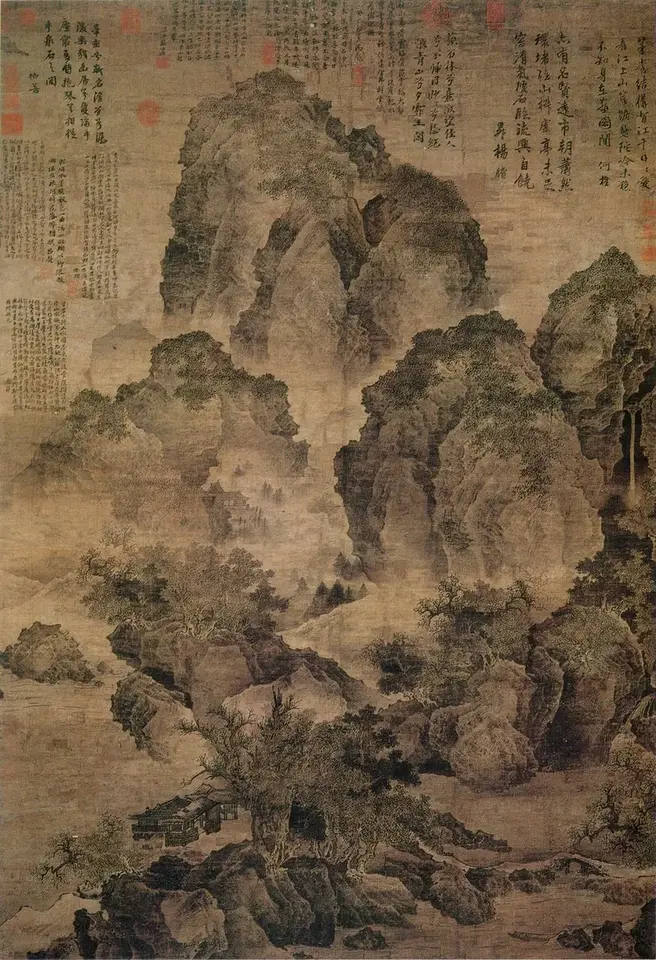
His preeminent triumph remains Travelers among Mountains and Streams, now conserved in the National Palace Museum in Taipei. Measuring 206.3 centimeters by 103.3 centimeters on silk, this breathtaking hanging scroll presents an awe-inspiring central mountain wall textured with thousands of raindrop strokes. A thread-like waterfall plummets from a cleft into deep mist; below, amidst giant boulders and gnarled trees, a team of mules driven by two packmen winds along a mountain path. While the figures are minute as ants, their dynamic pacing is rendered with astonishing realism. Concealed among the leaves of a low tree in the lower right foreground sits the master's signature: "Fan Kuan." Ming theorist Dong Qichang acclaimed this work as "the foremost painting of the Song," and Xu Beihong celebrated it as a sublime national treasure capable of overpowering all viewers. The Yuan critic Tang Hou observed: "Dong Yuan captured the spiritual atmosphere of mountains, Li Cheng captured their physical posture, but Fan Kuan captured their inner bone structure." Fan Kuan thus stands as an immortal pillar in world art history.
Key Achievements
Formulating the Aesthetic Creed of "Taking Nature and the Mind as Master"
Breaking free from derivative emulation of prior masters, Fan Kuan articulated the principle that artistic inspiration must arise from natural phenomena and internal contemplation, spending decades in solitary mountain retreats to observe shifting atmospheres.
Inventing Raindrop Texture Strokes and the Monumental Northern Idiom
Fan Kuan developed the raindrop texture strokes (raindrop texture strokes) and the dense accumulated-ink method, matching them with a towering high-distance composition. His method brilliantly captured the rugged geological essence of northern mountains, widely celebrated as capturing "the bone structure of mountains."
Creating the Immortal Masterpiece Travelers among Mountains and Streams
Fan Kuan painted Travelers among Mountains and Streams, Snowy Cold Forest Landscape, and Snow Mountain Temple, establishing the quintessential summit of Song landscape art. Grouped with Li Cheng and Dong Yuan as the Three Great Masters of Northern Song landscape (Three Great Masters of Northern Song landscape), his work fundamentally guided the Southern Song academy and centuries of East Asian landscape painting.