Birth into Prominence
Born into an elite family in Maoling, Fufeng, studying classical texts and mastering martial strategy in frontier garrisons.
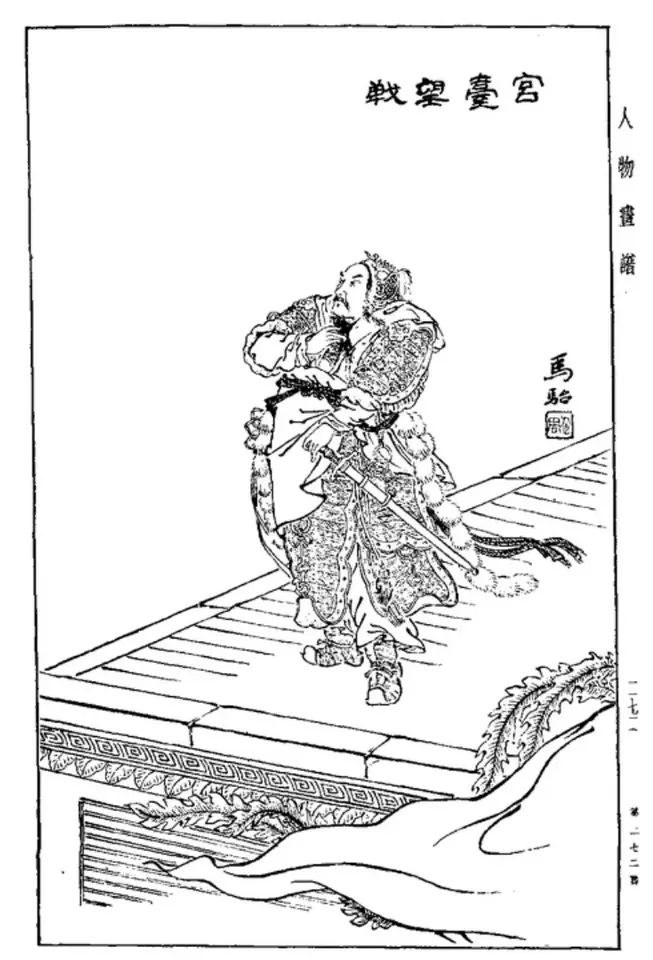
耿弇
Geng Yan (耿弇, 3–58 CE), courtesy name Bozhao, was a native of Maoling in Fufeng (modern Xingping, Shaanxi). He was an eminent founding general and military strategist of the Eastern Han Dynasty, ranked fourth among the celebrated Twenty-Eight Generals of Yuntai under Emperor Guangwu (Liu Xiu), and ennobled as the Marquis of Haozhi. Born into a prominent bureaucratic lineage, he was the eldest son of Geng Kuang, Grand…
Geng Yan (耿弇, 3–58 CE), courtesy name Bozhao, was a native of Maoling in Fufeng (modern Xingping, Shaanxi). He was an eminent founding general and military strategist of the Eastern Han Dynasty, ranked fourth among the celebrated Twenty-Eight Generals of Yuntai under Emperor Guangwu (Liu Xiu), and ennobled as the Marquis of Haozhi. Born into a prominent bureaucratic lineage, he was the eldest son of Geng Kuang, Grand Administrator of Shanggu. In his youth, he immersed himself in the Confucian classics while cultivating mastery of equestrian archery and military strategy. In 23 CE, at the age of twenty-one, Geng Yan renounced the short-lived regimes of Emperor Gengshi and the pretender Wang Lang at Songzi, journeying north to join Liu Xiu, who was then serving as Grand Minister of War, and was hailed as his trusted host of the northern corridor. During the wars of dynastic reunification, Geng Yan demonstrated exceptional strategic brilliance. He coordinated the deployment of elite shock cavalry from Shanggu and Yuyang to assist Liu Xiu in crushing Wang Lang, and subsequently formulated the comprehensive Nanyang Strategy that prioritized the pacification of Yan and Qi before unifying the realm. In the campaign against warlord Zhang Bu in the Qi-Lu region, Geng Yan executed classic tactical maneuvers—including feigning attacks, ambushing relief columns, and striking exposed flanks. When a stray arrow pierced his thigh during the Battle of Linzi, he drew his dagger, severed the shaft, and continued fighting without alerting his troops, annihilating Zhang Bu's army of two hundred thousand. Visiting the front, Emperor Guangwu praised him as surpassing Han Xin and bestowed the enduring proverb, "Where there is a will, there is a way." Over his military career, Geng Yan commanded independent operational theaters, pacifying forty-six commanderies and capturing over three hundred fortified cities. In 37 CE, upon the completion of national reunification, he voluntarily relinquished his general's seals and retired from active military command, attending imperial court sessions as a marquis. He passed away in 58 CE at the age of fifty-six and was posthumously honored as Marquis Min. He was later enshrined in the martial temples of the Tang and Song dynasties among the revered historical commanders.
Born into an elite family in Maoling, Fufeng, studying classical texts and mastering martial strategy in frontier garrisons.
Renounced Wang Lang and Emperor Gengshi at Songzi, journeying north to Lunu to join Liu Xiu.
Persuaded his father to mobilize elite cavalry from Shanggu and Yuyang, joining Liu Xiu at Guang'a to destroy Wang Lang.
Advised Liu Xiu to establish an independent base in Hebei, appointed General-in-Chief and taking control of Youzhou cavalry.
Supported Liu Xiu's accession as Emperor Guangwu, appointed General-in-Chief Who Establishes Awe, and defeated rebel forces at Aocang.
Crushed the Wuxiao peasant army at Yiyang, ennobled as Marquis of Haozhi with revenues from Haozhi and Meiyang.
Proposed the grand strategy to conquer Yan and Qi at Chongling, and defeated rebel commanders Deng Feng and Yan Cen.
Spearheaded the eastern campaign, capturing Zhu'a within half a day, ambushing General Fei Yi, and securing Jinan Commandery.
Captured Linzi through tactical deception, severed an arrow in his thigh while fighting, and destroyed Zhang Bu's main army.
Completed the pacification of the Qi-Lu region and returned to Guanzhong to launch the western offensive against Wei Xiao.
Besieged Gaoping to compel the surrender of rebel general Gao Jun, bringing the Longyou campaign to a close.
Voluntarily returned his military seals following total reunification, retiring as a marquis.
Passed away in Luoyang at the age of fifty-six, posthumously honored as Marquis Min.
Geng Yan descended from the prestigious Geng clan of Fufeng, originally from Julu, which had been relocated to Maoling during the Western Han Dynasty under the imperial mausoleum resettlement decrees. His father, Geng Kuang, was an accomplished Confucian scholar who studied the Laozi alongside Wang Kuang under the master Anqiu Wangzhi, later serving as governor of Shuodiao (the Han Shanggu Commandery) under the Xin Dynasty. As the eldest son, Geng Yan was schooled in the Book of Songs and the Book of Rites. Raised in the rugged northern frontier, he was inspired by cavalry maneuvers and archery, cultivating keen strategic acumen alongside classical learning.
In 23 CE, the Green Forest Army overthrew the Xin Dynasty and enthroned Liu Xuan as Emperor Gengshi. Seeking to secure administrative stability, Geng Kuang submitted to the new regime and retained his post as Grand Administrator of Shanggu. However, chaotic infighting among rebel generals alarmed Geng Kuang, who dispatched the twenty-one-year-old Geng Yan to Chang'an with regional tributes to consolidate his position.
Arriving at Songzi in Hebei, Geng Yan encountered the sudden rebellion of Wang Lang, a fortune-teller who claimed to be the son of Emperor Cheng of Han and rallied powerful northern gentry to seize Handan. While his accompanying clerks Sun Cang and Wei Bao deserted to join Wang Lang, Geng Yan discerned that the pretender was a fraudulent charlatan destined for failure. Learning that Grand Minister of War Liu Xiu was operating near Lunu, Geng Yan rode north to offer his allegiance.
During their initial audience, Geng Yan analyzed the geopolitical landscape, urging Liu Xiu to establish an independent power base in Hebei and promising to mobilize northern frontier cavalry to eliminate Wang Lang. Delighted by his strategic clarity, Liu Xiu treated him with warm affection, keeping him as a trusted aide. When hostile forces chased Liu Xiu north toward Jicheng, Geng Yan again urged him to summon the elite cavalry of Shanggu and Yuyang, prompting Liu Xiu to call him his host of the northern corridor. Although chaotic skirmishes in Jicheng briefly separated the two men, Geng Yan rode through the lines back to Shanggu to rally military aid.
Upon returning to Shanggu, Geng Yan coordinated with his father Geng Kuang, Commandant Kou Xun, and Chief Clerk Jing Dan to align the commandery fully behind Liu Xiu. Geng Kuang formed an alliance with Grand Administrator Peng Chong of neighboring Yuyang. Each commandery contributed two thousand shock cavalry and one thousand infantry. Geng Yan, Jing Dan, and Kou Xun led the Shanggu forces, uniting with the Yuyang contingent under Wu Han, Wang Liang, and Gai Yan.
This united northern strike force marched south through Zhuo, Zhongshan, Julu, Qinghe, and Hejian commanderies, slaying more than four hundred of Wang Lang's officers, decapitating thirty thousand enemy soldiers, and taking twenty-two cities. They rendezvoused with Liu Xiu at Guang'a, where the overjoyed leader proclaimed that he would share his mid-course triumph with the northern generals. Liu Xiu conferred the rank of Lieutenant General upon Geng Yan and five other commanders, and ennobled Geng Kuang and Peng Chong as General-in-Chief.
In May of 24 CE, Geng Yan accompanied Liu Xiu to lay siege to Handan. Geng Yan's cavalry spearheaded repeated assaults against the heavily fortified capital, successfully breaching the walls and executing Wang Lang, thereby extinguishing the largest separatist regime in northern China.
The elimination of Wang Lang elevated Liu Xiu's military prestige, alarming Emperor Gengshi in Chang'an. Gengshi conferred the title of Prince of Xiao upon Liu Xiu, ordered him to disband his armies, and dispatched Miao Zeng as Regional Inspector of Youzhou, alongside Wei Shun and Cai Chong as administrators of Shanggu and Yuyang, aiming to strip Liu Xiu of his northern frontier base.
Observing Liu Xiu lying dejected in the Wenming Hall in Handan, Geng Yan entered the bedchamber and presented a decisive assessment: Emperor Gengshi's regime was unraveling, the people yearned for the true restoration of the Han Dynasty, and surrendering command would lead to destruction. He urged Liu Xiu to refuse the imperial summons and authorize him to raise fresh levies in Youzhou. Convinced, Liu Xiu promoted Geng Yan to General-in-Chief and dispatched him and Wu Han to Youzhou.
Geng Yan executed Wei Shun and Cai Chong upon arrival, while Wu Han eliminated Miao Zeng, securing complete command over the ten commanderies of Youzhou and their cavalry forces. Leading these northern formations southward, Geng Yan served as vanguard in crushing various peasant coalitions, including the Tongma, Gaohu, Qingdu, and Youlai. In campaigns spanning Ludong, Pinggu, and Junmi, Geng Yan and his fellow generals inflicted massive casualties, pacifying the Hebei plain.
In 25 CE, Liu Xiu proclaimed himself emperor at Haocheng, founding the Eastern Han Dynasty. Geng Yan was appointed General-in-Chief Who Establishes Awe, capturing Aocang and forcing the surrender of the Aoxin rebels to secure the eastern approaches to the new capital of Luoyang.
In 26 CE, he was ennobled as Marquis of Haozhi, receiving the revenues of Haozhi and Meiyang. He subsequently took part in the imperial campaign that shattered the Wuxiao army at Yiyang, accepting the surrender of fifty thousand troops, before proceeding south to Nanyang to defeat rebel leader Deng Feng and repel the invasion of Yan Cen at Rang County, capturing thousands of soldiers.
In 27 CE, Peng Chong rebelled in Yuyang, allying with nomadic horsemen and the warlord Zhang Bu in Qi. When Peng Chong sought to induce Geng Kuang to join the revolt, Geng Kuang executed the emissaries. Mindful of court scrutiny regarding his father's independent regional post, Geng Yan presented the Nanyang Strategy to Emperor Guangwu at Chongling: he proposed pacifying the northern rebels in Yuyang and Zhuo, absorbing surrendered peasant units in the Central Plains, and launching a coordinated offensive into Qi to eliminate Zhang Bu.
Emperor Guangwu adopted the plan. To dispel suspicions of regional collusion, Geng Yan requested to return to Luoyang, while Geng Kuang sent his third son, Geng Guo, to serve at court. Reassured by the clan's loyalty, Guangwu directed Geng Yan to prepare the campaign against Qi.
In 29 CE, following the pacification of Peng Chong's rebellion, Geng Yan teamed with Grand Marshal Wu Han to defeat the Fuping and Huosuo peasant armies in Pingyuan, enlisting forty thousand surrendered troops into his strike force. He then launched the campaign against Zhang Bu, who controlled twelve commanderies in the Qi-Lu region. Zhang Bu had fortified Lixia with several tens of thousands of troops under General Fei Yi, while stationing garrisons at Zhu'a and Zhongcheng.
Advancing across the Yellow River, Geng Yan executed a calculated maneuver of besieging cities to draw out relief columns. He launched a surprise assault on Zhu'a, carrying the walls within half a day, and deliberately allowed fleeing soldiers to escape to Zhongcheng. Terrified by the rapid collapse of Zhu'a, the garrison at Zhongcheng abandoned their heavily fortified earthworks overnight.
When Fei Yi dispatched his brother Fei Gan to hold Juli, Geng Yan moved his army before Juli, ordered his troops to construct siege towers, and announced an imminent assault. He then allowed captured scouts to escape back to Lixia. Believing his brother was in mortal danger, Fei Yi marched thirty thousand elite troops out of Lixia to relieve Juli. Geng Yan left three thousand soldiers to maintain the siege and ambushed Fei Yi along the march. Slaying Fei Yi in battle, Geng Yan displayed his severed head before Juli, prompting Fei Gan to abandon the town and flee. Geng Yan swept through forty remaining outposts, pacifying Jinan Commandery in two weeks.
Geng Yan then advanced toward Linzi, the ancient capital of Qi. Regional commandery administrators held Linzi with over ten thousand troops, while Zhang Bu's brother Zhang Lan guarded Xi'an forty li to the west with twenty thousand elite soldiers. Subordinate officers urged an attack on the smaller city of Xi'an, but Geng Yan argued that Xi'an was well-provisioned and difficult to storm, whereas Linzi was sprawling and lightly defended.
Geng Yan announced that he would assault Xi'an in five days, prompting Zhang Lan to fortify his defenses. On the fourth night, Geng Yan ordered his troops to march through the darkness toward Linzi. Arriving at dawn, his troops scaled the walls and captured the city within half a day. Cut off from behind, Zhang Lan abandoned Xi'an and retreated to Juxian.
Enraged by the loss of his regional capital, Zhang Bu rallied an army of two hundred thousand to retake Linzi. Geng Yan lured the hostile vanguard into urban corridors and launched a surprise cavalry charge against their flank. During the clash, a stray arrow struck Geng Yan's thigh. With blood soaking his uniform, he drew his dagger, severed the protruding shaft, and continued fighting without notifying his staff. Heartened by his leadership, his troops routed the enemy vanguard.
The following morning, Zhang Bu mounted a final assault. Learning that Emperor Guangwu was approaching with reinforcements, General Chen Jun advised Geng Yan to hold the ramparts and await the sovereign. Geng Yan rejected the advice, declaring that a loyal subject must prepare a victory feast for his monarch rather than leave enemies for the throne to defeat. Leading his troops into the field, he fought from dawn until dusk, shattering Zhang Bu's army and pursuing the remnants across eighty li to the Jumei River, capturing thousands of supply wagons.
Arriving at Linzi, Emperor Guangwu was deeply moved by the sight of the battlefield and Geng Yan's wound. At the victory banquet, Guangwu compared his victory over Zhang Bu to Han Xin's conquest of Qi, praising his achievements as even more arduous and uttering the famous commendation: "Where there is a will, there is a way." Zhang Bu surrendered, and Geng Yan demobilized over one hundred thousand soldiers, restoring civil order across Qi.
In 30 CE, following the pacification of eastern China, Geng Yan was reassigned to the western theater. Together with Gai Yan and other commanders, he marched into Longyou to confront the regional warlord Wei Xiao. After initial setbacks at Longdi, Geng Yan held the defensive line at Qi County, shielding the Guanzhong region.
In 32 CE, Emperor Guangwu launched a western expedition, and Geng Yan advanced along multiple routes to force the surrender of sixteen commanderies. Following Wei Xiao's death, his general Gao Jun defended Gaoping with ten thousand troops. Geng Yan maintained a siege for over a year until Guangwu arrived in Guanzhong, pairing Kou Xun's diplomacy with Geng Yan's military pressure to secure Gao Jun's surrender. The fall of Luomen brought the pacification of Longyou to a successful conclusion.
In 37 CE, upon the submission of Gongsun Shu in Sichuan and the total reunification of China, Emperor Guangwu sought to ease military command and cultivate civil governance. Recognizing the sovereign's strategic intent, Geng Yan voluntarily surrendered his seals as General-in-Chief Who Establishes Awe, retiring from active military duty to attend the court as a marquis. Guangwu deeply respected his discretion, regularly consulting him on frontier defense and major military policies.
Geng Yan passed away in Luoyang in 58 CE at the age of fifty-six. Emperor Ming of Han bestowed the posthumous title Marquis Min, and his eldest son Geng Zhong inherited the marquisate. In 60 CE, when Emperor Ming commissioned the portraits of the Twenty-Eight Generals of Yuntai for the southern palace, Geng Yan was placed fourth in the order of precedence.
Geng Yan possessed rare strategic foresight. In 27 CE, when Eastern Han faced simultaneous threats from Peng Chong's northern revolt, eastern warlords, and southern insurrections, Geng Yan submitted the Nanyang Strategy to Emperor Guangwu.
He outlined a sequence of operations: first securing the northern frontier cavalry, second absorbing peasant units in the central plains, and finally massing concentrated field forces to crush Zhang Bu in Qi. This integrated grand strategy gave Eastern Han clear strategic direction, securing the conquest of northern and eastern China.
The campaign against Zhang Bu showcased Geng Yan's mastery of tactical maneuver. By capturing Zhu'a within half a day and deliberately releasing prisoners to panic Zhongcheng, he captured dozens of defensive encampments without striking a blow.
His feint against Juli enabled him to ambush Fei Yi's relief column, while his diversion toward Xi'an opened the path to seize Linzi. These classic operations stand as prime historical examples of applying Sunzi's principles of striking where the enemy is unprepared.
At the Battle of Linzi, Geng Yan displayed extraordinary courage. Pierced through the thigh by an arrow while leading his cavalry, he cut the shaft with his sword to conceal his wound from his men, maintaining army morale through hours of fighting.
Refusing to shift the burden of battle onto the approaching emperor, he launched a counteroffensive that shattered Zhang Bu's army. His bravery prompted Emperor Guangwu to bestow the timeless accolade, "Where there is a will, there is a way," which became an enduring moral proverb across Chinese culture.
Geng Yan was one of the few Eastern Han commanders entrusted with independent theater operations. Unlike other generals who operated within the main imperial army, Geng Yan frequently commanded independent campaigns across vast distances.
From his mobilization of northern cavalry against Wang Lang to his conquest of Qi and his operations in Longyou, Geng Yan subdued forty-six commanderies and captured over three hundred fortified cities, leaving an operational record surpassed only by Deng Yu and Wu Han.
In an era when founding commanders frequently fell victim to imperial purges, Geng Yan demonstrated exceptional political wisdom. At the height of his prestige in 37 CE, he perceived Emperor Guangwu's policy of demilitarization and voluntarily relinquished his military authority.
His decision preserved harmonious relations between monarch and minister, ensuring that the Geng clan remained one of the most prominent noble families throughout the Eastern Han Dynasty, producing generals and imperial consorts for generations.
FIGURES ASSOCIATED WITH THIS DYNASTY