Entering the Pass
Joined Liu Bang's uprising, accompanying Li Yiji to negotiate with Qin commanders at Wuguan Pass to secure the Han advance into Guanzhong.
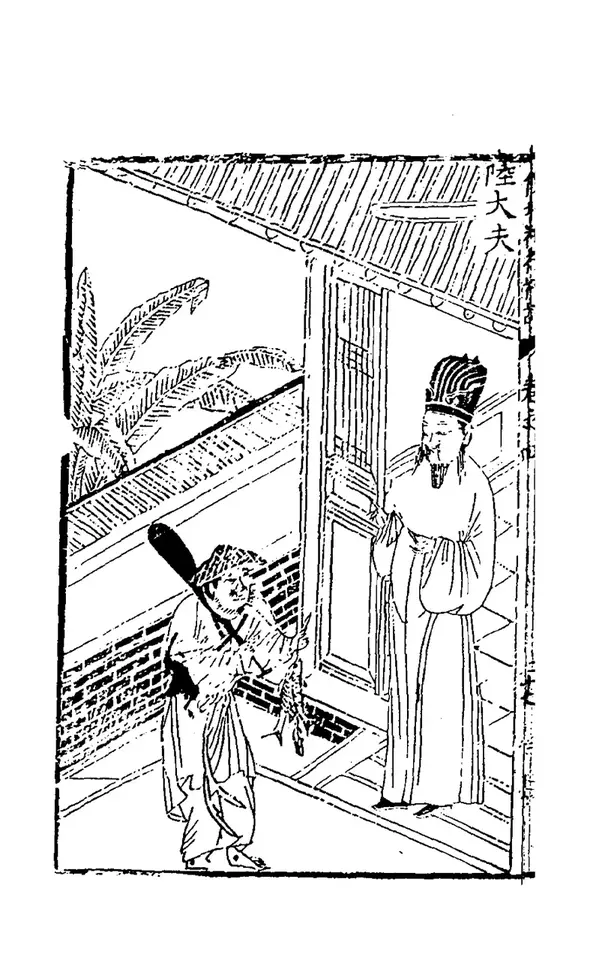
陆贾
Lu Jia (陆贾, c. 240–170 BCE), a native of the Chu region (modern Xuzhou area, Jiangsu), was a preeminent founding statesman, diplomat, political philosopher, and master essayist of the Western Han dynasty. During the anti-Qin uprisings and the Chu-Han Contention, Lu Jia served as a trusted advisor to Liu Bang (Emperor Gaozu of Han), earning renown across the realm as an "eloquent persuader" who frequently undertook…
Lu Jia (陆贾, c. 240–170 BCE), a native of the Chu region (modern Xuzhou area, Jiangsu), was a preeminent founding statesman, diplomat, political philosopher, and master essayist of the Western Han dynasty. During the anti-Qin uprisings and the Chu-Han Contention, Lu Jia served as a trusted advisor to Liu Bang (Emperor Gaozu of Han), earning renown across the realm as an "eloquent persuader" who frequently undertook perilous diplomatic missions among regional warlords. In 196 BCE, following the establishment of the Han dynasty, Lu Jia was dispatched as an imperial envoy to Nanyue, where former Qin commander Zhao Tuo had proclaimed himself Martial King of Nanyue. Through powerful moral persuasion and strategic geopolitical analysis, Lu Jia humbled Zhao Tuo's insolence, inducing him to accept imperial investiture and submit as a vassal of the Han dynasty without shedding a single drop of blood, whereupon Lu Jia was promoted to Grand Palace Grandee. Lu Jia was the chief intellectual architect of the early Han synthesis of Confucian moral philosophy and Daoist non-action (wuwei). When Emperor Gaozu crude remarked that he had won the empire from horseback and had no use for the Classic of Poetry or Classic of Documents, Lu Jia famously retorted: "Your Majesty won the empire from horseback, but can you govern it from horseback?" Commissioned by Gaozu to analyze the rise and fall of ancient states, Lu Jia authored the twelve-essay masterpiece Xinyu (New Discourses), pioneering the governing philosophy of "acquiring through military force but preserving through civil virtue," which laid the ideological foundation for the Wen-Jing Governance. During Empress Dowager Lu's regency, Lu Jia tactfully feigned illness to retire, subsequently engineering the vital political alliance between Chancellor Chen Ping and Grand Commandant Zhou Bo that dismantled the Lu clan's coup and restored imperial authority under Emperor Wen. Dispatched a second time to Nanyue in 179 BCE, he persuaded Zhao Tuo to permanently renounce his imperial title. His historical work Chuhan Chunqiu (Spring and Autumn of Chu and Han) provided essential primary source material for Sima Qian's Shiji.
Joined Liu Bang's uprising, accompanying Li Yiji to negotiate with Qin commanders at Wuguan Pass to secure the Han advance into Guanzhong.
Dispatched by Liu Bang to negotiate with Xiang Yu at Guangwu, gathering intelligence and facilitating the return of the captive imperial family.
Dispatched as imperial envoy to Nanyue; rebuked Zhao Tuo's insolent demeanor and persuaded him to accept Han vassalage, elevated to Grand Palace Grandee.
Authored the twelve chapters of Xinyu to refute Gaozu's disdain for classical learning, laying the philosophical cornerstone of early Han governance.
Perceiving deadly factional perils under Empress Dowager Lu's regency, retired from court under the pretext of illness to live at Haozhi.
Privately visited Chancellor Chen Ping, orchestrating the civilian-military alliance with Grand Commandant Zhou Bo to preserve the Liu dynastic succession.
Dispatched by Emperor Wen to Nanyue, successfully convincing Zhao Tuo to abandon the imperial title and restore tribute relations.
Divided his wealth among his five sons and passed away peacefully in his homeland at around seventy years of age.
Lu Jia was born in the Chu region around modern Xuzhou during the twilight of the Warring States period. Following the Qin unification of China, the enforcement of draconian legalist statutes generated profound resentment among scholars and commoners across the former southern kingdoms. Endowed with natural eloquence, sharp geopolitical insight, and deep erudition in the Confucian classics and diverse philosophical traditions, Lu Jia cultivated the grand strategic arts of interstate diplomacy. When peasant uprisings led by Chen Sheng and Wu Guang erupted against the Second Emperor of Qin, Liu Bang mobilized volunteers in Pei County; Lu Jia joined his retinue as an intellectual strategist and traveling diplomatic envoy.
In 207 BCE, as Liu Bang's army marched westward toward the Qin heartland, Zhao Gao assassinated the Second Emperor and sent clandestine envoys proposing to partition the Guanzhong region with Liu Bang. Sensing an ambush, Liu Bang dispatched Li Yiji and Lu Jia to negotiate with Qin border commanders at Wuguan Pass. Leveraging the anxiety of the Qin officers who feared execution by their own tyrannical court, Lu Jia offered lucrative personal bribes and promises of noble titles, effectively paralyzing their defensive resolve. The Han army executed a lightning assault on the undefended pass, capturing Wuguan and compelling the surrender of Ziying, King of Qin, at Xianyang.
During the subsequent four-year Chu-Han Contention, Lu Jia served as Liu Bang's primary diplomatic envoy, negotiating with neutral and wavering regional warlords. In 203 BCE, as the armies of Chu and Han were locked in an exhausting stalemate at Xingyang and Chenggao, Liu Bang's father (the Grand Upright Sovereign) and wife (Lady Lu Zhi) remained hostages in Xiang Yu's camp. Lu Jia was repeatedly dispatched into the Western Chu headquarters, demonstrating extraordinary personal courage as he argued that continuous warfare exhausted the empire, gathering vital intelligence on Chu supplies that eventually facilitated the peaceful return of the imperial family.
In 202 BCE, Liu Bang defeated Xiang Yu at the Battle of Gaixia, uniting the central plains and ascending the imperial throne as founding Emperor Gaozu of the Han dynasty. However, the distant southern coastal regions of Nanhai, Guilin, and Xiang Commandery—originally pacified under the Qin dynasty by Ren Xiao and Zhao Tuo—had severed contact with the north during the civil wars. Zhao Tuo commanded over one hundred thousand troops and proclaimed himself Martial King of Nanyue, ruling an autonomous southern empire beyond the Five Ridges.
In 196 BCE, having suppressed rebellious Han princes such as Han Xin and Ying Bu, Emperor Gaozu resolved to bring Nanyue into the imperial fold. He created Zhao Tuo King of Nanyue, bestowing an imperial jade seal, and commissioned the eloquent Lu Jia as imperial ambassador to journey across the treacherous southern mountains to Panyu (modern Guangzhou).
Upon receiving the Han ambassador, Zhao Tuo deliberately displayed gross disrespect. He dressed in local barbarian attire with his hair bound in an indigenous topknot, sprawled out insolently on a bamboo couch with his legs extended, refusing all standard imperial court etiquette. Unmoved by this display, Lu Jia stood erect before the court and rebuked the monarch with thunderous moral authority: "Your Majesty is originally a native of the Central Plains, where your ancestral graves and kinsmen remain in Zhending! Today you abandon civilized Han robes and caps, violate your ancestral nature, and mimic barbarian customs to receive the Son of Heaven's ambassador with such contempt! I privately consider such behavior utterly unworthy of a king!"
Lu Jia continued with trenchant strategic analysis: "Emperor Gaozu has extinguished the tyrannical Qin and annihilated Xiang Yu, extending sovereign majesty across the four seas. Hearing that you rule Nanyue without aiding tyrants, the emperor dispatched me to confer the royal seal upon you. If you foolishly imagine you can defy the Han empire with the meager population of Nanyue, the Han court need only dispatch several hundred thousand veterans southward down the rivers; your kingdom will be pulverized into dust! The imperial court could also unearth your ancestral tombs in Zhending and exterminate your clan! What will become of you then?"
Shaken to the core, Zhao Tuo leapt up from his couch, adjusted his robes, and bowed repeatedly to apologize to Lu Jia, confessing: "Living among barbarians for so long, I forgot civilized etiquette. Your stern words have awakened me to the divine virtue of the Han emperor!" Zhao Tuo hosted lavish banquets for Lu Jia over several months, praising him as a teacher whose wisdom surpassed decades of study. Zhao Tuo officially accepted the Han seals, submitting a memorial pledging eternal tributary vassalage. Upon his departure, Zhao Tuo presented Lu Jia with raw rhinoceros horns, white jades, and treasures valued at a thousand pieces of gold. Returning to Chang'an, Lu Jia was warmly commended by Emperor Gaozu and promoted to Grand Palace Grandee.
As a dedicated scholar, Lu Jia recognized the profound difference between conquering an empire and administering a state. Emerging from humble commoner origins, Emperor Gaozu was an impatient soldier who held scholar-officials in open contempt. Whenever Lu Jia quoted the Classic of Poetry and Classic of Documents during imperial audiences, Gaozu would angrily shout: "Your father won the world on the back of a warhorse! What use do I have for the Poetry and the Documents?"
Undaunted by the emperor's coarse fury, Lu Jia calmly replied: "Your Majesty won the empire from horseback, but can you govern it from horseback? If the Qin dynasty, after unifying the realm, had abandoned tyranny to practice benevolence and righteousness, following the exemplary virtue of ancient sage kings, how could Your Majesty ever have acquired the empire?"
Humiliated and enlightened by the profound truth of Lu Jia's words, Emperor Gaozu fell silent, his face filled with shame. The emperor commanded Lu Jia to systematically analyze why the Qin dynasty had collapsed so abruptly, alongside the structural causes for the rise and fall of the Shang and Zhou dynasties. Working tirelessly, Lu Jia synthesized Confucian moral benevolence with Daoist Huang-Lao quietism, composing twelve masterful essays.
As each chapter was completed, Lu Jia recited it aloud in the imperial palace. Emperor Gaozu applauded with enthusiasm, and the gathered civil and military ministers shouted ten thousand years in universal admiration. Gaozu officially titled the collection Xinyu (New Discourses). In New Discourses, Lu Jia pioneered the governing doctrine of "acquiring through force but preserving through virtue," arguing that imperial governance must lighten punishments, reduce agrarian taxation, eliminate corvee burdens, and allow the populace to rest. This monumental treatise permanently reversed the survival of brutal Qin legalism, establishing the ideological blueprint for the Wen-Jing Governance and the four-century longevity of the Han dynasty.
In 195 BCE, Emperor Gaozu died, and his gentle son Emperor Hui ascended the throne, while supreme state power was monopolized by Empress Dowager Lu Zhi. Following Emperor Hui's early death after a seven-year reign, Empress Dowager Lu openly assumed regency, purging loyal imperial princes and elevating her kinsmen Lu Tai, Lu Chan, and Lu Lu as princes of the realm, seizing operational control of the metropolitan guard armies.
Endowed with extraordinary political foresight, Lu Jia recognized that the court had become a lethal arena. Knowing that remaining as an imperial attendant would drag him into fatal factional crossfire, he submitted his resignation under the pretext of grave illness, retiring to his country estate at Haozhi, west of Chang'an. Using the treasures gifted to him by Zhao Tuo, he acquired fertile farmland, patronized musicians and scholars, and traveled across rivers and mountains, projecting complete indifference toward court power to shield himself from the bloody purges of the Lu regency.
Yet while living in seclusion, Lu Jia remained passionately dedicated to preserving the Han dynastic lineage. He realized that only two senior statesmen possessed the stature to resist the Lu usurpation: Right Chancellor Chen Ping and Grand Commandant Zhou Bo. However, Chen Ping held administrative authority without military command and lived in fearful seclusion, while Zhou Bo controlled the northern garrison armies but lacked diplomatic subtlety; the two men harbored mutual distrust and maintained cool, distant relations.
In 180 BCE, Lu Jia took a simple carriage to the private residence of Chancellor Chen Ping. Entering the inner study, Lu Jia confronted the chancellor directly: "You occupy the exalted post of Right Chancellor and enjoy the revenues of ten thousand households, yet do you truly believe you can sleep soundly? The founding ministers are passing away, the young sovereign is helpless, and the Lu princes control the armed forces! If you and Grand Commandant Zhou Bo do not unite in trust, once the dynasty collapses, will your head remain on your shoulders?"
Terrified, Chen Ping bowed to the ground and pleaded for counsel. Lu Jia laid out his master plan: "Grand Commandant Zhou Bo is resolute and straightforward, commanding elite metropolitan divisions. You possess peerless strategic intellect, managing central government administration. If you humbly reach out to bind yourself in deep friendship with the Grand Commandant, uniting civil and military power, the Lu faction will not dare move! In this manner, the imperial house of Liu will be preserved, and your wealth and life will be secured!" Enlightened, Chen Ping presented Lu Jia with five hundred catties of gold and one hundred servants in gratitude. Chen Ping followed the advice, forming an indissoluble brotherhood with Zhou Bo that created an unbreakable net against the usurpation.
In July 180 BCE, Empress Dowager Lu died, and the Lu princes prepared to mobilize the guard armies to stage a coup d'état. Because Chen Ping and Zhou Bo had established their secret pact, they executed a synchronized counter-coup: Zhou Bo entered the Northern Army camp, commanding all soldiers loyal to the Liu clan to bare their right shoulders, instantly securing the loyalty of the entire metropolitan army. Concurrently, Chen Ping seized government tallies and sealed the palace gates. Within days, the Lu princes were arrested and executed, saving the Han dynasty from extinction and clearing the path for the enthronement of Liu Heng as Emperor Wen of Han.
Upon ascending the throne, Emperor Wen deeply honored Lu Jia for his decisive backstage role in saving the dynasty. Meanwhile, a critical crisis flared along the southern borders. During the final years of Empress Dowager Lu's regency, the court had enacted a total economic embargo on iron tools, cattle, and horses against Nanyue. Outraged by the embargo, King Zhao Tuo had revolted, proclaiming himself "Martial Emperor of Nanyue" and invading the Han tributary state of Changsha.
Seeking to resolve the conflict through moral suasion, Emperor Wen repaired Zhao Tuo's ancestral tombs in Zhending and treated his remaining relatives with lavish honors. Emperor Wen then reappointed the venerable Lu Jia as Grand Palace Grandee, dispatching him as chief imperial ambassador on a second mission to Nanyue.
Crossing the southern mountains once again, Lu Jia delivered Emperor Wen's magnanimous personal letter to Zhao Tuo, explaining the shared destiny of the Chinese civilization. Overcome with shame and gratitude toward Emperor Wen's benevolence and Lu Jia's moral stature, Zhao Tuo cast off his imperial robes, prostrating himself to submit a formal apology. He formally renounced the imperial title of Martial Emperor and pledged eternal allegiance as a vassal of the Han. For a second time, Lu Jia defused a catastrophic war without mobilizing a single soldier, preserving the territorial unity of the Han empire.
Following the triumphant completion of his second mission to Nanyue, Emperor Wen rewarded Lu Jia with five hundred catties of gold, fine carriages, and noble horses, venerating him as a premier elder statesman. However, possessing profound Daoist wisdom regarding the perils of overstaying in power, Lu Jia declined further office and retired permanently to his rural estate.
Distributing his vast wealth equally among his five sons, he granted several hundred pieces of gold to each to establish independent households. Lu Jia agreed with his sons: "I shall ride in a carriage drawn by four horses, accompanied by ten singers and retainers, rotating among your homes for ten days at a time. Whichever son's house I die in shall inherit my carriage and horses." Traveling happily among his sons, he feasted with family and conversed with village elders, living an extraordinarily fulfilling retirement.
In his final years, Lu Jia authored the historical masterpiece Chuhan Chunqiu (Spring and Autumn of Chu and Han) in nine volumes, recording the epic collapse of Qin, the Chu-Han wars, and the foundational deeds of early Han heroes based upon his personal observations. Written with objective narrative precision and elegant prose, the text became an invaluable contemporary historical record. When Grand Historian Sima Qian composed the Shiji, he drew extensively upon the Chuhan Chunqiu for the basic annals of Gaozu and Xiang Yu.
Around 170 BCE, Grand Palace Grandee Lu Jia passed away peacefully at his estate at around seventy years of age. Subduing Nanyue through pure eloquence, authoring the Xinyu to establish dynastic philosophy, and orchestrating the secret alliance to preserve the Liu house, Lu Jia achieved a flawless synthesis of moral scholarship and pragmatic statesmanship.
Nanyue was separated from the Central Plains by impenetrable mountain passes and defended by over one hundred thousand seasoned troops under Zhao Tuo. In the early reigns of Gaozu and Wen, the empire was exhausted by warfare and incapable of launching costly southern expeditions.
Twice commissioned as imperial envoy, Lu Jia ventured alone into the subtropical wilderness. On his first mission, he rebuked Zhao Tuo's insolence, expounded the mandate of heaven, and persuaded him to accept vassalage. On his second mission, he capitalized on Emperor Wen's benevolence to induce Zhao Tuo to permanently renounce the imperial title. Without losing a single soldier or spending treasury reserves, Lu Jia peacefully integrated the three commanderies of the Lingnan region into the unified Han empire.
Following the military conquest of China, the early Han ruling elite was dominated by rough military commanders who believed the empire could be governed solely by brute force from horseback.
Lu Jia possessed the extraordinary intellectual courage to confront Emperor Gaozu's anti-intellectual prejudice, composing the twelve chapters of Xinyu. Synthesizing Confucian moral governance with Daoist Huang-Lao non-action, he formulated the foundational doctrine of "acquiring through force but preserving through virtue," advocating tax reductions, legal clemency, and agrarian rest. This work redirected dynastic policy away from legalist tyranny, establishing the ideological foundation for the Wen-Jing Governance and the four-century stability of the Han empire.
When Empress Dowager Lu monopolized power and elevated her kinsmen to princely ranks, the survival of the Han dynasty stood on a knife's edge. Chancellor Chen Ping held administrative power without military command, while Grand Commandant Zhou Bo controlled troops but lacked political finesse.
Operating from retirement, Lu Jia intervened at the critical juncture. Visiting Chen Ping in secret, he exposed the fatal flaw of their estrangement and persuaded them to forge an unbreakable alliance between civil and military authorities. This historic reconciliation made possible the bloodless seizure of the Northern Army and the destruction of the Lu usurpation, preserving the Liu dynastic lineage.
Beyond his statecraft and philosophy, Lu Jia was a foundational pioneer of early Chinese narrative historiography.
In his retirement, he composed the Chuhan Chunqiu in nine volumes, providing an authoritative, firsthand documentary record of the fall of Qin and the Chu-Han civil wars. His vibrant characterizations and objective historical judgments established a high standard for early imperial prose, serving as a primary textual source for Sima Qian's Shiji.
FIGURES ASSOCIATED WITH THIS DYNASTY