Imperial Birth
Born in the imperial palace of Luoyang as the sixteenth son of Emperor Wu and Lady Cheng.
司马颖
Sima Ying (279 – October 306), courtesy name Zhangdu, was a native of Wen County in Henei Commandery. The sixteenth son of Emperor Wu of Jin (Sima Yan) and younger half-brother of Emperor Hui (Sima Zhong), he was born to the imperial concubine Lady Cheng. Famed throughout the imperial court for his handsome stature, noble bearing, and refined manners, Sima Ying was nevertheless intellectually mediocre, politically…
Sima Ying (279 – October 306), courtesy name Zhangdu, was a native of Wen County in Henei Commandery. The sixteenth son of Emperor Wu of Jin (Sima Yan) and younger half-brother of Emperor Hui (Sima Zhong), he was born to the imperial concubine Lady Cheng. Famed throughout the imperial court for his handsome stature, noble bearing, and refined manners, Sima Ying was nevertheless intellectually mediocre, politically short-sighted, and chronically vulnerable to manipulative courtiers. Enfeoffed as Prince of Chengdu in 289 with four commanderies across Yi Province comprising one hundred thousand households, he served in capital guard commands. In 299, after showing open indignation when consort relative Jia Mi coerced court ministers into signing the deposition of Crown Prince Sima Yu, Sima Ying was ostracized by the Jia faction and dispatched north to govern Yecheng as Senior General Who Subdues the North and Commander of Military Affairs in Ji Province. During his early administration of Yecheng, Sima Ying governed with celebrated leniency under the guidance of his chief advisor Lu Zhi. He reduced taxes and corvee labor, opened public granaries to feed hundreds of thousands of refugees, and extended lavish patronage to prominent scholars, notably the renowned southern literary brothers Lu Ji and Lu Yun, establishing immense popularity across northern China. In 301, when Prince of Zhao Sima Lun usurped the imperial throne, Sima Ying responded to Prince of Qi Sima Jiong's call to arms, mobilizing two hundred thousand Hebei troops to march south. Shattering Sima Lun's elite guard at the Battle of Huangqiao, he entered Luoyang and restored Emperor Hui. Displaying celebrated moderation, Sima Ying declined the supreme Nine Bestowments and regent offices, retiring to Yecheng while organizing the burial of eight thousand fallen soldiers from the battlefield, earning universal acclaim as a reincarnation of the ancient Duke of Zhou. However, unchecked authority soon unmasked Sima Ying's deep-seated arrogance and despotic cruelty. Following the demise of Sima Jiong and the rise of Prince of Changsha Sima Ai in Luoyang, Sima Ying allied with Prince of Hejian Sima Yong to lay siege to the capital with three hundred thousand troops. When his army suffered catastrophic defeat at the hands of Sima Ai at Goutai, Sima Ying succumbed to the slander of his favored eunuch Meng Jiu and executed Lu Ji and his brother Lu Yun, exterminating the entire Lu clan and permanently alienating the educated elite. Following Sima Ai's murder in 304, Sima Ying deposed Crown Prince Sima Qin and declared himself Crown Younger Brother and Chancellor, ruling the dynasty remotely from his luxurious palace in Yecheng. Although he crushed an imperial punitive expedition led by Sima Yue at the Battle of Dangyin and captured the wounded Emperor Hui, his tyrannical rule precipitated catastrophic collapse when Inspector Wang Jun unleashed hordes of Xianbei and Wuhuan cavalry against Yecheng. Stripped of his army and hair, Sima Ying fled in terror to Luoyang and was dragged into captivity in Chang'an. Following years of wandering as a fugitive, he was captured in Dunqiu in 306 and secretly strangled in his cell by order of Liu Yu at age twenty-eight.
Born in the imperial palace of Luoyang as the sixteenth son of Emperor Wu and Lady Cheng.
Enfeoffed as Prince of Chengdu with one hundred thousand households across four western commanderies.
Rebuked Jia Mi for insolence against the Crown Prince and displayed indignation during the forced deposition.
Banished from the court to serve as Senior General Who Subdues the North and Commander of Ji Province.
Mobilized two hundred thousand Hebei troops, crushed the usurper's forces at Huangqiao, and restored Emperor Hui.
Refused supreme regent powers, returned to Yecheng, and interred eight thousand war dead, winning universal acclaim.
Allied secretly with Sima Yong to instigate the palace coup in which Sima Ai executed Sima Jiong in Luoyang.
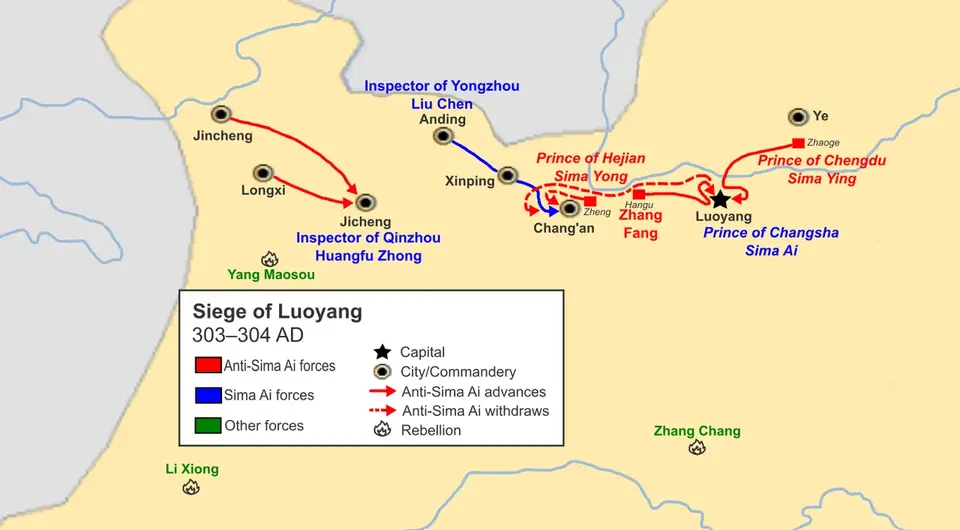
Resenting Sima Ai's governance, launched a joint offensive with Sima Yong to besiege Luoyang for months.
Blamed the defeat at Goutai on Lu Ji and executed the brothers Lu Ji and Lu Yun along with their entire clan.
Following Sima Ai's death, deposed Crown Prince Sima Qin and established his remote chancellor court at Yecheng.
Ambushed Sima Yue's imperial expedition at Dangyin, capturing the wounded Emperor Hui and confining him to Yecheng.
Wang Jun's Xianbei and Wuhuan cavalry stormed Yecheng; Sima Ying fled disheveled with the emperor to Luoyang.
Abducted to Chang'an by Zhang Fang; degraded from Crown Younger Brother back to Prince of Chengdu by Sima Yong.
Captured in Dunqiu while fleeing north; secretly strangled in Yecheng prison alongside his two sons by order of Liu Yu.
Sima Ying was born in the fifth year of Xianning (279) as the sixteenth son of Emperor Wu (Sima Yan), the founding ruler of the Western Jin dynasty. His birth mother was the palace concubine Lady Cheng. From childhood, Sima Ying possessed an imposing, tall physique, remarkably handsome features, and an elegant, gracious demeanor that made him the most physically striking among all of Emperor Wu's sons, earning him his father's deep affection. However, he was intellectually shallow, ignorant of historical statecraft, and easily manipulated by flatterers and household attendants. In the eleventh month of 289, Emperor Wu conducted a sweeping enfeoffment of imperial princes, investing the eleven-year-old Sima Ying as Prince of Chengdu. His feudal domain comprised four rich western commanderies—Shu, Guanghan, Qianwei, and Wenshan—yielding a monumental revenue of one hundred thousand households. Following the accession of his intellectually disabled elder half-brother Emperor Hui (Sima Zhong), Sima Ying remained in the capital Luoyang, holding prestigious military appointments such as Colonel of Agile Cavalry, Master of the Imperial Carriages, Cavalier Regular Attendant, and General of Chariots and Cavalry.
In late 299, the tyrannical Empress Jia Nanfeng and her nephew, Cavalier Regular Attendant Jia Mi, conspired to frame and depose Crown Prince Sima Yu. During a game of chess in the Eastern Palace, Jia Mi argued fiercely and insolently with the crown prince over board positions. Observing this, Sima Ying sternly reprimanded Jia Mi: "The Crown Prince is the future ruler of the realm; how dare you, a subject, behave with such utter insolence!" Jia Mi harbored deep resentment from that hour. Shortly thereafter, Empress Jia forced the intoxicated crown prince to transcribe a forged confession of treason, and Jia Mi convened the imperial princes and grand ministers in the court, compelling them under armed intimidation to sign a joint memorial demanding the crown prince's degradation. While the assembled nobles and elders trembled in terror and affixed their seals without protest, the twenty-one-year-old Sima Ying sat with a countenance of visible fury and indignation, adamantly refusing to give his assent. Recognizing Sima Ying's popularity and moral defiance, Jia Mi determined to remove him from the central government.
In early 300, the court issued an imperial edict dispatching Sima Ying to the frontier as Bearer of the Staff of Authority, Senior General Who Subdues the North, and Commander of Military Affairs in Ji Province, stationing him at Yecheng. Ever since Cao Cao had transformed Yecheng into his capital during the late Eastern Han dynasty, the citadel had stood as the premier administrative, logistical, and military bastion of the northern plains, endowed with immense granaries and armories. Aware of his youth and fragile foundation, Sima Ying placed his trust entirely in his chief of staff, Lu Zhi. A visionary strategist, Lu Zhi urged Sima Ying to govern Hebei with magnanimity to win over the hearts of the populace. Sima Ying followed this advice faithfully, ordering extensive reductions in land taxes and labor service, establishing charitable kitchens, and opening official granaries to provide grain, salt, and shelter for hundreds of thousands of refugees displaced by war and famine.
Simultaneously, under Lu Zhi's guidance, Sima Ying established an open academy in Yecheng to recruit scholars and disaffected literati. The brothers Lu Ji and Lu Yun, grandsons of the renowned Eastern Wu Chancellor Lu Xun, had languished in obscurity in Luoyang under northern aristocratic prejudice. Learning of their plight, Sima Ying dispatched envoys bearing lavish gifts to invite them north, appointing Lu Ji as Internal Administrator of Pingyuan and Lu Yun as Internal Administrator of Qinghe, treating them with extraordinary deference. Attracted by his open-handed patronship, renowned scholars such as Sun Hui and Wang Cui flocked to Yecheng. The northern commanderies flourished in peaceful industry, and the gentry and peasantry of Hebei hailed Sima Ying as a prince of unparalleled benevolence.
In the fourth month of 300, Prince of Zhao Sima Lun orchestrated a palace coup that purged Empress Jia and her clan, exploiting public outrage over the murder of Crown Prince Sima Yu. However, Sima Lun soon unveiled his own naked ambition, deposing Emperor Hui in the first month of 301 to usurp the imperial throne, declaring the Jianzhi era. Sima Lun and his favored chancellor Sun Xiu ruled with terror, distributing noble titles recklessly to sycophants while murdering upright ministers. In a bid to conciliate Sima Ying and neutralize his northern army, Sima Lun conferred upon him the titles of Senior General Conquering the North and Equal in Honor to the Three Excellencies, granting additional estates.
In the third month of 301, Prince of Qi Sima Jiong issued a righteous call to arms from Xuchang, rallying regional princes to depose the usurper. When the proclamation reached Yecheng, imperial envoys sent by Sima Lun were present in the hall. Lu Zhi counseled Sima Ying: "The Prince of Zhao has committed treason against heaven; gods and men are filled with wrath. Your Highness is a beloved son of Emperor Wu, possessing preeminent renown. If you lead a righteous crusade today, the entire empire will follow you!" Sima Ying acted decisively, executing Sima Lun's envoys in the public square and marshaling the combined hosts of Ji Province. Leading two hundred thousand veteran infantry and cavalry southward with Lu Zhi as chief advisor and Lu Ji as vanguard commander, his columns surged toward the Yellow River.
Alarmed by the northern uprising, Sima Lun dispatched fifty thousand of his best palace guards under commanders Sun Hui and Zhang Hong to hold the fortified crossing at Huangqiao. In the initial clash, Sima Ying's forward units were thrown into confusion by a ferocious enemy charge. Sima Ying personally rode to the front, leaning on his sword beneath the main war drums, ordering that any officer who retreated would be instantly beheaded. Inspired by their lord's personal courage amidst flying arrows, the Hebei veterans rallied. Detecting an overextended flank in Zhang Hong's formation, Sima Ying launched an overwhelming cavalry double envelopment across the plains of Huangqiao, annihilating the usurper's elite corps, slaying Zhang Hong, and taking thousands of prisoners. Sima Ying advanced victoriously across the Yellow River to Zhaoge.
Simultaneously, Sima Jiong's columns broke through at Yanshi, while Sima Yong's forces emerged from the passes. Palace commanders in Luoyang mutinied, beheading Sun Xiu and executing Sima Lun. In the fifth month of 301, Emperor Hui was restored to the throne, and Sima Ying led his grand army into Luoyang. Overjoyed by his deliverance, Emperor Hui issued an imperial rescript granting Sima Ying the supreme titles of Commander of Internal and External Armies and Manager of the Affairs of the Masters of Writing, bestowing the Nine Bestowments and urging him to take charge of the central administration.
Confronted with the pinnacle of dynastic power, Sima Ying listened to the farsighted counsel of Lu Zhi: "The Prince of Qi raised the standard of revolt first; if two formidable princes remain together in the capital, bloody friction is inevitable. Your Highness should decline these supreme honors, yield the credit to the Prince of Qi, and use your mother Lady Cheng's desire to return to Yecheng as an honorable pretext to retire to Hebei. By doing so, you will preserve filial and ministerial virtue, escape the political maelstrom of Luoyang, and observe unfolding events from a position of absolute safety. The entire realm will revere you as a living sage!" Sima Ying embraced this counsel, formally submitting memorials that repeatedly refused the Nine Bestowments and regent appointments, accepting only the title of Grand General. He then ordered his two hundred thousand troops to withdraw from the capital and return to Yecheng.
While marching past the old battlefield of Huangqiao, Sima Ying was deeply moved by the sight of more than eight thousand unburied skeletons of fallen soldiers from both sides bleaching in the wilderness. Halting his entire army, he mobilized several thousand soldiers to construct massive communal tombs near Wen County and Huangqiao, carefully interring every set of remains in wooden coffins. He then erected sacrificial altars and wept openly before the dead, offering libations and prayers. This act of profound compassion resonated across the realm; scholars penned eulogies celebrating his virtue, and public opinion widely compared him to the Duke of Zhou and Huo Guang, elevating his historical stature to its zenith.
Tragically, this immense prestige and military might soon eroded Sima Ying's superficial character. Once Sima Ying returned to Yecheng, sole executive power in Luoyang fell into the hands of Prince of Qi Sima Jiong. Sima Jiong quickly descended into corrupt megalomania, building palatial mansions, changing administrative statutes, and treating the emperor with contempt. Disillusioned with Sima Jiong, court ministers and regional garrisons increasingly looked toward Sima Ying at Yecheng to deliver the dynasty once more. However, Sima Ying's favored eunuch Meng Jiu fiercely opposed returning to Luoyang, fearing the loss of his personal influence, while Lady Cheng remained enamored of Yecheng's luxuries. Consequently, Sima Ying abandoned notions of constitutional service and began stockpiling arms to seize supreme power through force.
In late 302, Prince of Hejian Sima Yong issued a manifesto from Guanzhong denouncing Sima Jiong, and Sima Ying joined the coalition in armed rebellion, disregarding Lu Zhi's warnings. Inside Luoyang, Prince of Changsha Sima Ai struck first, leading a daring palace raid that overwhelmed and killed Sima Jiong after three days of combat. Sima Ai assumed the regency, proving to be an exceptionally courageous, incorruptible, and dedicated protector of Emperor Hui and the dynastic order.
Sima Ying had presumed that Sima Jiong's fall would automatically leave him supreme master of China. Enraged that Sima Ai had taken center stage without yielding the court to Yecheng, Sima Ying was consumed by bitter jealousy. In the eighth month of 303, Sima Ying formed an offensive pact with Sima Yong to wage open war against Sima Ai. Sima Ying mobilized more than two hundred thousand Hebei troops, appointing the southern literary titan Lu Ji as Forward Commander and General of the Rear, ordering him across the Yellow River. Sima Yong deployed general Zhang Fang with seventy thousand troops from the west, placing Luoyang under a dual siege of nearly three hundred thousand men.
Placing Lu Ji in supreme command of two hundred thousand northern soldiers proved disastrous. Northern commanders like Wang Cui, Qian Xiu, and Shi Chao despised southern exiles and openly disobeyed Lu Ji's orders, circulating malicious rumors that Lu Ji was treasonously coordinating with Sima Ai. Desperate and trapped by conflicting pressures, Lu Ji marched to Goutai and the deer park outside Luoyang in the tenth month of 303, where he was met by Sima Ai's core guard. Sima Ai fought on foot in the front ranks, inspiring his veterans to shatter Lu Ji's uncoordinated host. The Hebei army disintegrated in total rout; over ten thousand men were trampled or drowned, their floating corpses choking the Wen River.
Upon the survivors' return, the eunuch Meng Jiu—whose brother Meng Chao had been disciplined for looting by Lu Ji prior to dying in the battle—poisoned Sima Ying's mind with fabrications, alleging that Lu Ji had deliberately delayed his forces to betray the army to Sima Ai. Enraged beyond reason, Sima Ying refused to conduct any judicial inquiry and immediately dispatched Qian Xiu to execute Lu Ji in his camp. Facing death, Lu Ji sighed mournfully: "Shall I ever hear the cranes cry at Huating again?" Sima Ying extended his wrath through extermination, executing Lu Ji's brother Lu Yun, their younger brother Lu Dan, and every member of the Lu lineage. Though Chief Commander Jiang Tong submitted impassioned memorials exposing the slanders, Sima Ying ignored all appeals. The slaughter of the beloved Lu brothers sent shockwaves of grief and horror throughout the literary world, irrevocably shattering Sima Ying's reputation for virtue.
From the winter of 303 to the spring of 304, the siege of Luoyang dragged on under conditions of unimaginable horror. The civilian population was reduced to cannibalism, yet Sima Ai held the walls with fierce determination, repeatedly sallying forth to inflict tens of thousands of casualties upon Sima Ying and Zhang Fang. Just as the besiegers were growing exhausted, East Sea Prince Sima Yue, terrified of being slaughtered if the city fell, betrayed Sima Ai by night, organizing a mutiny of palace guards to seize the regent and deliver him to Zhang Fang's camp, where Sima Ai was roasted alive over an open pit.
With Sima Ai eliminated, Sima Ying entered Luoyang in triumphant majesty in the first month of 304. Stripping away his former pretenses of loyalty, he coerced Emperor Hui into deposing Crown Prince Sima Qin, banishing the boy to Qinghe. Compelling the court to submit petitions of advancement, Sima Ying formally proclaimed himself Crown Younger Brother, assuming the supreme office of Chancellor and Commander of Internal and External Armies.
However, unwilling to reside in the war-ravaged capital of Luoyang and longing for his luxurious stronghold, Sima Ying took the unprecedented step of establishing his official chancellery in Yecheng. He left Sima Yue to manage Luoyang, while transporting imperial registers, treasuries, and senior ministers to Yecheng, where he constructed imperial audience halls and rode in carriages bearing full imperial regalia. He established an authoritarian satellite court that held the captive throne in Luoyang under remote control. Sima Ying abandoned himself to wine, women, and lavish banquets, surrendering administrative governance entirely to the corrupt eunuch Meng Jiu, whose predatory bribery alienated the very Hebei populace that had once revered him.
In the seventh month of 304, Sima Yue, exasperated by Sima Ying's overbearing control, allied with generals Chen Zhen and Lu Yao to mount a counter-coup in Luoyang. Reinstating Sima Qin, Sima Yue rallied northern governors and persuaded Emperor Hui to personally lead an imperial punitive expedition of one hundred thousand troops to subjugate Yecheng.
Panicking at the news of an imperial expedition, Sima Ying initially considered abandoning Yecheng. His imperial uncle, Prince of Dong'an Sima Yao, urged Sima Ying to submit to the sovereign and beg forgiveness. Suspecting treason, Sima Ying instantly executed Sima Yao outside his hall. Urged to fight by generals Wang Hun and Cui Kuang, Sima Ying dispatched veteran commander Shi Chao with fifty thousand elite cavalry to ambush the imperial grand army near Dangyin. Deceived by false reports that Yecheng had already surrendered, Sima Yue's forces marched without battle formations.
Shi Chao sprang his ambush at Dangyin with devastating force. The imperial army disintegrated in panic, suffering over ten thousand casualties, and Sima Yue fled alone toward his fief in Donghai. As courtiers fled for their lives, Palace Attendant Ji Shao (son of the poet Ji Kang) threw himself in front of the emperor, shielding him with his own body until rebel soldiers dragged him down and butchered him on the spot, splattering the imperial robes with his blood. Emperor Hui was wounded in the face by three arrows and abandoned in the marsh grass. Shi Chao retrieved the wounded monarch, securing the imperial seal, and escorted him into Yecheng. Sima Ying rode out twenty li to receive the emperor, weeping feigned tears of apology while placing him under heavily armed house arrest, forbidding attendants from washing the blood of Ji Shao from his robes as a permanent threat. Through the victory at Dangyin, Sima Ying appeared to have achieved unchallenged mastery over the dynasty.
However, the triumph at Dangyin proved to be Sima Ying's undoing. From Jicheng, Inspector Wang Jun of Youzhou and Governor Sima Teng of Bing Province (brother of Sima Yue) denounced Sima Ying's abduction of the emperor and forged a military alliance with northern non-Han tribes. Mobilizing the fearsome cavalry of Duan Wuwuchen's Xianbei and Wuhuan confederations, Wang Jun led tens of thousands of barbarian horsemen southward into Ji Province.
Sima Ying rushed Shi Chao and Wang Cui northward, but their infantry was swept aside and massacred by the charging Xianbei cavalry at Pingji. Wang Jun's barbarian coalition swept unopposed to the gates of Yecheng. Terrified by the northern storm, Sima Ying found that the people and soldiers of Yecheng, exhausted by his misrule, refused to fight for his survival. In this supreme crisis, Liu Yuan, commander of the Five Divisions of the Xiongnu under Sima Ying's banner, proposed: "The Xianbei barbarians press our gates, and our garrisons cannot withstand them. Your Highness should grant me leave to return to Bing Province to rally one hundred thousand Xiongnu warriors to crush Wang Jun!" Desperate for salvation, Sima Ying commissioned Liu Yuan Northern Chanyu and sent him west, unwittingly releasing the catalyst that would consume northern China in the Sixteen Kingdoms era.
Liu Yuan never returned to relieve Yecheng. Days later, Wang Jun's Xianbei stormed the fortifications. Yecheng was subjected to a savage sack and massacre in which more than twenty thousand inhabitants were butchered, and thousands of palace maidens were abducted. In utter panic, Sima Ying abandoned all thought of resistance. Disheveled, unarmored, and accompanied by only a few dozen retainers, he dragged the terrified Emperor Hui out of the western gate and fled southward across the countryside. For days, the fugitive imperial party wandered without rations or shelter, begging for gruel from roadside peasants, before finally reaching Luoyang.
Upon entering Luoyang, Sima Ying discovered that the city had been seized by Sima Yong's ruthless general Zhang Fang. Viewing Sima Ying as a worthless liability, Zhang Fang abducted both Emperor Hui and Sima Ying to Chang'an. At Chang'an, Sima Yong stripped Sima Ying of his title of Crown Younger Brother and Chancellor, demoting him back to Prince of Chengdu and confining him under armed guard. In 306, Sima Yue launched a grand offensive with eastern provincial governors, recapturing Chang'an and rescuing Emperor Hui. As Sima Yong's regime collapsed, Sima Ying escaped the chaos with Lady Cheng, his wife, and his young sons Sima Pu and Sima Kuo, fleeing south toward Wuguan to seek asylum under Inspector Liu Hong of Jingzhou. When Liu Hong dispatched troops to apprehend him near Xinye, Sima Ying callously abandoned his mother and wife, fleeing northward with his two young sons toward Hebei to seek his former commander Gongshi Fan.
Reaching Dunqiu, the exhausted fugitives were recognized by magistrate Feng Song, who placed them in chains and escorted them to the dungeons of Yecheng. The northern theater commander, Prince of Fanyang Sima Xiao, hesitated to execute an imperial brother and kept him imprisoned. However, Sima Xiao died suddenly of an acute illness weeks later. His chief staff officers, Liu Yu and Liu Kun, were acutely aware that the populace of Hebei still harbored nostalgic memories of Sima Ying's early benevolent rule. Fearing that northern loyalists would exploit Sima Xiao's death to stage an insurrection around the prince, they decided to eradicate him in secret.
In the ninth month of 306, Liu Yu concealed Sima Xiao's death and forged an imperial death warrant. The prison warden Tian Hui entered the cell carrying a white silk cord. Seeing the cord, Sima Ying recognized that his end had come; he uttered a profound lament toward the ceiling and was strangled to death in the dim cell at the age of twenty-eight. His two young sons, Sima Pu and Sima Kuo, were strangled alongside him, their bodies buried unceremoniously on the muddy banks of the Zhang River. Months later, his former commanders Gongshi Fan and Ji Sang rose in open revolt, unearthing Sima Ying's coffin and carrying it at the head of their armies to avenge his death, torching Yecheng and slaughtering Sima Teng, plunging northern China into the total cataclysm of the Five Barbarians.
FIGURES ASSOCIATED WITH THIS DYNASTY