Resignation in Protest
Served as Section Clerk in Kuaiji, appealed in vain against the unjust execution of a filial widow, and resigned in tears.
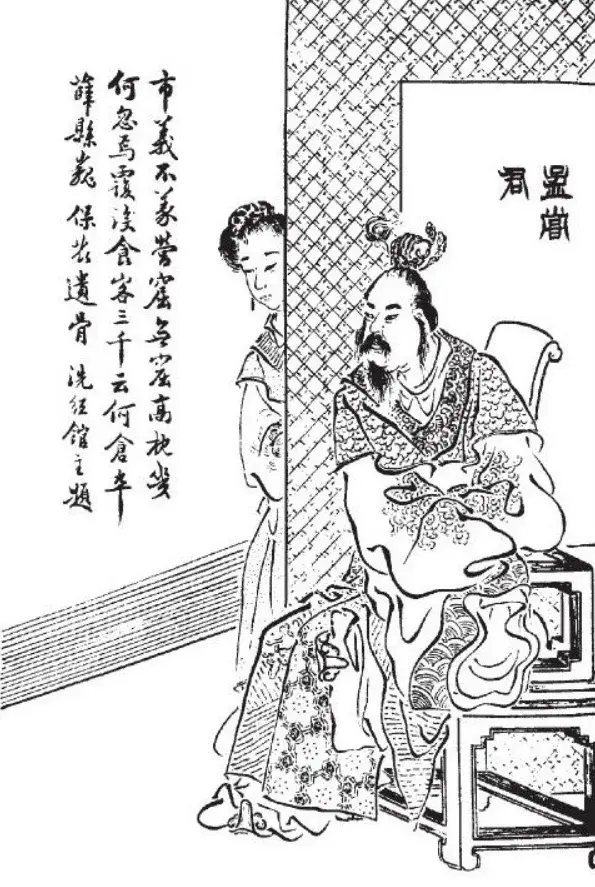
孟尝
Meng Chang (孟尝, ?–c. 171), courtesy name Bozhou, was a native of Shangyu County in Kuaiji Commandery during the mid-Eastern Han Dynasty, widely celebrated as an exemplary upright and compassionate official. In his youth, he cultivated impeccable moral integrity and entered official service as an Officer of the Household Registry Section in Kuaiji Commandery. When a virtuous widow in Shangyu was falsely accused by her…
Meng Chang (孟尝, ?–c. 171), courtesy name Bozhou, was a native of Shangyu County in Kuaiji Commandery during the mid-Eastern Han Dynasty, widely celebrated as an exemplary upright and compassionate official. In his youth, he cultivated impeccable moral integrity and entered official service as an Officer of the Household Registry Section in Kuaiji Commandery. When a virtuous widow in Shangyu was falsely accused by her sister-in-law of poisoning her mother-in-law, Meng Chang vigorously argued for her exoneration. When his superiors ignored his appeals and executed her, he wept bitterly and resigned in protest. When the subsequent Grand Administrator Yin Dan investigated the case during a severe regional drought, Meng Chang uncovered the truth and helped posthumously clear her name; upon executing the slanderer and sacrificing at the widow's grave, torrential rains ended the drought, spreading Meng Chang's fame throughout the southern provinces. Subsequently recommended as Filial and Incorrupt and Promoted Talent, Meng Chang served with distinction as Magistrate of Xu County before being elevated to Grand Administrator of Hepu. Hepu Commandery was an arid coastal frontier that relied on harvesting sea pearls to trade with neighboring Jiaozhi for grain. Previous corrupt administrators had imposed predatory levies and over-harvested pearl beds, exhausting the oysters and driving surviving colonies into Jiaozhi waters, which collapsed commerce and caused mass starvation. Upon taking office, Meng Chang banned destructive over-dredging, restored natural marine regeneration, and reopened equitable border markets. Within less than a year, pearl oysters returned to Hepu and trade revived, giving rise to the famous historical idiom "the pearls return to Hepu" (Hepu Zhu Huan). Later, when ill health prompted his retirement, local residents blocked roads to plead for his continuation; he slipped away disguised at midnight aboard a small riverboat and retired to marshland farming, attracting over a hundred scholarly families to settle nearby. Although Minister of the Master of Writing Yang Qiao submitted seven impassioned memorials urging the court to employ him, political corruption prevented his reinstatement, and he died peacefully at home at the age of seventy. In his famous Preface to the Prince of Teng's Pavilion, the Tang dynasty poet Wang Bo lamented: "Meng Chang was noble and pure, yet his devotion to his country remained unfulfilled."
Served as Section Clerk in Kuaiji, appealed in vain against the unjust execution of a filial widow, and resigned in tears.
Advised new administrator Yin Dan to execute the slanderer and honor the widow, instantly bringing timely rains to end a two-year drought.
Recommended as Filial and Incorrupt, appointed Magistrate of Xu County, where his administrative success earned top regional commendation.
Promoted to Grand Administrator of Hepu, abolished predatory quotas and banned reckless harvesting, restoring pearl beds and border commerce within a year.
Resigned due to illness, evaded blocking crowds by fleeing on a nocturnal riverboat, and retired to farm in marshlands with a hundred neighboring households.
Minister Yang Qiao submitted seven memorials offering his own life to recommend Meng Chang, yet court factionalism blocked his appointment.
Maintained scholarly contentment in modest circumstances, passing away peacefully at home at seventy.
Meng Chang was born into a prominent scholarly lineage in Shangyu County within Kuaiji Commandery. From his early years, he embraced Confucian ethical tenets, prioritizing self-discipline, personal honor, and public justice. He began his administrative career as an Officer of the Household Registry Section in the Kuaiji commandery government, overseeing census registrations, sacrificial rituals, and local judicial petitions, earning widespread esteem for his fairness.
During his tenure, a sensational family tragedy shocked Shangyu County. A local widow devotedly served her elderly mother-in-law, earning universal praise for her filial piety. Following the mother-in-law's death from old age, her jealous sister-in-law, coveting the family estate, falsely accused the widow of wearying of domestic care and administering lethal poison. Lazy and negligent magistrates accepted the confession extracted under severe torture and sentenced the innocent widow to execution.
Familiar with the case records, Meng Chang knew the charges were groundless. He rushed to the Grand Administrator's headquarters, presenting evidence and pleading for a retrial. However, the indifferent administrator refused to reconsider and ordered her immediate beheading. Devastated by the miscarriage of justice, Meng Chang wept outside the government gates for several days before relinquishing his seal of office and resigning. Following her death, Kuaiji Commandery suffered a devastating two-year drought that scorched fields and desiccated waterways, with all official rain prayers yielding no results.
When the incorrupt administrator Yin Dan assumed leadership of Kuaiji, he investigated the cause of the relentless calamity. Meng Chang visited the government offices to disclose the full details of the widow's wrongful execution, urging: "In ancient times, the filial woman of Donghai was unjustly put to death, provoking severe drought until Duke Yu voiced the truth, whereupon rain fell in abundance. Today, you should execute the slandering woman, offer solemn apologies at the widow's tomb, and clear her grievances; then the seasonal rains will surely descend." Yin Dan embraced this advice, arrested and executed the false accuser, and led officials in paying homage at the widow's grave. Clouds gathered instantly, pouring torrential rains that ensured a bountiful harvest, leading the commandery to revere Meng Chang's sagacity.
Following the vindication of the filial widow, Meng Chang's renown spread across the empire. The imperial court summoned him through examinations, recommending him as Filial and Incorrupt, followed quickly by selection as a Promoted Talent. He was appointed Magistrate of Xu County, an administrative seat in modern Sihong, Jiangsu. Xu County was characterized by dense river networks and mobile migrant populations. Meng Chang streamlined household registers, reduced corvee exactions, and promoted sericulture and farming. Within several years, the region achieved social harmony and agricultural prosperity, prompting regional inspectors and commandery leaders to rate his performance best in the province.
Recognizing his administrative gifts, the imperial court elevated Meng Chang to Grand Administrator of Hepu. Situated on the southern maritime frontier, Hepu was an environmentally unique commandery where rocky terrain discouraged crop cultivation, yet coastal waters teemed with rare pearls. Local inhabitants had for generations sustained their households by diving for natural pearls and trading them with neighboring Jiaozhi Commandery in exchange for rice and basic necessities.
Prior to Meng Chang's arrival, successive administrators had operated as rapacious extortionists. Colluding with wealthy merchants, they compelled pearl divers to scour the seabed day and night, scooping up every oyster regardless of maturity. This predatory exploitation devastated benthic breeding ecosystems, compelling surviving pearl oysters to migrate away into the waters of Jiaozhi.
The collapse of pearl populations halted commercial exchanges, cutting off food imports and precipitating severe famine. Starving villagers collapsed along roadsides, and the maritime economy disintegrated. Arriving in Hepu, Meng Chang was moved to tears by the devastation and resolved to execute fundamental reforms.
Taking charge at Hepu, Meng Chang initiated bold reforms. He visited fishing hamlets to investigate the plight of pearl divers, immediately abolishing illicit surcharges and predatory taxes invented by previous officials while punishing extortionate sub-officials.
Addressing the environmental devastation, Meng Chang revoked coercive administrative collection quotas and enacted fishing bans grounded in ecological observation. He strictly forbade the harvesting of immature oysters, designated specific harvesting zones and seasons, and granted marine beds adequate time for natural regeneration. Concurrently, he mobilized coastal inhabitants to cultivate arable riverbank terraces, reducing absolute dependence on pearl diving.
Simultaneously, Meng Chang dispatched envoys to open diplomatic and commercial negotiations with administrative authorities in Jiaozhi, opening border trade marts, dismantling barrier duties, and ensuring the smooth, stable importation of grain into Hepu. With exploitative extraction halted and coastal waters protected, the marine ecosystem rebounded rapidly.
Within less than a twelvemonth, an astonishing revival occurred: vast clusters of pearl-producing oysters returned and flourished once again in Hepu's shallow waters. Harbors along the coastline buzzed with commercial vessels, pearl divers resumed their ancestral livelihoods, food supplies stabilized, and starvation was eliminated. The entire commandery rejoiced, attributing the environmental and economic revival to Meng Chang's moral rectitude and praising it as divine benevolence, immortalized in Chinese cultural memory as the historic idiom "the pearls return to Hepu."
Meng Chang's success at Hepu was celebrated throughout the empire. However, years of rigorous administration within the damp, subtropical climate undermined his health. Unwilling to collect emoluments without performing active duties, and refusing to accumulate wealth from local pearl trades, he repeatedly submitted petitions requesting medical retirement.
The imperial court granted his release and summoned him to the capital for future reappointment. When word spread that Meng Chang was departing, thousands of local residents and gentry flooded government compounds and roadways. Citizens wept and clung to the carriage wheels, blocking the highway and begging him to remain in office.
Convinced that an open departure was impossible, Meng Chang feigned compliance and returned to his lodgings. In the dead of night, he donned the coarse clothing of a common peasant, discarded all official trappings, boarded a modest skiff anchored in a secluded inlet, and quietly drifted away under cover of darkness, completely leaving political office behind.
Returning to Kuaiji, Meng Chang eschewed bureaucratic circles, retiring instead to an isolated wetland marsh near the Shangyu coastline. He personally plowed the fields and tended crops, living a modest and self-sufficient agrarian life. Inspired by his lofty ethical stature, scholars and villagers from neighboring districts abandoned former homes and relocated beside his hermitage, erecting over a hundred thatched dwellings and transforming the remote wetland into a harmonious community.
Following Emperor Huan's accession, imperial governance fell increasingly under the control of arrogant consort kin and court eunuchs, resulting in rampant venality and the blatant sale of bureaucratic ranks. Yang Qiao, an incorrupt Minister of the Master of Writing and a fellow native of Kuaiji, knew Meng Chang possessed extraordinary competence and pristine integrity, and could not bear to see such a statesman languish in obscurity.
Yang Qiao submitted seven successive memorials to Emperor Huan, passionately championing Meng Chang's virtues. He wrote that Meng Chang embodied benevolence, championed righteousness, and possessed administrative talents far surpassing the ordinary. During his tenure at Hepu, he reformed local customs, caused the lost pearls to return, and saved starving populations. Though vast fortunes of gold and rare gems had passed through his hands in the south, he retired alone in poverty, tilling the soil without displaying worldly vanity. Yang Qiao declared Meng Chang a pillar of state, even invoking the ancient tradition of staking his life on the recommendation.
Nevertheless, in an era where palace cliques demanded immense bribes for high office, a spotless gentleman incapable of flattery had no avenue to power. Emperor Huan ignored the petitions, leaving Meng Chang unappointed. Meng Chang remained entirely untroubled, finding serene contentment among the mulberry groves and furrowed fields.
Around 171, Meng Chang passed away peacefully in his rustic cottage at the age of seventy. Though he never attained the three excellencies, his transformative governance at Hepu and his resolute refusal of ill-gotten wealth were celebrated by Fan Ye in the Book of the Later Han and immortalized through centuries of classical poetry.
While serving as an Officer of the Household Registry in Kuaiji, Meng Chang displayed remarkable judicial courage by resisting administrative negligence in a capital murder trial. Surrounded by passive colleagues and authoritarian superiors, he risked his career and wept openly outside the government offices to defend a wrongfully condemned widow.
When Grand Administrator Yin Dan later assumed command, Meng Chang boldly presented historical precedents to secure a posthumous pardon and judicial vengeance against the slanderer, ending a regional calamity. His intervention illustrated the Confucian ethos of placing human life and moral truth above bureaucratic expediency.
Meng Chang's administrative tenure at Hepu represents an early milestone in integrated ecological stewardship and commercial revitalization. Recognizing that over-dredging had destroyed oyster colonies, he rejected coercive extraction in favor of biological regeneration.
By establishing closed harvesting seasons, protecting juvenile shellfish, and securing peaceful cross-border trade with Jiaozhi to ensure stable food supplies, he restored the local pearl beds within a single year. This achievement generated the enduring cultural metaphor of the return of Hepu pearls, celebrating restorative and benevolent leadership.
As ruler of a commandery famed for rare treasures, Meng Chang handled immense fortunes without enriching himself. When local citizens blocked roads to prevent his departure, he chose a nocturnal escape in peasant garb, avoiding personal aggrandizement.
In retirement, he cultivated the soil with his own hands, inspiring more than a hundred families to gather around his humble homestead. His life exemplified the highest Confucian ideals of selfless public duty and noble agrarian disengagement.
FIGURES ASSOCIATED WITH THIS DYNASTY