Imperial Clansman Birth
Born into a prominent clan lineage in Feng County, Pei Commandery, as the great-great-grandson of Prince Yuan of Chu.
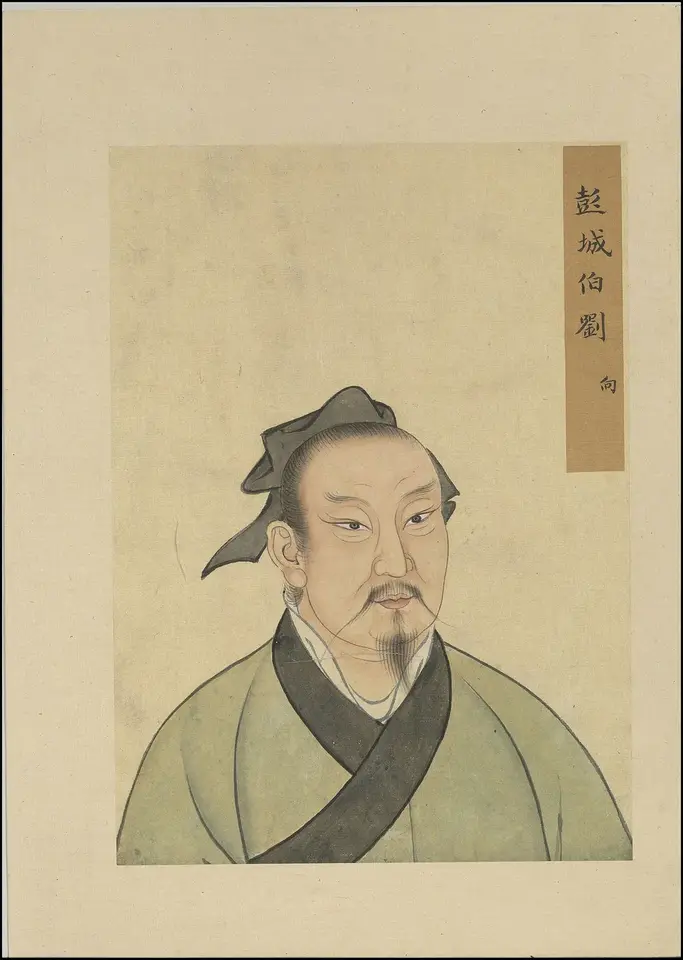
刘向
Liu Xiang (刘向, 77 BC – 6 BC), originally named Liu Gengsheng and styled Zizheng, was a native of Feng County in Pei Commandery. He was an imperial clansman of the Western Han dynasty, a distinguished classicist, a pioneering bibliographer, and an eminent prose writer, descending as the great-great-grandson of Prince Yuan of Chu, Liu Jiao. Renowned for his erudition in Confucian classical canons and his mastery of the Guliang…
Liu Xiang (刘向, 77 BC – 6 BC), originally named Liu Gengsheng and styled Zizheng, was a native of Feng County in Pei Commandery. He was an imperial clansman of the Western Han dynasty, a distinguished classicist, a pioneering bibliographer, and an eminent prose writer, descending as the great-great-grandson of Prince Yuan of Chu, Liu Jiao. Renowned for his erudition in Confucian classical canons and his mastery of the Guliang Commentary on the Spring and Autumn Annals, Liu Xiang entered palace service under Emperor Xuan after presenting exquisite rhapsodies, successively serving as Palanquin Gentleman, Grandee Remonstrant, and In Attendance. Under Emperor Yuan, he was promoted to Chamberlain for the Imperial Clan, but was twice imprisoned and demoted to commoner status for leading protests alongside Xiao Wangzhi and Zhou Kan against corrupt eunuch dominance. Following the accession of Emperor Cheng, Liu Xiang was recalled to high office, serving as Gentleman of the Household, Grand Palace Grandee, and Colonel of the Central Ramparts. In 26 BC, under imperial decree, he took charge of a comprehensive national project to collate the imperial secret library archives, systematically editing classical canons, commentary traditions, masters texts, and poetic rhapsodies over more than two decades. This effort produced Bielu (Separate Records), the first systematic bibliographical catalogue in Chinese history, while stabilizing foundational texts such as Zhanguo Ce (Strategies of the Warring States), Shanhai Jing (Classic of Mountains and Seas), and Chu Ci (Songs of Chu). In his later years, he courageously submitted memorials warning against the rising power of the consort clans, while compiling Xinxu (New Prefaces), Shuoyuan (Garden of Stories), and Lienu Zhuan (Biographies of Exemplary Women), establishing the foundational framework of classical bibliography, textual criticism, and moral history in China.
Born into a prominent clan lineage in Feng County, Pei Commandery, as the great-great-grandson of Prince Yuan of Chu.
Summoned into the palace after presenting dozens of literary rhapsodies, appointed as Palanquin Gentleman.
Reached the age of majority and received promotion to Grandee Remonstrant on account of his scholarship and rectitude.
Imprisoned and condemned to death after failing an imperial trial to produce alchemical gold, but spared upon his brother paying redemption fines.
Promoted to Chamberlain for the Imperial Clan and Palace Attendant upon the accession of Emperor Yuan.
Co-authored confidential memorials impeaching court eunuchs Hong Gong and Shi Xian, resulting in his imprisonment and dismissal.
Recalled as Gentleman of the Household, but swiftly framed by Shi Xian for remonstrating against court abuses and demoted to commoner status for fifteen years.
Recalled by Emperor Cheng with Nine-Chamberlain honors, appointed Gentleman of the Household to supervise waterway conservancy, later advancing to Grand Palace Grandee.
Commanded to lead the collation of ancient bamboo-slip and silk manuscripts in the imperial secret archives, creating Bielu.
Passed away in Chang'an at the age of seventy-two while serving as Colonel of the Central Ramparts, leaving his collation work to be completed by his son Liu Xin.
Liu Xiang belonged to the illustrious lineage of Prince Yuan of Chu, Liu Jiao, a younger sibling of Han founder Liu Bang. Across four generations, his great-grandfather Liu Piqiang, grandfather Liu De, and father Liu De had all attained premier ministerial offices while transmitting the Classic of Poetry and Confucian principles. Endowed with extraordinary memory and intellectual curiosity, Liu Xiang mastered pre-Qin philosophical discourses, the Guliang tradition, and poetic composition during his youth. In 66 BC, at a tender age, he presented dozens of rhapsodies to Emperor Xuan, who marveled at his eloquence and appointed him Palanquin Gentleman to accompany the court retinue.
Upon completing his capping ceremony in 60 BC, Liu Xiang earned promotion to Grandee Remonstrant due to his moral integrity and classical acumen. He participated actively in court debates regarding local administration and astronomical portents across Guandong. In 56 BC, influenced by ancient texts attributed to Prince Liu An of Huainan, Liu Xiang submitted an alchemical proposal to manufacture gold to replenish the state treasury. When the lavish experiments failed, Emperor Xuan grew furious and remanded him to the Commandant of Justice under capital charges. In this mortal crisis, his elder brother, Marquess Liu Demin of Yangcheng, expended substantial family fortunes to pay redemption funds, securing Liu Xiang's release from prison with the temporary forfeiture of his offices.
In 51 BC, Emperor Xuan recognized Liu Xiang's loyalty and scholarship, reappointing him as Gentleman of the Household and soon elevating him to Cavalier Attendant, Grandee Remonstrant, and In Attendance. When Emperor Yuan ascended the throne in 48 BC, the new monarch favored Confucian learning and elevated talented scholars. Liu Xiang was appointed Chamberlain for the Imperial Clan, assuming responsibility for imperial genealogical affairs and state decisions.
During this period, Palace Palace Attendants Hong Gong and Shi Xian accumulated immense clandestine power, forging alliances with imperial consort clans and silencing principled ministers. Viewing this usurpation as a mortal threat to dynastic stability, Liu Xiang allied with Grand Tutor Xiao Wangzhi and Lesser Chamberlain Zhou Kan. Liu Xiang submitted secret memorials citing historical precedents and celestial portents, arguing that eunuch dominance disrupted sovereign authority and demanding their removal from central government.
Hong Gong and Shi Xian struck back ruthlessly, framing Xiao Wangzhi and Liu Xiang for conspiracy against the state. Emperor Yuan credited the eunuchs' allegations, resulting in Xiao Wangzhi taking his own life and Liu Xiang being incarcerated. Through the steadfast appeals of upright peers, Liu Xiang escaped execution but was stripped of his ministerial rank. Although reinstated briefly as Gentleman of the Household in 44 BC, Liu Xiang persisted in condemning the eunuch clique. Shi Xian once more engineered false charges against him, resulting in his expulsion from office and reduction to commoner status, consigning him to private life in the countryside for fifteen years.
Following the accession of Emperor Cheng in 32 BC, the tyrannical eunuch clique was dismantled. Aware of Liu Xiang's integrity across successive reigns, Emperor Cheng summoned him back to metropolitan administration with the dignity of a former Nine Chamberlain, assigning him to supervise waterways in the capital environs. Demonstrating notable administrative efficiency in hydraulic projects, Liu Xiang was rapidly promoted to Grand Palace Grandee.
In 26 BC, recognizing that centuries of imperial fires, civil conflicts, and unauthorized copying had severely corrupted surviving ancient literature, Emperor Cheng decreed an empire-wide search for lost manuscripts and appointed Liu Xiang to direct the collation of the imperial secret archives. Stationed in the Tianlu and Shiqu Pavilions, Liu Xiang directed an elite editorial bureau: Colonel Ren Hong reviewed military treatises, Grand Astrologer Yin Xian examined astronomical and divination manuals, and Court Physician Li Zhuguo collated medical arts, while Liu Xiang personally directed the examination of Confucian classics, commentary lineages, masters philosophies, and poetic rhapsodies.
In this colossal endeavor, Liu Xiang formulated meticulous textual collation protocols. Whenever a text was retrieved, he gathered all available variants to cross-examine characters, eliminate redundancies, and repair fragmented bamboo slats, establishing an authoritative master copy. He then composed an analytical descriptive entry for each work, elucidating the author's background, ideological origins, transmission lineage, and thematic significance. These collected essays formed Bielu (Separate Records), the first systematic bibliographical catalogue in Chinese history. In 23 BC, Liu Xiang became Colonel of the Central Ramparts, persevering in this massive scholarly labor until his death, after which the work was continued by his youngest son, Liu Xin.
During the reign of Emperor Cheng, Liu Xiang watched with growing alarm as the sovereign neglected governance while the Empress Wang's relatives, known as the Five Marquesses, monopolized executive authority. Deeply troubled by this existential menace to the Liu dynasty, Liu Xiang repeatedly risked execution to deliver impassioned remonstrances. Citing the Five Agents teachings of the Book of Documents and astronomical anomalies from the Spring and Autumn Annals, he compiled the eleven-volume Hongfan Wuxing Zhuanlun (Treatise on the Five Phases of the Great Plan), presenting it to the throne to warn against the perils of consort family dominance.
Although Emperor Cheng expressed admiration for Liu Xiang's unwavering devotion, his irresolute character prevented him from curbing the consort clan's power. Recognizing that direct political remonstrance could no longer halt the dynastic decline, Liu Xiang redirected his efforts toward historical and moral education. Gathering anecdotes, philosophical dialogues, and historical episodes from pre-Qin and early Han records, he authored Xinxu (New Prefaces) in thirty chapters, Shuoyuan (Garden of Stories) in twenty chapters, and Lienu Zhuan (Biographies of Exemplary Women) in seven chapters, providing monarchs and scholar-officials with moral mirrors of virtue and vice.
In 6 BC, Liu Xiang passed away at his Chang'an residence at the age of seventy-two. Having served through the reigns of Emperors Xuan, Yuan, and Cheng, he remained steadfast in Confucian moral principles and dynastic loyalty. While his political warnings failed to prevent the eventual usurpation by Wang Mang, his foundational achievements in textual criticism and library science permanently safeguarded China's pre-Qin heritage for millennia.
Liu Xiang's most transformative contribution to Chinese intellectual history was his pioneering organization and critical collation of the imperial secret library. The intellectual heritage of the Hundred Schools of Thought had suffered catastrophic disruption during the Qin book burnings and the destructive wars between Chu and Han. Although the early Han dynasty had encouraged book donations, the imperial archives were cluttered with conflicting transcripts, disordered chapters, spurious accretions, and extensive scribal errors. Liu Xiang's collation work established the methodological foundation of classical Chinese textual criticism (Jiaochou Xue).
In practice, Liu Xiang established comparative cross-collation methods, comparing disparate provincial copies word by word, excising redundant duplicates, and reconstructing disordered bamboo strips into stable chapters. More importantly, he introduced the convention of appending an analytical narrative entry (Xulu) to every edited masterwork.
Each narrative entry systematically detailed the verification of the book's title, the author's biography and official career, an evaluation of its philosophical pedigree, the quantity of examined editions, and the final tally of collated chapters. Liu Xiang assembled these narrative prefaces into Bielu (Separate Records) across twenty volumes, organizing the national collection under six grand divisions: Six Arts, Masters Philosophies, Poetry and Rhapsodies, Military Strategy, Numerical Divination, and Occult and Medical Arts. This work established China's earliest classified national library catalogue, which served as the blueprint for Liu Xin's Qilüe (Seven Summaries) and Ban Gu's Yiwen Zhi (Treatise on Literature in the Book of Han).
The modern textual configurations, chapter structures, and traditional titles of many surviving pre-Qin classical and historical treatises owe their preservation directly to Liu Xiang's editorial work. Prior to his project, philosophical texts circulated as scattered individual chapters under varied and confusing designations. Liu Xiang synthesized and standardized these fragmented corpora.
In the case of Zhanguo Ce, the imperial holdings preserved varied collections bearing titles such as Guoce, Guoshi, Duanzhang, Shiyu, Changshu, and Xiushu. Liu Xiang compared these overlapping materials, recognized that they chronicled the strategies and persuasive speeches of itinerant debaters from the Warring States period through early Han, and reassembled them into thirty-three organized chapters under the unified title Zhanguo Ce. Furthermore, he recollated foundational masters works including Guanzi, Yanzi Chunqiu, Xunzi, Liezi, and Han Feizi, while collaborating with his son Liu Xin to edit the early geographical and mythological compendium Shanhai Jing.
In the realm of literature, Liu Xiang assembled the poetic masterpieces of Qu Yuan, Song Yu, and their Han imitators, compiling the definitive sixteen-volume anthology Chu Ci (Songs of Chu), while appending his own composition Jiutan (Nine Laments). Through this monumental editorial labor, Liu Xiang rescued irreplaceable pre-Qin intellectual traditions from oblivion, providing them with authoritative canonical status.
In classical philosophy and political ideology, Liu Xiang stood as the preeminent master of the Guliang commentary tradition on the Spring and Autumn Annals during the Western Han dynasty. At the Shiqu Pavilion conference in 51 BC, Liu Xiang served as a chief expositor defending the Guliang school, successfully securing official academic chairs for its doctrine. His interpretation of the annals stressed the ideals of imperial unity, sovereign authority, and the containment of regional hegemons.
Building upon Dong Zhongshu's concept of the interaction between Heaven and humanity, Liu Xiang developed an omen-based political critique. He investigated the cosmological interactions of the Five Elements, composing the eleven-volume Hongfan Wuxing Zhuanlun. This work meticulously correlated historical occurrences of solar eclipses, comets, earthquakes, and climatic abnormalities with administrative transgressions, monarchical vices, and ministers' usurpations.
Liu Xiang deployed this cosmological framework as an intellectual weapon to restrain arbitrary autocratic authority and warn against treacherous courtiers. In an era when the Wang consort family gradually dominated the central government, Liu Xiang repeatedly deployed astronomical anomalies to urge Emperor Cheng to reform his governance and curb the influence of Wang Mang's lineage. His analytical framework profoundly shaped Han dynasty political thought and established the structural model for the Treatises on Five Phases in successive standard dynastic histories.
Confronted with persistent political frustration in his later years, Liu Xiang channeled his historical erudition and moral concern into educational compilations. His Xinxu, Shuoyuan, and Lienu Zhuan represent masterpieces of Han dynasty moral philosophy and statecraft rhetoric.
Both Xinxu and Shuoyuan are organized under explicit thematic headings, including the Way of the Sovereign, the Arts of the Minister, State Administration, Honoring the Worthy, and Valuing Moral Virtue. Drawing from ancient historical chronicles and oral traditions, Liu Xiang selected compelling historical anecdotes and wise remonstrances, utilizing lively, accessible prose to illuminate principles of ethical kingship and personal cultivation. These works provided practical handbooks of governance for rulers and scholar-officials for centuries.
Furthermore, his seven-volume Lienu Zhuan represents the earliest surviving biographical work in China dedicated exclusively to women. Grouped under categories such as Maternal Models, Virtuous and Wise, Benevolent and Discerning, Chaste and Obedient, Righteous and Resolute, Eloquent and Competent, and Pernicious and Depraved, the work records more than a hundred notable women from antiquity through the Han dynasty. By highlighting exemplary figures like the Mother of Mencius alongside cautionary tales of dynastic destroyers, Liu Xiang expanded historical biographical conventions beyond male elites, establishing a durable genre that influenced East Asian ethical thought for generations.
FIGURES ASSOCIATED WITH THIS DYNASTY