Birth in Fufeng
Born into a scholar-gentry household in Pingling, Fufeng.
鲁恭
Lu Gong (鲁恭, 32–112), courtesy name Bokang, a native of Pingling in Fufeng, was a descendant of Western Han Chancellor Zhang Yu, a distinguished statesman serving across the reigns of Emperors Zhang, He, and An, and culminating as Minister of Education (Minister of Education). He is remembered as one of the foremost moral magistrates and upright officials in Han history. Orphaned at twelve upon the death of his father, Lu…
Lu Gong (鲁恭, 32–112), courtesy name Bokang, a native of Pingling in Fufeng, was a descendant of Western Han Chancellor Zhang Yu, a distinguished statesman serving across the reigns of Emperors Zhang, He, and An, and culminating as Minister of Education (Minister of Education). He is remembered as one of the foremost moral magistrates and upright officials in Han history. Orphaned at twelve upon the death of his father, Lu Gong and his younger brother Lu Pi lived in the Imperial Academy studying the Lu Tradition of the Book of Songs, earning renown for fraternal devotion and austere integrity. Recommended by Grand Tutor Zhao Xi, Lu Gong was appointed Magistrate of Zhongmu in 76, where he governed through moral transformation rather than punitive violence, peacefully resolving decades-old property disputes and reforming insubordinate officials. In 82, during a widespread locust plague that ravaged neighboring counties, the swarms conspicuously bypassed Zhongmu. An investigative inspector dispatched by Governor of Henan Yuan An witnessed locusts avoiding the county, wild pheasants resting beside humans without fear, and a young boy refusing to capture a nesting bird, immortalizing the "Three Wonders of Zhongmu." Subsequently appointed Chancellor of Le'an, he pacified bandit leader Zhang Han through moral clemency. In 97, he entered the supreme ranks of the Three Excellencies as Minister of Works, advancing to Minister of Education in 100. He retired due to age and passed away in 112 at eighty-one years of age.
Born into a scholar-gentry household in Pingling, Fufeng.
His father Lu Shu died in office as Governor of Wuling; twelve-year-old Lu Gong declined all condolences and gifts.
Resided at the Imperial Academy studying the Book of Songs, repeatedly declining provisions from Zhao Xi.
Began public service after his brother gained appointment; named Magistrate of Zhongmu.
Witnessed by investigator Fei Qin, his humane administration inspired the famed "Three Wonders of Zhongmu."
Appointed Chancellor of Le'an, pardoning and appointing bandit chief Zhang Han to restore peace.
Promoted to Minister of Works, entering the Three Excellencies.
Promoted to Minister of Education, recommending dozens of virtuous scholars.
Passed away in retirement at eighty-one years of age.
Lu Gong was born in 32 in Pingling, Fufeng Commandery. His distant ancestor was the Western Han Marquis of Anchang, Zhang Yu. His father, Lu Shu, served as Governor of Wuling during the reign of Emperor Guangwu, renowned for incorruptibility.
In 43, Lu Shu died at his post in Wuling. Lu Gong was twelve years old, while his brother Lu Pi was seven. The brothers wept continuously day and night in extreme grief. Lu Gong adamantly refused all funeral gifts and subsidies offered by local officials, managing the mourning rituals with a decorum exceeding that of grown men. At fifteen, he escorted his mother and brother to Luoyang, taking up quarters inside the Imperial Academy to study the Lu Tradition of the Book of Songs. Shutting their doors and declining all frivolous associations, the brothers earned the respect of the capital classicists. Defender-in-chief Zhao Xi admired their moral caliber, dispatching his sons annually with gifts of grain and wine, all of which Lu Gong politely declined.
Deeply devoted to his younger brother, Lu Gong feigned illness and refused all provincial appointments for decades, desiring that Lu Pi achieve public recognition first. Only after Lu Pi was recommended as a Worthy candidate in 76 did Lu Gong accept a minor clerical appointment in the commandery. Hearing this, Zhao Xi, by then Grand Tutor, immediately recruited Lu Gong into his ministerial staff, subsequently recommending him as a "Frank and Outspoken Remonstrator." Emperor Zhang summoned him via official carriage, appointing him Magistrate of Zhongmu.
As Magistrate of Zhongmu, Lu Gong made moral instruction the sole basis of his administration, completely avoiding punitive instruments. In one celebrated incident, a local farmer named Xu Bo engaged in a vicious boundary dispute that previous magistrates had failed to resolve for years. Lu Gong visited the disputed fields in person, speaking with warm empathy regarding fraternal and neighborly duties. Shamed by his moral guidance, the litigants apologized, voluntarily yielded the boundary strips, and withdrew their complaints.
When a local pavilion chief borrowed an ox from a farmer and refused to return it, the owner appealed to Lu Gong. Lu Gong summoned the officer, urging him repeatedly to return the animal, but the officer remained defiant. Instead of ordering corporal punishment, Lu Gong sighed: "This reflects the failure of my own moral guidance!" He untied his official seals, preparing to resign his magistracy. Terrified by the collective weeping of the yamen staff, the recalcitrant officer broke down in tears, returned the animal, and surrendered to the prison cells. Lu Gong pardoned him, cementing the absolute loyalty of his staff.
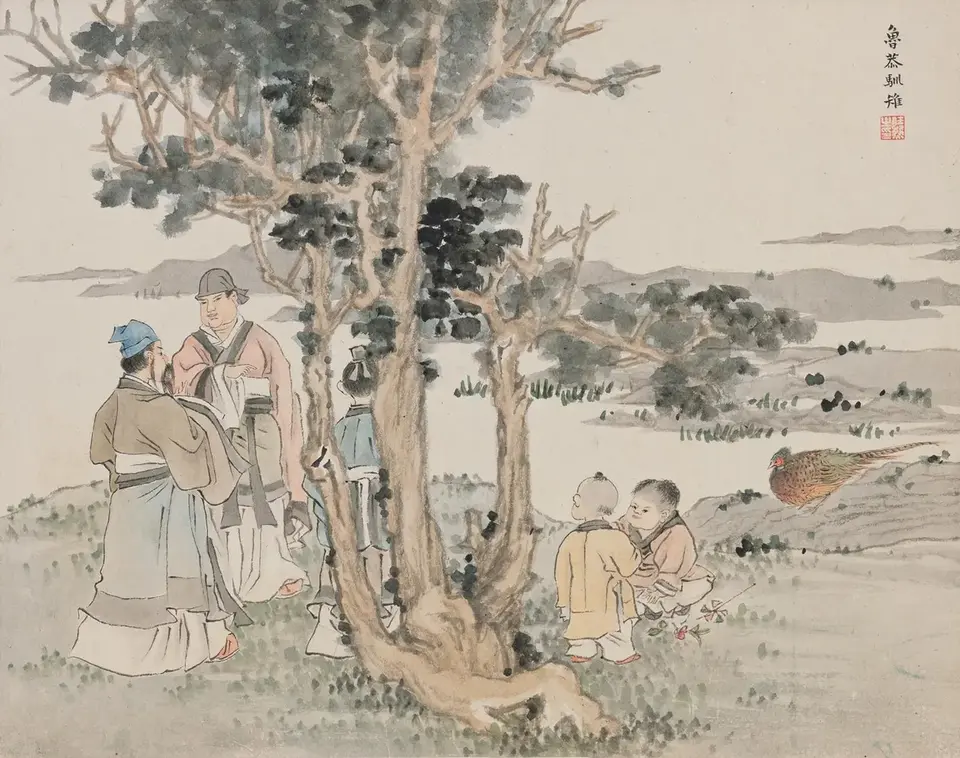
In 82, a colossal swarm of locusts devastated central China, stripping fields bare. Yet, when the swarms reached Zhongmu, they strangely diverged, encircling the county boundaries without consuming its crops. Skeptical of miraculous claims, Governor of Henan Yuan An dispatched investigator Fei Qin to conduct a covert audit. Accompanying Lu Gong into the countryside, Fei Qin rested beneath a mulberry tree. A wild pheasant flew down, resting serenely beside them. When a passing herd boy ignored the bird, Fei Qin asked: "Why do you not catch the pheasant?" The boy replied innocently: "The pheasant is rearing its young; catching it would kill its chicks."
Stunned, Fei Qin rose and bowed deeply to Lu Gong: "I came to inspect your governance. That locusts do not enter your borders is the first wonder; that your virtue tames wild beasts is the second wonder; that rural children possess compassionate hearts is the third wonder! Remaining longer would merely disturb an enlightened sage." Returning to Luoyang, Fei Qin reported his findings to Yuan An, who memorialized the facts to Emperor Zhang, establishing the legendary "Three Wonders of Zhongmu."
In 87, Lu Gong was promoted to Chancellor of Le'an in modern Shandong. Outlaws infested the coastal marshes, sacking administrative centers and defying military garrisons. Arriving in Le'an, Lu Gong instituted defensive fortifications while offering unreserved amnesties. Deeply moved by his credibility, bandit leader Zhang Han led hundreds of followers to surrender. Lu Gong successfully petitioned the throne to appoint Zhang Han as County Commandant of Bochang, directing him to pacify remaining outlaws, completely restoring peace across the region.
Under Emperor He, Lu Gong served as Chamberlain for the National Treasury, Minister of State, and Grand Master for Splendid Happiness. In 97, he was elevated to Minister of Works, ascending to Minister of Education in 100. Over his decade-long tenure in the Three Excellencies, he governed with serene moderation, recommending dozens of classical scholars to high posts. Facing complaints from aristocratic clans whose relatives were passed over, Lu Gong answered calmly: "I fret only over whether our scholarship is thorough; worthy scholars need not rely solely on ministerial appointments." In 109, he retired due to age. He passed away peacefully in 112 at eighty-one years of age.
FIGURES ASSOCIATED WITH THIS DYNASTY