Birth in Yunyang
Born into an official family in Yunyang of Zuofengyi, where his father served as imperial censor.
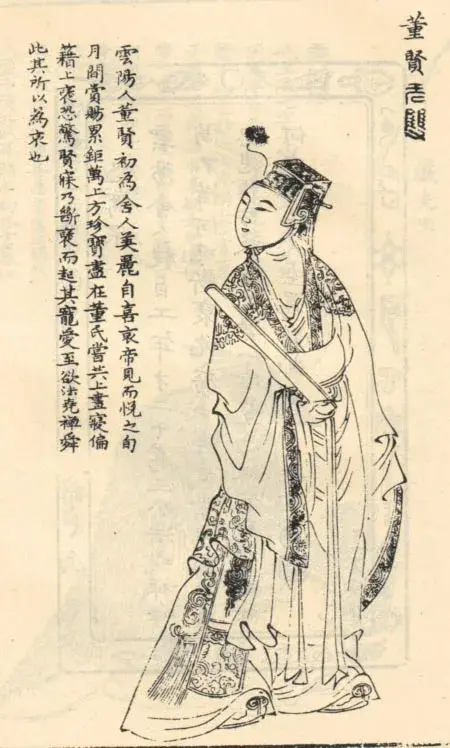
董贤
Dong Xian (董贤, 23–1 BCE), courtesy name Shengqing (圣卿), a native of Yunyang in Zuofengyi (左冯翊云阳, modern Jingyang County, Shaanxi), was an influential imperial favorite and minister during the reign of Emperor Ai of Han in the late Western Han dynasty. The son of Censor Dong Gong, Dong Xian entered official service through paternal privilege as an attendant in the Crown Prince's palace. Following the enthronement of Emperor…
Dong Xian (董贤, 23–1 BCE), courtesy name Shengqing (圣卿), a native of Yunyang in Zuofengyi (左冯翊云阳, modern Jingyang County, Shaanxi), was an influential imperial favorite and minister during the reign of Emperor Ai of Han in the late Western Han dynasty. The son of Censor Dong Gong, Dong Xian entered official service through paternal privilege as an attendant in the Crown Prince's palace. Following the enthronement of Emperor Ai, he served as an ordinary palace gentleman. In the second year of Jianping (5 BCE), when Dong Xian reported the water clock hours beneath the palace hall, Emperor Ai was captivated by his physical beauty and graceful demeanor, summoning him to court and elevating him to Gentleman of the Yellow Gate, launching his unprecedented ascendancy. Within months, Dong Xian advanced rapidly through the court hierarchy to become Supervisor of the Imperial Stud and Attendant-in-Ordinary, sharing imperial carriages and sleeping quarters with the sovereign. The emperor bestowed tens of millions of cash coins upon him, and on one famous occasion severed his own sleeve with a blade rather than wake Dong Xian asleep beside him, originating the enduring idiom of the "cut sleeve." In 3 BCE, Dong Xian was granted the noble title of Marquis of Gao'an on fabricated merits connected to an imperial witchcraft case. By 2 BCE, at the age of twenty-two, he was appointed Grand Marshall, commanding the imperial guards and standing at the pinnacle of the Three Excellencies. Following Emperor Ai's sudden demise in the sixth month of 1 BCE, Grand Empress Dowager Wang Zhengjun and her nephew Wang Mang staged an inner-palace coup, seizing the imperial seal and stripping Dong Xian of his offices. In despair, Dong Xian and his wife committed suicide on the same day, after which his colossal fortune was confiscated by the state.
Born into an official family in Yunyang of Zuofengyi, where his father served as imperial censor.
Following Emperor Ai's accession, promoted from crown prince attendant to gentleman-of-the-palace handling announcements.
Attracted Emperor Ai's attention while announcing the time, receiving instant elevation to Gentleman of the Yellow Gate.
Created Marquis of Gao'an with an estate of three thousand households following the fabricated Dongping conspiracy.
Appointed Grand Marshall and Minister of the Guards at age twenty-two, becoming the supreme minister of the empire.
Deprived of the imperial seals and stripped of office by Wang Mang upon Emperor Ai's death; committed suicide the same day.
Dong Xian was born into a bureaucratic family in Yunyang within the metropolitan Zuofengyi region. His father, Dong Gong, served successively as Imperial Censor and Magistrate of Yunyang during the reigns of Emperors Cheng and Ai. Dong Xian was gifted from youth with exceptional physical grace, gentle manners, and an accommodating disposition. When Liu Xin, then King of Dingtao, resided in the capital as heir apparent, Dong Xian obtained an appointment as Crown Prince's Retainer through his father's rank.
In the second year of Suihe (7 BCE), Emperor Cheng passed away, and Liu Xin ascended the throne as Emperor Ai. Dong Xian was reassigned according to standard routine to serve as a palace gentleman handling public documents and signaling the water clock beneath the steps of the Chengming Hall in the Weiyang Palace. In the second year of Jianping (5 BCE), as Dong Xian stood at attention announcing the hourly marks, Emperor Ai observed his delicate facial features from the elevated terrace. Deeply charmed by his appearance, the emperor ordered court heralds to usher him into the throne room. Enchanted by his deferential responses, the emperor immediately commissioned him as Gentleman of the Yellow Gate, granting him continuous access to the private imperial chambers.
Following his initial appointment, Dong Xian enjoyed meteoric advancement. Within a short period, Emperor Ai promoted him to Supervisor of the Imperial Stud and Attendant-in-Ordinary, making him the sovereign's most intimate daily companion. The emperor insisted that Dong Xian accompany him in the royal carriage during official excursions and attend him beside his couch at night. Palace workshops and tributary treasuries were opened to shower Dong Xian with jade ornaments, rare silks, and precious metals. In a single month, his accumulated monetary gifts surpassed one hundred million cash, astonishing the entire capital bureaucracy.
Because Dong Xian resided continuously within the palace, Emperor Ai permitted his wife to move into the inner palace quarters alongside him, while simultaneously taking Dong Xian's younger sister into the imperial harem as Bright Lady (Zhaoyi), ranking second only to the empress. His father Dong Gong was promoted to Director of the Minor Treasury and created Marquis of Guannei. Dong Xian's domestic influence eclipsed that of the established imperial consort clans of the Fu and Ding families, leaving empresses and ministers completely overshadowed.
The celebrated cultural episode of the "cut sleeve" unfolded during this period. One afternoon, Emperor Ai and Dong Xian took a midday rest together. When the emperor awoke and wished to attend state affairs, Dong Xian was still sleeping peacefully, resting his head upon the emperor's silk robe sleeve. Reluctant to disturb his favorite's slumber, Emperor Ai drew his belt knife and severed the sleeve, stepping down quietly from the couch. This episode demonstrated the extreme tenderness and indulgence the sovereign lavished on Dong Xian, prompting courtiers and attendants to imitate the fashion of cut sleeves in deference to the royal companion.
Emperor Ai was determined to create Dong Xian a full marquis, yet he was constrained by the foundational Han dynastic oath that nobility required military merit. In 3 BCE, expectant official Sun Chong and Grandee of the Imperial Household Xi Fugong accused King Yun of Dongping and his queen of performing witchcraft cursing the emperor. Emperor Ai instructed his conspirators to attribute the initial discovery of the conspiracy to Dong Xian, falsely asserting that Dong Xian had secretly alerted the throne.
Using this pretext, Emperor Ai promulgated an edict creating Dong Xian Marquis of Gao'an with an estate of one thousand households, quickly expanding it by two thousand more. Chancellor Wang Jia, an incorruptible elder statesman, saw through the fabricated charges against the King of Dongping and loathed the opportunistic flattery of Xi Fugong and Sun Chong. Wang Jia submitted numerous memorials denouncing Dong Xian's unmerited titles as a violation of imperial rituals and state laws, warning that unchecked favoritism corrupted the dynasty. Enraged by this resistance, Emperor Ai fabricated legal charges against the chancellor, throwing Wang Jia into the imperial prison, where the loyal minister starved himself to death.
Following Wang Jia's martyrdom, open criticism of Dong Xian vanished from the central court. In the first year of Yuanshou (2 BCE), the emperor's maternal uncle, Grand Marshall Ding Ming, was dismissed for showing sympathy to Wang Jia and harboring resentment toward Dong Xian. Emperor Ai thereupon issued a decree appointing the twenty-two-year-old Dong Xian as Grand Marshall and Minister of the Guards, placing him in command of the Southern Army palace guards and positioning him as the first of the Three Excellencies.
When foreign tribute delegations arrived in Chang'an, the Chanyu of the Xiongnu observed this youthful commander occupying the foremost seat among the imperial ministers. Astonished by his tender age, the steppe monarch inquired why such a youth led the empire, to which Emperor Ai boasted that Dong Xian possessed transcendent virtue. At formal palace banquets, an intoxicated Emperor Ai once openly proclaimed that he wished to emulate Yao abdicating to Shun by ceding the imperial throne to Dong Xian, prompting sharp rebuke from attendant Wang Hong.
Emperor Ai further mobilized state resources to construct an opulent mausoleum for Dong Xian directly adjacent to his own Yiling tomb. The private sepulcher was engineered with cypress timbering and multi-layered burial chambers reserved for emperors, surrounded by perimeter walls spanning several li. The sovereign even bestowed imperial jade burial shrouds upon Dong Xian in advance, displaying an unprecedented degree of imperial extravagance.
On the twenty-sixth day of the sixth month of 1 BCE, Emperor Ai died suddenly in the Weiyang Palace at the age of twenty-five. In his dying delirium, the sovereign handed the imperial seal ribbons to Dong Xian, charging him with the preservation of the realm. Completely lacking political experience and armed with no loyal faction, Dong Xian was paralyzed by panic.
Grand Empress Dowager Wang Zhengjun took immediate control, arriving at the Weiyang Palace to summon her nephew, Marquis of Xindu Wang Mang. Acting swiftly while Dong Xian remained bewildered, Wang Mang retrieved the imperial seals on the Dowager's authority and secured the palace gates. He then instructed the Masters of Writing to cross-examine Dong Xian, accusing him of administrative negligence in managing the royal funeral and failing to maintain military order.
Shortly thereafter, the Grand Empress Dowager issued an edict stripping Dong Xian of the Grand Marshall post. Recognizing that imprisonment and torturous execution were inevitable, Dong Xian and his wife retreated to their residence and committed suicide together on the same day. Suspecting that Dong Xian might have staged his death, Wang Mang ordered imperial examiners to break open the coffin to verify the corpse, before burying him hastily in prison grounds. Dong Xian's relatives were banished to the remote southern commanderies of Hepu, his billions of private cash assets were seized by the imperial treasury, and the marquisate of Gao'an was permanently abolished.
Dong Xian achieved the swiftest elevation in late Western Han history, advancing from an ordinary timekeeper to the supreme military regency within a few years. Through personal charm and deferential loyalty, he dominated the private affection of Emperor Ai.
His intimacy with the emperor bypassed the traditional constitutional roles of the inner and outer courts. For several years, his family enjoyed privileges surpassing those of legitimate consort houses, illustrating the profound structural fragility of the late Western Han court hierarchy.
To elevate Dong Xian to a full marquisate, Emperor Ai engineered the political trial of the King of Dongping, attributing investigative credit to Dong Xian. This episode damaged the integrity of the Han bureaucratic merit system.
When Chancellor Wang Jia defended ancestral institutions against this arbitrary reward, the monarch persecuted the chancellor to death. Dong Xian's ascent marked the breakdown of institutional checks and balances between the throne and the outer court bureaucracy.
During his peak dominance, Dong Xian enjoyed imperial prerogatives that crossed into dynastic transgression. His tomb adjacent to the Yiling was constructed using cypress timbering and jade burial vestments reserved solely for sovereigns.
Emperor Ai's declaration of emulating sage-king abdication in favor of Dong Xian alienated the Confucian gentry and senior aristocrats. This disregard for ancestral legitimacy isolated Dong Xian politically, ensuring his rapid destruction once his royal protector vanished.
Dong Xian's catastrophic fall acted as the direct catalyst for Wang Mang's definitive return to the apex of power. Emperor Ai's deathbed consignment of the imperial seals to an inexperienced companion created an administrative crisis that favored rapid intervention.
Wang Mang exploited the universal outrage against Dong Xian's corrupt ascendancy to present himself as the savior of the dynasty. By stripping Dong Xian of his offices and recovering the imperial seals, Wang Mang seized the office of Grand Marshall, consolidating total control over the state apparatus and paving the way for his ultimate usurpation.
FIGURES ASSOCIATED WITH THIS DYNASTY