Aristocratic Birth
Born into the Jingzhao Du clan; grandfather Du Ji and father Du Shu were eminent ministers of Cao Wei.
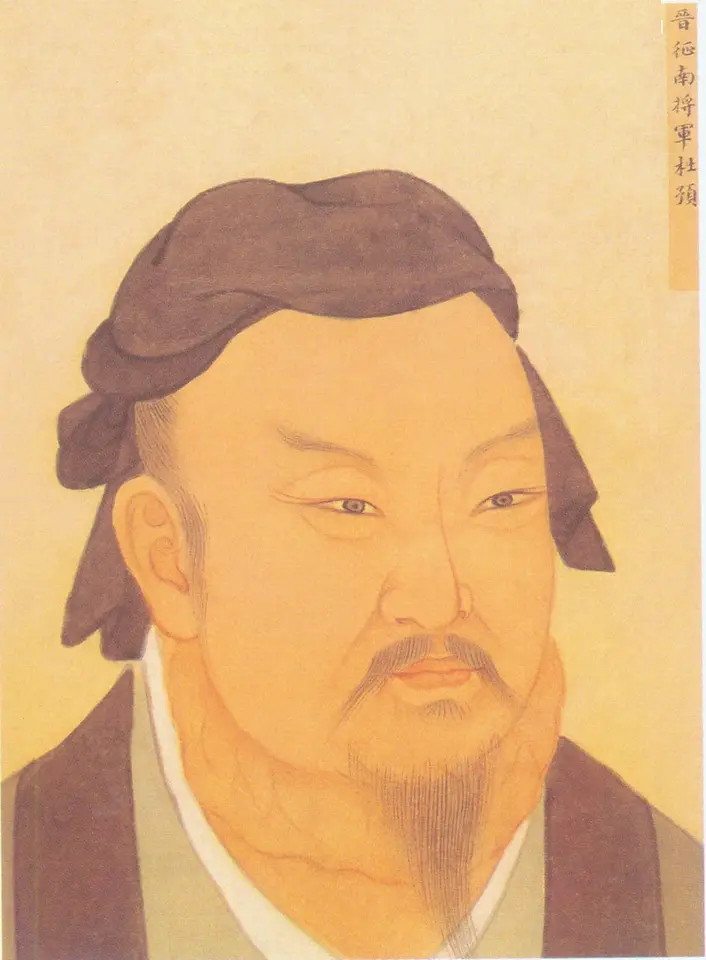
杜预
Du Yu (杜预, 222–285), courtesy name Yuankai (元凯), was a native of Duling in Jingzhao Commandery (present-day Xi'an, Shaanxi Province), hailing from the prestigious Jingzhao Du clan of the Guanzhong region. He was an eminent statesman, supreme military commander, classicist, and legal jurist active during the transition from the Three Kingdoms Cao Wei to the Western Jin Dynasty. His grandfather Du Ji served as Vice Director of…
Du Yu (杜预, 222–285), courtesy name Yuankai (元凯), was a native of Duling in Jingzhao Commandery (present-day Xi'an, Shaanxi Province), hailing from the prestigious Jingzhao Du clan of the Guanzhong region. He was an eminent statesman, supreme military commander, classicist, and legal jurist active during the transition from the Three Kingdoms Cao Wei to the Western Jin Dynasty. His grandfather Du Ji served as Vice Director of the Imperial Secretariat under Emperor Wen of Wei, and his father Du Shu served as Cavalier Regular Attendant. Du Yu possessed extraordinary erudition and versatile mastery in governance, scholarship, and warfare, earning the widespread contemporary admiration of being hailed as the "Du Arsenal". In his early career, Du Yu served the Cao Wei regime as a Gentleman of the Imperial Secretariat and married the younger sister of Sima Zhao, Princess Gaolu. Following the founding of the Western Jin Dynasty, he held pivotal posts including Intendant of Henan and Minister of Finance. He played an instrumental role in formulating and annotating the Jin Code (Taishi Code), championing the legal maxim that "statutes define crimes, while rites examine social hierarchies," thereby establishing the enduring tradition of integrating Confucian ritual norms into statutory law. When Yang Hu fell gravely ill, he strongly recommended Du Yu as his successor; Du Yu was subsequently appointed Grand General Who Subdues the South and Commander of Military Affairs in Jingzhou, orchestrating the overarching campaign to conquer the rival state of Eastern Wu. Between the winter of 279 and the spring of 280, Emperor Wu of Jin launched a massive multi-pronged expedition against Eastern Wu. Du Yu oversaw the Western front in Jingzhou, annihilating Wu general Zhang Shang, capturing the strategic fortress of Jiangling, and securing the unconditional surrender of the Jiaozhou and Guangzhou regions. His unstoppable offensive achieved the long-awaited reunification of China, bequeathing the famous historical idiom "like splitting bamboo". Following the pacification of Wu, he devoted himself to extensive water conservancy projects, excavating the Yangkou Canal and connecting the Han and Yangtze riverways to benefit local agricultural irrigation. In his later years, Du Yu produced the monumental thirty-volume commentary Explanations and Annotations on the Zuo Tradition of the Spring and Autumn Annals, integrating canon and commentary. Renowned for supreme achievements in both civil administration and martial triumph, Du Yu became the only figure prior to the Ming dynasty to be concurrently enshrined in both the Confucian Temple and the Martial Temple.
Born into the Jingzhao Du clan; grandfather Du Ji and father Du Shu were eminent ministers of Cao Wei.
His father Du Shu died in exile at Zhangwu; Du Yu lived in quiet reclusion, mastering classics, statecraft, and calendar science.
Married Sima Zhao's younger sister Princess Gaolu; appointed Gentleman of the Imperial Secretariat and inherited his father's marquisate.
Served as Chief Clerk under General Who Subdues the West Zhong Hui during the conquest of Shu; prudently preserved himself during Zhong Hui's rebellion.
Co-authored and annotated the Taishi Code, establishing the principle of interpreting law through ritual status; appointed Intendant of Henan.
Appointed Inspector of Qinzhou; dismissed for cautioning against rash offensive against the Xianbei, but soon recalled to counsel the throne as a marquis without office.
Appointed Minister of Finance; spent seven years directing the Yellow River pontoon bridge, performance evaluations, irrigation, and ever-normal granaries.
Recommended by the dying Yang Hu as his successor; appointed Grand General Who Subdues the South and Commander of Military Affairs in Jingzhou.
Submitted urgent memorials urging immediate offensive against Eastern Wu, resolving Emperor Wu's hesitation to launch the invasion.
Captured Jiangling and accepted the surrender of the Xiang, Han, Jiao, and Guang regions; ennobled as Marquis of Dangyang County.
Excavated the Yangkou Canal to link the Han River with Baling; summoned back to Luoyang in winter as Colonel Director of Retainers.
Passed away from illness at Deng County while en route to Luoyang at age sixty-four; posthumously honored as Grand General Who Subdues the South with the posthumous title Cheng.
Du Yu was born into the celebrated aristocratic Jingzhao Du clan of the Guanzhong region. His lineage had long been prominent across the Han and Wei dynasties. His grandfather Du Ji earned profound trust from Cao Cao for his exceptional administrative governance over Hedong Commandery, being likened to the Western Han model administrator Zhao Guanghan, and eventually rose to the rank of Vice Director of the Imperial Secretariat. Du Yu's father, Du Shu, was renowned for unbending integrity and outspoken frankness, holding the post of Cavalier Regular Attendant.
Owing to his uncompromising character, Du Shu clashed frequently with powerful court figures and repeatedly withdrew into private life. Following the demise of Emperor Ming of Wei, Du Shu was recalled as Inspector of Youzhou and Governor of Hedong. During the Zhengyuan and Jiaping eras, Du Shu adamantly refused to fawn upon the regency of Sima Yi, thereby incurring deep political animosity.
Following the Gaoping Tombs Coup of 249, Sima Yi had Du Shu impeached on trumped-up charges of dereliction, commuting his capital sentence to banishment in Zhangwu Commandery, where he died in 252. Heavily shadowed by his father's political disgrace, Du Yu spent his youth in long, compulsory reclusion in his home county, barred from taking official examinations or entering court service.
Throughout this prolonged period of adversity, Du Yu closed his doors to outside society and devoted himself passionately to the study of Confucian canons, ancient statutory codes, astronomical calendars, and military treatises, developing an abiding affection for the Zuo Tradition. He acquired a profound understanding of historical governance and statecraft, cultivating a cautious, astute temperament that laid an enduring foundation for his versatile career.
Following Sima Yi's death in 251, his sons Sima Shi and Sima Zhao successively seized paramount control over the Cao Wei court. Seeking to co-opt and placate the prominent aristocratic families of Guanzhong, Sima Zhao arranged for his younger sister, Princess Gaolu, to marry Du Yu. In 257, Du Yu was appointed as a Gentleman of the Imperial Secretariat, a prestigious administrative office overseeing personnel assessments, and inherited his father's former noble title as Marquis of Fengle Pavilion.
In the fifth month of 263, the Wei government mounted a three-pronged general offensive to extinguish Shu Han. Du Yu was assigned as Chief Clerk to Zhong Hui, General Who Subdues the West and supreme commander of the primary expeditionary force. Du Yu accompanied the army through the rugged defiles of Jiange into the Shu heartland. After Shu ruler Liu Shan surrendered, Zhong Hui's personal ambitions swelled wildly; plotting with the surrendered Shu commander Jiang Wei, Zhong Hui resolved to rebel and carve out an independent realm in Yizhou, intending to purge his fellow Wei generals.
Amid the chaos and bloodbath that accompanied the Chengdu mutiny, numerous commanders and staff officers were slain. Du Yu had long discerned that Zhong Hui was vain, reckless, and destined for destruction. Throughout the campaign, Du Yu kept an absolute distance from Zhong Hui's clandestine plots. When the troops mutinied, he remained calm and composed, successfully safeguarding his administrative seals and subordinates. Following Zhong Hui's demise, Du Yu returned safely to Luoyang, winning immense renown for his steady judgment and impeccable integrity.
In the twelfth month of the first year of the Taishi era (early 266), Sima Zhao's son Sima Yan accepted the abdication of the Wei emperor and established the Western Jin Dynasty. As a founding merit subject and imperial in-law, Du Yu was entrusted with vital responsibilities. The Western Jin court prioritized overhauling the convoluted legal legacy inherited from Han and Wei; Sima Zhao had already commissioned Jia Chong, Zheng Chong, Pei Xiu, and Xun Xu in 264 to draft a new code, and Du Yu was assigned to assist in drafting and producing the definitive commentaries.
In 268, the new legal compendium, known to history as the Jin Code (Taishi Code), was formally promulgated. The old Han statutes had expanded to over 7.7 million characters across more than 26,000 articles, creating pervasive ambiguity and rampant judicial corruption. Under Du Yu's guidance, the new code drastically excised redundancies, establishing clarity and conciseness. Du Yu composed the authoritative commentary Luben (Statute Fundamentals), championing the integration of Confucian ritual status into statutory interpretation.
In the same year, Du Yu was promoted to Intendant of Henan, placing him in direct charge of civil administration, public order, and judicial proceedings in the capital city of Luoyang. He governed with rigorous impartiality, cracking down on illegal land seizures and abuses perpetrated by entrenched aristocratic clans. Shortly thereafter, he proposed reforming the evaluation and promotion criteria for civil servants, which drew sharp opposition and impeachment from conservative officials like Shi Jian, leading to his temporary removal from office.
In 270, the Hexi Xianbei chieftain Tufa Shujineng initiated a widespread tribal insurrection against Jin authority in the northwest, during which Inspector of Qinzhou Hu Lie was slain in battle, sending shockwaves through the empire. The court recalled Du Yu as Military Commander under the General Who Pacifies the West and shortly elevated him to Inspector of Qinzhou, concurrently Colonel of Eastern Qiang and General of Light Chariots, ordering him to stabilize the Longyou frontier.
The imperial area commander Shi Jian impetuously pressured Du Yu to lead an under-equipped force into an immediate offensive. Having thoroughly surveyed the terrain and enemy deployments, Du Yu submitted a memorial cautioning that the Xianbei held high ground with superior cavalry, while imperial forces lacked supplies; he urged entrenchment and agricultural garrisons to wear down the rebels. Enraged, Shi Jian impeached Du Yu for obstructing military operations. Du Yu was relieved of command and escorted back to the Luoyang prison. Utilizing his profound mastery of the law, Du Yu invoked the "Eight Deliberations" provisions of the Jin Code, forfeiting his office and noble rank to expiate the charges without suffering physical punishment.
In 271, when the Xiongnu prince Liu Meng revolted, Emperor Wu recognized Du Yu's indispensable strategic acumen, summoning him to court deliberations as a marquis without portfolio, and soon officially appointed him Minister of Finance. Du Yu served in this position for seven consecutive years, submitting over fifty major proposals addressing granaries, price adjustments, salt transportation, tax quotas, and border defense. He invented a human-powered metallurgical blower called the "human blower" (renpai) and oversaw the construction of a permanent pontoon bridge over the Yellow River at Mengjin, resolving a millennium-old transport bottleneck. Observers marveled at his all-encompassing knowledge, celebrating him as the "Du Arsenal."
In the spring of 278, Yang Hu, the supreme commander on the Jingzhou frontier, fell critically ill and returned to Luoyang. On his deathbed, Yang Hu emphatically recommended to Emperor Wu that Du Yu be chosen as his successor. Following Yang Hu's passing in the eleventh month, Emperor Wu appointed Du Yu Grand General Who Subdues the South and Commander of Military Affairs in Jingzhou, headquartered at the vital hub of Xiangyang.
Upon arriving at Xiangyang, Du Yu immediately consolidated defenses, drilled riverine fleets, settled displaced refugees, and restored agriculture across southern Jingzhou. Observing that the Wu commander at Xiling, Zhang Zheng, was complacent and over-reliant on natural gorges, Du Yu launched a surprise ambush just prior to the final invasion, routing Zhang Zheng's forces. Du Yu deliberately publicized Zhang Zheng's prior reputation in official reports, successfully deceiving the suspicious Wu emperor Sun Hao into removing Zhang Zheng from command, thereby destabilizing Wu's western defense line.
Meanwhile, conservative ministers at the Jin court, including Jia Chong and Xun Xu, persistently opposed the invasion due to border unrest in the northwest. Du Yu submitted three urgent memorials directly to Emperor Wu. He meticulously analyzed Eastern Wu's political decadence, internal fracture, and overstretched military posture, passionately warning that "failing to seize what Heaven offers brings calamity upon oneself." Du Yu's lucid grand strategic analysis finally eliminated Emperor Wu's hesitation, cementing the decision to launch the general invasion.
In the first month of 280, the Western Jin launched a synchronized offensive involving more than 200,000 troops along six converging routes. Du Yu directed the western front from Jingzhou, commanding regional forces while coordinating with the grand fleet descending from Shu under Wang Jun. Du Yu dispatched subordinates Fan Xian and Yin Lin downriver to storm Xiling, seize Lexiang, execute Wu commander Lu Jing, and capture Grand Supervisor Sun Xin alive.
Du Yu subsequently concentrated his forces to encircle Jiangling, forcing the Wu area commander Wu Yan to surrender. Following the fall of Jiangling, the entire middle Yangtze region collapsed; the southern commanderies of Lingling, Guiyang, and Hengyang submitted in rapid succession. Du Yu then detached forces southward toward Guilin, issuing proclamations to Jiaozhou and Guangzhou, which yielded complete submission across the far south and severed all outside support for the Wu capital at Jianye.
At this juncture, several Jin commanders urged halting the offensive until autumn, citing impending summer rains, rising river levels, and the peril of epidemics. Du Yu strongly rejected delay, famously declaring: "Our imperial prestige is at its height, like the splitting of bamboo—once the first few joints are split, all the rest give way effortlessly before the blade!" He ordered Wang Jun's massive fleet to press eastward without pause. The Wu defense disintegrated completely; Sun Hao surrendered bound at Jianye, formally concluding the tripartite division of China.
Following the victorious conclusion of the conquest, the imperial court rewarded Du Yu's paramount contributions by expanding his estate by a thousand households, ennobling his son Du Dan as a pavilion marquis, and bestowing eight thousand bolts of silk. Mindful of the perils of excessive glory, Du Yu remained humble and unpretentious; he never boasted of his military feats at court, distributed all his monetary imperial rewards among his officers and clan members, and generously yielded primary public credit to field commanders like Wang Jun and Wang Hun.
Following the war, Du Yu remained in post as Grand General Who Subdues the South to govern the pacified Jingxiang region. He pursued generous policies of economic rehabilitation, mobilizing soldiers and civilians to construct extensive waterworks. He excavated the Yangkou canal to direct the Xia River into Baling, establishing an interconnected waterway between the Yangtze and Han rivers that shielded fertile tracts from floods and yielded continuous harvests.
The people of Jingzhou held Du Yu in profound affection, composing ballads praising his compassionate governance. Aware of the impermanence of mortal accomplishments, Du Yu had two grand stone steles carved detailing his campaigns and public works: one was submerged beneath the waters of the Han River at Mount Wan, and the other was erected atop Mount Xian, ensuring that future ages would remember his deeds regardless of geological transformations.
During his leisure hours in Xiangyang after the conquest of Wu, Du Yu distanced himself from social distractions and poured his remaining energy into his lifelong passion for classical scholarship. He had cherished the Zuo Tradition of the Spring and Autumn Annals since childhood, frequently joking that he suffered from a "Zuo Tradition obsession." He was dissatisfied with existing commentaries that severed canonical texts from their accompanying narratives.
After years of meticulous scholarship, Du Yu completed the thirty-volume Explanations and Annotations on the Zuo Tradition of the Spring and Autumn Annals. Breaking with the Han practice of treating scripture and commentary separately, he pioneered a chronological format that embedded Zuo's narrative directly beneath each corresponding year of the Spring and Autumn Annals, allowing textual meaning and historical reality to illuminate each other. This work became the foundational text adopted by Tang scholar Kong Yingda for his Correct Meaning of the Spring and Autumn Annals, establishing an enduring benchmark in Chinese classical studies.
In the winter of 284, the imperial court summoned Du Yu back to Luoyang to assume office as Colonel Director of Retainers, granting him the elite standing of Specially Advanced. Du Yu set out northward but fell gravely ill upon reaching Deng County. In the intercalary twelfth month of the fifth year of the Taikang era (early 285), Du Yu passed away in the post station of Deng County at the age of sixty-four. Deeply grieved, Emperor Wu posthumously elevated him to Grand General Who Subdues the South and Opener of the Office Equal in Rank to the Three Excellencies, granting the posthumous name Cheng. In his final written instructions, Du Yu strictly enjoined his descendants to conduct a frugal burial, and he was laid to rest before Mount Shouyang south of Luoyang in accordance with his wishes.
Du Yu holds an epochal position in the development of traditional Chinese jurisprudence. At the inception of the Western Jin Dynasty, the legal system inherited from the Han and Wei was severely flawed; Han statutes comprised over 7.7 million characters across more than 26,000 articles, whose intricate complexity enabled corrupt magistrates to arbitrarily manipulate sentences. In the early Taishi era, Du Yu was commissioned alongside Jia Chong, Zheng Chong, Pei Xiu, and Xun Xu to systematically formulate a new imperial code.
During the codification process, Du Yu articulated an innovative legislative philosophy: "statutes must be concise and illustrative; judicial hearings should be economical and prohibitions uncluttered." He insisted that statutory language should be accessible to commoners, that definitions of offenses should be straightforward without ambiguity, and that administrative prohibitions should not be excessively burdensome.
In his preface to the Jin Code, Du Yu formulated the first precise conceptual distinction between statutory penal law and administrative regulation: "Statutes define crimes, while ordinances preserve administrative systems." Under this framework, statutes (lu) served as penal codes determining punishments, while ordinances (ling) comprised governmental decrees and organizational rules. This definitive formulation profoundly shaped the codified legal traditions of the Sui, Tang, and later dynasties.
Furthermore, Du Yu's commentary Luben (Statute Fundamentals) was promulgated by imperial decree alongside Zhang Fei's commentary, endowing both with statutory authority as the celebrated "Zhang-Du Code." Du Yu championed the doctrine of "incorporating rites into statutory law," harmonizing Confucian ethical hierarchies with codified jurisprudence and marking the transition of Chinese legal scholarship into an autonomous, mature discipline.
From 271 to 278, Du Yu presided over the Ministry of Finance for seven consecutive years, managing imperial revenues, grain reserves, waterborne transport, and military logistical supplies. Confronted with widespread administrative laxity and aristocratic extravagance during the early Jin, Du Yu submitted his proposal for the "Six-Year Evaluation System" (liunian chuzhi fa) to Emperor Wu, instituting a rigorous and objective merit evaluation apparatus for all imperial officials.
Under this system, civil servants underwent continuous evaluation over a structured six-year cycle. Officials who maintained superior performance across the six years received extraordinary accelerated promotion; those with consistently inferior marks were formally dismissed; those with predominantly superior marks were retained in post; and those with predominantly inferior marks were demoted. This regulatory structure exerted a powerful stabilizing effect on the early Jin civil bureaucracy.
To ensure agricultural security and emergency grain reserves, Du Yu actively promoted the ritual imperial plowing of fields (jitian) and directed the widespread establishment of ever-normal granaries (changpingcang) across key prefectures. He instituted state market operations that purchased grain at fair prices during bumper autumn harvests to protect farmers from plummeting prices, and sold grain at affordable rates during spring shortages or localized famines to curb mercantile speculation.
In transportation engineering, Du Yu oversaw the historic construction of the Fupingjin pontoon bridge over the Yellow River at Mengjin. Northern crossings of the turbulent Yellow River near Luoyang had long been regarded as hazardous and seasonal. Du Yu accurately surveyed hydrological conditions, aligning massive barges anchored by heavy iron chains and surfacing them with timber planks. Emperor Wu personally inspected the bridge, marveling at its unprecedented scale. This pontoon bridge remained in continuous use for more than eight centuries until the Northern Song period.
Du Yu was not only a gifted statesman and general but also an ingenious mechanical innovator and astronomer. In ancient weapons metallurgy, blast furnaces traditionally relied on hydraulic blowers (shuipai); however, during dry seasons or in arid regions, water shortages frequently paralyzed production. Du Yu conducted rigorous experiments and successfully developed a mechanical bellows powered by treadles or manual levers, which he designated as the "human blower" (renpai).
The "human blower" operated independently of natural water currents, permitting continuous, all-weather iron smelting and weapons manufacture. This invention substantially augmented weapon production efficiency, furnishing crucial logistical support for the subsequent multi-front campaign against Eastern Wu.
To mitigate the arduous physical labor of grain processing among commoners, Du Yu investigated traditional pestles and watermills, inventing the "compound trip-hammer" (lianjidui) and "water-powered multi-mill" (shuizhuanlianmo). By harnessing the rotary power of river-driven waterwheels through geared wooden axles, this apparatus drove multiple pestles simultaneously for pounding rice while rotating stone millstones to grind flour, vastly conserving human labor across riparian provinces.
In astronomy, Du Yu recognized inaccuracies in the inherited calendars of the Wei-Jin period. Utilizing sophisticated mathematical reckoning and gnomon shadow measurements, he formulated a new calendar known as the Eryuan Qiandu Calendar, which significantly enhanced astronomical predictive accuracy. Moreover, drawing on advanced mechanical principles, he successfully reconstructed the lost ancient physical balancing vessel known as the qiqi (inclining vessel) and crafted elegant bronze ritual vessels modeled on Western Zhou archetypes, demonstrating profound technological and artisanal versatility.
Throughout the strategic conception and battlefield execution of the Western Jin campaign against Eastern Wu, Du Yu served as the primary architect and commander. From the moment he took command in Jingzhou in 278, he devised a meticulous plan to neutralize Wu's defensive bastions along the middle Yangtze, identifying Jiangling and Xiling as the critical western gateways that had to be captured first.
In late 279, when conservative ministers urged aborting the campaign due to the onset of winter and difficult supply lines, Du Yu submitted an impassioned emergency memorial, warning that leaving Eastern Wu unmolested would grant them time to fortify their strongholds and rally their population. His urgent counsel resolved Emperor Wu's final hesitations, setting the imperial armies in motion.
When fighting commenced, Du Yu employed combined frontal assaults and covert tactical infiltrations. He directed staff officers Guan Ding, Zhou Zhi, and Fan Xian to lead an elite detachment across the Yangtze under cover of night, infiltrating behind the Wu garrison at Lexiang to ignite signal fires across Mount Ba. Panicked by the appearance of Jin forces in his rear, Wu commander Sun Xin attempted to retreat into Lexiang but was ambushed and captured alive outside the city gate.
Du Yu subsequently launched a coordinated assault on Jiangling, annihilating the forces under Wu area commander Wu Yan and liberating the middle reaches of the Yangtze. Capitalizing on this momentum, Du Yu dispatched flying columns southward into Jiaozhou and Guangzhou, securing their capitulation without further resistance. His celebrated strategic decision to press forward "like splitting bamboo" enabled Wang Jun's naval forces to descend unhindered upon Jianye, concluding the war within months and reunifying the realm with minimal bloodshed.
Du Yu's enduring scholarly renown rests upon his monumental contributions to Confucian classical hermeneutics. Throughout his lifetime, Du Yu was passionately devoted to the Zuo Tradition of the Spring and Autumn Annals. He observed that since the Han dynasty, commentators had persistently conflated the Zuo Tradition with the Gongyang and Guliang traditions, creating fractured interpretations and severing the canonical text of Confucius from Zuo Qiuming's historical narrative.
Over years of meticulous research, Du Yu produced the seminal thirty-volume Explanations and Annotations on the Zuo Tradition of the Spring and Autumn Annals. In this masterpiece, Du Yu pioneered the structural integration of canon and commentary. Organizing the material strictly according to the twelve dukes of the State of Lu, he placed the canonical Spring and Autumn Annals text at the beginning of each year, immediately followed by the Zuo Tradition narrative and accompanied by his rigorous philological and historical glosses.
Additionally, Du Yu composed the fifteen-volume Explanatory Illustrations of the Spring and Autumn Annals (Chunqiu Shili), systematically categorizing the rituals, bureaucratic offices, geography, and interpretive rules embedded in the classic. He also compiled the Long Calendar of the Spring and Autumn Annals (Chunqiu Changli), employing advanced calendrical calculations to reconstruct the lunar phases and intercalary months of the Zhou dynasty, resolving numerous historical discrepancies that had puzzled scholars for centuries.
Du Yu's scholarly corpus achieved undisputed canonical status. During the Tang dynasty, Emperor Taizong commissioned Kong Yingda to compile the Correct Meaning of the Five Classics, wherein Du Yu's commentary was adopted as the exclusive standard base for the Spring and Autumn Annals. In 647, Du Yu was formally enshrined in the Confucian Temple alongside the ancient sages, establishing an everlasting intellectual monument to his scholarly brilliance.
FIGURES ASSOCIATED WITH THIS DYNASTY