Birth on the Steppe
Born into the Xianbei tribe; cast out due to his father Touliuhou's jealousy and raised by his maternal grandparents.
檀石槐
Tan Shihuai (檀石槐, 137–181 AD) was the supreme chieftain of the northern nomadic Xianbei people and the founder of the Xianbei Tribal Confederation during the mid-to-late Eastern Han dynasty. Born into the Touliuhou clan, he was cast out in infancy due to his father's suspicions and raised by his maternal grandparents. Endowed with imposing physical strength, unmatched archery skills, and shrewd political intellect, he gained…
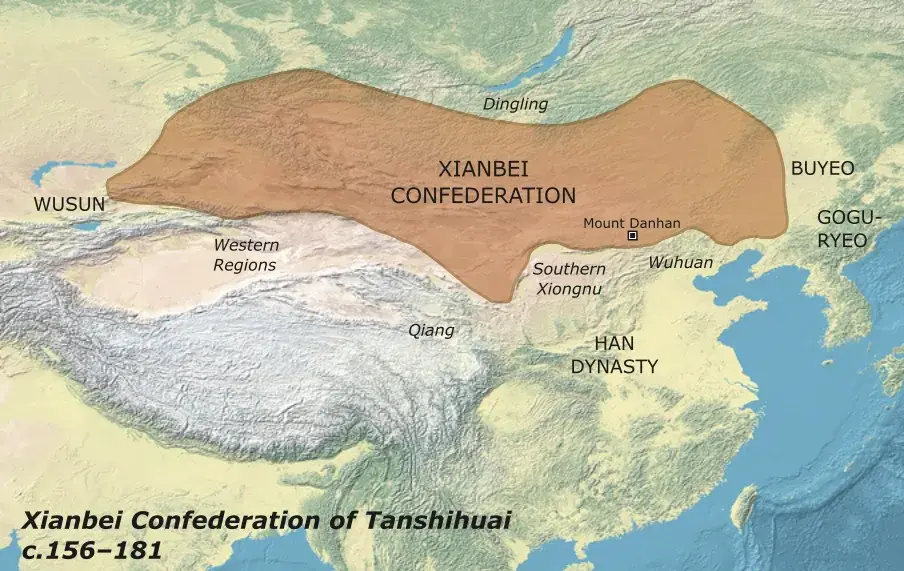
Tan Shihuai (檀石槐, 137–181 AD) was the supreme chieftain of the northern nomadic Xianbei people and the founder of the Xianbei Tribal Confederation during the mid-to-late Eastern Han dynasty. Born into the Touliuhou clan, he was cast out in infancy due to his father's suspicions and raised by his maternal grandparents. Endowed with imposing physical strength, unmatched archery skills, and shrewd political intellect, he gained legendary renown at age fourteen by riding out alone to reclaim stolen livestock, earning unanimous election as tribal chieftain (daren). Between the Yongshou and Guanghe eras, Tan Shihuai united the fractured Xianbei clans, establishing his supreme royal headquarters at Danhan Mountain along the Chuochou River (modern Dongyang River in Shangdu, Inner Mongolia) and inaugurating a decisive turning point in northern steppe history. During his reign, Tan Shihuai launched massive military campaigns: raiding Eastern Han frontier defenses to the south, subduing the Dingling in the north, repelling Buyeo in the east, and crushing the Wusun in the west. He completely occupied the vast ancestral domains of the former Xiongnu Empire, forging an expansive nomadic confederation spanning over 14,000 leagues from east to west and 7,000 leagues from north to south. When the Eastern Han court attempted to pacify him with royal seals and marital alliances, Tan Shihuai adamantly refused, instead reorganizing his domain into Eastern, Central, and Western divisions, each governed by subordinate chieftains under his centralized command. In 177 AD (6th year of Xiping), Emperor Ling dispatched three columns comprising thirty thousand elite cavalry under Colonel of the Wuhuan Xia Yu, General Who Smashes the Xianbei Tian Yan, and General of the Xiongnu Zang Min to invade the steppe across two thousand leagues. Tan Shihuai orchestrated an elastic defense, drawing the Han columns deep into the desert before encircling them with all three divisions, inflicting an overwhelming defeat where nearly eighty percent of the Han forces were annihilated. He also relocated over a thousand captured Wa (or Han) fishermen to the Qin River to develop net-fishing and alleviate food shortages. Tan Shihuai died in 181 AD at the age of forty-five, having propelled the Xianbei onto the main stage of East Asian history.
Born into the Xianbei tribe; cast out due to his father Touliuhou's jealousy and raised by his maternal grandparents.
At age fourteen, rode out alone to defeat raiders and recover stolen cattle, earning election as tribal chieftain.
Established his royal court at Danhan Mountain; united Xianbei clans and raided Yunzhong Commandery with four thousand cavalry.
Led tens of thousands of horsemen across nine Han border commanderies; rejected Han offers of kingship and organized the confederation into three divisions.
Ambushed and annihilated three Han expeditionary armies under Xia Yu, Tian Yan, and Zang Min deep in the northern desert.
Relocated over a thousand Wa fishermen to the Qin River to introduce net-fishing, overcoming regional grain shortages.
Passed away at his Danhan Mountain headquarters at age forty-five; succeeded by his son Helian as the confederation began to fracture.
The origins of Tan Shihuai are steeped in legendary steppe lore. His father, Touliuhou, was a Xianbei warrior who served on military campaigns with the Northern Xiongnu for three years. During his prolonged absence, his wife gave birth to Tan Shihuai at home. Upon his return, Touliuhou was enraged, suspecting infidelity, and drew his blade to slay the infant.
His wife explained with calm resolve: "While walking across the open wilderness in broad daylight, I heard rolling thunder across the heavens. As I gazed upward, a brilliant hailstone fell from the clouds into my mouth. I accidentally swallowed it and subsequently conceived, giving birth after ten months. This child was bestowed by Heaven and is destined for greatness; I implore you to spare his life!" Unconvinced, Touliuhou abandoned the newborn in the wilderness. Refusing to let her child perish, the mother secretly dispatched servants to carry the baby to her maternal family, who raised him under the name Tan Shihuai.
Growing up among his maternal kin, Tan Shihuai matured into a youth of formidable physical stature, daring courage, and keen tactical intelligence. Around 151 AD, when he was only fourteen or fifteen, chieftains from a hostile neighboring tribe raided his grandfather's encampment, driving off their entire herd of cattle and horses.
While his clan wept in helplessness, young Tan Shihuai seized his lance, slung his whistling arrows across his back, and mounted a solitary warhorse to track the raiders across the plains. Riding with extraordinary speed, he overtook the raiding party, charged their ranks with thunderous roars, and struck down several enemy champions with deadly archery. Terrified by his solitary charge, the raiders scattered in panic, allowing Tan Shihuai to herd the entire stolen livestock back to his grandfather's camp. This astounding feat won him the profound awe and devotion of all neighboring clans. Establishing clear regulations and arbitrating judicial disputes with flawless fairness, he earned universal obedience, and the elders unanimously acclaimed him as supreme chieftain (daren).
During the early Yongshou era of the Eastern Han dynasty, Tan Shihuai harnessed his remarkable organizing genius and military prestige to subjugate rival steppe clans, uniting the disparate Xianbei factions into a cohesive military alliance.
To establish a permanent administrative center, he constructed his royal court at Danhan Mountain along the Chuochou River (modern Dongyang River in Shangdu, Inner Mongolia), situated over three hundred leagues north of Gaoliu. Surrounded by natural mountain ramparts and abundant pasturelands, Danhan Mountain formed an ideal redoubt from which to oversee nomadic grazing lands and launch cavalry raids against the Great Wall perimeter. Awed by his growing military prowess, chieftains from both the eastern and western steppe submitted to his banner.
Tan Shihuai initiated sweeping military expansions across the Eurasian steppe. His disciplined cavalry raided Han frontier outposts in the south, drove back the fierce Dingling in the north, shattered the Buyeo kingdom in the east, and defeated the formidable Wusun in the west. In doing so, he annexed the entire territorial domain formerly held by the Xiongnu Empire.
Under Tan Shihuai's governance, the Xianbei domain expanded to cover over fourteen thousand leagues from east to west and seven thousand leagues from north to south, incorporating all major steppe waterways, salt lakes, and mineral resources. In the autumn of 156 AD, Tan Shihuai personally led three to four thousand horsemen into Yunzhong Commandery, inaugurating a multi-decade offensive against the Eastern Han dynasty.
Throughout the Yanxi era (158–163 AD), Xianbei cavalry struck deep into Yanmen and Liaodong borderlands, inflicting heavy casualties. In the summer of 166 AD, Tan Shihuai mobilized tens of thousands of horsemen in a synchronized assault across nine Han border commanderies, slaughtering garrison troops and seizing administrative centers. The Han court dispatched veteran general Zhang Huan with Southern Xiongnu cavalry, prompting Tan Shihuai to withdraw his raiders safely beyond the frontier.
Faced with relentless steppe incursions and an exhausted imperial treasury, Emperor Huan and his ministers recognized that military garrisons could not contain the Xianbei cavalry. Emulating traditional Han strategies used against the Xiongnu, Emperor Huan dispatched imperial envoys across the desert bearing purple cords and golden seals, offering to invest Tan Shihuai with the title of "King of the Xianbei" alongside an imperial princess in marriage to establish peace.
Tan Shihuai scorned the imperial overture. Disdaining the tributary system, he flatly rejected both the royal title and the marriage alliance, expelling the Han envoys from Danhan Mountain and ordering intensified raids against imperial garrisons along the frontier.
To consolidate administrative control over his sprawling empire, Tan Shihuai replaced traditional clan assemblies with a sophisticated tripartite military administrative structure: territory extending east of Youbeiping to the Liaodong borders, adjacent to Buyeo and the Yilou across twenty townships, formed the Eastern Division, governed by chieftains Mijia, Queji, Suli, and Huaitou; territory from Youbeiping west to Shanggu across ten townships formed the Central Division, commanded by Kezui, Queju, and the Murong lineage; and territory from Shanggu west to Dunhuang and the Wusun across twenty townships formed the Western Division, supervised by Zhijian Luoluo, Rilu Tuiyan, and Yanliyou. Subordinate chieftains exercised regional administrative authority, but supreme strategic command remained centralized at Tan Shihuai's Danhan Mountain headquarters, creating the institutional prototype for future nomadic steppe states.
Following the accession of Emperor Ling in 168 AD, Xianbei raids against You, Bing, and Liang provinces escalated into annual catastrophes, leaving border garrisons depleted and civilian populations displaced.
Desperate to eliminate the nomadic menace, the Han court planned an all-out punitive offensive. In the eighth month of 177 AD, Emperor Ling appointed Colonel of the Wuhuan Xia Yu to advance from Gaoliu, General Who Smashes the Xianbei Tian Yan to march from Yunzhong, and General of the Xiongnu Zang Min to lead the Southern Xiongnu Chanyu out of Yanmen. Each army comprised ten thousand elite cavalry, forming a coordinated force of thirty thousand horsemen advancing over two thousand leagues into the northern steppe to encircle Danhan Mountain.
Faced with this massive invasion, Tan Shihuai executed a masterclass in nomadic elastic defense. Knowing the Han columns were overextended and reliant on fragile supply chains, he ordered his vanguards to conduct fighting retreats, luring the imperial armies two thousand leagues into the arid steppe interior. Once the exhausted Han divisions were isolated without mutual support, Tan Shihuai ordered a general counteroffensive, unleashing all three divisions in a simultaneous pincer assault.
Surrounded on the open steppe, the Han cavalry were overwhelmed by dense whistling archery and mobile cavalry charges. The imperial armies disintegrated into complete rout. Commanders Xia Yu, Tian Yan, and Zang Min cast aside their imperial tallies and baggage wagons, escaping back across the frontier with only dozens of surviving retainers. Nearly eighty percent of the thirty thousand imperial soldiers fell on the battlefield, with fewer than one-tenth returning home. The disaster at Xiping marked the most catastrophic frontier defeat of the Eastern Han dynasty, cementing Tan Shihuai's invincible reputation across East Asia.
By 178 AD, rapid population growth within the unified confederation began to outpace traditional pastoral and hunting production, threatening the steppe tribes with severe food shortages.
Tan Shihuai surveyed the geography of his domain, traveling to the Wuji Qin River (in modern Silingol), where he observed a wide, slow-flowing waterway spanning hundreds of leagues teeming with fish. However, because nomadic pastoralists possessed no traditions of naval navigation or net weaving, they could not harvest the aquatic bounty.
Learning that the Wa people (ancient inhabitants of the Japanese archipelago or coastal maritime tribes) were renowned for maritime netting techniques, Tan Shihuai dispatched cavalry expeditions to raid coastal settlements, capturing over one thousand Wa households. He relocated these maritime families to the banks of the Qin River, tasking them with weaving hemp nets and harvesting riverine fisheries to feed the nomadic tribes. This innovative measure diversified the steppe economy and successfully averted famine, demonstrating his exceptional administrative pragmatism.
In 181 AD, Tan Shihuai passed away at Danhan Mountain at the age of forty-five. Because the Xianbei confederation remained a transitional alliance dependent upon his personal charisma and iron military discipline, his death precipitated swift political unraveling.
His son, Helian, lacked his father's strategic vision and was killed by Han archers during an assault on Beidi Commandery. Subsequent internal wars between Tan Shihuai's grandsons Qianman, Kuitou, and Budugen, alongside the rising warlord Kebineng, shattered the confederation into dozens of independent regional factions. Nevertheless, Tan Shihuai's unification of the steppe created the geopolitical foundation for the future rise of the Tuoba, Murong, and Yuwen Xianbei dynasties that would rule northern China during the Northern and Southern Dynasties.
At age fourteen, Tan Shihuai rode out alone against rival raiders who had plundered his grandfather's herds, defeating the enemy and reclaiming all cattle.
His personal valor and impartial arbitration of tribal disputes earned the devotion of his kin, leading to his unanimous election as supreme chieftain (daren).
He established his supreme court at Danhan Mountain, uniting disparate Xianbei clans and subjugating the Dingling, Buyeo, and Wusun.
He annexed the entire ancestral territory of the former Xiongnu Empire, creating an expansive nomadic domain extending fourteen thousand leagues from east to west.
He proudly rejected Emperor Huan's offers of investiture as "King of the Xianbei" and royal marriage alliances, maintaining absolute steppe sovereignty.
He divided his expansive confederation into Eastern, Central, and Western divisions, establishing an institutionalized command hierarchy that transformed nomadic governance.
In 177 AD, when three Han expeditionary armies totaling thirty thousand cavalry advanced two thousand leagues into the desert, Tan Shihuai orchestrated an elastic defense.
Encompassing the overextended invaders with his three divisions, he annihilated nearly eighty percent of the imperial forces, inflicting the worst defeat in Eastern Han frontier history.
Confronting pastoral resource depletion, he captured over a thousand Wa households skilled in net-fishing and settled them along the Qin River.
By developing extensive inland fisheries to supplement dairy and meat rations, he resolved a catastrophic food crisis through far-sighted economic adaptation.
FIGURES ASSOCIATED WITH THIS DYNASTY