Birth | Born in the area of Dijiashe, Xihe County, Fen Prefecture; the specific birthplace is not reliably recorded.
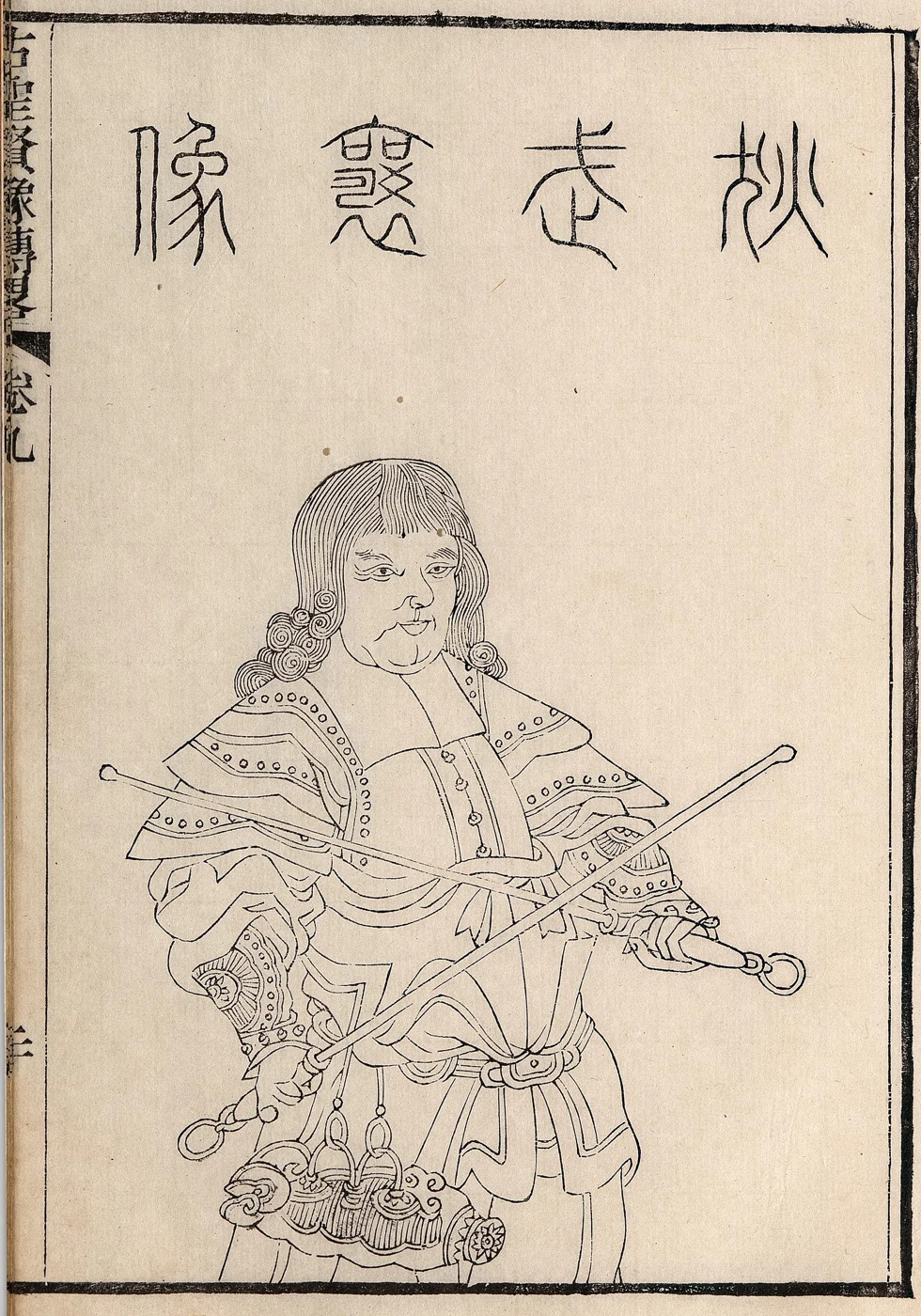
1008 CE–1057 CE
General
Di Qing
狄青
Di Qing (1008(first year of Dazhong Xiangfu)–1057(second year of Jiayou)), courtesy name Hanchen, was a Northern Song general from Dijiashe in Xihe County, Fen Prefecture, who rose to become Military Affairs Commissioner. He joined the army early in life and retained facial tattoo marks under the military tattooing system. During the wars between the Northern Song and Western Xia, he repeatedly served in the vanguard, took…
1008 CE–1057 CENorthern Song
PROFILE
Di Qing (1008(first year of Dazhong Xiangfu)–1057(second year of Jiayou)), courtesy name Hanchen, was a Northern Song general from Dijiashe in Xihe County, Fen Prefecture, who rose to become Military Affairs Commissioner. He joined the army early in life and retained facial tattoo marks under the military tattooing system. During the wars between the Northern Song and Western Xia, he repeatedly served in the vanguard, took fortified positions, helped construct frontier strongpoints, and gradually rose to senior military office. Fan Zhongyan urged him to read the Zuo Commentary, after which he studied military methods and historical affairs as well as fighting skills. In 1052(fourth year of Huangyou), Di Qing was ordered to Guangxi to suppress Nong Zhigao's forces. In the following year he won in the area of Kunlun Pass and Guirenpu and recovered Yongzhou. After the battle he released captives who had been coerced into following the rebels, and he refused to report Nong Zhigao dead before the identity of a corpse had been verified. He later became Military Affairs Commissioner, but because of his origins in the ranks and the court's concern over a military officer controlling armed forces, he was sent out of the capital to govern Chen Prefecture in 1056(first year of Jiayou) and died there the following year.
- Other names
- Di Hanchen; the Tattoo-faced General
- Courtesy name
- Hanchen
- Period
- Song · Northern Song
- Date of Birth
- 1008 CE(1st year of the Dazhong Xiangfu era, Song;month and day unknown)
- Date of Death
- 1057 CE(2nd year of the Jiayou era, Song)
- Dynasty / polity
- Song · Northern Song
- Identity
- General
- Ethnicity / group
- Not reliably confirmed in currently available sources
- Native place
- Xihe, Fenzhou, Northern Song (present-day Fenyang, Lüliang, Shanxi)
- Place of birth
- Unknown
- Major achievements
- Rose from the ranks despite facial tattooing; decisively defeated Nong Zhigao and suppressed the rebellion centered on Yongzhou
- Alternative name
- "Tattooed-Face General" (later designation derived from the tattooing on his face);Northern Song
- Dynasty/Polity
- Northern Song;Northern Song general and Military Affairs Commissioner
- Ethnic affiliation
- Not reliably established in the available sources;Xihe County, Fen Prefecture
- Spouse
- Lady Wei;Wuxiang
- Posthumous appointments
- Secretariat Director; later additionally Prefect of the Masters of Writing;Sanban assignment, Yanzhou command post, military posts in Jingyuan Circuit, Deputy Commissioner of Military Affairs, Military Affairs Commissioner, Tong Zhongshu Menxia Pingzhangshi
LIFE TIMELINE
Di Qing (1008(first year of Dazhong Xiangfu)–1057(second year of Jiayou)) | Di Qing (1008(first year of Dazhong Xiangfu)–1057(second year of Jiayou)), courtesy name Hanchen, was a Northern Song general from Dijiashe in Xihe County, Fen Prefecture, who rose to become Military Affairs Commissioner.
Enlistment in the capital | In his youth Di Qing was skilled with horse and bow, so he enlisted in the capital and was assigned to the Imperial Horse Direct, later selected for the scattered direct troops. Because soldiers of the time were tattooed to prevent desertion, he bore tattooed characters on his face.
Frontier service | After Li Yuanhao began hostilities, Di Qing was appointed to a Sanban duty post, as a palace attendant, and as commander of the Yanzhou Command, then went to the northwestern front.
In 1038(first year of Baoyuan) | In 1038(first year of Baoyuan), Western Xia forces attacked Bao'an; Di Qing led the Song troops to victory there.
Frontier promotion | Promoted to a higher military post after distinguished defensive service and continued serving on the northwestern frontier.
CE – 1040 CE(2nd year of the Baoyuan era – 1st year of the Kangdi
1039 CE – 1040 CE(2nd year of the Baoyuan era – 1st year of the Kangding era) | After 1039(second year of Baoyuan) he was promoted for defensive service. | After 1039(second year of Baoyuan) he was promoted for defensive service.
Study of classics and history | Yin Zhu recommended Di Qing to Han Qi and Fan Zhongyan; Fan Zhongyan gave him the Zuo Commentary to study.
In 1040(first year of Kangding) | In 1040(first year of Kangding), after discussing military matters with him, the circuit official Yin Zhu recommended him to Han Qi and Fan Zhongyan and described him as possessing the material of a good general.
Promotion as frontier commander | Promoted to Inspector of Qin Prefecture, Deputy Military Administrator of Jingyuan Circuit, and deputy military commissioner for strategy and campaigning.
In 1042(second year of Qingli) | In 1042(second year of Qingli), Di Qing was promoted to Inspector of Qin Prefecture, Deputy Military Administrator of Jingyuan Circuit, and deputy military commissioner for strategy and campaigning.
Military promotion | Added the posts of commander-in-chief of the Four Divisions of the Pengri and Tianwu armies and Training Commissioner of Huizhou.
In 1044(fourth year of Qingli) he was appointed commander-in-chief of the Four Divisions o | In 1044(fourth year of Qingli) he was appointed commander-in-chief of the Four Divisions of the Pengri and Tianwu armies and Training Commissioner of Huizhou.
Ordered to suppress the rebellion | Nong Zhigao took Yongzhou and advanced against several Lingnan prefectures; Di Qing memorialized requesting command and was sent south.
He later became Military Commissioner of Zhanghua and Prefect of Yan | He later became Military Commissioner of Zhanghua and Prefect of Yan, and in June 1052(fourth year of Huangyou) was promoted to Deputy Commissioner of Military Affairs.
Arrival at Binzhou and enforcement of discipline | Di Qing reached the front, punished officers who had disobeyed orders, and established unified command.
Victory at Guirenpu | After crossing Kunlun Pass, Song forces attacked from both wings, defeated Nong Zhigao's forces, and recovered Yongzhou.
Postwar measures | Released 7,200 captured people who had been coerced into following the rebels; refused to report Nong Zhigao dead because the corpse had not been reliably identified.
Military Affairs Commissioner | After the campaign, first resumed office as Deputy Commissioner of Military Affairs and then became Military Affairs Commissioner.
First month | In the first month Di Qing made a night raid on Kunlun Pass and routed Nong Zhigao at Guirenpu, recovering Yongzhou; in the fifth month he was promoted to Commissioner of Military Affairs.
Sent to Chen Prefecture | After flooding in the capital, the court removed him from the Bureau of Military Affairs and sent him to govern Chen Prefecture with the title Tong Zhongshu Menxia Pingzhangshi.
Death | Died of illness in Chen Prefecture; posthumously appointed Secretariat Director and given the posthumous title Wuxiang.
Di Qing died of illness in Chen Prefecture in 1057(second year of Jiayou). | Di Qing died of illness in Chen Prefecture in 1057(second year of Jiayou).
Posthumous commemoration | Emperor Shenzong ordered a portrait of Di Qing placed in the palace and sent an envoy to sacrifice at his family home.
In 1068(first year of Xining) | In 1068(first year of Xining), Emperor Shenzong mentioned Di Qing while reviewing leading commanders of recent times, ordered his portrait placed in the palace, and sent an envoy to sacrifice at his family home.
BIOGRAPHY
Biography
Early Military Career Di Qing came from Dijiashe in Xihe County, Fen Prefecture. The two surviving encyclopedia sources confirm that his family farmed and identify his father as Di Pu and his mother as Lady Hou, but they do not reliably establish his specific birthplace or ethnic affiliation. On how he entered the army, material cited in the full text says that, while still a teenager, he became involved in a conflict with people from his locality, was arrested, tattooed, removed from the household register, and sent to the capital for military service. Another account gives a shorter account, stating that he later entered the army and that soldiers were commonly tattooed to deter desertion. Because the details of his early arrest rest more heavily on a single source, they are presented as rather than expanded further. Di Qing was skilled at riding and archery. He initially served in the Imperial Horse Guard and was later selected for another palace military unit. After the Song–Western Xia wars broke out, in 1038(first year of Baoyuan) he was appointed to a Sanban duty post, served as a palace attendant, and commanded the Yanzhou post on the northwestern frontier. Song forces there had suffered repeated defeats and many soldiers were fearful, while Di Qing repeatedly served in the vanguard. The History of Song and the encyclopedia texts record that over four years he took part in twenty-five engagements and was struck by arrows eight times. They also describe him entering battle with loose hair and a bronze mask. This combat image comes from historical biographies; later fictional portrayals of an "Iron-Masked General" are not incorporated as historical fact. ### Western Xia War and Promotion During the northwestern fighting, Di Qing captured Jintang City, advanced as far as Youzhou, and participated in building Qiaozigu and the forts of Zhao'an, Fenglin, Xinzhai, Dalang, and other frontier positions to control strategic points. In 1038(first year of Baoyuan), Western Xia forces attacked Bao'an; Di Qing led the Song troops to victory there. one account calls this the ‘Bao'an victory’ and says he then helped build forts to guard strategic points. The source gives no verifiable Gregorian month and day, so the event is dated only to the year. Sources also record raids against Western Xia groups, destruction of military supplies, seizure of tents, and capture of people. Because these are records of military operations in wartime, the account summarizes the military outcomes without allowing accounts of merit to obscure harm to local populations and without combining inconsistent statistics from different sources. Di Qing was once seriously wounded in fighting at Anyuan, but when he heard that enemy forces had returned he still went to reinforce the position, encouraging his troops to fight hard. After 1039(second year of Baoyuan) he was promoted for defensive service. In 1040(first year of Kangding), after discussing military matters with him, the circuit official Yin Zhu recommended him to Han Qi and Fan Zhongyan and described him as possessing the material of a good general. Fan Zhongyan gave him the Zuo Commentary, arguing that a commander should understand past and present rather than rely on personal courage alone. Di Qing thereafter studied the classics, history, and military writings of earlier periods, gradually developing from a front-line officer known primarily for courage into a commander versed in military history and strategy. In the eleventh lunar month of 1040(first year of Kangding), he was appointed Superintendent of Jingzhou and later rose through the ranks to Deputy Commissioner of the Western Palace Gate Guard. In 1042(second year of Qingli), Di Qing was promoted to Inspector of Qin Prefecture, Deputy Military Administrator of Jingyuan Circuit, and deputy military commissioner for strategy and campaigning. In 1044(fourth year of Qingli) he was appointed commander-in-chief of the Four Divisions of the Pengri and Tianwu armies and Training Commissioner of Huizhou. After Western Xia submitted, he was transferred to the Zhending area and held senior posts in the infantry and cavalry commands. The tattoo marks remained on his face. Emperor Renzong once told him to use medicine to remove them, but Di Qing replied that he had risen through military merit and that the marks could serve as a reminder to other soldiers, and he declined to remove them. He later became Military Commissioner of Zhanghua and Prefect of Yan, and in June 1052(fourth year of Huangyou) was promoted to Deputy Commissioner of Military Affairs. ### Campaign against Nong Zhigao In 1052(fourth year of Huangyou), Nong Zhigao, leader of Guangyuan Prefecture, rose in revolt, captured Yongzhou, and attacked a succession of prefectures along the river, putting Lingnan under severe pressure. Song forces previously sent against him had suffered repeated defeats. Di Qing memorialized asking to take command. The court appointed him Commissioner of the Southern Hall of the Palace Administration and gave him authority over forces and operations in the Jinghu region and Guangnan. After reaching Binzhou, he joined the forces of Sun Mian and Yu Jing and required the commanders to obey unified orders and not fight independently. Before Di Qing arrived, the Guangxi military official Chen Shu had led infantry into battle and been defeated at Kunlun Pass. Di Qing attributed the defeat to disunified command and punished Chen Shu, Yuan Yong, and more than thirty other officers under military law. He then avoided an immediate assault and ordered the army to rest for ten days, causing Nong Zhigao's side to misjudge the timing of the Song advance. Di Qing then led cavalry rapidly across Kunlun Pass and formed for battle at Guirenpu. The vanguard commander Sun Jie was killed, after which Di Qing ordered cavalry on both wings to attack from the flanks. Song forces defeated and pursued Nong Zhigao's army. Sources differ on the distance of the pursuit and the numbers killed or captured, so the account does not combine those statistics; what can be confirmed is that the Song army won, Nong Zhigao left Yongzhou, and Di Qing's army entered and recovered the city. After entering Yongzhou, Di Qing ordered battlefield bodies collected and dealt with, and he gathered 7,200 civilians described in the source as older and able-bodied, who had been captured or coerced by Nong Zhigao's forces, comforted them, and released them. When a corpse wearing a gold dragon robe was found, some officers proposed reporting that Nong Zhigao was dead. Di Qing held that the identity could not be confirmed and preferred to report that Nong Zhigao had escaped rather than claim an unverified success. These two postwar decisions are as much part of his command record as the battle itself: he worked to restore order and release coerced civilians while also limiting military reports to verifiable facts. The surviving sources do not say where all those released later went, so their destinations are not supplied here. ### Handling the Proposal to Borrow Troops from Jiaozhi During the Nong Zhigao Rebellion of 1052(fourth year of Huangyou), Jiaozhi offered to send troops to assist the Song, and the court at one point prepared provisions and rewards. After reaching the front, Di Qing told Yu Jing to stop sending envoys to request those troops and explained his reasons to Emperor Renzong: Jiaozhi's stated plan to send troops might not be reliable, using foreign troops to suppress an internal rebellion could make the Song dependent on the other side, and it might give Jiaozhi an opportunity to expand its involvement. The court accepted his position, and the Song army suppressed the rebellion without Jiaozhi troops. This was part of the campaign's foreign-policy and operational planning and should not be reduced to a vague description of "foresight." ### Military Affairs Commissioner and Later Years After the campaign, Di Qing first resumed office as Deputy Commissioner of Military Affairs and then became Military Affairs Commissioner. Emperor Renzong rewarded his service with a residence and favorable promotions for his sons. Di Qing enjoyed high prestige in the army, while court officials were also uneasy about a man from the ranks holding authority in the Bureau of Military Affairs. The sources record rumors involving a dog growing horns and strange lights at his residence; these were contemporary rumors, not evidence that Di Qing was plotting rebellion or behaving abnormally. In 1056(first year of Jiayou), flooding struck the capital, and Di Qing moved to Daxiangguo Temple for refuge. Because he stayed in one of its halls, the matter became a subject of court discussion. The court removed him from the post of Military Affairs Commissioner and sent him to govern Chen Prefecture with the title Tong Zhongshu Menxia Pingzhangshi. Di Qing died of illness in Chen Prefecture in 1057(second year of Jiayou). Emperor Renzong mourned him, posthumously appointed him Secretariat Director, and gave him the posthumous title Wuxiang. one account and the Long Draft of the Continuation of the Comprehensive Mirror in Aid of Governance cited there place his death in the third lunar month The available materials do not allow the two dates to be safely reconciled here as equivalent calendar dates, so the information table records the difference and the main narrative follows the year-and-month account. In 1068(first year of Xining), Emperor Shenzong mentioned Di Qing while reviewing leading commanders of recent times, ordered his portrait placed in the palace, and sent an envoy to sacrifice at his family home. These were posthumous honors, not offices or achievements held during his life.
From the Ranks to a Good General: His Services in the Song-Xia War and His Reading
In his teens Di Qing was thrown into prison by the constables after a quarrel with a fellow villager, had his face tattooed, his household registration cancelled and was sent to the capital for service in the army; he was skilled with bow and horse, first in the mounted imperial horse unit and then selected for the dispersed guards. When war with Xia broke out he was made a third-class usher, palace attendant and commander of Yanzhou, and sent to the north-western frontier. At that time the subordinate generals were repeatedly beaten by Xia and the soldiers were mostly afraid, and Di Qing on campaign was always in the van; "in four years he fought twenty-five battles great and small and took a stray arrow eight times." He broke Jintang city and raided Youzhou, slaughtered the clans of Pengmie, Suixiang, Maonu, Shangluo, Qingqi and Jiakou, burned several tens of thousands of Xia's stored grain, took two thousand three hundred tents and five thousand seven hundred prisoners; and he fortified Qiaozigu and built the forts of Zhao'an, Fenglin, Xinzhai and Dalang, all of them "holding the enemy's vital points." The histories say that once, fighting at Anyuan, he was gravely wounded and yet, hearing the enemy had come, sprang up and galloped to meet them, so that his soldiers strove to be first; and that in battle he let down his hair and wore a bronze mask, going in and out among the enemy, who all gave way and none dared oppose him. In 1040 the assistant military commissioner Yin Zhu, having talked with him of the art of war, admired him and recommended him to Han Qi and Fan Zhongyan as "material for a good general"; and Fan Zhongyan gave him the Zuo Commentary on the Spring and Autumn, saying that a general who does not know past and present has only a common man's courage, after which Di Qing "bent himself to study and mastered the military methods of the commanders from Qin and Han times, and was thereby the better known," going out as supervisor of Jingzhou in the eleventh month. Emperor Renzong had wished to receive him for his repeated merits, but as Xia was then pressing Weizhou he was sent straight to Jingyuan, and painters were ordered to take his likeness and send it to the capital — according to the tomb inscription by Yu Jing, so that "in the capital men did not use his name but called him Di the Myriad, likening him to Guan and Zhang." He rose afterwards to be assistant commissioner of the western upper pavilion gate, governor of Qinzhou, deputy commander of the Jingyuan circuit and deputy commissioner for the recruitment and pacification, and then commander of the four flanking columns of the Ridi Tianwu guards and commissioner of Huizhou; and when Yuanhao submitted he was transferred to be deputy commander of the Zhending circuit, serving in turn as commandant of the imperial foot guards, defence commissioner of Meizhou, deputy commander of the foot guards and acting governor of the Baoda and Anyuan armies, and then deputy commander of the horse guards. He had struggled in the ranks for more than ten years before he became prominent, his face still tattooed; and when the emperor ordered him to use medicine to remove the marks, he pointed to his face and said that the emperor had raised him by merit without asking about his birth or family, and that whatever he was today came from that tattoo, which he wished to keep to encourage the army, and did not dare obey.
The Pacification of Nong Zhigao: His Request to Go, the Beheading of a General, and the Battle at Guirenpu
In the Huangyou years Nong Zhigao of Guangyuan prefecture rebelled, took Yongzhou and nine more prefectures along the river, besieged Guangzhou, and threw Lingnan into disorder; Yang Tian and others achieved nothing for a long time, and Sun Mian and Yu Jing were made pacification commissioners against him, yet the emperor remained anxious. Di Qing memorialized asking to go, and at his audience the next day said that he had risen from the ranks and had nothing but fighting with which to repay the state, and asked for several hundred foreign tribal cavalry with some imperial guards to bring the rebel's head to the palace; and the emperor, admiring his words, made him commissioner of the southern court of the proclamation, pacification commissioner of Jinghu south and north and commissioner for the suppression of the Guangnan bandits, and gave him wine in the Chuigong hall at his departure. Nong Zhigao having returned to hold Yongzhou, Di Qing joined Sun Mian's and Yu Jing's forces and halted at Binzhou. Earlier Jiang Xie and Zhang Zhong had both been killed through despising the enemy, greatly damping the army's name; and Di Qing therefore warned the generals not to fight the rebels on their own initiative but to await his orders. Yet the Guangxi commander Chen Shu, before Di Qing arrived, had attacked the rebels with eight thousand foot and been routed at the Kunlun pass, and the palace usher Yuan Yong and others had fled; and Di Qing, saying that want of a single order was why armies were beaten, assembled the generals in the hall in the morning, had Chen Shu brought up and Yuan Yong and thirty others summoned, condemned them for defeat and flight, and had them taken outside the camp gate and beheaded, at which Sun Mian and Yu Jing looked at each other aghast and the generals' knees shook. He then halted the army and had them rest ten days, so that the enemy's scouts reported to Nong Zhigao that the Song would not advance soon; and the very next day he formed up his horse and men and crossed the Kunlun pass in a day and a night, deploying out of Guirenpu. The rebels, having lost their strong ground, came out to fight, and the Song vanguard under Sun Jie died fighting at the foot of the hill while the rebels' spirit rose high and Sun Mian and the others turned pale with fear; and Di Qing, white banner in hand, directed the cavalry out from both wings to take the rebels unawares, broke them utterly and pursued for fifty li, taking several thousand heads, while of Nong Zhigao's party Huang Shimi, Nong Jianzhong and Nong Zhizhong and the false officials fifty-seven were killed and more than five hundred rebels taken alive, and Nong Zhigao fled by night after burning the city.
His Measures after Entering the City and His Refusal of Jiaozhi's Troops
At dawn Di Qing brought his troops into the city and took gold, silver, silk and jade worth tens of thousands and several thousand head of stock, and gathered seven thousand two hundred grown men and elders who had been captured and coerced by the rebels and, having comforted them, released and dismissed them; he hung the heads of Huang Shimi and the others from the wall of Yongzhou and collected the rebels' corpses into a mound for a monument at the north corner of the city. Among the corpses was one in a golden dragon robe, and his subordinates said Nong Zhigao was dead and wished to report it; but Di Qing said how could they know it was not a trick, and that he would rather let Nong Zhigao be lost than deceive the court to win merit. After this he was again deputy commissioner of military affairs and was advanced to commissioner of the Huguo army and governor of Hezhong; and returning to the capital he was praised by the emperor, made commissioner of military affairs, given a mansion in the Dunjiaofang ward and had his sons' ranks advanced out of course. In foreign policy, Jiaozhi had offered troops to help put down the rebellion, and Yu Jing thought the offer sincere, laying in ten thousand men's rations at Yongzhou and Qinzhou, while the court decreed thirty thousand strings to Jiaozhi for military expenses and promised rich rewards after the rebellion was put down. Di Qing on reaching the front at once ordered Yu Jing to send no envoys to borrow troops, memorializing that Li Dezheng's claim of fifty thousand foot and a thousand horse was not the truth, that to borrow troops abroad to put down a rebellion at home was no advantage to them, that if one Nong Zhigao could ravage the two Guang provinces and the court could not suppress him, and they then borrowed barbarian troops whose greed knows no honour and so stirred up war, how should they withstand them; and he asked that Jiaozhi's help be refused. The court agreed, the rebellion was put down by the Song armies alone, and men admired his far-sightedness. As to his manner of command, the histories also record that he first ordered his ranks and made rewards and punishments clear, shared hunger and cold and hardship with his soldiers, and commonly gave the credit to his officers after a victory; and that after the pacification he handed the remaining business to Sun Mian. These records fill out the other side of the picture: known as a vanguard who broke into the ranks, he was also a man of unified orders, clear rewards and punishments, and the rebuilding of order after the fighting.
Commissioner of Military Affairs and His Last Years
Di Qing was commissioner of military affairs for four years, and whenever he appeared the soldiers would point him out and praise him to one another. Because the ministers were uneasy at a man of the ranks holding the military secretariat, the remonstrating officials seized on the reports that a dog in his household had grown horns and that his house had several times shone, asking that he be sent out of the capital to preserve his reputation, but the emperor gave no answer. In 1056 the capital was flooded and Di Qing moved to the Great Xiangguo temple to escape the water, and his lodging in the hall there gave rise to discussion at court; the court therefore took from him the military secretariat and sent him out as governor of Chenzhou with the title of joint manager of the affairs of the Chancellery. In 1057 Di Qing died of illness at Chenzhou, and Emperor Renzong made mourning for him, posthumously making him president of the Secretariat with the posthumous name Wuxiang (the Continuation of the Comprehensive Mirror recording that he died in the third month). In 1068 Emperor Shenzong, speaking of the commanders of recent times, mentioned Di Qing, had his portrait brought into the palace and sent envoys to sacrifice at his house — an honour after his death and not an office or achievement of his lifetime.
Major Activities
Northwestern Campaigns and Frontier Defense Di Qing repeatedly served in the vanguard during the Song–Western Xia wars and took part in capturing Jintang City, advancing to You Prefecture, and constructing frontier forts. The records describe not only personal assaults but also reconnaissance, recruitment of archers, troop training, use of deception, and control of strategic routes. The Long Draft also says that he arranged the ranks and rewards before a march, shared hardship with his soldiers, and often yielded credit to subordinate commanders. After the Nong Zhigao campaign, he left the remaining administrative arrangements to Sun Mian. These accounts present his command practice alongside his personal combat record. Figures for casualties, destroyed supplies, and captives vary among the historical accounts; the article therefore retains verifiable operations and strategic results without adding the separate figures into a precise total. ### Kunlun Pass Campaign and Military Discipline In the campaign against Nong Zhigao's forces, Di Qing first required the commanders to operate under unified orders and then punished Chen Shu and other officers after they fought independently and were defeated. After resting the army for ten days, he exploited the enemy's mistaken expectations, crossed Kunlun Pass, and used cavalry attacks on both wings at Guirenpu. The victory recovered Yongzhou and reversed a series of earlier Song setbacks. His enforcement of discipline involved both severe punishment of officers who disobeyed orders and an effort to prevent losses caused by separate, unauthorized engagements; the executions should not be isolated from this command context. ### Postwar Pacification and Verification of Results After recovering Yongzhou, Di Qing released 7,200 civilians who had been captured or coerced into following the rebels. When subordinates inferred from a corpse's clothing that Nong Zhigao had been killed and prepared to claim the success, Di Qing refused to report an identity that could not be confirmed and instead reported that Nong Zhigao had escaped. The first action concerned treatment of civilians after the battle, while the second concerned accuracy in military reporting and claims of merit. Both are directly recorded and form indispensable parts of the campaign account. ### Refusing to Borrow Jiaozhi Troops Jiaozhi offered to send troops to assist in suppressing the rebellion, and the Song court initially prepared supplies. Di Qing argued that the offer might not be reliable and that introducing foreign troops could expand Jiaozhi's involvement in Song internal affairs. The court accepted his position, and Song forces ultimately completed the campaign themselves. His judgment considered the source of military forces, diplomatic dependence, and postwar security together.
His Fighting Image, His Frontier Works, and the Layers of the Sources
In later ages Di Qing is often presented as the "iron-faced general," and the basis of that image is the record that in battle he "let down his hair and wore a bronze mask, going in and out among the rebels, who all gave way and none dared oppose him." But the same records show a side that did not depend on personal charges: in the north-west he took part in the capture of Jintang city and the raid on Youzhou, and he fortified Qiaozigu and built the forts of Zhao'an, Fenglin, Xinzhai and Dalang, all of which "held the enemy's vital points," which is a matter of controlling roads and strong ground; and the record also includes scouting the ground, recruiting archers, training troops and using feigned forces. In command he first ordered his ranks and made rewards and punishments clear, shared hardship with his men, gave the credit to his officers, and handed over the remaining business after the campaign. These do not contradict the image of the charge, but to confuse the two is to reduce an officer who fought twenty-five battles and took eight arrows in four years to a legendary bravo.
In the sources there are several layers to be kept apart. First, the figures: as to the raids on the Xia clans, the burning of stores, the tents taken and the prisoners, the numbers in the different entries do not agree, so that the confirmable actions and strategic results should be kept and the figures not added into a precise total. Second, the reason for his early arrest: the source is comparatively single, and it should be treated as what is recorded rather than pushed into further detail. Third, the reports of the dog with horns and the shining house: these were rumours of the day and no evidence that Di Qing plotted rebellion or behaved abnormally, and the historians place them under the remonstrating officials' request for his transfer precisely because they were pretexts of political talk. Fourth, the honours after death: Shenzong's bringing of the portrait into the palace and sending offerings to his house belong to later remembrance and cannot be read back as his standing or authority in life. Taken as a whole, that he rose from the ranks to the military secretariat shows one side of Northern Song practice in raising men by merit without regard to birth, while the ministers' unease at his holding the secretariat and the spread of rumours show the tension of the same period between civil and military men and between families of birth; and his keeping the tattoo on his face to encourage the army is precisely that double tension embodied in one man.
Personal Relations
- Di Pu: father; the sources describe the family as farmers, and he later received posthumous honors.
- Lady Hou: mother; later titled Grand Lady of Yan State.
- Di Su: elder brother; served as a palace military officer.
- Lady Wei: wife; titled Lady of Ding State.
- Di Zi: eldest son; held posts including an audience-service office and Training Commissioner of Jiazhou.
- Di Yong: son; held posts including an office in the Court of State Ceremonial; historical sources record military merit.
- Di Liang, Di Hui, Di Jian, and Di Shuo: sons; appear in family records with varying detail about their offices and lives. The sources differ on the total: the source lists six sons by name, while The article records the names found in the sources without asserting a reconciled total.
- Emperor Renzong of Song: ruler who appointed Di Qing to northwestern and Guangnan military commands, later made him Military Affairs Commissioner, and granted posthumous honors after his death.
- Yin Zhu: circuit official who discussed military affairs with Di Qing and recommended him to Han Qi and Fan Zhongyan.
- Han Qi: Northern Song statesman who, together with Fan Zhongyan, recognized and promoted Di Qing.
- Fan Zhongyan: Northern Song statesman who gave Di Qing the Zuo Commentary and urged him to study the classics and history.
- Sun Mian: Northern Song official who participated in the Nong Zhigao campaign and commanded forces with Di Qing.
- Yu Jing: Northern Song official who participated in the campaign, had been ordered to contact Jiaozhi, and later stopped seeking its troops at Di Qing's urging.
- Nong Zhigao: leader of Guangyuan Prefecture whose forces captured Yongzhou and fought the Song; they were defeated under Di Qing's command.
- Chen Shu: Guangxi military official who fought without authorization before Di Qing's arrival and was defeated at Kunlun Pass; later punished under military law.
- Yuan Yong: Song commander who fled after Chen Shu's defeat and was punished together with other officers.
- Li Yuanhao: ruler of Western Xia, whose forces fought Di Qing during the Song–Western Xia wars.
Anecdotes
The History of Song records that Emperor Renzong once ordered Di Qing to apply medicine to remove the tattoo marks on his face. Di Qing replied that he had risen through military merit rather than family background; the marks were part of the reason he had advanced, and he wished to keep them as encouragement to soldiers. He therefore declined to obey the order. This anecdote is recorded in the historical biography and is not treated as evidence for later fictional portrayals of the ‘Iron-Masked General.’
Historical Assessment
The History of Song records Yin Zhu describing Di Qing as having the qualities of a good general, while Fan Zhongyan's admonition that a commander ignorant of past and present was merely a brave commoner encouraged him to study history. These two records respectively show early recognition of his military ability and his development from an officer known for courage into one who studied military learning. After Di Qing defeated Nong Zhigao's forces, Emperor Renzong urgently ordered that his rewards be discussed. In 1068(first year of Xining), Emperor Shenzong, reviewing commanders of recent times, described him as a soldier who had risen from the ranks to fame among Chinese and non-Chinese peoples, possessed intelligence and strategy, and knew how to conduct himself cautiously, and ordered sacrifices to him. This was an imperial retrospective assessment of his military career. Di Qing's promotion also intensified Northern Song concerns about military power. His departure from the Bureau of Military Affairs was connected both with discussion after the capital's flood and with a political structure in which civil officials were wary of senior soldiers controlling troops. Reports of strange lights and of a dog growing horns at his home were contemporary rumors and cannot be treated as factual evidence. Later claims that he was an incarnation of the "Martial Star," and his portrayals in stories about Judge Bao and the Yang family generals, belong to folklore and literature rather than to his historical actions or contemporary assessments.
FIGURES ASSOCIATED WITH THIS DYNASTY
Bibliography
- Toghto et al., History of Song, vol. 290, “Biography of Di Qing.”