Studying Under Hou Cang
Born in Suiyang, Liang Kingdom; studied the Classic of Rites under Hou Cang alongside his uncle Dai De.
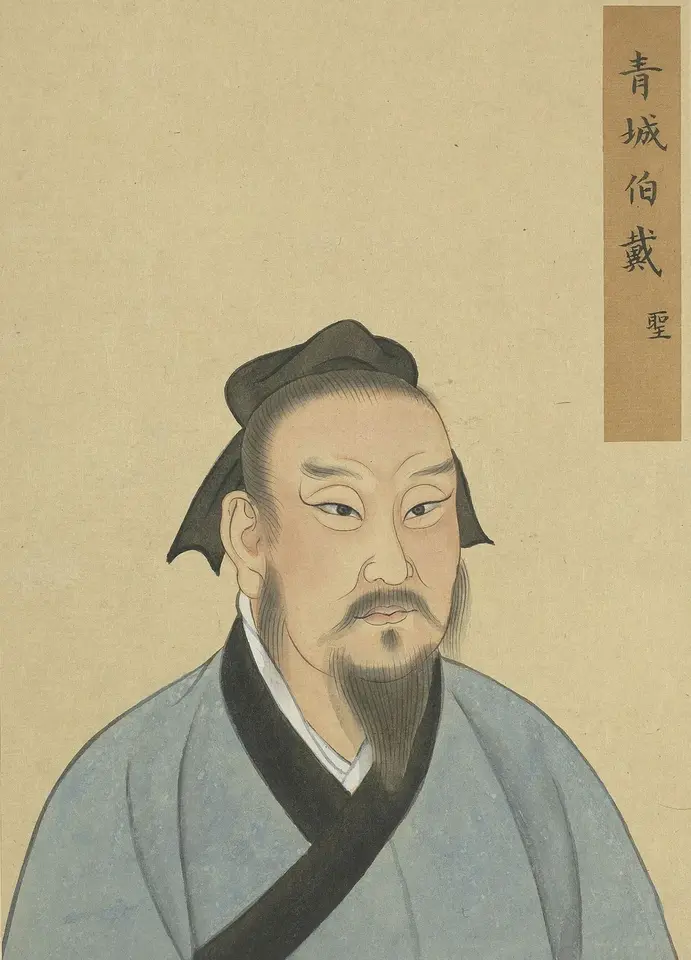
戴圣
Dai Sheng (dates of birth and death unknown), styled Cijun, was a native of Suiyang in the Liang Kingdom (modern Suiyang District, Shangqiu City, Henan Province). He was an eminent New Text classical master, ritual specialist, Governor of Jiujiang, and Erudite (Boshi) during the reigns of Emperor Xuan and Emperor Yuan of the Western Han dynasty. Together with his paternal uncle Dai De, he was celebrated as one of the two…
Dai Sheng (dates of birth and death unknown), styled Cijun, was a native of Suiyang in the Liang Kingdom (modern Suiyang District, Shangqiu City, Henan Province). He was an eminent New Text classical master, ritual specialist, Governor of Jiujiang, and Erudite (Boshi) during the reigns of Emperor Xuan and Emperor Yuan of the Western Han dynasty. Together with his paternal uncle Dai De, he was celebrated as one of the two preeminent ritual authorities of the Han era, collectively referred to as the "Greater and Lesser Dai," with Dai Sheng establishing the influential Lesser Dai School of Ritual (Xiaodai Xue). Born into an esteemed scholar-official family of Liang, Dai Sheng studied the Classic of Rites (Yili in seventeen chapters) under the famous ritual master Hou Cang alongside his uncle Dai De. Dai Sheng probed deeply into the subtle principles of ancient ritual systems, mastering not only ceremonial codes but also the political philosophy of personal cultivation, family regulation, and state governance. In 51 BCE (the third year of the Ganlu era), Emperor Xuan convened the famous Shiqu Pavilion Conference in the Weiyang Palace to harmonize discrepancies among the Five Classics. Serving as a senior Erudite representative, Dai Sheng offered decisive interpretations on fundamental lineage questions, such as the succession of the primary descent line (dazong) and mourning grades. His proposals received Emperor Xuan's personal ratification and were codified into state ritual law, firmly establishing the Lesser Dai School within the imperial academy. In his administrative career, Dai Sheng rose to Governor of Jiujiang. Prioritizing moral transformation over rigid statutory codes, he was secretly investigated by He Wu, the Regional Inspector of Yangzhou. After resigning and returning to the capital, Dai Sheng's son was implicated in a robbery case in Lujiang; He Wu handled the trial with strict impartiality and acquitted his son, prompting Dai Sheng to feel deep remorse and forge an enduring friendship with He Wu. Dai Sheng's greatest cultural legacy was compiling and editing the forty-nine chapters of the Lesser Dai Book of Rites (Xiaodai Liji, the standard received Liji). Gathering foundational pre-Qin and Han treatises on ritual ethics, governance, and cosmology, the work contains monumental chapters such as "The Great Learning" (Daxue), "The Doctrine of the Mean" (Zhongyong), and "The Evolution of Rites" (Liyun). Later annotated by the Eastern Han scholar Zheng Xuan, the text was elevated to one of the Five Classics, profoundly shaping Chinese moral and institutional order for over two millennia.
Born in Suiyang, Liang Kingdom; studied the Classic of Rites under Hou Cang alongside his uncle Dai De.
Appointed Erudite; summoned to the Shiqu Pavilion to harmonize the Five Classics and arbitrate lineage rules.
Appointed Governor of Jiujiang; resigned following an informal oversight notification by Inspector He Wu.
Returned to the imperial academy as Erudite; deeply moved when He Wu justly acquitted his son, cementing their bond.
Taught classical students in Chang'an, editing and compiling forty-nine core treatises into the Lesser Dai Book of Rites.
Dai Sheng was born in Suiyang, the capital of the Liang Kingdom (present-day Suiyang District, Shangqiu, Henan Province). His family was a distinguished lineage renowned for dedication to Confucian classical learning. His uncle, Dai De, was already a celebrated master of ancient ritual traditions and ancestral temple institutions. Immersed in this rigorous domestic tradition, Dai Sheng read extensively from childhood, displaying a particular passion for the ceremonial and musical systems of the Three Dynasties.
During the reigns of Emperor Zhao and Emperor Xuan, the imperial court vigorously patronized Confucian learning. Dai Sheng journeyed with his uncle Dai De to Pei Commandery to study under Hou Cang, the leading ritual scholar of the era who had received the seventeen chapters of the Classic of Rites from Xiao Fen of Xiacheng and Gaotang Sheng. Under Hou Cang's tutelage, Dai Sheng engaged in rigorous textual analysis day and night. Beyond memorizing the intricate procedures of sacrificial offerings, royal audiences, capping, weddings, and funeral protocols, he grasped the profound civilizing function of ritual in maintaining imperial cohesion.
Due to their extraordinary erudition, the two men gained imperial renown and were collectively honored as the "Greater and Lesser Dai"—Dai De being the Greater Dai and Dai Sheng the Lesser Dai. Both men established independent interpretive frameworks, culminating in the establishment of the Greater Dai and Lesser Dai Schools of Ritual within the Western Han scholarly world.
In 51 BCE, Emperor Xuan convened the famous Shiqu Pavilion Conference in the Weiyang Palace to eliminate divergent interpretations of pre-Qin classics and consolidate state ideology. The Emperor appointed Imperial Tutor Xiao Wangzhi and Commandant of the Central Rampart Liu Xiang to preside over the debates, summoning Dai Sheng as a foremost Erudite of the Classic of Rites.
During the conferences regarding the primary lineage and mourning rituals, Dai Sheng exhibited profound erudition and sharp political acumen. Addressing the issue of lineage succession when a primary descent branch (dazong) lacked heirs, Dai Sheng argued that the primary lineage must never be severed; if no concubine's son existed, the eldest son of a secondary branch must inherit the lineage to preserve ancestral sacrifices. Emperor Xuan endorsed this position and incorporated it into imperial law.
Furthermore, regarding mourning garments worn by married daughters for their biological parents or ministers mourning the Son of Heaven, Dai Sheng provided rigorous canonical proofs, defining degrees of kinship and ritual propriety. Deeply impressed, Emperor Xuan issued edicts commending his scholarship. Consequently, the Lesser Dai School was officially established with an Erudite chair in the Imperial Academy, elevating Dai Sheng to the pinnacle of classical scholarship.
Following the enthronement of Emperor Yuan, Dai Sheng's scholarly prestige earned him promotion from academic Erudite to Governor of the strategically vital commandery of Jiujiang.
As an esteemed classical master, Dai Sheng was self-assured and favored governance through moral virtue over bureaucratic legal statutes. His relaxed attitude toward fiscal registers and administrative regulations drew criticism from local functionaries. Around this time, the incorruptible and uncompromising official He Wu was appointed Regional Inspector of Yangzhou, with Jiujiang falling directly under his supervisory jurisdiction. Inspecting the commandery according to the six statutory articles of imperial surveillance, He Wu uncovered multiple administrative irregularities committed under Dai Sheng's tenure.
Respecting Dai Sheng's status as a preeminent ritual master, He Wu refrained from submitting an immediate indictment to the throne. Instead, he employed an informal oversight notification (luzhang), privately revealing the findings to Dai Sheng as a discreet warning. Proud by nature, Dai Sheng felt both frightened and resentful upon discovering that his missteps were known. Fearing impending impeachment, Dai Sheng preemptively submitted his resignation on grounds of illness, stepping down as governor and returning to the capital to resume his Erudite post.
Back in Chang'an, Dai Sheng harbored resentment, frequently disparaging He Wu among high ministers. Several years later, however, a dependent retainer of Dai Sheng's son colluded with bandits in Lujiang Commandery, leading to the arrest of Dai Sheng's son. By coincidence, He Wu was presiding over judicial affairs in the region. Expecting He Wu to exploit the case for vengeance, Dai Sheng despaired. Yet He Wu conducted an impartial investigation, verified that Dai Sheng's son had taken no part in the crime, and ordered his immediate acquittal.
Overwhelmed by remorse and admiration for He Wu's judicial integrity, Dai Sheng openly confessed his prior pettiness, apologized to He Wu, and forged a profound lifelong friendship with him. Whenever He Wu visited Chang'an for imperial audiences, Dai Sheng personally visited his quarters, creating a celebrated historical example of reconciliation between upright Han scholar-officials.
In his later years, Dai Sheng withdrew from bureaucratic politics to devote himself entirely to editing classical texts and mentoring students.
Following the destruction of books during the Qin dynasty, ancient ritual literature had survived only in fragments. Although the Han academy possessed the seventeen chapters of the Classic of Rites, more than one hundred and thirty scattered treatises recording the discourses of Confucius and his disciples on moral governance and ceremonial spirit remained disorganized in imperial archives and private collections. While Dai De had condensed these into eighty-five chapters in the Greater Dai Book of Rites, Dai Sheng applied a more rigorous editorial eye, selecting forty-nine treatises of profound philosophical and practical significance to form the Lesser Dai Book of Rites (Xiaodai Liji).
In this compilation, Dai Sheng preserved not only detailed accounts of ancestral rites and administrative procedures, but also core masterpieces of Confucian moral philosophy. Chapters such as "The Great Learning" outlined the path of self-cultivation leading to world peace; "The Doctrine of the Mean" formulated the philosophy of equilibrium and cosmic harmony; "The Evolution of Rites" articulated the vision of the Great Harmony (Datong); and "Record on Education" (Xueji) established eternal pedagogical principles.
Dai Sheng lectured extensively in Liang and Chang'an, training renowned scholars such as Qiao Ren and Yang Rong, who propagated his teachings across the empire. In the Eastern Han, master scholar Zheng Xuan composed standard commentaries for Dai Sheng's compilation, causing it to supersede the older Classic of Rites. By the Tang and Song dynasties, the Lesser Dai Book of Rites became one of the primary Five Classics, serving as an indispensable foundation for the imperial examination system and imperial statecraft for two thousand years.
In 51 BCE, Dai Sheng represented ritual scholars at the Shiqu Pavilion Conference, successfully defending the principle that the primary descent line must never be severed and resolving intricate mourning disputes. His rulings received Emperor Xuan's approval and established the official canonical status of the Lesser Dai School.
Dai Sheng systematically reviewed pre-Qin and Western Han ritual literature, distilling over one hundred texts into the forty-nine chapters of the Lesser Dai Book of Rites. Preserving core texts such as "The Great Learning" and "The Doctrine of the Mean," he elevated ritual studies from procedural formalities to a comprehensive political philosophy.
Building upon the lineage of Hou Cang, Dai Sheng established the Lesser Dai School of New Text ritual studies, securing an Erudite chair in the imperial academy. He trained leading classical scholars including Qiao Ren and Yang Rong, laying a permanent foundation for Confucian classical scholarship.
FIGURES ASSOCIATED WITH THIS DYNASTY