Birth into Gentry Clan
Born into the prominent Ban scholarly clan of Fufeng, receiving extensive education in classics, history, and mathematics.
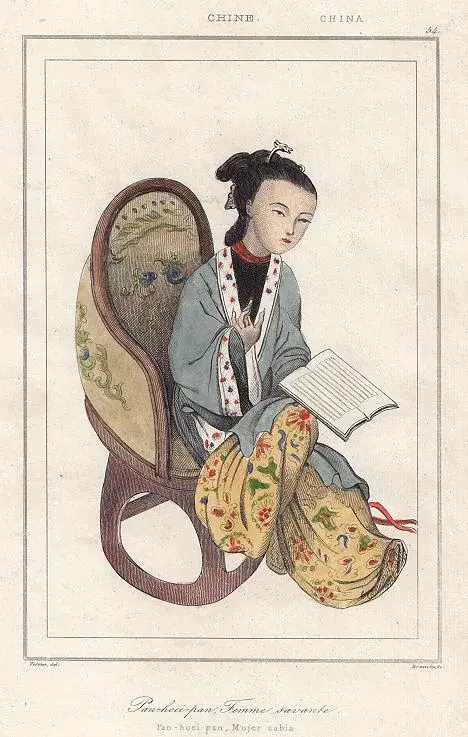
班昭
Ban Zhao (班昭, c. 49–c. 120), courtesy name Huiban, was a distinguished historian, writer, and intellectual of the Eastern Han Dynasty. Hailing from Anling in Fufeng Commandery (modern Xianyang, Shaanxi), she was the daughter of the eminent scholar Ban Biao and the younger sister of historian Ban Gu and the general Ban Chao. Following Ban Gu's death with the Book of Han (Han Shu) unfinished, Ban Zhao was commissioned by…
Ban Zhao (班昭, c. 49–c. 120), courtesy name Huiban, was a distinguished historian, writer, and intellectual of the Eastern Han Dynasty. Hailing from Anling in Fufeng Commandery (modern Xianyang, Shaanxi), she was the daughter of the eminent scholar Ban Biao and the younger sister of historian Ban Gu and the general Ban Chao. Following Ban Gu's death with the Book of Han (Han Shu) unfinished, Ban Zhao was commissioned by Emperor He to enter the Dongguan Imperial Library, where she completed the Eight Tables and the Treatise on Astronomy, becoming the first female author of an official Chinese standard history. Renowned for her erudition in classics and mathematics, Ban Zhao was invited into the imperial palace to instruct Empress Deng Sui, palace consorts, and noblewomen, earning the venerated title "Cao Dajia". During Empress Dowager Deng's regency, she served as a trusted political advisor in the inner court, offering crucial strategic guidance on state governance and warning the imperial in-laws to retreat from excessive power to preserve their clan. Her treatise Lessons for Women (Nu Jie) established standard codes of conduct and advocated female literacy, while her sixteen poetic works, including the celebrated Rhapsody on an Eastward Journey (Dongzheng Fu), made enduring contributions to classical Chinese literature.
Born into the prominent Ban scholarly clan of Fufeng, receiving extensive education in classics, history, and mathematics.
Married Cao Shoushu (Cao Shou) at age fourteen, conducting herself with marital propriety before being widowed in early life.
Following Ban Gu's death in prison, Emperor He commanded Ban Zhao to enter the Dongguan Imperial Library to complete the Book of Han.
Submitted an eloquent memorial to Emperor He pleading for her aged brother Ban Chao's return from the Western Regions, moving the court to grant recall.
Commanded by Emperor He to compose the Rhapsody on the Great Bird (Daque Fu) upon the arrival of ostrich and lion tributes from Parthia.
Formally instructed Empress Deng Sui and court ladies in classical literature, statecraft, and arithmetic, honored as "Cao Dajia".
Empress Dowager Deng began her regency; Ban Zhao participated in confidential court deliberations and policy consultations.
Penned Lessons for Women (Nu Jie) in seven chapters, providing a systematic framework for female ethical conduct and education.
Accompanied her son Cao Cheng to his magisterial post in Changyuan, composing the celebrated Rhapsody on an Eastward Journey.
Passed away peacefully in the capital at over seventy years of age; Empress Dowager Deng donned mourning dress and imperial envoys oversaw her funeral.
Ban Zhao belonged to the distinguished Ban clan of Anling in Fufeng, an aristocratic lineage renowned for administrative service and intellectual excellence throughout the Western and Eastern Han dynasties. Her father, Ban Biao, was an eminent historian who authored the Continuation of the Records of the Grand Historian (Shiji Houzhuan). Her eldest brother, Ban Gu, was the principal architect of the Book of Han, while her second brother, Ban Chao, was the legendary general who pacified the Western Regions and was enfeoffed as the Marquis of Dingyuan.
Immersed in this rigorous domestic academic environment, Ban Zhao studied classical Confucian canons, dynastic chronicles, and poetic forms from early childhood. She developed an exceptional command of astronomical calculations, calendrical computation, and mathematical analysis.
Around age fourteen, Ban Zhao married Cao Shoushu (Cao Shou), a respected gentleman from the same commandery. She managed household affairs with diligence, cultivating mutual respect within the marriage. Following the premature death of her husband, Ban Zhao chose not to remarry, dedicating herself to raising her young son Cao Cheng and maintaining moral integrity and scholarly discipline.
In the fourth year of the Yongyuan era (92), General-in-Chief Dou Xian was stripped of power, and Ban Gu died in prison due to political association with Dou's faction. The monumental manuscript of the Book of Han remained incomplete, lacking the crucial Eight Tables (Ba Biao) and the Treatise on Astronomy (Tianwen Zhi).
Recognizing Ban Zhao's peerless erudition and deep familiarity with her family's historical materials, Emperor He issued an imperial edict summoning her to the Dongguan Imperial Library in Luoyang. Working amidst thousands of archival rolls, she undertook the laborious task of cross-referencing archives, rectifying chronological gaps, and writing the missing portions of the standard history.
Ban Zhao independently authored the extensive Eight Tables and the Treatise on Astronomy, establishing systematic cross-tabular indices that organized historical figures into chronological and ethical grids. Her rigorous methodology brought the hundred-volume Book of Han to completion.
Because the archaic prose style of the Book of Han was difficult for contemporary scholars to comprehend, Emperor He instructed prominent scholars, including Ma Rong, to study under Ban Zhao at the Dongguan Library. Sitting behind a screen, she lectured on textual interpretation, training a new cohort of classical historians.
While Ban Zhao laboured in the imperial library, her brother Ban Chao had spent over three decades consolidating Han authority across more than fifty kingdoms of the Western Regions. Advanced in age and plagued by chronic illnesses, Ban Chao repeatedly petitioned the throne for permission to return to his homeland, but his requests were routinely deferred due to border instability.
In 100, seeing her brother's life drawing to an end in remote lands, Ban Zhao submitted her famous Memorial Pleading for Ban Chao's Return (Shangshu Hedi Fenliu Zishu Biao). Her poignant prose detailed Ban Chao's failing health, declining vitality, and the diminishing deterrent effect of an incapacitated commander upon foreign tribes. Deeply touched by her fraternal devotion, Emperor He recalled Ban Chao, who returned safely to Luoyang in 102.
Emperor He also held Ban Zhao's literary eloquence in high esteem. Whenever foreign embassies arrived with exotic tributes, Ban Zhao was commissioned to compose court rhapsodies. In 101, when King Pacorus II of the Parthian Empire dispatched envoys presenting lions and ostriches ("great birds of Tiaozhi"), Ban Zhao penned the Rhapsody on the Great Bird (Daque Fu), capturing the wonder of the occasion.
Impressed by her comprehensive mastery of classics and mathematics, Emperor He summoned Ban Zhao into the inner quarters of the palace to instruct Empress Deng Sui, imperial consorts, and court ladies in literature, state history, and arithmetic. The entire imperial court addressed her respectfully as "Cao Dajia".
Following Emperor He's demise in 105, Empress Deng took control of imperial governance as regent for the infant Emperor Shang and subsequently Emperor An. Empress Dowager Deng, having been Ban Zhao's pupil, maintained profound reverence for her teacher, frequently consulting her on state policies, judicial reviews, and appointments.
During the Yongchu era, Empress Dowager Deng's elder brother Deng Zhi served as General-in-Chief, with his brothers occupying key offices across the administration. As public unease grew over the concentration of power within the Deng family, Empress Dowager Deng sought Ban Zhao's confidential counsel on whether to retain them in high office.
Drawing upon historical precedents of consort clans who suffered violent extermination after clinging to supreme authority, Ban Zhao advised the regent to urge her brothers toward voluntary resignation, citing Yan Ying's moderation and Fan Li's retirement. Acting on her counsel, Deng Zhi and his brothers resigned their offices, preserving the family from immediate political backlash.
In her twilight years, observing that young women within her lineage were entering marriages unprepared for the demands of domestic governance and family ethics, Ban Zhao composed the famous moral manual Lessons for Women (Nu Jie) in seven chapters: Humility, Husband and Wife, Respect and Compliance, Womanly Conduct, Singleness of Purpose, Implicit Obedience, and Harmony with In-Laws.
The treatise presented practical guidelines for navigating patriarchal family dynamics, emphasizing modesty, self-restraint, and industrious labor, while breaking tradition by insisting that girls receive formal classical education to understand moral righteousness. The book circulated widely among aristocratic families and became a defining guide for female conduct throughout subsequent dynasties.
In 113, her son Cao Cheng was appointed Magistrate of Changyuan in Chenliu Commandery. Ban Zhao traveled eastward with him to his post, capturing her reflections on historical monuments and personal hardship in the Rhapsody on an Eastward Journey (Dongzheng Fu).
Ban Zhao passed away around 120 in Luoyang at the age of over seventy. Empress Dowager Deng expressed deep sorrow, donning plain mourning dress and dispatching imperial chamberlains to supervise funeral arrangements, according her the highest civic honors.
Ban Zhao's primary scholarly achievement was the completion of the Book of Han (Han Shu), China's first standard dynastic history. Entrusted with the legacy of her father Ban Biao and brother Ban Gu, she resolved complex chronological issues and independently drafted the Eight Tables and the Treatise on Astronomy.
Her innovative methodology in the Table of Ancient and Modern Persons categorized over 1,500 historical figures along coordinate axes of historical era and moral grade, demonstrating acute mathematical rigor. By completing this text and educating scholars such as Ma Rong, she safeguarded the preservation of Han historical memory.
Serving as personal mentor and confidante to Empress Dowager Deng, Ban Zhao exercised quiet but profound influence on state decisions during a critical period of imperial succession.
Her strategic guidance during the Deng consort clan crisis demonstrated acute statesmanship, guiding the regent away from disastrous factional confrontation through timely aristocratic concession and preserving institutional stability.
Through Lessons for Women (Nu Jie), Ban Zhao produced China's earliest systematic philosophical treatise on female moral cultivation. While reflecting the social realities of the Han dynasty, the work made a historic defense of female literacy, asserting that neglecting a daughter's education was a dereliction of moral duty.
In literature, her sixteen known works of prose and poetry established her reputation as a major Eastern Han writer. Her Rhapsody on an Eastward Journey remains a cornerstone of early Chinese travel literature, renowned for its blending of personal introspection with moral history.
In the official Book of the Later Han (Hou Han Shu), Fan Ye dedicated an entry to Ban Zhao in the Biographies of Exemplary Women, praising her profound learning and literary elegance: "Ban Zhao possessed vast learning and supreme talent. The title of Cao Dajia resounded throughout the empire. Her compositions and historical treatises were radiant, and her moral voice was universally acclaimed."
The literary critic Liu Xie observed in The Literary Mind and the Carving of Dragons (Wenxin Diaolong): "Ban Zhao's Eastward Journey unites feeling and form; though its words are restrained, its meaning is vast and profound."
Tang dynasty historiographer Liu Zhiji, writing in the General Principles of Historiography (Shitong), recognized her contribution to the Book of Han, placing her scholarly achievements on par with those of Ban Gu. Modern scholars revere Ban Zhao as one of the world's earliest female historians, educators, and political thinkers.
FIGURES ASSOCIATED WITH THIS DYNASTY