Succession to the Jochid Ulus | After Jochi's death, Batu became the principal heir to the Jochid lands; his elder brother Orda and other Jochid princes accepted his leading position.
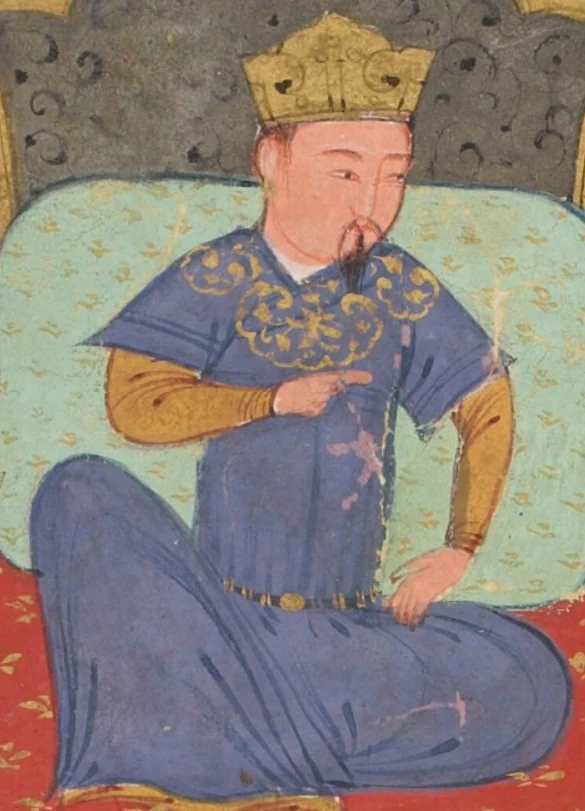
1209 CE–1256 CE
Mongol princecommander of the Second Mongol Western Campaignruler of the Jochid Ulus
Borjigin Batu
孛儿只斤·拔都
Borjigin Batu (1209-1256), a son of Jochi and grandson of Genghis Khan, was one of the most powerful western princes of the Mongol Empire. After Jochi's death, Batu became the principal leader of the Jochid Ulus. In 1235(7th year of Ögedei's reign), Ögedei appointed him to command the princes in a major western expedition. Mongol forces subsequently entered the Kipchak steppe, Volga Bulgaria, the Rus' principalities, Poland,…
1209 CE–1256 CEMongol Empire
PROFILE
Borjigin Batu (1209-1256), a son of Jochi and grandson of Genghis Khan, was one of the most powerful western princes of the Mongol Empire. After Jochi's death, Batu became the principal leader of the Jochid Ulus. In 1235(7th year of Ögedei's reign), Ögedei appointed him to command the princes in a major western expedition. Mongol forces subsequently entered the Kipchak steppe, Volga Bulgaria, the Rus' principalities, Poland, and Hungary. After the western army withdrew eastward in 1242(1st year of Töregene Khatun's regency), Batu developed the lower Volga region as the center of the Jochid Ulus. Later historians commonly refer to the resulting polity as the Golden Horde. During Güyük's reign, Batu did not attend the quriltai associated with Güyük's accession. After Güyük's death, Batu supported Möngke's succession as Great Khan. Sources do not fully agree on the exact year in which the khanate was established, the scope of its territory, or the sequence of succession within Batu's family. This article therefore describes the formation of the polity as a process and does not project the later institutional structure and frontiers of the Golden Horde backward into Batu's lifetime.
- Other names
- Batu; Sain Khan (title)
- Period
- Mongol Empire
- Date of Birth
- 1209 CE(exact month and day unknown)
- Date of Death
- 1256 CE(exact month and day unknown)
- Dynasty/polity
- Mongol Empire; Jochid Ulus (the Jochid polity, later commonly called the Kipchak Khanate or Golden Horde)
- Identity
- Mongol prince; commander of the Second Mongol Western Campaign; ruler of the Jochid Ulus
- Place of birth
- Not clearly recorded in reliable sources
- Place of death
- Not clearly recorded in the available sources
- Ethnicity
- Mongol
- Clan/tribe
- Borjigin clan
- Parents
- Father: Jochi; mother: Uqu Ujin Khatun (as the sources record)
- Main ruling career
- Inherited the principal leadership of the Jochid lands; used the lower Volga region as his political center; supported Möngke's accession as Great Khan
- Major achievements
- Commanded the Second Mongol Western Campaign; expanded Jochid domination in the Rus' lands and Volga region; helped create a stable political center for the Jochid Ulus; participated in determining succession to the position of Great Khan of the Mongol Empire
LIFE TIMELINE
Birth | Borjigin Batu (1209-1256), a son of Jochi and grandson of Genghis Khan, was one of the most powerful western princes of the Mongol Empire.
Support for Ögedei | Joined other Jochid princes at the quriltai and supported Ögedei's accession as Great Khan.
Appointed commander of the western expedition | Ögedei ordered Batu to command princes in the campaign against the Kipchaks, Rus', and other western regions, with Subutai as a principal military commander.
Advance into the Volga region | Batu and princes from several branches of the imperial clan concentrated their armies and captured Volga Bulgaria and other areas.
Campaign against the Kipchaks and Rus' | Bačman was captured, and Mongol forces entered the Rus' lands and took Ryazan and other cities.
Capture of Rus' cities | Mongol forces captured Moscow, Vladimir, and other cities before changing the direction of their advance.
Capture of Kyiv | Batu's forces took Kyiv and cities in the southern Rus' lands, increasing military pressure on Eastern Europe.
CE(the 10th year of the reign of Emperor Taizong of the Mongol Em
1238 CE(the 10th year of the reign of Emperor Taizong of the Mongol Empire) | Expeditions into Poland and Hungary | Mongol armies defeated local forces in the fighting at Legnica and on the Sajó River, entered Hungary, and occupied Pest and other places.
CE(the 11th year of the reign of Emperor Taizong of the Mongol Em
1239 CE(the 11th year of the reign of Emperor Taizong of the Mongol Empire) | Withdrawal eastward and development of the lower Volga region | After Ögedei's death, Batu led the western army eastward; he subsequently developed Sarai as the principal political center in the lower Volga region.
CE(the 12th year of the reign of Emperor Taizong of the Mongol Em
1240 CE(the 12th year of the reign of Emperor Taizong of the Mongol Empire) | Declined to continue eastward | On learning that Töregene intended to enthrone Güyük, Batu ordered Subutai and the princes to continue eastward, while he remained in the lower Volga region on grounds of illness.
CE(the 13th year of the reign of Emperor Taizong of the Mongol Em
1241 CE(the 13th year of the reign of Emperor Taizong of the Mongol Empire) | Confrontation with Güyük | When Güyük traveled westward, Batu moved east with his forces; after learning of Güyük's death, he turned back without the two sides fighting.
Convened princes to discuss a new Great Khan | Batu assembled princes within his sphere of influence to discuss the succession and explicitly supported Möngke.
Support for Möngke's formal accession | Batu sent Berke and others with an escort to accompany Möngke eastward; Möngke became Great Khan at an assembly attended by princes from several branches.
CE(the 1st year of the reign of Emperor Dingzong of the Mongol Em
1246 CE(the 1st year of the reign of Emperor Dingzong of the Mongol Empire) | Death | Batu died, after which the Jochid ruling house passed through several succession changes.
CE(the 3rd year of the reign of Emperor Dingzong of the Mongol Em
1248 CE(the 3rd year of the reign of Emperor Dingzong of the Mongol Empire) | In 1248(3rd year of Güyük's reign) | In 1248(3rd year of Güyük's reign), Güyük traveled west and prepared to move toward Batu's sphere of influence.
Convocation to elect a new khan | Batu convened the princes in his territory to discuss the succession and declared his support for Möngke.
CE(the 1st year of the reign of Emperor Xianzong of the Mongol Em
1251 CE(the 1st year of the reign of Emperor Xianzong of the Mongol Empire) | In 1251(1st year of Möngke's reign) | In 1251(1st year of Möngke's reign), Batu sent his younger brother Berke and others with an escort to accompany Möngke eastward.
CE(the 5th year of the reign of Emperor Xianzong of the Mongol Em
1255 CE(the 5th year of the reign of Emperor Xianzong of the Mongol Empire) | Death | He died in the Kipchak Khanate.
CE(the 6th year of the reign of Emperor Xianzong of the Mongol Em
1256 CE(the 6th year of the reign of Emperor Xianzong of the Mongol Empire) | Death | Batu died in 1256(6th year of Möngke's reign).
BIOGRAPHY
Biography
Succession to the Jochid Ulus Batu was Jochi's second son. The New History of Yuan similarly describes Orda's deference and the princes' confirmation of Batu as successor. After Jochi's death, Batu controlled the principal Jochid forces and territories extending toward the Volga and Kipchak steppe. His brothers governed different areas, but Batu stood at the head of the Jochid princes because of his position within the family, military strength, and control of his father's principal domains. Sources differ on the year of Jochi's death: the gives 1225 Following this project's source-priority rules, the timeline uses the date of 1225(20th year of Genghis Khan's reign), while the description of the succession process follows the points jointly supported by the two encyclopedic sources and the New History of Yuan. After Genghis Khan died in 1227(22nd year of his reign), Batu and other Jochid princes attended the succession assemblies and supported Ögedei as Great Khan. The 1229 quriltai consolidated the political arrangement among the princely branches. Batu maintained cooperation with Ögedei while increasingly becoming the leading prince controlling the western territories and capable of influencing succession to the position of Great Khan. ### Command of the Second Mongol Western Campaign In 1235(7th year of Ögedei's reign), Ögedei convened a quriltai and decided to concentrate princes and armies from several branches for renewed westward expansion. Batu was appointed senior commander among the princes, while Subutai directed major military operations. Participants included princes from the Ögedeid, Chagataid, Toluid, and Jochid lines. Batu did not personally direct every battlefield action; each princely contingent operated under its own leaders, while Subutai and other generals handled major marches, sieges, and field battles. The campaign moved through Volga Bulgaria, the Kipchak steppe, and the Rus' principalities. In 1236(8th year of Ögedei's reign), Mongol armies concentrated in the Volga region and captured Volga Bulgaria and other territories. The following year, Batu, Subutai, and other commanders attacked Kipchak groups, and Bačman was captured. In the autumn and winter, Mongol forces crossed into the Rus' lands and took Ryazan, Kolomna, and other cities. In 1238(10th year of Ögedei's reign), Moscow and Vladimir fell, and Grand Prince Yuri Vsevolodovich of Vladimir was defeated and killed near the Sit River. Mongol forces then shifted toward the Caucasus and areas around the Volga before continuing into the southern Rus' lands during the winter. In 1240(12th year of Ögedei's reign), Batu's army captured Kyiv and then moved into Galicia and other regions. In 1241(13th year of Ögedei's reign), the western army advanced by separate routes into Poland and Hungary. The northern force defeated a Polish-German army at Legnica, while the main force fought the Hungarian army on the Sajó River and later entered Pest. The campaigns demonstrated the Mongol army's ability to use divided advances, reconnaissance, mobility, and coordinated operations to overcome defenses in multiple regions. Exact troop strengths, casualty figures, and some tactical details vary widely in the chronicles cited by the encyclopedic sources, and this article does not use figures that cannot be cross-checked. In 1242(1st year of Töregene Khatun's regency), Batu's forces continued operations toward the Danube. After news arrived of Ögedei's death, Batu led the army eastward and suppressed resistance among Kipchak groups on the return journey. The western expedition did not establish lasting direct Mongol administration over all of Europe, but it transformed the military balance in Eastern Europe and allowed Batu to redirect his principal resources toward consolidating the Jochid lands. ### Development of the Jochid Ulus and Politics of the Great Khanate Batu developed Sarai in the lower Volga region as an ordo and political center. Rus' princes had to obtain recognition and investiture from his court and fulfill corresponding obligations; in parts of the Rus' lands Batu governed indirectly through local princes. The Jochid Ulus was extensive, and Batu's brothers and their descendants gradually developed their own regional spheres of rule. Later historians commonly refer to the western Jochid polity centered on the lower Volga as the Golden Horde. Different sources date its “foundation” to the return from the western campaign, the establishment of Sarai, or later institutional development. This article therefore treats 1242 as an important point in the formation of a stable ruling center rather than assuming that the fully developed later state already existed in that year. At the quriltai for Güyük's enthronement in 1246, during Töregene Khatun's regency, Batu did not attend, citing illness. After Ögedei's death in 1241, Batu had delayed attending the assembly to choose a new Great Khan; Güyük was eventually enthroned in 1246. Political tension between Batu and Güyük continued during Güyük's reign. In 1248(3rd year of Güyük's reign), Güyük traveled west and prepared to move toward Batu's sphere of influence. Batu marched east with his forces but, after reaching the region of the Ala Taq, learned that Güyük had died and turned back. one account mentions a tradition that Güyük's death was connected with a plot by Batu, but reliable evidence does not confirm this claim, and the article does not present it as historical fact. After Güyük's death, first Töregene Khatun and then Oghul Qaimish exercised regency authority, and the imperial succession again became a matter of dispute among the princes. Batu convened a meeting of princes within his sphere of influence, declined to make himself Great Khan, and supported Tolui's son Möngke. In 1251(1st year of Möngke's reign), Batu sent his younger brother Berke and others with an escort to accompany Möngke eastward. Möngke was formally elected at an assembly attended by princes from several branches, and Batu's influence in the western empire increased because of his role in the succession. His support for Möngke did not eliminate competition among the princely houses, but it was a key factor in the transfer of the Great Khanship to the Toluid line. Batu died in 1256(6th year of Möngke's reign). another account and the New History of Yuan both record that his son Sartaq succeeded to the relevant authority, after which Ulaghchi briefly held power and Batu's younger brother Berke succeeded. Sources do not fully agree on Ulaghchi's exact relationship to Sartaq, the order of succession, or regency arrangements. The article therefore retains only the succession relationships that can be confirmed and does not place disputed kinship claims in the information table.
Batu was born in 1209, the second son of Jochi, his name meaning "firm" in Mongol. He was one of the chief commanders of the Mongol western campaign and the founder of the Kipchak khanate, the Golden Horde. In 1235 Ögedei ordered an expedition against Europe with Batu as commander and Subutai as his second; the Mongols broke the Kipchak and the Russian principalities in turn, took Kiev in 1240, and in 1241 defeated the Polish and Hungarian armies at Liegnitz and on the Sajo.
In 1242, on word of Ögedei's death, Batu withdrew east and founded his khanate on the lower Volga with its capital at Sarai, its territory running from the lower Danube to the Irtysh and including the Russian principalities, which afterward paid tribute for long. In power he had complex relations with Güyük and Möngke at the Mongol center, and having supported Möngke's accession he saw the khanate's relations with the Yuan court settle.
He died in 1255 at about forty-six, his brother Berke succeeding him. The Kipchak khanate lasted more than two hundred years, the longest of the four great Mongol khanates, its influence on Russian history especially deep.
The organization of his campaigns shows the character of Mongol armies on distant expeditions: mobility of horse, advance by separate routes and defeat of enemies one by one, with supplies drawn from conquered regions. The expedition did not hold eastern Europe long, but Mongol control of the Russian principalities lasted more than two centuries.
The family's relation with the Mongol center is an important subject in the study of the khanates' division: the cooperation of the Jochid and Toluid lines in Möngke's accession gave the Kipchak khanate a rather special position among them.
The founding of the Kipchak khanate extended Mongol rule onto the East European plain, its political organization taking shape with myriarchies and chiliarchies beneath the khan, while the conquered Russian principalities kept their own forms of government and paid tribute. The arrangement is fairly representative among the Mongol khanates.
His diplomacy and military dispositions in power are closely tied to the political changes at the Mongol center, the exchanges appearing in both Chinese and Persian sources.
The results of his western campaign and the founding of the Kipchak khanate give him an important place in Mongol history.
The documents of his dealings with the Mongol center appear in both Chinese and Persian sources, the two emphasizing different things.
In his time the khanate's relations with the Yuan court and the Ilkhanate gradually steadied.
Major Activities
Coordination of the Western Campaign and Expansion of Jochid Power As senior commander among the princes, Batu coordinated the participation of multiple princely contingents and generals including Subutai in the Second Mongol Western Campaign. Mongol forces advanced from the Volga region into the Kipchak steppe, the Rus' lands, Poland, and Hungary, capturing major centers and defeating several opposing armies. The campaign did not lead to permanent occupation of all Europe, but it extended Batu's political influence across Eastern Europe and gave him an independent military and resource base within Mongol princely politics. ### Establishment of a Lower Volga Ruling Center Batu developed Sarai and used it as the center of the Jochid Ulus, maintaining rule through princely appanages, local intermediaries, and recognition of Rus' princes. Different Jochid branches later formed separate regional polities. The later Kipchak Khanate, also commonly called the Golden Horde, emerged from the long development of this structure. Calling Batu a founder can summarize his foundational role, but it should not imply that the full later frontiers, institutions, and titles were all fixed during his lifetime. ### Influence on Succession to the Great Khanship Batu supported the existing imperial arrangement when Ögedei became Great Khan. After relations with Güyük deteriorated, Batu declined to participate in Güyük's accession assembly. Following Güyük's death, Batu convened princes and supported Möngke, helping the Toluid line gain the Great Khanship. This increased Batu's position as the leading western prince while also contributing to the growing division of political power among the descendants of Genghis Khan.
Personal Relations
- Borjigin Temüjin: grandfather; founder of the Mongol Empire.
- Borjigin Jochi: father; founder of the Jochid Ulus, whose principal leadership Batu inherited.
- Uqu Ujin Khatun: mother; recorded by another account, while - Borjigin Orda: elder brother; according to another account and the New History of Yuan, yielded the principal succession to Batu.
- Borjigin Berke: younger brother; later succeeded to western Jochid rule.
- Borjigin Sartaq: son; succeeded to the relevant authority after Batu's death.
- Borjigin Ulaghchi: later successor; sources differ on his exact father-son relationship with Batu.
- Borjigin Ögedei: Great Khan who organized the western expedition and appointed Batu senior commander among the princes.
- Borjigin Güyük: son of Ögedei and Great Khan; had a political conflict with Batu.
- Borjigin Möngke: son of Tolui; Batu supported his succession as Great Khan.
- Borjigin Subutai: Mongol general who participated in and commanded major military operations during the western campaign.
Historical Assessment
The New History of Yuan, as quoted Baike, describes Batu as generous with wealth and able to win the loyalty of soldiers, and uses the title “Sain Khan,” meaning “good khan,” to summarize his generosity toward his followers. another account cites William of Rubruck's observations on Batu's position among the Mongol princes and also paraphrases the New History of Yuan on his support for Möngke. These materials reflect Batu's influence within the army and princely politics but do not justify recasting the conquest and destruction of towns during the western campaigns as purely benevolent activity. Later assessments emphasize both Batu's military ability in directing the western campaign, his organization of Jochid rule, and his role in imperial succession, while also noting the destruction of cities and population losses caused by Mongol warfare in the Rus' lands and Eastern Europe. His historical role therefore needs to be considered across military expansion, local rule, and the politics of the Mongol princely houses rather than reduced to a single label such as “hero” or “conqueror.”
FIGURES ASSOCIATED WITH THIS DYNASTY
Bibliography
- Song Lian et al., History of Yuan, relevant annals of Emperors Taizong, Dingzong, and Xianzong. Used to check Ögedei's order for the western campaign, princely activities, and Mongol chronology.
- Ke Shaomin, New History of Yuan, vol. 106, “Biography 3.” Used to check Batu's succession to Jochid authority, western campaigns, and support for Möngke.