Birth in Chengdu
Born into a reputable lineage in Chengdu, Shu Commandery; given the childhood name Quanzi and trained in classical scholarship and swordsmanship.
司马相如
Sima Xiangru (司马相如, 179–118 BCE), courtesy name Changqing (长卿) and childhood name Quanzi (犬子), was a native of Chengdu, Shu Commandery (modern Chengdu, Sichuan Province). He stands as an extraordinary man of letters, the paramount master of Han classical rhapsody (fu), and an accomplished imperial diplomat of the Western Han Dynasty, venerated throughout Chinese cultural history as the "Sage of Rhapsody" (Fusheng) and "Master…
Sima Xiangru (司马相如, 179–118 BCE), courtesy name Changqing (长卿) and childhood name Quanzi (犬子), was a native of Chengdu, Shu Commandery (modern Chengdu, Sichuan Province). He stands as an extraordinary man of letters, the paramount master of Han classical rhapsody (fu), and an accomplished imperial diplomat of the Western Han Dynasty, venerated throughout Chinese cultural history as the "Sage of Rhapsody" (Fusheng) and "Master of Verse" (Cizong). In his youth, he read voraciously across the classics and practiced swordsmanship, adopting the personal name Xiangru out of admiration for the upright integrity and courage of Warring States statesman Lin Xiangru. During the reign of Emperor Jing of Han, he secured appointment as a Cavalier Attendant-in-Ordinary through family wealth, but finding that the emperor possessed no taste for literature, he resigned due to illness to join the court of Liu Wu, Prince Xiao of Liang, residing at the Liang garden academy alongside poets Zou Yang and Mei Cheng to compose the celebrated Rhapsody of Sir Vacuous (Zixu Fu). Following Prince Xiao's demise, Sima Xiangru returned to Shu in poverty, sojourning in Linqiong where he enchanted the newly widowed aristocratic beauty Zhuo Wenjun by playing the zither song Feng Qiu Huang (The Phoenix Seeking Its Mate). Their nocturnal elopement and subsequent enterprise running a wine tavern in Linqiong—with Wenjun tending the tavern counter and Xiangru washing vats in coarse clothing—became an enduring romantic legend. Upon reading the Zixu Fu, the young Emperor Wu of Han lamented that he could not share an age with its author; when local official Yang Deyi revealed that Xiangru was alive, Emperor Wu summoned him to the imperial capital. Xiangru composed the magnificent Rhapsody on the Imperial Park (Shanglin Fu), presenting an imperial vision of panoramic majesty coupled with subtle moral admonition against royal extravagance, winning appointment as Palace Gentleman. During Western Han expansion into the southern borderlands, Sima Xiangru was twice dispatched as imperial commissioner holding the imperial tally (chijie). He authored the famous Proclamation on Ba and Shu (Yu Bashu Xi) to quell civil unrest over road construction, and subsequently composed the Refutation of the Elders of Shu (Nan Shu Fulao), peacefully negotiating the submission of diverse ethnic tribes across Qiong, Ze, Ran, Mang, and Siyu. He oversaw the opening of the Lingguan Trail and established over ten counties, permanently incorporating the southwestern frontier into the administrative network of the unified empire. In his later years, plagued by chronic diabetes, he retired to Maoling, authoring masterpieces such as Rhapsody on the Great Man (Daren Fu) and Rhapsody of the Tall Gate Palace (Changmen Fu). He died in 118 BCE, leaving behind the posthumous Treatise on the Feng and Shan Sacrifices (Fengshan Wen), which served as the liturgical and philosophical blueprint for Emperor Wu's historic sacrifice at Mount Tai.
Born into a reputable lineage in Chengdu, Shu Commandery; given the childhood name Quanzi and trained in classical scholarship and swordsmanship.
Deeply inspired by the loyalty and courage of Warring States minister Lin Xiangru, formally adopted the personal name Sima Xiangru.
Purchased appointment as an imperial Gentleman (lang) through family wealth, serving as Cavalier Attendant-in-Ordinary under Emperor Jing.
Resigned from court due to illness and traveled east to join the literary salon of Liu Wu, Prince Xiao of Liang, composing the Rhapsody of Sir Vacuous.
Prince Xiao died; returned to Shu in poverty and courted Zhuo Wenjun with the zither song Feng Qiu Huang at the Linqiong estate of Zhuo Wangsun.
Opened a tavern in Linqiong where Wenjun tended the counter and Xiangru washed wine vessels; Zhuo Wangsun divided his wealth, granting them rich estates.
Summoned to the capital after Emperor Wu read Zixu Fu; presented the grand Rhapsody on the Imperial Park and was appointed Palace Gentleman.
Appointed Leader of Court Gentlemen and imperial commissioner; authored Proclamation on Ba and Shu to placate regional unrest over military road works.
Traveled south again to pacify the southwestern barbarians, composing Refutation of the Elders of Shu, opening the Lingguan Trail, and establishing ten counties.
Succumbed to chronic illness in Maoling; his posthumous Treatise on the Feng and Shan Sacrifices was delivered to Emperor Wu by his wife Zhuo Wenjun.
Sima Xiangru was born in 179 BCE (the first year of the Former Era of Emperor Wen of Han) in the regional metropolis of Chengdu, Shu Commandery (modern Chengdu, Sichuan Province). His ancestors were originally prominent gentries of the eastern plains who had been relocated to the fertile Sichuan basin following the Qin unification. His parents were of gentle temperament; noting that their young son was physically delicate yet exceptionally bright, they bestowed upon him the endearing childhood name "Quanzi" (meaning little puppy). From early childhood, Xiangru displayed brilliant intellect and acute aesthetic sensitivity, mastering classical historical texts and poetry while concurrently practicing equestrian archery and swordsmanship, cultivating an expansive character that blended martial vigor with literary refinement.
As he matured and advanced in classical studies, the young scholar became fascinated by the historical deeds of Warring States figures recorded in ancient chronicles. He developed profound reverence for Lin Xiangru, the celebrated prime minister of the State of Zhao, who had preserved national honor through fearless diplomatic encounters during the Return of the Jade to Zhao and the Meeting at Mianchi, while demonstrating patriotic forbearance toward General Lian Po. Emulating Lin Xiangru's selfless dedication to the state and moral nobility, he cast aside his childhood moniker and adopted the personal name Sima Xiangru, styling himself Changqing.
In the early reign of Emperor Jing of Han, Sima Xiangru utilized his family's accumulated assets to purchase the status of imperial Gentleman (lang) under Han statutory regulations, entering the imperial palace in Chang'an as a Cavalier Attendant-in-Ordinary (Wuqi Changshi). His duties involved escorting the emperor on equestrian hunting excursions and performing sentry rotations within the forbidden grounds. However, Emperor Jing was of austere, legalist disposition, favoring administrative penal codes while harboring complete indifference toward poetic rhetoric. Finding himself surrounded by bureaucratic routine and denied intellectual fulfillment, Sima Xiangru languished in obscurity and frustration.
In 150 BCE (the first year of the Middle Era of Emperor Jing), Liu Wu, Prince Xiao of Liang—the emperor's full younger brother and ruler of a vast, prosperous eastern principality—traveled to the capital of Chang'an for an imperial audience. Renowned for his wealth and patronage of the arts, Prince Xiao traveled with an entourage of the empire's most distinguished rhetoricians and rhapsodists, including Zou Yang of Qi, Mei Cheng of Huaiyin, and Zhuang Ji of Wu. Sima Xiangru met these eminent men of letters in the capital; their shared devotion to literature fostered an immediate and profound camaraderie.
Seizing this intellectual opportunity, Sima Xiangru resigned his minor military post on the pretext of chronic illness and accompanied Prince Xiao eastward to the Liang capital of Suiyang (modern Shangqiu, Henan). Prince Xiao received the young writer with great honor, housing him within the palace academy alongside Mei Cheng and Zou Yang. The Liang royal park, known as the Rabbit Garden, sprawled across dozens of square li, featuring wooded hills, interconnected lakes, and exotic fauna, providing an ideal setting for literary creation.
Within this scholarly haven, Sima Xiangru's creative powers flourished. Synthesizing the lyrical emotionalism of the Songs of Chu, the rhetorical agility of Warring States debaters, and the panoramic imperial ethos of the unified Han dynasty, he composed his breakthrough masterpiece, the Rhapsody of Sir Vacuous (Zixu Fu). The work featured a fictional debate between Sir Vacuous, an emissary of Chu, and Master Probably-Not of Qi, each boasting of their sovereign's hunting parks and game reserves. Xiangru structured the piece to culminate in the authoritative voice of Lord No-Such-Person, who subordinated feudal pride to the universal majesty and moral moderation of the Han emperor, establishing the classic structural paradigm of the Han grand rhapsody.
In 144 BCE, Prince Xiao of Liang died abruptly of illness, causing his literary circle to disperse. Impoverished and without institutional support, Sima Xiangru returned to his ancestral home in Chengdu. His parents had long since passed away, leaving the family property ruined and the household destitute. Learning of his friend's return, Wang Ji, the magistrate of Linqiong County and an intimate acquaintance from Xiangru's days in the capital, sent a message urging him to seek refuge in Linqiong.
Arriving in Linqiong, Xiangru lodged at the government hostel, where Magistrate Wang visited him daily with ostentatious humility, sparking immense local curiosity. Linqiong was the center of the regional iron-smelting industry, home to merchant millionaires whose wealth rivaled princes. The foremost iron magnate, Zhuo Wangsun, and fellow smelting tycoon Cheng Zheng resolved to host a lavish banquet for the magistrate and his celebrated guest, assembling over a hundred local officials and prominent gentry.
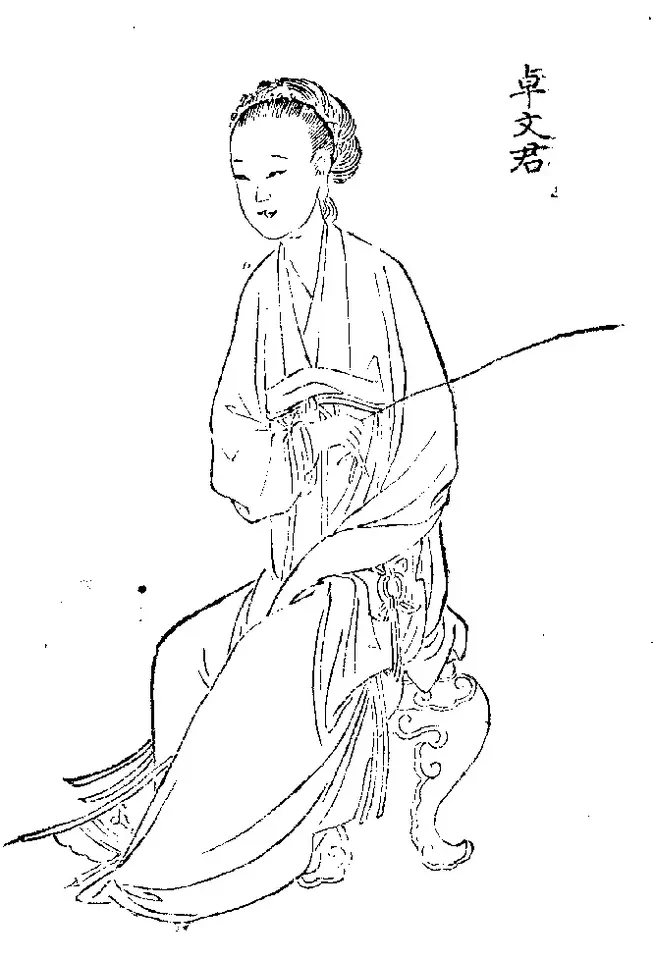
During the feast, Magistrate Wang presented a zither to Xiangru, imploring him to perform. Possessing a commanding presence and elegant poise, Xiangru accepted the instrument and performed the romantic melody Feng Qiu Huang (The Phoenix Seeking Its Mate). Among the listeners was Zhuo Wangsun's seventeen-year-old daughter, Zhuo Wenjun, a brilliant poet and musician who had recently returned home following the death of her husband. Listening from behind the curtain, Wenjun was captivated by Xiangru's handsome demeanor and recognized the zither's passionate declaration of love.
After the banquet, Xiangru sent a message through Wenjun's maid, reaffirming his devotion. Defying rigid patriarchal decorum and class hierarchy, Wenjun slipped out of her father's walled estate that night and fled with Xiangru to Chengdu. Upon arriving, however, Wenjun discovered that Xiangru's house was bare, lacking even basic furnishings. Recognizing that pride would not feed them, Wenjun proposed returning to Linqiong to engage in trade. Selling their remaining possessions, they purchased a modest storefront in the Linqiong market. Wenjun stood behind the earthen counter selling wine, while Xiangru donned the coarse shorts of an ordinary laborer, washing wine vats alongside servants.
Mortified that his daughter and son-in-law were working as menial tavern keepers in full public view, Zhuo Wangsun barricaded himself inside his manor in shame. Clan elders and friends intervened, reminding him of Xiangru's transcendent talent and predicting his inevitable rise to high office. Conceding defeat, Zhuo Wangsun granted the couple one hundred household servants, one million copper coins, and Wenjun's full bridal dowry. Returning to Chengdu as wealthy proprietors, Xiangru and Wenjun purchased fertile estates, establishing a celebrated romance that would echo down Chinese history.
In 138 BCE, the energetic nineteen-year-old Emperor Wu of Han sat upon the imperial throne. An avid patron of literature, Emperor Wu read the Rhapsody of Sir Vacuous and exclaimed with deep regret that he was not born in the same age as its author. Standing nearby, the imperial dog keeper Yang Deyi, who hailed from Shu, knelt and revealed that the rhapsody had been composed by his fellow townsman Sima Xiangru. Delighted, Emperor Wu dispatched an urgent courier to summon Xiangru to the capital.
Arriving at the imperial palace, Xiangru was granted an audience. When the emperor praised the Zixu Fu, Xiangru remarked that the piece merely described the petty hunts of feudal lords and was unworthy of the imperial presence, requesting permission to compose a grander rhapsody on the emperor's imperial hunt. Emperor Wu furnished him with writing brush and silk in the inner palace.
Xiangru composed his definitive masterwork, the Rhapsody on the Imperial Park (Shanglin Fu). Expanding upon the fictional framework of Zixu Fu, the work introduced Lord No-Such-Person, who rebuked the emissaries of Chu and Qi by presenting an overwhelming panorama of the imperial park of Shanglin. Xiangru depicted hundreds of square li of mountains, winding rivers, palace towers, and exotic menageries with linguistic precision. Crucially, the rhapsody concluded with moral admonition: after the thrill of the chase, the emperor reflects upon the waste of public wealth and the disruption of agriculture, dismantling hunting parks, distributing food stores to the starving, and cultivating moral rites. Astounded by the work's visionary brilliance and philosophical depth, Emperor Wu appointed Sima Xiangru as Palace Gentleman.
In 135 BCE, the Kingdom of Minyue launched an assault on Southern Yue, prompting Han military intervention. Seizing this strategic opportunity, Tang Meng, magistrate of Panyang, proposed constructing a military road through Yelang (modern Guizhou) to outflank Southern Yue. Emperor Wu approved the plan, dispatching Tang Meng as Leader of Court Gentlemen to mobilize tens of thousands of corvee laborers from Ba and Shu. However, the extreme mountainous terrain and Tang Meng's brutal enforcement triggered widespread panic, desertion, and impending revolt across the Sichuan basin.
Deeply concerned by the escalating crisis, Emperor Wu recognized that Xiangru possessed immense regional prestige. He appointed Sima Xiangru as Leader of Court Gentlemen, entrusting him with the imperial tally to serve as commissioner to Ba and Shu. Arriving in Chengdu, Xiangru composed the Proclamation on Ba and Shu (Yu Bashu Xi). The proclamation candidly acknowledged administrative overreach, declared that Tang Meng's harsh measures did not reflect imperial benevolence, and ordered local magistrates to halt punitive conscription and provide relief to suffering households. The proclamation diffused the volatile situation and restored civil peace without bloodshed.
In 130 BCE, ethnic tribal leaders from Qiong and Ze, having witnessed Han trade with Yelang, requested tributary status. However, conservative Shu gentry opposed further frontier engagement, complaining of military costs. Emperor Wu once again commissioned Xiangru to lead an imperial embassy into the southwestern borderlands. To overcome local opposition, Xiangru authored the Refutation of the Elders of Shu (Nan Shu Fulao), articulating an expansive imperial philosophy that linked internal moral governance with the civilization of distant border regions, convincing regional elites to support national expansion.
Xiangru traveled deep into uncharted mountainous terrain, meeting tribal chieftains of the Qiong, Ze, Ran, Mang, and Siyu peoples. Combining diplomatic dignity with imperial gifts, he persuaded dozens of tribal chieftains to submit peacefully to Han rule. Xiangru supervised the dismantling of old fortified passes, opened the Lingguan Trail connecting Sichuan to Yunnan, and established one military commandery and more than ten counties. Through peaceful statecraft, Xiangru integrated thousands of square li of southwestern territory into the administrative fabric of the Western Han.
Following his diplomatic triumphs, Xiangru returned to Chang'an, where he enjoyed great imperial favor. However, political prominence incited bureaucratic envy. An anonymous memorial accused Xiangru of accepting bribes while on his southern mission, leading Emperor Wu to strip him of his post. Xiangru endured this disgrace with equanimity, living quietly for over a year until the court confirmed the allegations were entirely false, whereupon Emperor Wu restored him to the rank of Gentleman.
Naturally proud and detached, Xiangru suffered from chronic diabetes (xiaoke). Disgusted by the sycophancy of court ministers and holding no ambitions for high ministerial office, he frequently took sick leave. Admiring his talent, Emperor Wu appointed him Director of the Wenyuan Imperial Park (Wenyuan Ling), a prestigious sinecure overseeing the ancestral park of Emperor Wen, allowing him to live comfortably in his country residence at Maoling outside the capital. There, he authored the Rhapsody of the Tall Gate Palace on behalf of the displaced Empress Chen, capturing her domestic isolation with lyrical pathos. In response to Emperor Wu's obsession with immortality cults, he composed the Rhapsody on the Great Man, depicting celestial voyages on winged dragons to subtly mock the pursuit of physical immortality.
In 118 BCE, Xiangru's health deteriorated rapidly. Fearing that his literary manuscripts might be lost, Emperor Wu dispatched his secretary Suo Zhong to Maoling to collect his writings. When Suo Zhong arrived, the sixty-two-year-old literary master had already passed away. His grieving widow Zhuo Wenjun delivered a solitary scroll, explaining that Xiangru had left it specifically for the emperor's envoys.
Upon unrolling the manuscript, Emperor Wu found Sima Xiangru's final masterpiece, the Treatise on the Feng and Shan Sacrifices (Fengshan Wen). The treatise traced the historical legitimacy of imperial sacrifices, praised the Han dynasty's unification of all under heaven, and outlined liturgical rites for ascending Mount Tai to announce the completion of the imperial mandate. Emperor Wu was deeply moved by Xiangru's enduring loyalty. In 110 BCE, Emperor Wu ascended Mount Tai to conduct the historic Feng and Shan sacrifices, adopting the liturgical blueprint envisioned by his deceased poet. Though Xiangru passed away in rustic retirement, his literary genius and strategic vision permanently shaped the cultural and geographic identity of the Chinese empire.
Sima Xiangru's crowning cultural achievement was the structural and aesthetic perfection of the Han grand rhapsody (han dafu), elevating it to the paramount literary genre of the Han dynasty and earning him the enduring titles of "Sage of Rhapsody" and "Master of Verse." Xiangru inherited the emotional lyricism of Qu Yuan's Songs of Chu and the dialectical argumentation of Xunzi, synthesizing them with the imperial ethos of the unified Western Han state. His works expanded the expressive capacity and vocabulary of the Chinese language, establishing the definitive model for court literature across subsequent dynasties.
His twin rhapsodies, the Rhapsody of Sir Vacuous and the Rhapsody on the Imperial Park, represent the artistic summit of classical descriptive literature. Xiangru utilized an innovative multi-voiced dialogue among fictional archetypes to transcend linear narrative constraints. Deploying parallel cadences, rich auditory imagery, and comprehensive naturalistic catalogs, he depicted the mountains, waters, palaces, and royal cavalcades of the imperial realm. Crucially, the works adhered to the ethical principle of "moral admonition within aesthetic abundance" (quan bai er feng yi), concluding with impassioned warnings against imperial indulgence and calling for moral governance, establishing a timeless aesthetic standard.
Xiangru demonstrated remarkable creative versatility across diverse literary forms. In the Rhapsody on the Great Man (Daren Fu), composed to critique Emperor Wu's infatuation with Daoist immortality cults, he constructed a mythic cosmology of dragon-drawn chariots navigating cosmic realms, embedding philosophical irony within majestic fantasy. Conversely, in the Rhapsody of the Tall Gate Palace (Changmen Fu), he abandoned grand descriptive rhetoric to render the melancholy of the neglected Empress Chen, pioneering the aesthetic genre of palace lamentation (gongyuan) and feminine interiority in classical Chinese literature.
Beyond his literary brilliance, Xiangru was an accomplished diplomat and frontier strategist. Commissioned twice by Emperor Wu to pacify the southwestern borderlands, he rejected violent conquest in favor of political conciliation. Traveling among the chieftaincies of the Qiong, Ze, Ran, Mang, and Siyu tribes, he secured their voluntary allegiance, dismantled defensive barriers, and opened the vital Lingguan Trail. His diplomacy integrated vast southwestern territories into the Han commandery system, fostering cultural exchange between central China and minority nationalities and establishing an enduring foundation for national unity.
In administrative rhetoric and political argumentation, Xiangru produced enduring classics of Chinese prose. His Proclamation on Ba and Shu combined administrative clarity with genuine empathy for civilian hardship, averting rebellion and setting a permanent standard for imperial proclamations. His Refutation of the Elders of Shu utilized sophisticated dialectics to dismantle isolationist resistance to southwestern expansion, arguing for imperial integration as a historical imperative. Both texts displayed vigorous philosophical vision and refined diction, serving as foundational models for classical bureaucratic prose.
Xiangru's posthumous Treatise on the Feng and Shan Sacrifices (Fengshan Wen) stands as a foundational text in Chinese political philosophy and ritual history. Composed on his deathbed, the treatise synthesized dynastic legitimacy, cosmological mandate, and historical precedents to construct the complete liturgical architecture for imperial sacrifices at Mount Tai. This treatise provided Emperor Wu with the theological justification to execute the historic Mount Tai sacrifices in 110 BCE, cementing the ideological unification of the Han empire and exerting a lasting influence on imperial state ritual.
FIGURES ASSOCIATED WITH THIS DYNASTY