Imperial Commission
Responded to Emperor Wu's call for envoys to the Greater Yuezhi, receiving the imperial tally to lead over a hundred men west from Longxi.
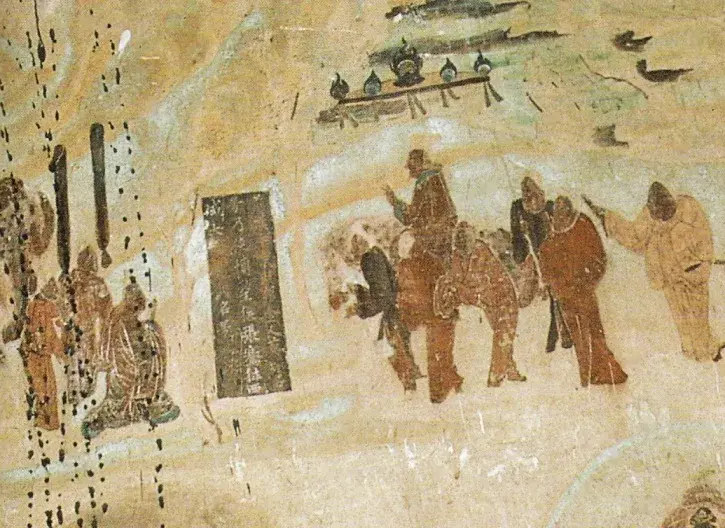
张骞
Zhang Qian (张骞) (? – 114 BC) was a native of Chenggu County in Hanzhong Commandery (modern Chenggu County, Shaanxi Province). He was an outstanding diplomat, explorer, traveler, and military commander of the Western Han dynasty, universally revered as the pioneer of the overland Silk Road and celebrated by Sima Qian as the first person to open the Western Regions to the Chinese world. In 139 BC (the second year of the…
Zhang Qian (张骞) (? – 114 BC) was a native of Chenggu County in Hanzhong Commandery (modern Chenggu County, Shaanxi Province). He was an outstanding diplomat, explorer, traveler, and military commander of the Western Han dynasty, universally revered as the pioneer of the overland Silk Road and celebrated by Sima Qian as the first person to open the Western Regions to the Chinese world. In 139 BC (the second year of the Jianyuan era), Emperor Wu of Han sought an alliance with the Greater Yuezhi to launch a pincer movement against the Xiongnu. Serving as a palace gentleman, the young Zhang Qian answered the imperial call, took up the imperial tally, and led an expedition of over a hundred men west out of Longxi. Intercepted and captured by the Xiongnu in the Hexi Corridor, he was held captive in the northern steppes for ten years, yet remained unyielding and preserved the imperial tally intact throughout his long confinement. Escaping westward across the Pamir Mountains, he traveled through Dayuan and Kangju, ultimately reaching the Yuezhi court along the Oxus River and visiting Bactria. Captured once again on his return journey and detained for more than a year, he seized the opportunity of dynastic turmoil among the Xiongnu to return safely to Chang'an in 126 BC (the third year of the Yuanshuo era). Of the hundred men who set forth, only Zhang Qian and his Xiongnu guide Tangyifu survived the thirteen-year ordeal. In 123 BC (the sixth year of the Yuanshuo era), Zhang Qian accompanied Supreme General Wei Qing on a military expedition against the Xiongnu as a commandant, using his profound knowledge of northern grasslands and water sources to guide the imperial forces, for which he was ennobled as the Marquis of Bowang. Following the decisive Battle of Mobei in 119 BC, which expelled the main Xiongnu host, Zhang Qian proposed the grand strategy of severing the right arm of the Xiongnu by forging an alliance with Wusun. Appointed Leader of Court Gentlemen, he led a lavish diplomatic retinue of three hundred men, accompanied by tens of thousands of livestock and enormous quantities of silk and gold, on his second expedition westward. Operating from the Wusun court, he dispatched vice-envoys to Dayuan, Kangju, Greater Yuezhi, Bactria, Parthia, and India. Appointed Director of Receptions in 114 BC, he died shortly thereafter in Chang'an. Zhang Qian's two epic expeditions shattered the nomadic blockade of Central Asia, officially opened the trans-Eurasian Silk Road, fostered unprecedented intercultural exchange between East and West, and laid the geopolitical foundation for the establishment of the Protectorate of the Western Regions.
Responded to Emperor Wu's call for envoys to the Greater Yuezhi, receiving the imperial tally to lead over a hundred men west from Longxi.
Captured in the Hexi Corridor by Xiongnu cavalry and held captive under the Chanyu for ten years while resolutely safeguarding the imperial tally.
Fled during reduced surveillance, traversed the Pamir Plateau, traversed Dayuan and Kangju, and reached the Greater Yuezhi along the Oxus River.
Visited Bactria, where he identified Sichuan bamboo canes and cloth, discovering ancient trade routes connecting southwest China with northern India.
Detained again by Xiongnu on his return route, escaped during internal succession conflicts, and returned to Chang'an after thirteen years.
Campaigned under Wei Qing as a commandant, guiding the army through desert water sources, and was ennobled as the Marquis of Bowang.
Campaigned alongside Li Guang; condemned to execution for delayed military arrival, redeemed himself under imperial statutes, and was stripped of his peerage.
Proposed severing the right arm of the Xiongnu, was appointed Leader of Court Gentlemen, and led three hundred envoys on his second major western mission.
Dispatched vice-envoys across Central Asia and escorted dozens of Wusun emissaries presenting tribute horses to the imperial court in Chang'an.
Promoted to Director of Receptions; died of illness from long-term exhaustion in Chang'an and was returned for burial in Chenggu, Hanzhong.
Zhang Qian was born in Chenggu County of Hanzhong Commandery (modern Bowang Town, Chenggu County, Shaanxi Province). Historical records provide scarce details regarding his youth, but portray him as a man of resolute character, unswerving loyalty, broad vision, and exceptional magnanimity. During the transition between Emperor Jing and Emperor Wu, Zhang Qian entered imperial service as a palace gentleman, standing watch in the sovereign halls. Having recovered prosperity through several decades of non-intrusive administration under the Wen and Jing reigns, the Western Han empire possessed ample economic and military strength. The ambitious young Emperor Wu resolved to overturn the passive policy of appeasement through marriage alliances and seek active strategic solutions to eradicate nomadic border aggression.
Early in the Jianyuan era, imperial interrogators obtained vital intelligence from captured Xiongnu soldiers: Lao Shang Chanyu of the Xiongnu had previously routed the nomadic Yuezhi confederation, killed their chieftain, and fashioned his severed skull into a ceremonial drinking vessel according to steppe custom. Forced to migrate westward, the surviving Yuezhi harbored deep resentment against their conquerors but lacked military allies to exact revenge. Emperor Wu recognized that a strategic alliance with the Yuezhi could encircle the northern nomads from both flanks. In 139 BC, the emperor issued an imperial edict seeking courageous emissaries to travel to the distant west. Zhang Qian stepped forward enthusiastically, taking upon himself this unprecedented and hazardous journey.
In 138 BC, grasping the imperial tally granted by Emperor Wu, Zhang Qian departed from Longxi alongside Tangyifu, an enslaved archer of northern nomadic heritage, leading an expedition of over a hundred military officers, soldiers, and attendants. At that time, the Hexi Corridor and the territories encircling the Tianshan Mountains were controlled by nomadic cavalry. Shortly after passing the imperial outposts, the delegation was surrounded and captured by nomadic patrols, and escorted to the steppe headquarters of Junchen Chanyu.
When questioned about his destination, the Chanyu scoffed at the idea of an imperial mission traveling through his domain to contact his western adversaries. Zhang Qian was interned under close surveillance on the northern grazing grounds. Over ten long years of detention, the Chanyu attempted to undermine his allegiance by giving him a nomadic wife, with whom he had children, and offering ranks and gifts. Nevertheless, Zhang Qian held fast to his mission and preserved his imperial tally without wavering, while quietly memorizing steppe routes, seasonal water supplies, and defensive outposts.
In 128 BC, vigilance around his encampment relaxed, and Zhang Qian seized the opportunity to escape eastward with Tangyifu and several followers. Rather than fleeing back toward China, they pressed westward into uncharted deserts, facing severe dehydration and starvation, kept alive only by Tangyifu's remarkable skill with the composite bow in hunting wildlife. Traversing the forbidding heights of the Pamir Plateau, known anciently as the Onion Range, they reached Dayuan. Welcomed by the local ruler, who had long desired direct ties with the Han Empire, Zhang Qian was provided guides and translators to traverse Kangju, eventually reaching the northern banks of the Oxus River, where the displaced Greater Yuezhi had established their court.
Upon reaching the Yuezhi headquarters, Zhang Qian found the strategic landscape fundamentally transformed. Following the death of their old chieftain, the Yuezhi had subjugated the agricultural lands of Bactria. Living in peace along the fertile riverbanks, free from steppe harassment, the Yuezhi elite and population enjoyed agricultural abundance and had completely abandoned thoughts of vengeance against the distant northern nomads. Over the course of more than a year, Zhang Qian pressed his proposals for a military alliance, but the Yuezhi leadership showed no willingness to embark on a distant campaign.
Recognizing that a diplomatic pact was unattainable, Zhang Qian crossed south over the Oxus River to explore the markets and urban centers of Bactria. While inspecting local goods, he observed woven cloths and bamboo walking canes originating from the southwestern Chinese commander of Shu. Inquiring about their provenance, local merchants explained that these goods had been brought by traders from Shendu (ancient India), located several thousand li southeast, where people fought atop elephants in hot climates. Through this insight, Zhang Qian deduced that an ancient trade route must link the southwestern border regions of Sichuan and Yunnan directly to the Indian subcontinent, furnishing crucial geographic knowledge for later imperial expansion into the southwest.
In 127 BC, Zhang Qian commenced his return journey. To bypass the northern nomadic patrols along the Hexi Corridor, he skirted the southern rim of the Tarim Basin along the northern foothills of the Kunlun Mountains, planning to return through the Qiang tribal regions of the Tibetan Plateau. However, the Qiang were also subject to nomadic authority, and Zhang Qian was again captured and detained for over a year. In 126 BC, the death of Junchen Chanyu plunged the northern confederation into violent succession conflict. Taking advantage of the chaos, Zhang Qian escaped with his nomadic wife and Tangyifu, racing across the frontier to reach Chang'an. Of the original embassy of over a hundred men, only Zhang Qian and Tangyifu returned alive after thirteen hazardous years.
Upon returning to Chang'an, Zhang Qian presented Emperor Wu with comprehensive intelligence detailing the geography, military strengths, urban customs, and trade goods of Dayuan, Kangju, Greater Yuezhi, Bactria, Parthia, and India. The emperor received him with high acclaim, elevating him to the rank of Grand Palace Grandee and conferring an official title upon Tangyifu. Zhang Qian's systematic report provided the central imperial court with its first concrete understanding of Central, South, and West Asian civilizations, fundamentally broadening China's geographical horizon.
In the spring of 123 BC, Supreme General Wei Qing directed six armies north across Dingxiang against the Xiongnu. Because of his thorough knowledge of steppe terrain, Zhang Qian was appointed as a military commandant to accompany the main column. Amidst the waterless wastes where units frequently lost their bearings, Zhang Qian accurately located reliable grazing pastures and hidden springs, allowing the imperial forces to avoid thirst and starvation and achieve a victory that yielded more than ten thousand enemy casualties. In the subsequent imperial awards, Emperor Wu commended him for his indispensable guidance and ennobled him as the Marquis of Bowang, with a feudal estate of eight hundred households.
However, political and military fortunes fluctuated. In 121 BC, Zhang Qian joined General Li Guang in an expedition departing from Youbeiping. Li Guang's vanguard of four thousand horsemen was encircled by forty thousand enemy cavalry, suffering grievous casualties over two days of ferocious combat. Zhang Qian's main force arrived late due to logistical delays. Under the severe provisions of Han military statutes, failure to meet military deadlines carried the penalty of execution. Zhang Qian paid the mandated redemption fine to commute the death penalty, but was stripped of his noble title and reduced to the status of a commoner. Despite this setback, he remained devoted to frontier strategy and monitored Western Regions developments closely.
In 119 BC, Supreme General Wei Qing and General of Agile Cavalry Huo Qubing struck a devastating blow against the northern nomads in the Battle of Mobei, forcing the Chanyu to flee beyond the Gobi Desert. With the Hexi Corridor secured and the commanderies of Wuwei and Jiuquan established, Zhang Qian presented a strategic proposal: the Wusun confederation in the Ili Valley bore ancient enmity toward the Xiongnu; by offering lavish gifts and marital ties, the imperial court could induce them to return to their eastern pastures and sever the western branch of nomadic influence.
Emperor Wu approved the strategy and commissioned Zhang Qian as Leader of Court Gentlemen, granting him imperial tallies to command a grand embassy. In the winter of 119 BC, Zhang Qian departed with three hundred subordinates, six hundred horses, tens of thousands of sheep and cattle, and enormous stores of silk, jade, and gold. This mission stood as the most magnificent diplomatic undertaking in Han history. Upon arriving at the Wusun capital, Zhang Qian was received with deep respect by Kunmo Liejiaomi. Although internal divisions among Wusun factions prevented an immediate relocation eastward, the Wusun monarch was profoundly impressed by imperial prestige.
While stationed in Wusun territory, Zhang Qian operated as the nerve center of imperial diplomacy, sending dozens of vice-envoys bearing tallies to Dayuan, Kangju, Greater Yuezhi, Bactria, Parthia, India, and Khotan to promote political alliances and commercial ties. In 115 BC, Zhang Qian prepared to return to the capital, escorted by several dozen Wusun nobles and emissaries sent by their ruler, who brought tens of fine horses to pay tribute and observe the grandeur of the Han Empire.
In the autumn of 115 BC, Zhang Qian arrived in Chang'an alongside the grand Wusun delegation. Emperor Wu hosted the foreign emissaries in Weiyang Palace, displaying imperial palace halls, organized military formations, and overflowing treasuries. Astounded by the splendor, the Wusun emissaries returned with glowing reports, which led directly to the celebrated diplomatic marriage alliances between Han imperial princesses and Wusun monarchs. In recognition of his accomplishments, Emperor Wu appointed Zhang Qian to the post of Director of Receptions, making him one of the nine supreme ministers managing foreign relations and tributary affairs.
In 114 BC, worn down by decades of relentless travel and harsh conditions, Zhang Qian died of illness in Chang'an at around fifty years of age. His remains were returned to his homeland of Chenggu for imperial burial. Following his death, his vice-envoys returned to the capital guiding large foreign delegations and merchant caravans from Central and Western Asia, inaugurating an era of flourishing state-to-state relations. Subsequent imperial ambassadors who traversed the western frontiers continued to invoke the name and prestige of the Marquis of Bowang to secure the trust of foreign rulers. Through his enduring courage and vision, Zhang Qian opened the Silk Road, earning the eternal praise of Sima Qian for initiating intercultural communication and leaving an indelible mark upon human history.
Zhang Qian was the foremost trans-continental explorer and diplomatic pioneer in ancient Chinese and world history. Sima Qian described his achievement as opening the void, denoting that prior to his expeditions, the Chinese world possessed no systematic knowledge of the lands west of the Pamir Mountains. Through unrelenting perseverance across two epic missions, Zhang Qian endured blizzards, deserts, starvations, and a decade of captivity, mapping out overland routes extending from Chang'an across Central Asia to West and South Asia. His pioneering voyages established the Silk Road, which fostered Eurasian trade and cultural exchange for two millennia.
Throughout the prolonged confrontation between the Han dynasty and the northern nomads, Zhang Qian formulated the strategic doctrine of severing the enemy's western flank. Capitalizing on the resentment felt by oasis kingdoms against nomadic subjugation, his diplomacy integrated Central Asian city-states into an alliance network with the Han court. The alliance forged with the Wusun shattered nomadic hegemony in the west, giving the Han Empire strategic control over the northwestern frontier and leading directly to the establishment of the Protectorate of the Western Regions in 60 BC, which brought the region under Chinese administrative governance.
Zhang Qian's expeditions catalyzed one of the most transformative transfers of technology and flora in global history. Along the newly opened overland routes, Chinese silk, iron casting, deep-well excavation techniques, lacquerware, and advanced agricultural methods spread into Central Asia and the West. Concurrently, Zhang Qian and his missions introduced Central Asian agricultural cultivars—including grapes, alfalfa, walnuts, sesame, carrots, cucumbers, pomegranates, and garlic—as well as heavenly horses into northern China, transforming agricultural production, dietary habits, and cavalry capabilities.
The firsthand accounts submitted by Zhang Qian on the political systems, military strength, economic practices, and geography of thirty-six western kingdoms were recorded in the Records of the Grand Historian. This work provided the ancient world with its earliest systematic geographic literature concerning Central and South Asia. By replacing mythological folklore with rigorous empirical observations, Zhang Qian established an enduring tradition of pragmatic geographic inquiry and endowed the Han civilization with an expansive, cosmopolitan global perspective.
FIGURES ASSOCIATED WITH THIS DYNASTY