Birth
Born into a scholarly family in Tongcheng, Anqing, exhibiting remarkable intellectual curiosity from youth.
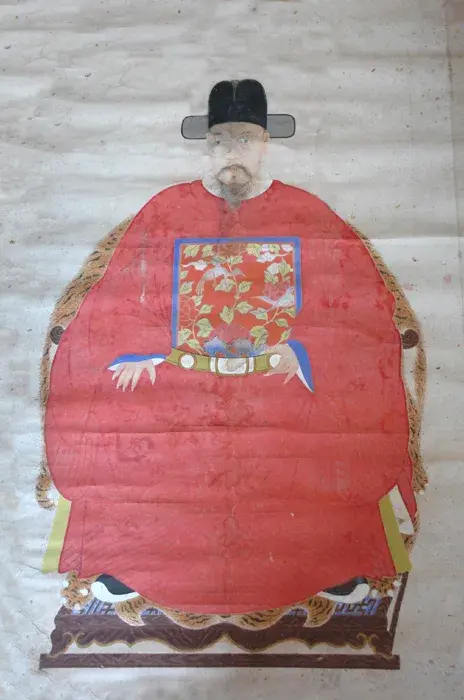
1575 CE–1625 CE
左光斗
Zuo Guangdou (左光斗, 1575–1625 CE), courtesy name Yizhi (遗直) and art name Gongzhi (共之), was a celebrated statesman, senior supervisory official, and prominent Donglin leader during the Wanli and Tianqi reigns of the Ming dynasty. A native of Tongcheng in Anqing Prefecture, he obtained the Jinshi degree in 1607 and served with distinction as Drafter in the Secretariate, Investigating Censor, Regional Inspector of Zhili, Junior…
Zuo Guangdou (左光斗, 1575–1625 CE), courtesy name Yizhi (遗直) and art name Gongzhi (共之), was a celebrated statesman, senior supervisory official, and prominent Donglin leader during the Wanli and Tianqi reigns of the Ming dynasty. A native of Tongcheng in Anqing Prefecture, he obtained the Jinshi degree in 1607 and served with distinction as Drafter in the Secretariate, Investigating Censor, Regional Inspector of Zhili, Junior Sub-Director of the Court of Judicial Review, and Left Assistant Censor-in-Chief. He is venerated in Chinese history as one of the "Six Gentlemen of the Donglin Clique". During his tenure as Regional Inspector and agricultural supervisor in Zhili, Zuo Guangdou actively promoted northern military agro-colonies and irrigation infrastructure. He authored the influential treatise Three Causes and Fourteen Proposals for Water Conservancy, digging hundreds of li of canals across the capital region and cultivating thousands of qing of wet-rice paddies, which significantly alleviated strategic grain shipping strains from the south. During this tour, he discovered the impoverished young scholar Shi Kefa in a snow-bound temple, mentoring him into a legendary national hero. In 1620, following the sudden death of Emperor Guangzong, Consort Li attempted to seize administrative power by holding the teenage heir apparent Zhu Youxiao hostage in the Qianqing Palace. Zuo Guangdou and Censor Yang Lian courageously confronted the inner court, forcing Consort Li's relocation and securing the coronation of Emperor Xizong. During the Tianqi era, as eunuch dictator Wei Zhongxian usurped supreme power, Zuo Guangdou drafted a fearless memorial cataloging thirty-two capital offenses against the tyrant. In 1625, Wei Zhongxian fabricated bribery charges, casting Zuo Guangdou into the imperial prison of the Embroidered Uniform Guard. Despite undergoing horrific torture, Zuo Guangdou remained steadfastly defiant until his death in prison on August 29, 1625. Following the purge of the eunuch faction under Emperor Chongzhen, he was posthumously rehabilitated, awarded the office of Right Censor-in-Chief and Junior Guardian of the Heir Apparent, and granted the posthumous title Zhongyi (Loyal and Resolute).
Born into a scholarly family in Tongcheng, Anqing, exhibiting remarkable intellectual curiosity from youth.
Passed the metropolitan examination and was appointed Drafter in the Secretariate.
Appointed Investigating Censor, inspecting Central Beijing and dismantling a massive network of fraudulent official credentials.
Commissioned as Regional Inspector of Zhili; developed extensive northern rice agriculture and discovered Shi Kefa on a snowy night.
Prevented Consort Li from usurping regency upon Guangzong's death, escorting the young heir to ascend as Emperor Xizong.
Promoted to Assistant Director and subsequently Junior Sub-Director of the Court of Judicial Review, impeaching corrupt magnates.
Advanced to Left Assistant Censor-in-Chief; drafted thirty-two capital charges against Wei Zhongxian, dismissed from office.
Arrested on fabricated charges, endured horrific torture in the Embroidered Guard prison, and died on August 29 at age fifty-one; posthumously rehabilitated in 1628 CE under Emperor Chongzhen as Right Censor-in-Chief and Junior Guardian of the Heir Apparent.
Zuo Guangdou was born in 1575 in Zhongluo Village, Tongcheng County, Anqing Prefecture. His father Zuo Chuying was an austere and upright community elder who instilled in his sons a rigorous moral foundation. Ranking third among his brothers, Zuo Guangdou displayed formidable intellectual talent and an eidetic memory from early youth. Rather than indulging in speculative Neo-Confucian debates, he focused his scholarship on practical statecraft, including agrarian engineering, hydraulic management, and fiscal administration, viewing personal moral cultivation as inseparable from social utility.
While studying in Tongcheng, Zuo Guangdou forged bonds with local reform-minded scholars, observing the deepening political factionalism and border challenges of the late Ming state. In 1607, at the age of thirty-two, he traveled to Beijing and passed the Dingwei metropolitan examinations, attaining the Jinshi degree. In accordance with imperial custom, he was assigned as Drafter in the Secretariate, handling drafting and imperial archives.
In this introductory post, Zuo Guangdou distinguished himself by integrity and refusal to cultivate patron ties with powerful ministers. As military conflicts expanded along the Liaodong frontier, state expenditures surged. Although holding a junior post, Zuo Guangdou submitted several insightful memorials concerning border troop maintenance, military taxation, and frontier logistics, urging the crown to curb palace waste rather than imposing crushing levies upon the destitute commoners.
In 1614, following superior administrative appraisals, Zuo Guangdou was selected as Investigating Censor in the Censorate, receiving the critical assignment to inspect the Central Ward of Beijing. During the late Wanli reign, bureaucratic discipline had decayed severely. Capital magnates, eunuchs, and corrupt clerks operated illicit enterprises with impunity. Within the Ministry of Personnel itself, unscrupulous clerks collaborated with brokers to forge imperial seals and sell counterfeit certificates of official appointment.
Unintimidated by aristocratic connections, Zuo Guangdou conducted clandestine investigations throughout the city. Having secured incontrovertible evidence, he deployed imperial guards in a coordinated raid on the forgery ring, capturing hundreds of fraudulent documents, illicit seals, and corrupt clerks. Over a hundred guilty individuals were arrested and prosecuted under strict statutes. This dramatic judicial strike stunned the capital, ending fraudulent appointments and restoring administrative discipline. Court dignitaries commended his unbending rectitude.
In 1619, following the catastrophic Ming defeat at the Battle of Sarhu, the strategic position in Liaodong collapsed. The court was forced to transport millions of bushels of grain annually along the Grand Canal from the south to feed northern border garrisons, an operation plagued by enormous logistics costs, silting, and frequent droughts. Recognizing the urgent necessity of establishing agricultural self-sufficiency in the capital region, the throne appointed Zuo Guangdou Regional Inspector of Zhili, concurrently supervising education and agricultural agro-colonies.
Assuming office, Zuo Guangdou traversed the waterways and lowlands of Shuntian, Baoding, Hejian, and Zhending prefectures with measuring rods and compasses. Rejecting the entrenched prejudice that northern soil was unfit for wet-rice cultivation, he argued that previous failures stemmed from poor drainage and lack of technical knowledge. He authored the seminal treatise Three Causes and Fourteen Proposals for Water Conservancy, detailing fourteen practical methods for canal excavation, floodgate construction, soil desalination, and seasonal water management.
Under his direct supervision, regional authorities excavated hundreds of li of arterial canals, reclaimed vast tracts of marshes, and established several thousand qing of productive paddy fields. Because northern peasants were unfamiliar with wet-rice cultivation, Zuo Guangdou recruited experienced farmers from the Yangtze Delta to demonstrate seedling raising, transplanting, weeding, and harvesting. Within a few seasons, the capital region yielded abundant rice harvests, drastically reducing reliance on southern canal grain and earning widespread civilian gratitude.
While directing imperial examinations across Zhili, Zuo Guangdou was determined to identify men of moral character and practical talent rather than superficial rhetoricians. During this tour, he performed an act of mentorship that became legendary in Chinese cultural history.
During a severe winter blizzard, Zuo Guangdou traveled in plain attire to inspect rural academies. Arriving at a dilapidated Buddhist temple outside the city, he entered an unheated guest hall and discovered a young scholar asleep at an icy desk, his arm resting on a newly written essay analyzing national defense and statecraft. Picking up the draft, Zuo Guangdou was struck by its passionate patriotism, lucid prose, and strategic clarity.
Deeply moved by the youth's devotion and concerned that the bitter cold might harm him, Zuo Guangdou gently took off his own sable coat, draped it over the sleeping student, and quietly closed the door before leaving without waking him. Inquiries revealed that the student was Shi Kefa, a candidate from Shucheng.
The following day during the regional examination, Zuo Guangdou summoned Shi Kefa, ranked his paper first among twenty districts, and invited him into his private quarters. Facing the young scholar, Zuo Guangdou remarked with emotion that while his own sons were ordinary, Shi Kefa alone possessed the talent and virtue to carry forward his lifelong mission. Shi Kefa bowed in tears, becoming Zuo Guangdou's devoted disciple and later rising to become the legendary southern Ming commander who defended Yangzhou against Qing armies to the death.
In September 1620, Emperor Guangzong died abruptly after reigning for merely a month following the "Red Pill Case." Consort Li, a favored concubine supported by rising eunuch Wei Zhongxian, seized control of the Qianqing Palace and held the sixteen-year-old heir apparent Zhu Youxiao hostage, intending to coerce the court into declaring her Empress Dowager so she could rule as regent from behind the screen.
While many ministers hesitated, Zuo Guangdou and Censor Yang Lian resolved to protect the imperial succession. Zuo Guangdou drafted a scathing memorial denouncing Consort Li's actions as an unlawful usurpation reminiscent of ancient empresses, warning that an inner palace coup threatened the dynasty's very survival and demanding the immediate release of the crown prince.
Enraged by the memorial, Consort Li repeatedly summoned Zuo Guangdou to enter the inner quarters, intending to arrest or assassinate him. Standing fearlessly before the palace gate, Zuo Guangdou sternly rebuked the eunuch messengers, declaring that as an imperial censor he answered only to the sovereign and would never enter the concubines' private quarters without royal authority.
Joined by Yang Lian and a resolute phalanx of courtiers, Zuo Guangdou forced his way through the palace gates, pushed aside imperial attendants, and escorted the weeping prince safely to Cijing Palace. Outmaneuvered by the court's unity, Consort Li was forced to vacate the main halls. On October 1, 1620, Zhu Youxiao ascended the throne as Emperor Xizong. Zuo Guangdou's decisive leadership in resolving the Palace Relocation Case cemented his status as a pillar of dynastic legitimacy.
Following the ascension of Emperor Xizong, Zuo Guangdou was appointed Assistant Director and later Junior Sub-Director of the Court of Judicial Review. In 1624, he was promoted to Left Assistant Censor-in-Chief. However, Emperor Xizong neglected court duties to indulge in carpentry, enabling eunuch dictator Wei Zhongxian to seize control of the Palace Secretariate and terrorize the bureaucracy with his secret police.
Refusing to submit to eunuch tyranny, Donglin ministers launched a concerted counterattack. In July 1624, Yang Lian submitted his famous memorial enumerating twenty-four heinous crimes committed by Wei Zhongxian. Zuo Guangdou immediately mobilized dozens of censors to endorse the indictment. When the emperor, deceived by Wei Zhongxian, dismissed the petition, Zuo Guangdou spent consecutive nights drafting a comprehensive indictment listing thirty-two capital crimes against the eunuch.
Anticipating fatal retaliation, Zuo Guangdou sent his aged mother and family back to Tongcheng, preparing to lay down his life. However, Wei Zhongxian's spies intercepted news of the impending memorial. Alarmed by Zuo Guangdou's unyielding determination, Wei Zhongxian struck first, forging an imperial decree two days before the memorial could be presented to strip Zuo Guangdou and Yang Lian of official rank and dismiss them from public service.
In early 1625, Wei Zhongxian escalated his purge by framing the leaders of the Donglin movement. After torturing imperial clerk Wang Wenyan to death for refusing to implicate honest ministers, the eunuchs forged false confessions alleging that Zuo Guangdou, Yang Lian, and four other Donglin leaders had accepted 20,000 taels in bribes from frontier commanders. In April 1625, Embroidered Uniform Guard officers arrested Zuo Guangdou in Tongcheng and hauled him to Beijing in heavy iron chains.
Incarcerated in the notorious Northern Prison of the Embroidered Uniform Guard, Zuo Guangdou was subjected to horrifying tortures directed by Xu Xianchun. Prison interrogators drove iron spikes through his ankles, seared his flesh with red-hot branding irons, and fractured his ribs with copper mallets. Covered in blood and burns, Zuo Guangdou refused to sign false confessions, cursing his tormentors with unyielding defiance.
During his imprisonment, his disciple Shi Kefa bribed guards with fifty taels of silver, disguising himself as a servant to infiltrate the dungeon. Finding his mentor sitting against the wall with his face charred beyond recognition and his lower legs crushed to the bone, Shi Kefa collapsed and wept.
Hearing his student's voice, Zuo Guangdou forced open his scorched eyelids and rebuked him with fury, demanding why he had entered such a fatal trap. He shouted that the empire was on the verge of ruin and that Shi Kefa was needed to save the realm, warning that rather than watching his student perish in an imperial purge, he would bash his own head against the stone floor. Trembling and weeping, Shi Kefa fled the prison.
On August 29, 1625, Zuo Guangdou succumbed to the tortures in prison at the age of fifty-one. Following his death, Wei Zhongxian continued to persecute his family, demanding the repayment of non-existent bribes and torturing his elder brother Zuo Guangji to death. The entire populace of Tongcheng wept over the destruction of the righteous clan.
In late 1627, Emperor Xizong died, and his brother Zhu Youjian ascended the throne as Emperor Chongzhen. Chongzhen acted swiftly to eliminate the eunuch faction, driving Wei Zhongxian to commit suicide. In 1628, the emperor issued an imperial proclamation fully exonerating the Six Gentlemen of the Donglin Clique.
Zuo Guangdou was posthumously restored to office and elevated to Right Censor-in-Chief and Junior Guardian of the Heir Apparent. His son Zuo Hui was awarded an imperial official appointment, and memorial shrines were erected in Tongcheng to honor his loyalty. In 1645, the Southern Ming court granted him the posthumous title Zhongyi. His uncompromising integrity and sacrifice established him as an enduring exemplar of Confucian moral heroism.
Zuo Guangdou was an outstanding exemplar of practical statecraft in the late Ming era. Recognizing that the capital's total dependence on southern canal grain was a grave strategic vulnerability, he conducted thorough hydrological surveys across Zhili and authored Three Causes and Fourteen Proposals for Water Conservancy. By constructing innovative floodgates, interconnecting natural lakes, and teaching local farmers techniques for cultivating wet rice, he transformed thousands of qing of marshland into fertile granaries, leaving an enduring legacy in northern agricultural history.
During the succession crisis of 1620, Zuo Guangdou exhibited exceptional political courage. Confronting Consort Li's bid to usurp regency by holding the crown prince hostage, he spearheaded the court's resistance, personally entering the palace to secure the prince and ensuring an orderly dynastic transition. His decisive actions thwarted an inner court coup and stabilized the Ming state.
Zuo Guangdou possessed an extraordinary ability to recognize genuine virtue and talent. His discovery and nurturing of Shi Kefa during a winter storm in Zhili illustrated his dedication to educating successors for the realm. In his final moments in prison, his fierce insistence that Shi Kefa preserve his life to serve the nation reflected the highest ideals of Confucian mentorship, creating an iconic cultural model of master and disciple united in patriotic sacrifice.
Facing the murderous ascendancy of Wei Zhongxian, Zuo Guangdou chose martyrdom over complicity. His courage in drafting thirty-two capital charges against the dictator and his unyielding resilience under savage prison tortures embodied the noble tradition of remonstrance, inspiring generations of scholars and establishing the moral high ground of the late Ming reformist movement.
FIGURES ASSOCIATED WITH THIS DYNASTY