Princely Investiture
Born on the seventeenth day of the second lunar month in Nanjing; ennobled as Prince of Lu at barely two months old.
朱檀
Zhu Tan (March 15, 1370 – January 2, 1390) was the tenth son of the Hongwu Emperor (Zhu Yuanzhang, Emperor Taizu of Ming) and his consort, Noble Consort Guo Ningfei (elder sister of Marquis Wuding Guo Ying). Born in Yingtian Prefecture (modern Nanjing, Jiangsu), he was ennobled as the founding Prince of Lu at barely two months of age. In 1385, at the age of fifteen, he departed to take up his princely seat in Yanzhou…
Zhu Tan (March 15, 1370 – January 2, 1390) was the tenth son of the Hongwu Emperor (Zhu Yuanzhang, Emperor Taizu of Ming) and his consort, Noble Consort Guo Ningfei (elder sister of Marquis Wuding Guo Ying). Born in Yingtian Prefecture (modern Nanjing, Jiangsu), he was ennobled as the founding Prince of Lu at barely two months of age. In 1385, at the age of fifteen, he departed to take up his princely seat in Yanzhou Prefecture, Shandong, governing four subprefectures and twenty-three counties. Naturally precocious, Zhu Tan possessed a refined aesthetic sensibility, excelling in poetic composition, calligraphy, painting, the guqin zither, and weiqi chess, earning the deep affection of Emperor Taizu and the inner palace. However, upon arriving in Yanzhou, Zhu Tan succumbed to hedonism and an obsessive pursuit of Daoist longevity. He established alchemical furnaces in his palace to concoct elixirs of immortality and illegally constructed a pleasure villa outside the city walls. In 1387, an enraged Emperor Taizu subjected Zhu Tan to the humiliating punishment of tonsure (having his head shaved like a criminal) and commanded his primary consort, Lady Tang (eldest daughter of Duke of Xin Tang He), to commit suicide. Undeterred, Zhu Tan continued to ingest toxic mineral elixirs containing mercury and lead, blinding both of his eyes. On January 2, 1390, Zhu Tan died of acute mineral poisoning at the premature age of twenty. Lamenting his self-destructive folly, Emperor Taizu bestowed upon him the pejorative posthumous title of "Huang" (meaning unbridled and dissolute), known to history as Prince Huang of Lu. Between 1970 and 1971, Chinese archaeologists excavated his tomb at Mount Jiulong in Zoucheng, Shandong, unearthing over a thousand pristine imperial treasures—including a Tang dynasty guqin zither, Song and Yuan painting scrolls, a nine-tassel imperial crown, and jade scholar's utensils—rendering it celebrated as the "Number One Princely Tomb of the Ming Dynasty."
Born on the seventeenth day of the second lunar month in Nanjing; ennobled as Prince of Lu at barely two months old.
Emperor Taizu commissions Li Shanchang and Guo Ying to build the Lu princely palace in Yanzhou modeled after the Forbidden City.
Marries the eldest daughter of Tang He in the third month; departs Beijing in the tenth month to assume his seat in Yanzhou.
Establishes Daoist altars, recruits alchemical practitioners to refine mercury elixirs, and seeks physical immortality.
Accused of illicit stays outside the city, Zhu Tan is subjected to criminal tonsure, and Consort Tang is commanded to commit suicide.
To maintain political ties with Tang He, Emperor Taizu invests Tang He's second daughter as Zhu Tan's new primary consort.
Prolonged ingestion of mercury and heavy metal compounds severely damages his optic nerves, causing total blindness.
Dies of acute metallic elixir poisoning on the sixteenth day of the twelfth lunar month at age twenty; Emperor Taizu bestows the title Huang.
The intact underground palace at Mount Jiulong in Zoucheng is excavated, recovering 1,116 exquisite national treasures.
Zhu Tan was born on March 15, 1370 (the seventeenth day of the second lunar month in the third year of the Hongwu era) in the imperial palace at Nanjing. His biological mother, Consort Guo Ningfei, was from a prominent military lineage that had supported Zhu Yuanzhang since his early uprisings in Fengyang, while his maternal uncle Guo Ying was a distinguished founding general who had attained the noble rank of Marquis Wuding.
When Zhu Tan was merely fifty days old, on May 2, 1370, Emperor Taizu held grand court ceremonies, officially investing the infant as Prince of Lu. Among all the twenty-six sons of the Hongwu Emperor, Zhu Tan was the youngest ever to receive a princely patent, reflecting the emperor's immense fondness for Consort Guo and her lineage.
Zhu Tan grew into a handsome, intellectually gifted youth. Receiving rigorous classical instruction in the imperial Daben Hall under venerable Confucian masters such as Song Lian, he displayed remarkable artistic sensitivity. He read widely in historical annals, mastered poetic composition, practiced calligraphy, and became highly proficient in playing the guqin and playing weiqi. Emperor Taizu and Empress Ma cherished the young prince, frequently praising him as an exemplary royal son endowed with classical virtue.
In March 1380, as the Prince of Lu reached adolescence, Emperor Taizu issued a decree to construct a monumental princely palace in Yanzhou Prefecture, Shandong.
Yanzhou was an ancient strategic bastion of the central plains with deep Confucian cultural traditions. To construct an imperial residence for his tenth son, Zhu Yuanzhang assigned premier grand civil founder Li Shanchang to select the site and appointed the prince's uncle, Guo Ying, to oversee construction. The Yanzhou princely palace replicated the architectural layout of the imperial palace in Nanjing, featuring four gates, three formal halls, residential quarters, and garden pavilions comprising over eight hundred rooms, praised in local gazetteers as a magnificent urban citadel resembling the imperial Forbidden City.
In April 1385, Emperor Taizu arranged Zhu Tan's marriage, investing Lady Tang, eldest daughter of the eminent founding general Duke of Xin Tang He, as Princess Consort of Lu.
In November of that year, fifteen-year-old Zhu Tan formally departed Nanjing to take up residence in Yanzhou. His princely appanage encompassed four subprefectures and twenty-three counties with an annual stipend of fifty thousand piculs of grain and extensive bodyguard garrisons, positioning him as an essential guardian prince in northern China.
Removed from his father's direct imperial supervision in Nanjing, Zhu Tan's youthful restraint disintegrated into unbridled hedonism.
Surrounded by vast regional revenues, Zhu Tan sought to prolong his earthly delights indefinitely. Influenced by prevailing Daoist esoteric traditions, he became consumed with achieving bodily transcendence and eternal life.
Zhu Tan constructed Daoist ritual chambers within his palace, summoning numerous occult practitioners and alchemists to chant scriptures and practice esoteric arts. He squandered massive sums dispatching emissaries across the realm in search of rare herbal ingredients, setting up metallurgical furnaces within the palace courtyards to smelt immortal pills containing lethal concentrations of mercury, lead, and sulfur.
His behavior grew increasingly transgressive. Growing impatient with palace sumptuary restrictions, he ordered the illegal construction of an unauthorized pleasure garden in the countryside outside Yanzhou. There, he took Princess Consort Tang, courtesans, and personal attendants on frequent overnight excursions, openly violating strict Ming dynastic statutes that forbade imperial feudatories from leaving their walled capitals without imperial authorization.
Reports of Zhu Tan's illicit excursions and alchemical excesses were swiftly transmitted to Nanjing by imperial secret agents.
Emperor Taizu governed with iron discipline, enforcing draconian punishments against imperial princes who breached dynastic laws. Outraged by Zhu Tan's defiance and involvement with occult sorcerers, Emperor Taizu dispatched high commissioners and imperial guards to Yanzhou to conduct a rigorous judicial purge.
In 1387, Emperor Taizu handed down severe sentences. Consort Tang was held culpable for indulging her husband's nocturnal excursions and was commanded to commit suicide by hanging. Although Zhu Tan was spared execution because of his royal blood, Emperor Taizu subjected him to the humiliating corporal punishment of tonsure, ordering his hair shaved off like a common convict.
In traditional China, tonsure was regarded as an intolerable degradation of physical honor, making Zhu Tan's punishment unique in the annals of early Ming royalty. Nonetheless, to appease the loyal founding general Tang He, Emperor Taizu issued an edict in the autumn of 1387 investing Tang He's second daughter as the successor Princess Consort of Lu.
The disgrace of tonsure and the violent death of his first wife failed to awaken Zhu Tan from his delusions. Instead, isolated and despondent, he plunged deeper into spiritual escapism.
Zhu Tan intensified his consumption of alchemical pills. Compounded from cinnabar, realgar, lead carbonate, and liquid mercury, these toxic concoctions caused severe chronic heavy-metal poisoning.
In 1388, eighteen-year-old Zhu Tan suffered severe optic nerve atrophy from the toxic mercury compounds, losing his sight entirely. Yet, blinded and ailing, he was persuaded by deceptive charlatans that blindness was an auspicious physical manifestation of shedding mortal bones, prompting him to consume even higher doses of the lethal elixirs.
On January 2, 1390 (the sixteenth day of the twelfth lunar month in the twenty-second year of the Hongwu era), Zhu Tan died of terminal metallic poisoning in his Yanzhou palace at the age of twenty.
When the death report reached Nanjing, Emperor Taizu was overcome with equal measures of grief and fury. Denouncing the wasted promise of a brilliant prince who destroyed himself through irrational superstition, the emperor declared: "Absurd! Utterly disgraceful!" The Ministry of Rites was commanded to assign the pejorative posthumous title of "Huang" (meaning reckless and neglectful), branding him forever as Prince Huang of Lu.
According to ancient rules of posthumous nomenclature, "Huang" denoted a ruler who abandoned governance for hedonism and troubled the people through reckless indulgence. Emperor Taizu's refusal to soften this verdict illustrated his uncompromising intolerance toward moral failure among imperial princes.
At Zhu Tan's death, his only son, Zhu Zhaohui, was barely two years of age. Taking pity on the innocent orphan, Emperor Taizu ordered the infant raised in the imperial palace in Nanjing. In 1403, following the accession of the Yongle Emperor, Zhu Zhaohui was formally invested as the second Prince of Lu, posthumously known as Prince Jing of Lu.
Having witnessed the tragic consequences of his father's alchemical obsession, Prince Jing governed with exemplary rectitude and adherence to Confucian rituals throughout a peaceful sixty-four-year reign. The Lu princely lineage flourished as one of the longest-lived cadet branches of the Ming imperial clan, enduring across thirteen generations and sixteen princes, culminating in Prince Zhu Yihai's heroic resistance against the Qing conquest in the seventeenth century.
While Zhu Tan's life was marred by tragedy, his final resting place—situated on the southern slopes of Mount Jiulong in Zoucheng, Shandong—has proven to be an archaeological treasure of paramount national significance.
Between the spring of 1970 and 1971, the Shandong Provincial Museum and the Institute of Archaeology of the Chinese Academy of Sciences conducted a comprehensive scientific excavation of the Prince Huang of Lu Mausoleum. Covering an area of seventy thousand square meters, the tomb was carved deep into the limestone bedrock, featuring an anterior hall, posterior burial chamber, and lateral chambers replicating an underground palace.
Because the subterranean chambers had never been disturbed by grave robbers, the tomb yielded 1,116 pristine national treasures. Among these was the only surviving complete early Ming imperial crown: a ceremonial nine-tassel crown (Jiuliu Mian) adorned with gold wire and jade beads, along with a nine-seam leather court cap (Pibian). The excavation also brought to light full sets of prince's woven gold robes, the gilt-wood "Treasure of the Prince of Lu" seal, and 432 painted wooden ceremonial figurines. Recognized by archaeologists as the "Number One Princely Tomb of the Ming Dynasty," it remains the premier reference site for early Ming imperial regalia and funerary rites.
The artifacts recovered from Zhu Tan's tomb provide tangible confirmation of the History of Ming's assertion that he "delighted in literature, honored scholars, and excelled in poetry."
Among the unearthed relics was the legendary Tang dynasty guqin zither named "Tianfeng Haitao" (Sea Billows in the Sky Wind). Exquisitely crafted by Tang luthiers, this masterwork bears an inscription and imperial jade seal personal to Emperor Gaozong of Song, representing one of the rarest musical instruments in Chinese cultural history.
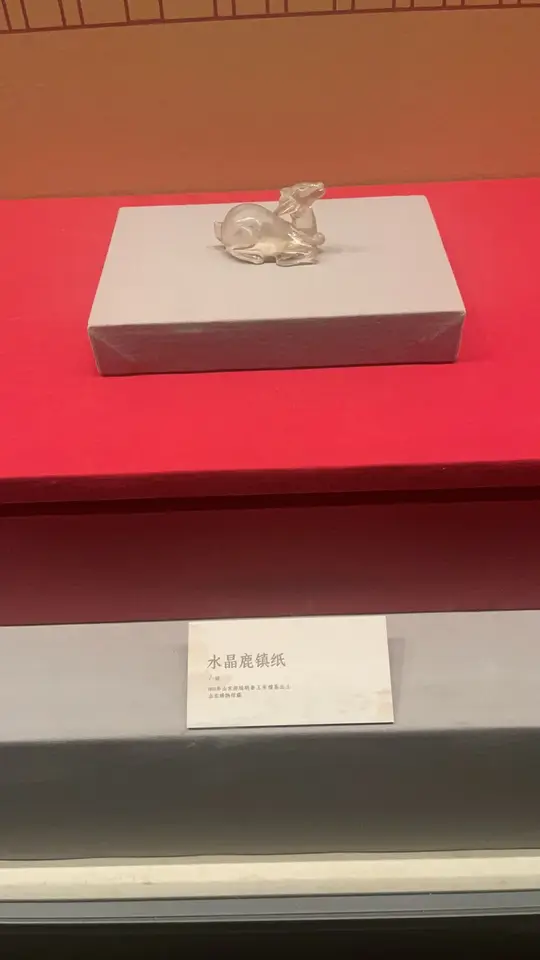
The tomb also preserved an original handscroll painting of white lotuses by Yuan dynasty master Qian Xuan, a gold-powder round fan inscribed by Emperor Gaozong of Song, celadon porcelain from the Longquan kilns, and fine blue-and-white porcelain from Jingdezhen. His desk accessories included ivory-carved calligraphy brushes, an archaistic jade brush rest, a carved rock-crystal deer paperweight, and an antique red-and-white bone weiqi board, alongside early Yuan woodblock editions of the Collected Commentaries on the Four Books. The recovery of these treasures reveals the sophisticated artistic and intellectual pursuits that flourished among the early Ming imperial elite.
FIGURES ASSOCIATED WITH THIS DYNASTY