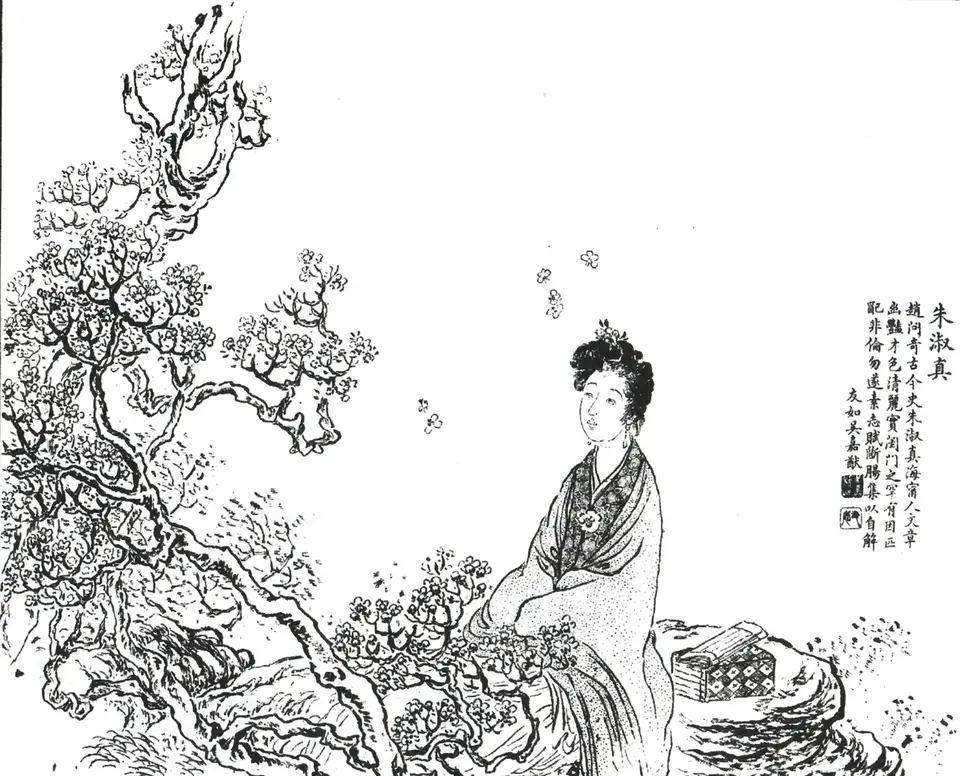
PROFILE
Zhu Shuzhen (朱淑真, fl. 12th century), art name Youqi Jushi, was a celebrated female ci lyricist, poet, and literary artist of the Southern Song dynasty, hailing from Qiantang with ancestral roots in Haining. She lived during the transition between the Northern and Southern Song and the early Southern Song; her exact birth and death dates are unrecorded in dynastic histories.
Born into an established scholar-official household in Qiantang, Zhu exhibited precocious intelligence from childhood, mastering historical classics, poetry, painting, calligraphy, and the seven-stringed zither. While her youth was culturally affluent, her family arranged her marriage to a vulgar and shallow municipal merchant or clerk, creating an irreconcilable intellectual and emotional rift. Zhu endured decades of profound emotional distress within this unfulfilling marriage, channeling her sorrow, romantic longings, and defiance of patriarchal confinement into poignant verse. Celebrated for her delicate, weeping lyricism and intense emotional honesty, she stands alongside Li Qingzhao as one of the twin peaks of female poetry in the Song dynasty, immortalized by masterworks such as Shengchazi: Lantern Festival and Jiangchengzi: Springtime. Following her premature demise, her conservative parents burned her remaining manuscripts in grief and disapproval; however, scholar Wei Duanli diligently collected surviving copies from circulating anthologies, publishing Duanchang Ji and Duanchang Ci, which secured her place in world literature.
- Art Name
- Youqi Jushi
- Dynasty
- Southern Song
- Ancestral Home
- Qiantang (modern Hangzhou, Zhejiang Province)
- Primary Identity
- Female ci lyricist, poet, literary scholar
BIOGRAPHY
Chronology
- 1135 (Shaoxing 5) | Birth in Qiantang | Born into an established official family in Qiantang, receiving thorough instruction in classics, painting, and music.
- 1150 (Shaoxing 20) | Arranged Marriage | Married under parental arrangement to an incompatible spouse, experiencing deep emotional isolation.
- 1158 (Shaoxing 28) | Youqi Hermitage | Established her quiet retreat named Youqi, adopting the art name Youqi Jushi to compose poetry and play the zither.
- 1165 (Qiandao 1) | Excursions on West Lake | Traveled around the West Lake, composing seasonal nature verses reflecting solitary sorrow.
- 1178 (Chunxi 5) | Premature Demise | Passed away after prolonged depressive illness; her parents burned her surviving manuscripts.
- 1182 (Chunxi 9) | Posthumous Publication | Scholar Wei Duanli gathered circulating transcripts and published Duanchang Ji in ten volumes.
Biography
Cultural Upbringing in the Southern Capital
Zhu Shuzhen was born into a respected bureaucratic lineage in Qiantang, the metropolitan district of Lin'an. Following the southward relocation of the dynastic capital, Lin'an blossomed into the political and cultural center of the empire. The misty beauty of the West Lake provided rich inspiration for the young poet. Reared in a comfortable household, Zhu demonstrated exceptional literary sensitivity from her earliest years.
Beyond classical verse, Zhu mastered traditional music and fine arts, creating delicate bird-and-flower paintings and playing the zither. Her early poems reflected youthful joy and genuine delight in spring blossoms, earning high praise from relatives and capital scholars who recognized her as a preeminent talent among the literati women of Lin'an.
Forced Marriage and Domestic Isolation
In traditional society, however, marriage was governed strictly by parental authority. Upon reaching marriageable age, her parents betrothed her to a petty municipal official or merchant lacking literary education.
Following the wedding, Zhu discovered that her husband was obsessed with mundane profit and trivial socializing, completely incapable of appreciating poetry, philosophy, or music. Rather than valuing her intellect, he treated her artistic pursuits with scorn. Trapped in a spiritual desert, Zhu endured profound emotional desolation. Her verse from this period captured the agony of an intellectual soul chained to an uncomprehending companion, inaugurating the tragic motif that came to define her literary legacy.
Hermitage and Defiant Lyricism
To escape her hostile domestic environment, Zhu established a secluded dwelling on the outskirts of Qiantang, naming it the Youqi Retreat and adopting the art name Youqi Jushi. In this quiet refuge, she closed her doors to worldly distractions, finding solace in her books, zither, and inkstone.
Within her retreat, she channeled her deep melancholy, her longing for genuine spiritual love, and her protest against patriarchal conventions into verse. Her celebrated lyric to the tune Shengchazi: Lantern Festival depicted the stark contrast between past romantic happiness and present solitary abandonment during the festival night, characterized by direct, unadorned phrasing of immense emotional power. Rather than remaining passive, her poetry gave voice to an authentic feminine consciousness.
Premature Loss and the Rescue of Duanchang Ji
Decades of relentless depression and isolation took a heavy toll on Zhu's physical health. In the Chunxi reign of Emperor Xiaozong, she passed away in seclusion.
Following her death, her conservative parents viewed her impassioned, emotionally candid verses as a violation of traditional feminine modesty. Distressed by her tragic fate, they threw all her surviving manuscripts into the fire, seeking to erase her literary trace. Fortunately, many of her lyrics had already been copied by literati, collectors, and musicians across Jiangnan. Moved by her genius and tragic life, scholar Wei Duanli spent years tracking down surviving copies, assembling hundreds of poems into the ten-volume Duanchang Ji (Heartbreak Collection) and Duanchang Ci, rescuing her legacy from oblivion.
Major Achievements
Composing Duanchang Ji as a Monument of Women's Literature
Zhu Shuzhen's greatest achievement was her authorship of the landmark collection Duanchang Ji. In a literary tradition where female voices were systematically marginalized, Zhu recorded the authentic psychological landscape of women trapped in arranged marriages.
Comprising over three hundred poems and dozens of lyrics, her work departed completely from the artificial, idealized salon verses composed by male literati pretending to write from a woman's perspective. Zhu wrote directly from her lived pain, openly celebrating the sanctity of mutual affection and protesting the cruelty of arranged betrothals, creating an enduring masterpiece of feminine self-expression.
Developing a Delicate and Direct Lyric Aesthetic
In lyric craft, Zhu achieved an aesthetic standard rivaling Li Qingzhao. Her diction was crystalline, fluent, and devoid of obscure pedantry, yet layered with evocative musical cadence.
She excelled in direct emotional disclosure combined with stark environmental contrasts. In her lyric to the tune Jianzi Mulan Hua, she repeated the word solitary five times in the opening lines to convey total domestic isolation, pushing the aesthetic possibilities of the delicate lyric school to new emotional boundaries.
The Universal Resonance of Shengchazi
Zhu's lyric to the tune Shengchazi: Lantern Festival stands as one of the most celebrated poems in classical Chinese literature. Through the dramatic contrast between the brilliant lantern festival of the past and the solitary weeping of the present, the poem captured the bittersweet memory of lost love with heartbreaking succinctness.
The work was set to music and transmitted across centuries, remaining a timeless cultural treasure of Chinese lyrical art.
Personal Relationships
- Literary Contemporary: Li Qingzhao, paramount female lyricist with whom Zhu is celebrated as the twin peaks of Song women's poetry.
- Rescuer of Manuscripts: Wei Duanli, Southern Song scholar who gathered her scattered verses and published Duanchang Ji.
- Prefatory Author: Zheng Yuanzuo, scholar who authored a commemorative preface celebrating Zhu's talent and virtue.
Historical Evaluations
- Duanchang Ji Xu (Wei Duanli): Her lyrics are crystalline and exquisite, her emotions deep and sincere. Gifted with divine talent yet cursed by human fate, none can read her collection without shedding tears.
- Siku Quanshu Zongmu Tiyao: Zhu Shuzhen's feelings were profound and her reflections lofty; her poetry was clear and startling, representing a rare genius among women.
- Baiyuzhai Cihua (Chen Tingzhuo): Although Zhu Youqi's lyrics lacked the heavy historic weight of Li Qingzhao, her lingering sorrow possessed a transcendent charm beyond imitation.
Related Entries
- Shengchazi: Lantern Festival
- Duanchang Ji
- Duanchang Ci
- Li Qingzhao
- Wei Duanli
Bibliography
Bibliographic information is not yet available for this entry.