Birth in Yingtian
Born on the eighteenth day of the eleventh lunar month in Nanjing as the third son of Zhu Yuanzhang.
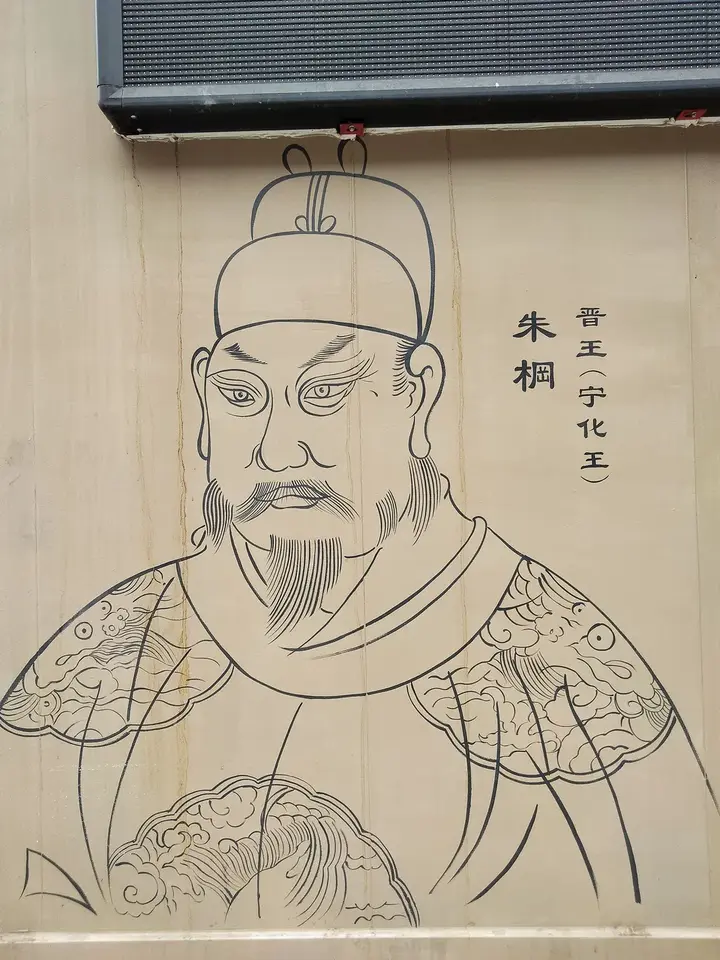
朱棡
Zhu Gang (朱棡, 1358–1398), posthumously titled Prince Gong of Jin, was the third son of Emperor Taizu of Ming (Zhu Yuanzhang) and Empress Ma. As the inaugural Prince of Jin, he was one of the paramount border princes entrusted with defending the northern frontier of the early Ming empire. Endowed with natural intelligence, a striking appearance, and an imposing beard, Zhu Gang exhibited a dignified presence and keen strategic…
Zhu Gang (朱棡, 1358–1398), posthumously titled Prince Gong of Jin, was the third son of Emperor Taizu of Ming (Zhu Yuanzhang) and Empress Ma. As the inaugural Prince of Jin, he was one of the paramount border princes entrusted with defending the northern frontier of the early Ming empire. Endowed with natural intelligence, a striking appearance, and an imposing beard, Zhu Gang exhibited a dignified presence and keen strategic acumen from an early age. He studied Confucian classics and statecraft under the esteemed scholar Song Lian and master calligraphy under Du Huan, attaining high proficiency in both civilian learning and military leadership. In 1370, at the age of twelve, he was ennobled as Prince of Jin, remaining temporarily in Nanjing while his princely palace was being constructed in Taiyuan. In 1378, after completing his adulthood rites, Zhu Gang formally assumed residence in his fief of Taiyuan. En route to his seat, he flogged an imperial chef over food; Emperor Taizu promptly dispatched an urgent missive sternly admonishing him to treat subordinates with compassion and beware of small grudges festering into fatal disasters. Taking the paternal rebuke to heart, Zhu Gang transformed his conduct, becoming respectful toward his retainers and diligently administering his fiefdom. Over the ensuing two decades, he inspected key fortifications across the northern frontier, reorganized the garrison troops of Shanxi, pacified surrendering Mongol nobility, and commanded northern military campaigns. In 1390, he was appointed supreme commander of the western route army during a major punitive expedition against the Northern Yuan, operating alongside the Prince of Yan to secure the frontier. Zhu Gang played a pivotal role in constructing the forward defense system beyond the Great Wall, directing the construction of the Dongsheng fortification network, establishing eighteen military guards from Dongsheng to Xuanfu, and organizing widespread military farming and horse pastoralism across regional grazing grounds. He also supervised the manufacturing of firearms, artillery rockets, and armored war chariots, modernizing Ming tactical doctrines against nomadic cavalry. In 1398, Zhu Gang succumbed to illness at his princely mansion in Taiyuan at the age of forty-one. Deeply grieved, Emperor Taizu suspended court audiences for three days and conferred the posthumous name Gong upon him. Zhu Gang's dedicated guardianship of Shanxi made him an indispensable pillar of the early Ming northern defense strategy.
Born on the eighteenth day of the eleventh lunar month in Nanjing as the third son of Zhu Yuanzhang.
Formally granted the title of Prince of Jin by Emperor Taizu at age twelve.
Lady Xie, daughter of military commander Xie Cheng, was formally invested as his primary consort.
Dispatched to Fengyang to pay homage to ancestral tombs and undergo rigorous cavalry training.
Commenced personal rule in Taiyuan, becoming the principal military defender of Shanxi.
Accepted the submission of four destitute Northern Yuan princes and safely escorted them to Nanjing.
Appointed commander of the western route army to campaign against Northern Yuan remnants in the desert.
Appointed general Fang Zhao to oversee Dongsheng and began constructing extensive forward fortifications.
Supervised military horse-breeding across thirteen border guards and organized firearm production.
Passed away from acute illness on the thirtieth day of the third lunar month at age forty-one.
Zhu Gang was born on December 18, 1358 (the eighteenth day of the eleventh lunar month of the eighteenth year of the Zhizheng reign) in Yingtian Prefecture (modern-day Nanjing). He was the third son of Zhu Yuanzhang and Empress Ma. Characterized by prominent features, an imposing beard, and a calm, decisive manner, he showed great aptitude for both statecraft and martial strategy. To prepare his sons for imperial governance, Emperor Taizu engaged the eminent Confucian scholar and Academician of the Hanlin Academy Song Lian to instruct Zhu Gang in Confucian statecraft, classical philosophy, and historical cycles. Concurrently, calligrapher Du Huan taught him formal clerical script.
In April 1370, at the age of twelve, Zhu Gang was ennobled as the Prince of Jin alongside his brothers. Because northern border regions remained volatile and his official princely palace in Taiyuan was still under construction, he remained at court in Nanjing to further his studies. In August 1373, Emperor Taizu selected the eldest daughter of Xie Cheng, Commander-in-Chief of the Taiyuan Guard, as Zhu Gang's primary consort, creating a crucial strategic connection with regional military forces.
In February 1376, Emperor Taizu sent Zhu Gang, Prince of Qin Zhu Shuang, and Prince of Yan Zhu Di to Zhongdu Fengyang to experience the ancestral homeland and observe farming hardships. In autumn of that year, the princes were stationed at the Fengyang military grounds to conduct extensive maneuvers in cavalry archery, battlefield signaling, and tactical formations. This hands-on martial apprenticeship provided Zhu Gang with essential operational command experience before his deployment to the frontier.
In April 1378, after his capping ceremony marking full adulthood, Zhu Gang set out for Taiyuan. En route, dissatisfied with food quality, he severely whipped an accompanying imperial chef named Xu Xingzu. Upon receiving report of the incident, Emperor Taizu sent an urgent courier with a stern admonition: "I have pacified the realm for decades with utmost rigor, yet for twenty-three years I have never uttered a harsh word or raised a hand against chef Xu Xingzu. Regardless of size, grievances plant the seeds of ruin; you must never mistreat close attendants out of arrogance." Deeply chastised, Zhu Gang reformed his temperament, treating subordinates with consistent politeness thereafter.
Upon settling in Taiyuan, Zhu Gang made the city the central fortress of regional defense. He toured frontier outposts including Datong, Yanmen Pass, and Pianguan, strengthening defenses across the garrisons of the Shanxi Regional Military Commission. In February 1388, four Northern Yuan noble princes, cornered and facing starvation amidst Ming border pressure, arrived at Taiyuan to surrender. Zhu Gang welcomed them hospitably, provided provisions and clothing, and escorted them safely to Nanjing, displaying astute diplomacy toward nomadic border factions.
In January 1390, Northern Yuan remnants led by Chancellor Yaozhu and Grand Marshal Nair Buqa launched predatory incursions against Ming border settlements. Emperor Taizu ordered a massive counter-offensive, assigning Zhu Gang and Prince of Yan Zhu Di to lead joint eastern and western columns into the steppes. Commanding the western army alongside Dingyuan Marquis Wang Bi, Zhu Gang advanced beyond Datong into the desert; however, an imperial dispatch ordered him back to Taiyuan to welcome Crown Prince Zhu Biao on an inspection tour, and the western force withdrew without engaging the enemy main body.
In 1391, malicious detractors submitted secret memorials alleging that Zhu Gang had concealed armed soldiers in the Wutai Mountains, mined iron in secluded valleys, and forged forbidden weapons with subversive intent. Emperor Taizu summoned Zhu Gang to Nanjing for inquiry. Thanks to Crown Prince Zhu Biao's steadfast intervention and thorough investigations proving the claims baseless, Zhu Gang was cleared, had his honors reaffirmed, and returned to Taiyuan. Following this crisis, he governed with even greater prudence.
In late 1392, recognizing the strategic importance of the Ordos Loop, Zhu Gang assigned capable general Fang Zhao to command the forward outpost of Dongsheng. He oversaw the construction of a twenty-li stone city wall at Dongsheng and established eighteen military garrisons from Dongsheng to Xuanfu, constructing an integrated defensive screen north of the Great Wall.
In January 1397, Emperor Taizu issued comprehensive instructions based on his strategic geography charts, ordering Zhu Gang to oversee horse pastoralism and agro-military colonies along a seven-hundred-li frontier zone stretching from Dongsheng westward to Ningxia and eastward to Datong and Xuanfu. Following imperial directives, Zhu Gang taught frontier soldiers to process sheep wool and milk, break young horses for cavalry use, and build fortified brick redoubts during farming off-seasons.
Under Zhu Gang's meticulous direction, the Shanxi princely armory manufactured thousands of firearms, rocket-launchers, and armored war chariots, integrating infantry, cavalry, and artillery into a formidable combined-arms doctrine. However, relentless field duties took a heavy toll on his health.
On March 30, 1398, Zhu Gang fell mortally ill and passed away at his Taiyuan palace at the age of forty-one. In Nanjing, Emperor Taizu was overcome with grief, suspending court sessions for three days and granting him the posthumous title of Prince Gong. He was interred at Mount Tuo near Taiyuan, and his eldest son Zhu Jixi inherited the princely throne. Over his two decades in Taiyuan, Zhu Gang solidified the northern defense line and established a benchmark of princely duty during the early Ming period.
Assuming residence in Taiyuan in 1378, Zhu Gang directed military resources across Shanxi, rebuilt the ancient fortifications of Taiyuan, and coordinated regional garrisons to transform the area into a premier strategic base against nomadic invasions.
Entrusted by Emperor Taizu with western command during the 1390 campaign, Zhu Gang marshaled tens of thousands of elite frontier troops alongside veteran generals like Wang Bi, projecting formidable military presence into the steppes and deterring Northern Yuan raiding parties.
Zhu Gang oversaw the construction of extensive defensive redoubts at Dongsheng, stationed veteran commander Fang Zhao there, and established eighteen new border guards between Xuanfu and Dongsheng, projecting Ming military power deep into the steppe frontier.
Faithfully executing the imperial frontier defense blueprint, Zhu Gang organized pastoral colonies across thirteen northern guards, expanded cavalry horse reserves, and spearheaded the production of firearms and combat chariots, enhancing the operational mobility and defensive resilience of Ming border armies.
The Veritable Records of Ming Taizu commended Zhu Gang's leadership, stating: "The Prince was sharp and courageous; he studied under Academician Song Lian and calligraphy under Du Huan. He had striking features, a handsome beard, and an authoritative presence endowed with great intellect. When Emperor Taizu enfeoffed his sons, he appointed the Prince to Jin as a defensive shield for the dynasty, a duty he maintained for many years." The History of Ming recorded: "Prince Gong of Jin was the third son of Taizu. He studied literature under Song Lian and calligraphy under Du Huan... With fine eyes and an imposing beard, his demeanor commanded respect, and he possessed strategic cleverness. In his fiefdom, he trained his troops rigorously and maintained strict discipline; Taizu relied on him heavily."
Modern institutional historians regard Zhu Gang as one of the indispensable pillars of the early Ming nine-border defense network. Based in Taiyuan, his administrative stewardship over Shanxi and forward logistics at Dongsheng provided crucial regional stability against residual Northern Yuan cavalry forces. His systematic integration of pastoralism, military garrisons, and gunpowder armaments demonstrated the defensive efficacy of early Ming princely fiefs.
FIGURES ASSOCIATED WITH THIS DYNASTY