Age one | Born on the fifth day of the fifth lunar month at Loutian Fort, Yingle Ward, Yingdao County, Daozhou.
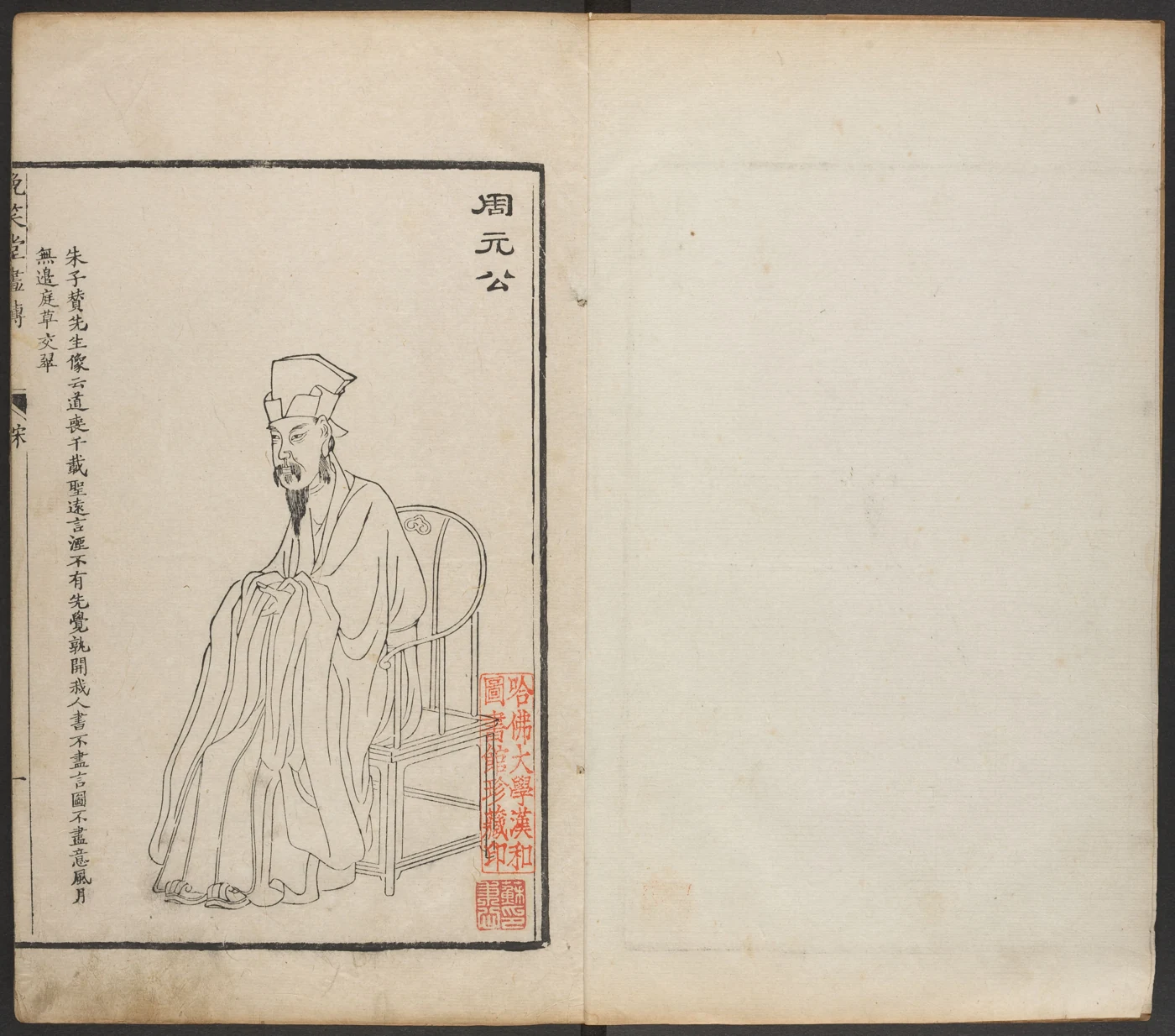
1017 CE–1073 CE
Writerofficialand Neo-Confucian philosopher
Zhou Dunyi
周敦颐
Zhou Dunyi (1 June 1017–14 July 1073), originally named Dunshi and courtesy name Maoshu, later changed his name to Dunyi to avoid a former personal name of Emperor Yingzong. He used the art name Lianxi and was commonly known as Master Lianxi. He came from Loutian Fort in Yingdao, Daozhou, in present-day Dao County, Hunan. A Northern Song official, philosopher, and writer, he is regarded in the Chinese source as a founder of…
1017 CE–1073 CENorthern Song
PROFILE
Zhou Dunyi (1 June 1017–14 July 1073), originally named Dunshi and courtesy name Maoshu, later changed his name to Dunyi to avoid a former personal name of Emperor Yingzong. He used the art name Lianxi and was commonly known as Master Lianxi. He came from Loutian Fort in Yingdao, Daozhou, in present-day Dao County, Hunan. A Northern Song official, philosopher, and writer, he is regarded in the Chinese source as a founder of Song-Ming Neo-Confucianism and is grouped with Shao Yong, Zhang Zai, Cheng Hao, and Cheng Yi as the “Five Masters of the Northern Song.” Building on Confucian learning while incorporating elements associated with Buddhism and Daoism, he formulated a cosmology centered on the phrase “non-polar yet Supreme Ultimate,” made “sincerity” a philosophical core, wrote Explanation of the Diagram of the Supreme Ultimate and Tongshu, and advocated self-cultivation through “taking quietude as primary” and establishing the human ultimate. His ideas were developed by Cheng Hao and Cheng Yi and later systematized by Zhu Xi, becoming an important foundation of Cheng-Zhu Neo-Confucianism.
- Other names
- Zhou Maoshu; Master Lianxi
- Courtesy name
- Maoshu
- Art name
- Lianxi
- Period
- Northern Song
- Date of Birth
- 1017
- Date of Death
- July 24 1073
- Dynasty/Polity
- Northern Song
- Identity
- Writer, official, and Neo-Confucian philosopher
- Ethnicity/People
- Not recorded in historical sources
- Native place
- Loutian Fort, Yingdao, Daozhou (present-day Dao County, Hunan)
- Place of birth
- Loutian Fort, Yingle Ward, Yingdao County, Daozhou
- Place of death
- Not recorded in historical sources
- Highest office
- See Biography and Major Deeds
- Major achievements
- Foundational Northern Song Neo-Confucian thinker; author of Explanation of the Diagram of the Supreme Ultimate and Tongshu; emphasized sincerity and quietude
LIFE TIMELINE
Age fourteen | Built a study near Moon Rock; tradition says contemplation of its form inspired his understanding of the Supreme Ultimate.
Age fifteen | Father Zhou Fucheng died; went with his mother to live with his maternal uncle Zheng Xiang, Scholar of the Dragon Diagram Pavilion.
Age twenty | Performed the coming-of-age rite; received an appointment as registrar in the Directorate for Palace Buildings through his uncle's privilege and married Lady Lu.
Age twenty-four | Transferred as registrar of Fenning and resolved a long-standing doubtful case after one examination.
Age twenty-eight | Became judicial manager in the Nanan Military Prefecture.
Age twenty-nine | Argued with the harsh transport commissioner Wang Kui to save a prisoner, threatening to resign; Wang relented and released the man.
Age thirty | Cheng Xiang sent his sons Cheng Hao and Cheng Yi to study with him; in winter Zhou became magistrate of Chen County in Chenzhou and promoted education.
Age thirty-one | Established a study hall at Yushan in Chenzhou.
Age thirty-two | Transferred as magistrate of Guiyang County, Chenzhou, where he gained a strong administrative reputation.
Age thirty-three | Lectured to prefect Li Chuping; after Li's death escorted the coffin home and managed his household affairs.
Age thirty-eight | Became Assistant Director of the Court of Judicial Review and magistrate of Nanchang County, Hongzhou.
Age forty-three | Befriended Pu Zongmeng and married Pu's younger sister as his second wife.
Age forty-four | Left his post in Hezhou and returned to the capital; met Wang Anshi and conversed with him for days and nights.
Age forty-five | Promoted to Erudite of the Directorate of Education and assistant administrator of Qianzhou; while passing Jiangzhou built a study at the foot of Mount Lu and named it Lianxi.
Age forty-seven | Wrote “On the Love of the Lotus” in the fifth month; promoted to Vice Director in the Ministry of Works' Waterways branch.
Age forty-eight | Transferred as assistant administrator of Yongzhou.
Age fifty-five | Appointed judicial commissioner of Guangnan East Circuit and inspected Chaozhou and Huizhou.
Age fifty-six | Contracted a miasmic illness, requested command of Nankang, and settled at the Lianxi study below Mount Lu.
Age fifty-seven | Died on the seventh day of the sixth lunar month at the Lianxi study and was buried on the twenty-first day of the eleventh month beside his mother's grave in Xianju County.
BIOGRAPHY
Biography
Family Background and Early Life
Zhou Dunyi came from an official family. His father Zhou Fucheng had served as magistrate of Guiling County. The Zhou lineage was described as a prominent clan associated with Runan from Han times. Zhou was born on the fifth day of the fifth lunar month of Tianxi 1 (1 June 1017) at Loutian Fort in Yingle Ward, Yingdao County, Daozhou. His original name was Dunshi and his courtesy name Maoshu; he later changed his given name to Dunyi to avoid a former personal name used by Emperor Yingzong before accession.
In 1030, at fourteen, he built a study near Moon Rock west of Lianxi. The rock has eastern and western entrances, a hollow interior, and a rounded top that resembles the phases of the moon when viewed upward. Later tradition held that contemplation of this formation helped him grasp the principle of the Supreme Ultimate. In 1031 his father died and was buried near the ancestral residence in Yingle. Zhou, then fifteen, went with his mother to his maternal uncle Zheng Xiang, Scholar of the Dragon Diagram Pavilion. Zheng admired his aspirations, treated him like a son, and brought him to the capital Kaifeng.
In 1036 Zhou performed the adult cap ceremony and already had a reputation for moral seriousness. Under the court system, officials could nominate a relative for an entry appointment; Zheng gave this privilege to Zhou, who received a trial appointment as registrar in the Directorate for Palace Buildings. The same year he married Lady Lu, daughter of Lu Can, a vice director in the Ministry of War.
Early Official Career and the Nanan Prison Case
In 1040 Zhou became registrar of Fenning, present-day Xiushui, Jiangxi. In 1041 a lawsuit that had long remained unresolved was reportedly clarified by him after a single interrogation, leading locals to praise his ability.
In 1044, on the recommendation of a Ministry of Justice commissioner, Zhou became judicial manager in the Nanan Military Prefecture. The next year a prisoner who did not legally deserve death was threatened with harsh punishment by transport commissioner Wang Kui, known as a severe and domineering official. Other officials were afraid to argue, but Zhou insisted on the law. When Wang would not listen, Zhou threw down his court tablet and prepared to resign, declaring that he would not remain in office if he had to kill a man merely to please another. Wang reconsidered and the prisoner was spared. The episode greatly increased Zhou's reputation.
Education in Chen County and Administration in Guiyang
In the winter of 1046, after a recommendation from Wang Kui, Zhou became magistrate of Chen County in Chenzhou. He immediately promoted schooling, lectured in the existing county school, and wrote a “Record on Repairing the School.” That year Cheng Xiang, an Assistant Director of the Court of Judicial Review who had met Zhou in Nanan, judged his bearing extraordinary and his learning grounded in the Way. He became Zhou's friend and sent his sons Cheng Hao and Cheng Yi to study under him. In 1047 Zhou established a study hall at Yushan in Chenzhou.
In 1048 Zhou became magistrate of Guiyang County and gained a strong reputation for government. Prefect Li Chuping respected him as more than a subordinate and sought instruction. Zhou lectured to Li daily, and the source says Li made genuine progress after a year. When Li died in 1049 and left a young son, Zhou declared the matter his own responsibility, escorted the coffin home for burial, and repeatedly helped manage the family's affairs.
By 1053 senior officials were recommending Zhou for his record in Chenzhou and Guiyang. In 1054 he became Assistant Director of the Court of Judicial Review and magistrate of Nanchang County in Hongzhou. Residents reportedly rejoiced because they remembered his early reputation for resolving the difficult case at Fenning, while powerful households, corrupt clerks, and unruly young men warned one another not to violate his orders.
Hezhou, Qianzhou, and the Name Lianxi
Between roughly 1056 and 1060 Zhou served as judge in Hezhou, present-day Hechuan, Chongqing. In 1059 Pu Zongmeng passed through Hezhou and talked with Zhou for three days and nights. Deeply impressed, Pu married his younger sister to Zhou as a second wife; she later bore Zhou Tao.
In the sixth month of 1060 Zhou left Hezhou and returned to the capital, where he met Wang Anshi, who was also returning to report. The two admired one another and conversed at length. The Chinese source says Wang, four years younger, reflected so deeply after Zhou's departure that he forgot sleep and food, and that both men gained new intellectual stimulus from the exchange.
In 1061 Zhou was promoted to Erudite of the Directorate of Education and assistant administrator of Qianzhou. His friend Pan Xingsi waited for him at a relay station in Jiangzhou and invited him to tour Mount Lu. Zhou was captivated by the scenery and wanted to settle there, so he built a study at the mountain's foot. A stream before it flowed from Lotus Peak and joined the Pen River. Because Zhou often washed his cap tassels there, he used “Lianxi” as the name of the place and as his own sobriquet. In 1062 he traveled on Mount Mazu with Zhao Qingxian.
Yongzhou, Shaozhou, and Judicial Commissioner of Guangnan
In the first month of 1063 Zhou traveled through Yudu County, toured Luoya with Qian Jian, Hou Tuo, Shen Ji, Sheng Xiyan, and others, and built a Lianxi Pavilion at Shanshan. In the fourth month Emperor Yingzong ascended the throne, and Zhou was promoted to Vice Director in the Waterways branch, while his late father received a posthumous official rank. In the fifth month Zhou attended a gathering of literary friends and wrote the celebrated short essay “On the Love of the Lotus.”
In the winter of 1064 he transferred as assistant administrator of Yongzhou. In 1068, while holding that post, he acted as administrator of Shaozhou. On the third day of the first month he conducted rites at the prefectural school honoring Confucius and the ancient teachers, composing sacrificial texts for Confucius and Yan Hui.
In 1070 Zhou became a director in the Waterways branch and was promoted to judicial commissioner of Guangnan East Circuit. On the ninth day of the first month of Xining 4, corresponding in the Chinese source to 31 January 1072, he formally assumed the commission. During less than a year he traveled widely through Guangdong on inspection and wrote poems including “Inscribed at Datian Hall” and “Inscribed at Mount Luofu.”
Retirement and Death
The Chinese source states that in 1071 Zhou contracted a miasmic illness and also learned that water erosion threatened the grave of Lady Zheng at Runzhou. He therefore requested command of Nankang. On the first day of the eighth month of 1072 he transferred there. On the sixteenth day of the twelfth month he moved his mother's grave from Runzhou to Sanqishan in Qingquanshe, Dehua County, Jiangzhou. He thereafter lived at the Lianxi study below Lotus Peak on Mount Lu, near his mother's reburial site.
On the seventh day of the sixth lunar month of Xining 6 (14 July 1073), Zhou died of illness at the Lianxi study, aged fifty-seven. On the twenty-first day of the eleventh month he was buried, in accordance with his wishes, beside his mother's grave in Xianju County. Pan Xingsi wrote his epitaph and Pu Zongmeng the grave inscription. Under Emperor Ningzong he later received the posthumous title Yuan and became known as Duke Yuan. Under Emperor Lizong of the Southern Song he was ordered to receive sacrifices in the Confucian temple, giving official recognition to his status as a foundational Neo-Confucian thinker.
Family and Early Years
According to the chronological biography by Du Zheng of the Song, Zhou Dunyi was born on the fifth day of the fifth month of 1017 "at Loutian fort in Yingle village of Yingdao county in Daozhou," his original name being Dunshi and his courtesy name Maoshu, changed to Dunyi to avoid the old name of the prince of Yingzong's household. His family, the biography says, "had been enfeoffed by Han as descendants of Zhou at Runan and were a noted house for generations." His father Zhou Fucheng passed the presented-scholar examination in 1015 and rose to be magistrate of Guiling in Hezhou; his mother, Lady Zheng (982-1037), was of Hengzhou, her ancestral home Kaifeng, and having first married the gentleman Lu and borne a son, Lu Dunwen, married Zhou Fucheng as his second wife in 1009. Zhou Dunyi's father died when he was eight, after which he lived with his mother and his half-brother at Loutian village. His precocity left stories among his kin: at the Double Ninth of 1021, when his father and uncles were chatting and could not think what to name the five mounds before the village, the small Dunyi, playing nearby, said at once that they were like five stars — the eastern one Jupiter, the southern Mars, the western Venus, the northern Mercury, the middle Saturn — and that together they should simply be called the "Five-Star Mounds," which the elders thought reasonable, so naming them and making them a sight of Loutian. He "was clever and fond of study from childhood, diligent in thought, and when he met a question he liked to get to the bottom of it"; he would often ask his uncle in Hengzhou where the stars came from, why the sun rises in the east and sets in the west, why the moon waxes and wanes, and why wind and rain come; by twelve or thirteen he had read the Four Books and the Books of Documents, Odes, Rites and Spring and Autumn, some of them by heart, and could write essays marked by "new conceptions and views of his own." The Moon Cliff, some seven kilometres from his old home, was later joined to the beginnings of his thought: the cave has two openings, east and west, and a man within it sees the "moon" change with his position — entering by the east and walking west, he sees at first a "waning crescent," then a sickle, then a little boat, waxing from crescent to full; at the centre of the cave the "bright moon" overhead is at the full; walking on, it wanes again to a crescent once more. It is said that at fourteen Zhou Dunyi built himself a study at the Moon Cliff, read there, and there understood the principle that "the Ultimateless is the Supreme Ultimate," laying the ground of his later thought.
The Beginning of His Career, Schools and Teaching
In 1036, at twenty, Zhou Dunyi assumed the cap of manhood, his "character and sense of right being outstanding and known at the time"; by custom the court allowed an official to recommend one of his juniors for minor office, and his uncle Zheng Xiang gave him the chance, so that he became a secretary of the imperial works, marrying in the same year Lady Lu, daughter of Lu Can, a bureau director in the ministry of war. In 1040 he was transferred to be assistant magistrate of Fenning, and in 1041 a lawsuit long unsettled was, when he took it up, "clarified at a single hearing and closed," the local people saying in wonder that "the officials here before were not his equal." In 1044, on the recommendation of a commissioner of the ministry of justice, he became judicial adviser of the Nan'an army; the next year a prisoner who by law should not have died was to be punished severely by the transport commissioner Wang Kui, "a cruel and violent official whom none dared to oppose," and Zhou Dunyi alone argued with him; when Wang would not listen, Zhou "laid down his tablet and asked to resign," saying: "How can one be an official like this? If killing men is to please others, I will not do it." Wang Kui understood and the prisoner was spared. It was at Nan'an that Cheng Xiang, then an assistant minister, saw that his "bearing was that of no common man" and, talking with him, found that he "knew the Way in his learning," and made friends with him; in 1046 Cheng Xiang sent his two sons, Cheng Hao and Cheng Yi, to study under him, and in 1047 Zhou formally founded a school hall at Yushan in Chenzhou. Transferred on Wang Kui's recommendation to be magistrate of Chen county in Chenzhou, he "on reaching the county at once repaired the school to teach men" and wrote a "Record of the Repair of the School"; in 1048 he became magistrate of Guiyang county in Chenzhou, where the commandery governor Li Chuping thought him so worthy that "he did not treat him as a subordinate," and asked him for instruction in reading, Zhou answering that "your knowledge is not yet sufficient; I may expound it for you," so that by 1049 Li Chuping had indeed learned something. In 1054, on the recommendation of many officials, he became assistant minister of the court of judicial review and magistrate of Nanchang county in Hongzhou, and the people of Nanchang, hearing he was coming, "said with joy, 'This is he who, first in office at Fenning, could decide doubtful cases; now we have a place to bring our suits'"; and they warned one another not to disobey his orders. In 1059 Pu Zongmeng talked with him for three days and said he had never thought there could be such a man in the world, afterwards marrying his sister to him as his second wife. In the sixth month of 1060, released from Hezhou and returning to the capital, he met Wang Anshi, who admired him greatly, "regretted that they had not met earlier," and was so absorbed after he left that he forgot to sleep and eat.
The Name Lianxi and His Last Years
In 1061 Zhou Dunyi became a court scholar of the National Academy and assistant prefect of Qianzhou; passing through Jiangzhou he "loved the beauty of Mount Lu and thought of settling there," and built a study hall at its foot. "Before the hall was a stream rising below Lotus Peak and flowing into the Pen river; the master washed his cap-strings there and rejoiced in it, and so took the name Lian for himself," agreeing with his friend Pan Xingsi to meet there in other days for poetry and song — whence the name Lianxi. In the first month of 1063 he travelled to Yudu, invited Qian Jian, Hou Tuo and Shen Ji to roam the Luocuo cliffs and had a record cut in stone, and built the Lianxi Pavilion at Shanshan; in the fourth month of the same year the Yingzong emperor came to the throne, and he was advanced to vice-director of the bureau of works, his father Zhou Fucheng being posthumously made a bureau director; in the fifth month, drinking with friends of letters and verse, he "finished at one stroke" a prose piece of a hundred and nineteen characters, the "On the Love of the Lotus" that has come down the ages. In the winter of 1064 he was transferred as assistant prefect of Yongzhou; in 1070 he became a director of the bureau of works and was promoted judicial commissioner of Guangnan East, taking up the office in the first month of 1072 — a post he held less than a year, in which he "travelled everywhere on inspection, his footsteps covering almost all the hills and waters of Guangdong," writing poems such as "Inscribed on the Hall of Dadian" and "Inscribed on Mount Luofu." In the same year he caught the pestilential fever and retired, settling below Lotus Peak at Mount Lu, and moved his mother's grave from Runzhou to a place near his own dwelling. On the seventh day of the sixth month of 1073 he died at the Lianxi study hall below Mount Lu, aged fifty-seven; in the same year Zhao Bian, appointed again to command Shu, heard that he had retired and memorialized asking that he be kept, "but the order reached his door when the master had already died of illness," and he was buried in the eleventh month beside the grave of the lady of Xianju, as he had charged, Pan Xingsi writing the epitaph and Pu Zongmeng the grave inscription.
Major Activities
Founding Role in Neo-Confucianism
The Chinese source presents Zhou Dunyi as a founder of Song-Ming Neo-Confucianism. In an intellectual environment where Confucian, Buddhist, and Daoist ideas interacted, he reworked the Daoist term “non-polar,” the Book of Changes concept of the Supreme Ultimate, the Doctrine of the Mean idea of sincerity, and cosmological theories of yin-yang and the Five Phases. His surviving philosophical writings are compact—a Diagram of the Supreme Ultimate, the roughly two-hundred-character Explanation of the Diagram of the Supreme Ultimate, and the less-than-three-thousand-character Tongshu—but became central to later Neo-Confucian conceptual structures.
Explanation of the Diagram of the Supreme Ultimate sets out a cosmogony beginning with “non-polar yet Supreme Ultimate.” Through movement and stillness the Supreme Ultimate gives rise to yin, yang, and the myriad things. Humanity receives the finest endowment and is most spiritually responsive. The sage models the Supreme Ultimate in establishing the “human ultimate”; the Chinese source identifies this with sincerity, described as pure and supremely good, the basis of the Five Constants and source of the hundred forms of conduct. Zhou's theory brought the term “non-polar” into Confucian philosophical discourse while drawing on the Book of Changes tradition and elements associated with Daoism and Chan Buddhism.
Literary Achievement
In the fifth month of 1063 Zhou wrote the 119-character prose essay “On the Love of the Lotus.” It famously praises the lotus as rising from mud without being stained and washed by clear ripples without becoming gaudy. The lotus becomes an image of the noble person, while chrysanthemum represents the recluse and peony wealth and rank. The essay expresses Zhou's ideal of moral character and became one of his best-known literary works.
Administration and Justice
Zhou served successively as registrar of Fenning, judicial manager of the Nanan Military Prefecture, magistrate of Chen County and Guiyang, magistrate of Nanchang, judge in Hezhou, assistant administrator of Qianzhou and Yongzhou, acting administrator of Shaozhou, and judicial commissioner of Guangnan East Circuit. The Chinese source repeatedly emphasizes clear judgment and integrity: he resolved a long-doubtful case at Fenning, risked office to defend a prisoner in Nanan, intimidated powerful and corrupt interests in Nanchang, promoted education in Chen County, governed Guiyang effectively, and traveled diligently through Guangdong as judicial commissioner.
Promotion of Education
Wherever he served, Zhou gave attention to schools. In Chen County he used the old county school for teaching and lecturing; in 1047 he founded a study at Yushan; in 1061 he built the Lianxi study at Mount Lu; and in Shaozhou he performed school rituals honoring the sages. The source summarizes his educational outlook as directing people toward goodness and moral cultivation, taking the Six Classics as primary and sincerity as the foundation.
Relations with Contemporaries
Zhou had intellectual and personal ties with many important contemporaries. In 1046 Cheng Hao and Cheng Yi studied under him and later became major Neo-Confucian thinkers. In 1060 he met Wang Anshi and talked with him day and night. Pan Xingsi was a close friend and later wrote his epitaph. Pu Zongmeng conversed with him for three days and nights and became his relative by marriage. He traveled with Zhao Qingxian and lectured to prefect Li Chuping.
His Thought and His Foundational Role in Neo-Confucianism
Zhou Dunyi raised many new questions and framed new answers, advancing Confucianism by a step: the concepts of the Ultimateless, the Supreme Ultimate, yin and yang, the five agents, motion and rest, quiescence, perfect sincerity, freedom from desire and the following of transformation that he set out became the material of endless discussion and development among later Neo-Confucians and form an important part of its system of categories. The frame of his cosmology is that "the Supreme Ultimate is the Ultimateless": the Ultimateless, or nothing, gives rise to the Supreme Ultimate, or being; the Supreme Ultimate can move and be still, and moving produces yang, being still produces yin; at the extremity of motion it tends to rest and at the extremity of rest it returns to motion, motion and rest "having one another for root"; yin and yang produce the two modes of heaven and earth, whose further transformation produces water, fire, wood, metal and earth, the five agents, whose qi in motion drives the cycle of spring, summer, autumn and winter, so that "the five agents are unified in yin and yang, yin and yang in the Supreme Ultimate, and the Supreme Ultimate has its origin in the Ultimateless"; the two qi and the "essence" of the five agents combine to form male and female, and among the myriad things man, "obtaining the finest of heaven and earth, is the most intelligent." At the heart of his philosophy is the single word sincerity, at once the highest state of the way of heaven, of man and of their unity, and divided into an ontology of heaven and an ontology of the mind. In the "Explanation of the Diagram of the Supreme Ultimate" he treats man's morality and nature as the same process of Ultimateless and Supreme Ultimate, yin-yang and five agents as the generative process of the universe, thus providing a cosmological foundation for sincerity; and drawing on the doctrine of sincerity in the Doctrine of the Mean he derives a doctrine of man from his cosmology, building an ethics founded on sincerity. For its attainment he proposed perfect sincerity and quiescence: human nature has five grades — firm and good, firm and evil, yielding and good, yielding and evil, and the mean — and only by reaching perfect sincerity is it perfected; and to reach it one must "check anger, block desire, turn to good and correct faults, passing from few desires to no desire," a doctrine of quiescence in fact taken from Buddhist meditation — he called himself a "poor Zen guest," studied under the monk Shouya of the Helin temple, and practised sitting in meditation with the Chan master Changcong of Donglin. His educational thought includes the aim of "teaching men to incline to good and to advance in virtue and learning," the content of "the Six Classics as the basis and sincerity as the root" — the word sincerity appearing in the Penetrating the Book of Changes as many as twenty times — and the method of "self-study as the main thing, with stress on rousing." His political thought divides into government by virtue and by punishment: the former in cultivating sagely virtue, stressing the way of teachers and promoting ritual and music — "when the way of teachers is established good men are many, and when good men are many the court is upright and the empire governed"; the latter in his view of virtue and punishment and of caution in punishing, holding punishment to be "the last resort to make up for a deficiency of virtue" and urging that it be used with care and clarity. He expounded ritual and music from ethics too, holding that "ritual is principle and music is harmony," that the substance of ritual lies in principle, and that only when the relations of prince and minister, father and son, elder and younger brother, husband and wife each attain their principle is there harmony; hence ritual must be spoken of before music. Faced with the poverty and weakness of the Northern Song he urged that the tendency of the empire be recognized early and strength accumulated to reverse it, and in politics inclined to reform and praised the new measures.
In the genealogy of Neo-Confucianism Zhou Dunyi is the founder of Song-Ming learning: in an age of confluence among Confucianism, Buddhism and Daoism he recast the "Ultimateless" of the Laozi, the "Supreme Ultimate" of the Commentary on the Changes, the "sincerity" of the Doctrine of the Mean and the doctrines of the five agents and yin-yang to give later Neo-Confucians their categories and models of cosmological ontology — he has, indeed, "the merit of the beginning," and the "enlargement" of the two Cheng brothers and the "great synthesis" of Zhu Xi were in a sense no more than the further perfecting and systematizing of his foundation. Under Emperor Lizong of the Southern Song an edict gave him a place in the sacrifices of the Confucian temple, and his position as a founder of Neo-Confucianism was officially acknowledged. His line continued: his son Zhou Tao, born at Qianzhou, first appointed to judicial office, passed as a presented scholar in 1088 and served as magistrate of Guichi, transport commissioner of the two Zhe and prefect of Chengdu, ending as a grand master of court discussion and expositor of the pavilion of excellent counsel; and Zhou Tao's tenth-generation descendant Yize settled at Qitian in Sifen, Liling, Hunan, whose descendants, by the twenty-eighth generation, were spread through Hengling, Qitian, Nan'an and Zhai river, more than ten thousand souls.
Personal Relations
- Father: Zhou Fucheng, magistrate of Guiling County
- Mother: Lady Zheng, Lady of Xianju County and elder sister of Zheng Xiang
- Maternal uncle: Zheng Xiang, Scholar of the Dragon Diagram Pavilion
- Wife: Lady Lu, daughter of Lu Can, vice director in the Ministry of War; second wife Lady Pu, younger sister of Pu Zongmeng
- Sons: Zhou Shou, Zhou Dao (both ritual assistants in the Imperial Ancestral Temple), and Zhou Tao
- Cheng Xiang: Assistant Director of the Court of Judicial Review; befriended Zhou at Nanan
- Cheng Hao and Cheng Yi: pupils
- Pan Xingsi: close friend and author of Zhou's epitaph
- Pu Zongmeng: friend and relative by marriage, author of the grave inscription
- Li Chuping: prefect who studied with Zhou
- Emperor Yingzong of Song: Zhou changed his personal name to avoid the emperor's former name
- Emperor Ningzong of Song: bestowed the posthumous title Yuan
- Emperor Lizong of Song: ordered Zhou to be sacrificed to in the Confucian temple
- Wang Kui: transport commissioner and harsh official with whom Zhou fought over the fate of a prisoner
Historical Assessment
Northern Song and Contemporary Assessments
- Cheng Xiang judged Zhou's bearing extraordinary and, after conversation, believed he understood the Way in learning. (Lianxi Gazetteer: Chronological Biography)
- Pu Zongmeng reportedly exclaimed in astonishment that such a man existed in the world and admired his lofty and open character. (Lianxi Gazetteer: Chronological Biography)
- After meeting Zhou, Wang Anshi was said to have reflected so intensely that he forgot sleep and food. (Lianxi Gazetteer: Chronological Biography)
Southern Song and Yuan Periods
- Zhu Xi strongly promoted the Explanation of the Diagram of the Supreme Ultimate, grouped Zhou with the Cheng brothers, Zhang Zai, Shao Yong, and Sima Guang as major Northern Song masters, and said that Zhou had recovered learning no longer transmitted from the sages. (History of Song, “Biographies of the Learning of the Way”)
- The Song-Yuan xue'an states that after Confucius and Mencius, Han scholars chiefly transmitted the classics while subtle teaching on human nature and the Way had long declined; Zhou's rise, followed by the Cheng brothers, Zhang Zai, and others, restored sacred learning.
- Lu Xiangshan rejected the use of the term “non-polar” in Zhou's diagram and debated the issue with Zhu Xi.
Ming and Qing Periods
- Ming scholar Xue Xuan honored Zhou as an ancestral founder of Neo-Confucianism, saying his learning linked the Confucian tradition of the ancient schools with the later Luoyang and Fujian traditions.
- Early Qing scholar Huang Zongyan argued in A Critique of the Explanation of the Diagram of the Supreme Ultimate that the diagrammatic tradition derived from Chen Tuan, emphasizing a Daoist background.
- Mao Qiling and others likewise argued for Daoist origins of the diagram, generating continuing debate about the sources of Zhou's thought.
Modern Period
- Feng Youlan's History of Chinese Philosophy calls Zhou an opening figure of the Learning of the Way and argues that he supplied a basic framework developed by the Cheng brothers and Zhu Xi.
- Qian Mu described him as a crucial intermediary linking Confucius and Mencius to Cheng-Zhu Neo-Confucianism.
- Xu Gang argues that Zhou genuinely made the initiating contribution and that the Cheng brothers' expansion and Zhu Xi's synthesis elaborated and systematized a foundation already laid by him.
FIGURES ASSOCIATED WITH THIS DYNASTY
Bibliography
- History of Song, juan 427, “Biographies of the Learning of the Way”