Birth in Tiantai
Born into an imperial lineage in Tiantai, Taizhou, dedicating his youth to classical history and practical geographical studies.
赵汝适
Zhao Rugua (赵汝适, 1170–1231), courtesy name Boke, with ancestral roots in Kaifeng, was an eighth-generation descendant of Emperor Taizong of Song. Following the northward fall of the Northern Song capital, his ancestors settled in Tiantai, Taizhou (present-day Tiantai County, Zhejiang Province). He was an illustrious geographer, maritime administrator, and imperial clansman of the mid-Southern Song Dynasty. In 1196, Zhao…
Zhao Rugua (赵汝适, 1170–1231), courtesy name Boke, with ancestral roots in Kaifeng, was an eighth-generation descendant of Emperor Taizong of Song. Following the northward fall of the Northern Song capital, his ancestors settled in Tiantai, Taizhou (present-day Tiantai County, Zhejiang Province). He was an illustrious geographer, maritime administrator, and imperial clansman of the mid-Southern Song Dynasty. In 1196, Zhao earned his Jinshi degree, subsequently serving in regional posts including Registrar of Yuhang, Vice Magistrate of Xiangtan, Magistrate of Wuyi, Vice Prefect of Lin'an, and Prefect of Nanjian Prefecture, earning widespread respect for administrative efficiency and personal integrity. During the Baoqing era of Emperor Lizong, Zhao was appointed Superintendent of the Maritime Trade Office of Fujian Circuit, concurrently serving as Acting Prefect of Quanzhou and Director of the Southern External Imperial Clan Office. Operating from the world-famous maritime hub of Quanzhou, he administered civil governance, foreign trade ports, and royal clan affairs. He actively encouraged foreign commerce, overhauled customs regulations, and systematically interviewed foreign merchants, shipmasters, and envoys from Arabia, Persia, India, and Southeast Asia. Synthesizing oral accounts with classic maritime archives such as Answers from Beyond the Passes (Lingwai Daida), Zhao completed the monumental overseas geographical treatise Zhu Fan Zhi (Records of Foreign Peoples) in 1225. Comprising two volumes, the work meticulously documented the geography, customs, political systems, trade routes, and local products of fifty-eight foreign nations spanning from Japan to East Africa and the eastern Mediterranean, establishing an enduring cornerstone for medieval maritime history and later dynastic records such as the History of Song.
Born into an imperial lineage in Tiantai, Taizhou, dedicating his youth to classical history and practical geographical studies.
Passed the metropolitan civil service examinations, receiving his initial appointment as Registrar of Yuhang County.
Promoted through administrative ranks, serving as Vice Magistrate of Xiangtan, Observation Staff Judge of Shaoxing, and Magistrate of Wuyi.
Appointed Vice Prefect of the provisional capital Lin'an; stepped down four months later following his mother's demise to observe filial mourning.
Returned to officialdom as Prefect of Nanjian Prefecture in Fujian, promoting regional education and resolving judicial backlogs.
Promoted to Grand Master for Closing Court and appointed Superintendent of the Maritime Trade Office of Fujian Circuit in Quanzhou.
Concurrently appointed Acting Prefect of Quanzhou and Director of the Southern External Imperial Clan Office; completed Zhu Fan Zhi.
Transferred to serve as Prefect of Raozhou in Jiangnan East Circuit; later concurrently oversaw judicial inspection across Jiangnan East.
Pleading severe illness and exhaustion, received imperial authorization to serve as Supervisor of the Yuntai Daoist Abbey on Mount Hua.
Promoted to Grand Master for Court Discussion and Director of the Bureau of Imperial Declarations; retired in July and died in Linhai at sixty-two.
Zhao Rugua was born in the sixth year of the Qiandao era (1170) in Tiantai County, Taizhou. He was an eighth-generation direct descendant of Emperor Taizong (Zhao Jiong). Following the Jingkang Incident and the collapse of the Northern Song, his grandfather Zhao Burou migrated south with the retreating court, eventually taking up residence in Tiantai, where the lineage took root. His father, Zhao Shandai, served as Grand Master for Court Consultation and Prefect of Yuezhou, maintaining rigorous scholarly discipline within the household. Immersed in classical education from youth, Zhao mastered Confucian canons, institutional jurisprudence, and practical geography, cultivating an empirical methodology that guided his later administrative achievements.
In 1190, Zhao entered officialdom through hereditary privilege as a Gentleman of Fulfilling Ambitions. The following year, he placed first in the Ministry of Personnel evaluation examinations and was commissioned as Registrar of Yuhang County in Lin'an Prefecture. In Yuhang, he reformed labor service levies and improved tax equity. In 1196, Zhao sat for the imperial examinations, earning his Jinshi degree. Between 1199 and 1201, he served as Vice Magistrate of Xiangtan County in Tanzhou, where he cleared complex land registration disputes.
In 1205, Zhao was appointed Observation Staff Judge of Shaoxing Prefecture. His commendable service led to promotion in 1209 as Magistrate of Wuyi County in Wuzhou, where he spearheaded irrigation projects and reduced tax burdens on impoverished farmers. In 1216, he was promoted to Vice Prefect of Lin'an, the imperial capital. However, shortly after assuming office, his mother passed away, compelling him to relinquish administrative duties to fulfill traditional mourning rites in his home region.
In 1222, having concluded his mourning obligations, Zhao returned to the court as a Gentleman for Court Discussion. The following year, he was appointed Prefect of Nanjian Prefecture in inland Fujian. Finding Nanjian plagued by chronic legal backlogs, Zhao re-established academies, reformed rural schools, and restored judicial equity.
In August 1224, following the accession of Emperor Lizong, Zhao was elevated to Grand Master for Closing Court. In September, recognizing his administrative skill and incorruptibility, the imperial court dispatched him to Quanzhou as Superintendent of the Maritime Trade Office of Fujian Circuit. Along with Guangzhou, Quanzhou was the paramount trading port of Song China, hosting thousands of foreign merchants from the Persian Gulf, the Arabian Peninsula, the Indian subcontinent, and the Southeast Asian archipelago. Maritime tariff revenues and import monopolization formed a substantial pillar of the Southern Song fiscal budget.
Upon arriving in Quanzhou, Zhao acted vigorously to overhaul port governance. He inspected shipping registries, verified manifest declarations, and eliminated extortionate exactions traditionally imposed by corrupt port scribes, thereby safeguarding the security and property rights of overseas merchants. In July 1225, the imperial court further entrusted him with the concurrent office of Acting Prefect of Quanzhou; four months later, he was also appointed Director of the Southern External Imperial Clan Office, placing more than one thousand resident imperial clansmen under his direct supervision. Managing naval defense, municipal commerce, and imperial clan affairs simultaneously, Zhao instituted equitable trade regulations, ushering in an era of unprecedented maritime prosperity in the port known internationally as Zaiton.
While directing the Maritime Trade Office, Zhao observed that previous dynasties' overseas geographical accounts were vague, outdated, and filled with myth, failing to serve the practical needs of navigation, diplomacy, and trade regulation. Capitalizing on the daily presence of foreign sea captains, Arabian merchants, and polyglot maritime interpreters, Zhao transformed his official residence into an empirical research center.
Whenever merchant vessels dropped anchor in Quanzhou, Zhao summoned and entertained experienced foreign navigators and merchant chiefs. Employing interpreters, he interrogated them regarding the borders, ruling dynasties, religious beliefs, climatic conditions, and local commodities of their home nations, as well as seasonal maritime routes and sailing days. He compared their oral testimonies with official Song trade maps and Zhou Qufei's classic treatise Answers from Beyond the Passes (Lingwai Daida), expunging embellishments and retaining factual data. In the autumn of 1225, he finalized his two-volume magnum opus, Zhu Fan Zhi (Records of Foreign Peoples). In his preface, Zhao summarized his editorial principle: to interrogate foreign merchants, enumerate their polities, describe their terrain, translate their accounts into clear Chinese, delete vulgar absurdities, and preserve historical truth.
In June 1227, having completed his tenure in Quanzhou with distinction, Zhao was appointed Prefect of Raozhou in Jiangnan East Circuit. In Raozhou, he alleviated agricultural distress and maintained disciplined fiscal oversight. In 1228, he was promoted to Grand Master for Court Consultation.
In early 1230, the court appointed him concurrent Judicial Commissioner of Jiangnan East to settle intricate provincial litigation. Now sixty years old and suffering from chronic illnesses, Zhao submitted three memorials declining judicial duties, requesting a sinecure appointment instead. Emperor Lizong granted his plea, naming him Supervisor of the Yuntai Daoist Abbey on Mount Hua.
In the spring of 1231, on the occasion of the Empress Dowager's birthday festivities, Zhao was elevated to Grand Master for Court Discussion and summoned to serve as Director of the Bureau of Imperial Declarations. As his health continued to decline, he petitioned for full retirement in July. In September 1231, Zhao passed away peacefully at his estate at Mount Zhao'ao in Linhai at the age of sixty-two. His eldest son, Zhao Chongzhen, composed his comprehensive funerary epitaph and laid him to rest on the family grounds. In 1983, Chinese archaeologists discovered Zhao's intact epitaph stele in Lingwai Village, Linhai, providing definitive material confirmation for his career and historical contributions.
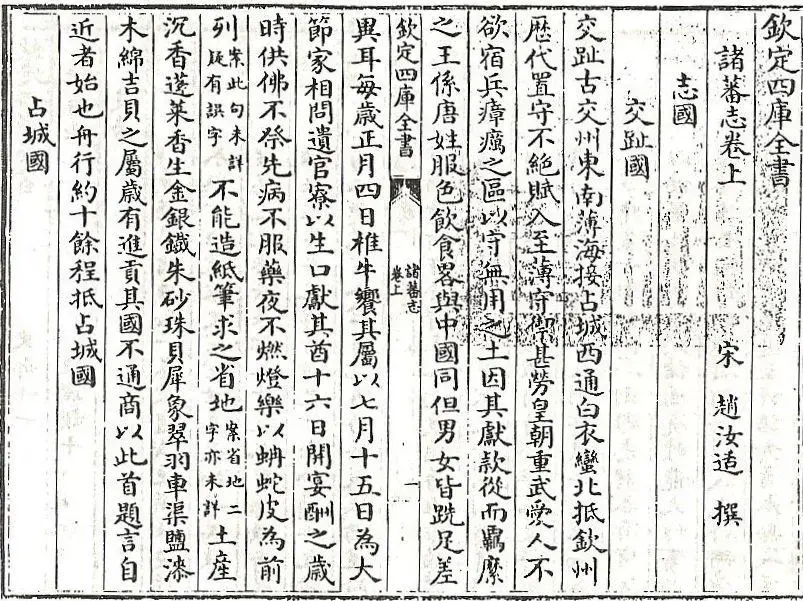
Zhao Rugua's supreme contribution to Chinese and world civilization was compiling Zhu Fan Zhi (Records of Foreign Peoples), the most comprehensive maritime geography produced during the Song Dynasty.
The work is organized into two meticulously structured volumes. Volume One, "Descriptions of Foreign Lands," delineates fifty-eight countries and kingdoms across the known maritime globe, encompassing Southeast Asian kingdoms such as Jiaozhi, Champa, Cambodia, Srivijaya, Java, Borneo, and Mait; South Asian realms like Chola and Ceylon; Middle Eastern metropolises like Baghdad and Cairo; and African polities including Zengji (Zanzibar) and Mulanpi (Morocco). Volume Two, "Descriptions of Foreign Commodities," surveys fifty-four varieties of luxury imports and botanical items, including frankincense, agalloch, black pepper, cloves, ambergris, ivory, rhinoceros horn, and cotton, detailing production techniques, cultivation, and pricing. Furthermore, the book delineates five primary transoceanic shipping routes linking Quanzhou to the South China Sea, the Indian Ocean, and the African coast, anticipating Marco Polo by more than seventy years and Wang Dayuan's Daoyi Zhilüe by more than a century.
Zhao Rugua was not merely an ivory-tower scholar, but a seasoned administrator who directed China's maritime frontier.
During his tenure overseeing the Fujian Maritime Trade Office and the Quanzhou prefecture, Zhao championed the economic principle that maritime trade generated public wealth while relieving the tax burdens of domestic agriculturalists. He institutionalized fair dock inspections, streamlined cargo tax evaluations, and cracked down on official corruption, providing comprehensive legal protection for foreign merchant communities. By establishing residential enclaves for overseas traders and respecting Islamic and Hindu dietary and burial traditions, he fostered a cosmopolitan atmosphere that established Quanzhou as one of the twin commercial capitals of maritime Asia alongside Guangzhou.
The empirical methodology and structural model established in Zhu Fan Zhi exerted a deep, lasting influence on Chinese geographical literature and modern global history.
The compilers of the Yuan-era History of Song adopted the core contents of Zhu Fan Zhi almost verbatim for the dynastic annals' "Treatise on Foreign Countries." Subsequent Ming maritime explorers and writers, including Ma Huan in Yingya Shenglan and Fei Xin in Xingcha Shenglan, consistently modeled their observational records on Zhao's template. In the eighteenth century, editors of the Siku Quanshu commended the work for its precision and factual reliability. In 1911, German Sinologist Friedrich Hirth and American scholar William Woodville Rockhill published an annotated English translation, generating international acclaim and establishing Zhu Fan Zhi as an indispensable primary source for the study of medieval Indian Ocean navigation and early Afro-Eurasian exchange.
FIGURES ASSOCIATED WITH THIS DYNASTY