Birth in Dunhuang
Born into the hereditary Zhang clan of Dunhuang, an eminent local lineage of Hexi.
799 CE–872 CE
张义潮
Zhang Yichao (张义潮, 799–872), also written as Zhang Yichao (张议潮), a native of Dunhuang in Shazhou (present-day Dunhuang, Gansu), was an illustrious military strategist, national hero, and the founder of the Guiyijun (Return to Righteousness Army) regime during the late Tang Dynasty. Born into a prominent aristocratic clan of Dunhuang, he witnessed the oppressive rule of the Tibetan Empire over the Hexi and Longyou regions…
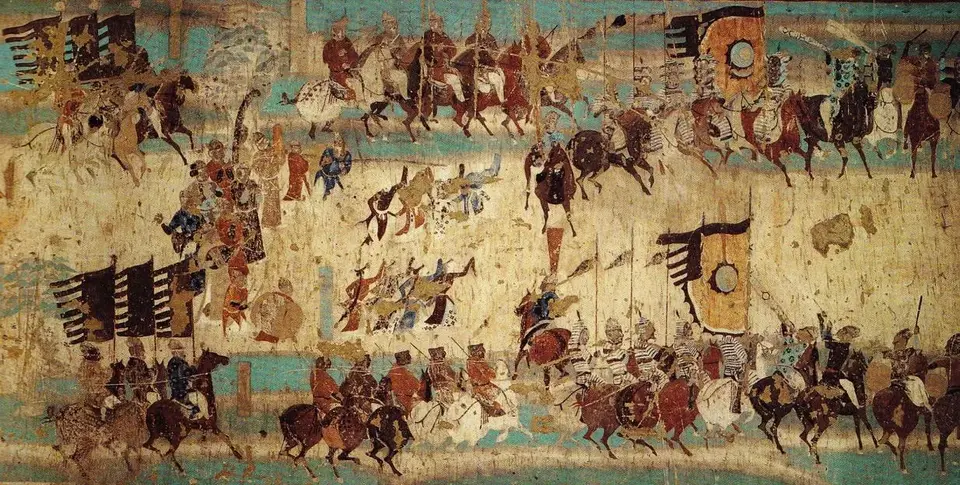
Zhang Yichao (张义潮, 799–872), also written as Zhang Yichao (张议潮), a native of Dunhuang in Shazhou (present-day Dunhuang, Gansu), was an illustrious military strategist, national hero, and the founder of the Guiyijun (Return to Righteousness Army) regime during the late Tang Dynasty. Born into a prominent aristocratic clan of Dunhuang, he witnessed the oppressive rule of the Tibetan Empire over the Hexi and Longyou regions during his youth and harbored an unwavering ambition to recover the lost imperial domains. In the second year of Dazhong (848) under Emperor Xuanzong, taking advantage of internal civil turmoil within the Tibetan regime, he united eminent local clans and Buddhist monastic leaders to launch an armed uprising in Shazhou, driving out the Tibetan garrison and assuming provisional leadership. Following this initial triumph, Zhang Yichao organized local militia, balanced agricultural reclamation with active warfare, and progressively recovered ten prefectures, including Gua, Yi, Xi, Gan, Su, Lan, Shan, He, Min, and Kuo. In the fifth year of Dazhong (851), he dispatched his elder brother Zhang Yitan to Chang'an to present the population registers and maps of the eleven recovered prefectures to the throne. Emperor Xuanzong formally established the Guiyijun Circuit at Shazhou, commissioning Zhang Yichao as its military commissioner. Over subsequent years, Zhang shattered incursions by the Tuyuhun and Nazhi Uyghurs, recaptured the paramount bastion of Liangzhou in 861, and reopened the long-severed Silk Road corridor. In 867, he traveled to Chang'an to serve as an imperial hostage in place of his deceased brother, being appointed Commander of the Right Shenwu Army and elevated to Minister of Works. He died in Chang'an in 872 and was posthumously honored as Grand Guardian. Cave 156 of the Mogao Caves preserves the famous mural Procession of Army Supervisor Zhang Yichao, commemorating his historic restoration of Hexi.
Born into the hereditary Zhang clan of Dunhuang, an eminent local lineage of Hexi.
Witnessed Tibetan oppression and hand-copied anonymous vernacular verses expressing sorrow over common misery and resolving to restore Tang rule.
Seized the opportunity of Tibetan internal strife to lead an uprising in Shazhou, routing the Tibetan garrison and liberating the city.
Sent Buddhist monk Wuzhen and secret envoys across northern deserts to deliver news of victory to Chang'an; appointed Defense Commissioner of Shazhou.
Sent his brother Zhang Yitan with maps and registers of eleven prefectures to Chang'an; Tang created Guiyijun and commissioned him as Military Commissioner.
Personally led elite cavalry to crush invading Tuyuhun and Nazhi Uyghur forces, securing the northern borders.
Dispatched nephew Zhang Huaishen at the head of seven thousand multiethnic troops on a protracted campaign against Liangzhou.
Stormed and recaptured the strategic fortress of Liangzhou, fully restoring all former territories of Hexi and Huanghuang.
Appointed concurrent Military Commissioner of Liangzhou by the imperial throne to supervise the central Hexi corridor.
Directed Uyghur chieftain Pugu Jun to crush remaining Tibetan hosts, beheading rebel leader Lun Kongre and sending his head to Chang'an.
Relocated to Chang'an following the death of his hostage brother; granted the rank of Commander of the Right Shenwu Army and Minister of Works.
Died of illness in his capital residence in the eighth month at age seventy-four; posthumously honored as Grand Guardian.
Zhang Yichao traced his lineage to the aristocratic Zhang clan of Dunhuang in Shazhou, originally rooted in Qinghe before migrating west during the Eastern Han Dynasty. For generations, the clan had supplied military commanders to Shazhou, standing as the preeminent gentry house in the western corridor. His father, Zhang Qianyi, had served as Governor of Shazhou under Tibetan rule and had intermarried with the influential Sogdian An clan, establishing extensive cross-cultural alliances that would prove vital to Zhang Yichao's future political and military endeavors.
Zhang Yichao grew to maturity under foreign Tibetan dominion. In the wake of the An Lushan Rebellion, Tang border defenses collapsed, enabling the Tibetan Empire to systematically overrun the Hexi and Longyou prefectures. Between 758 and 776, Kuo, Liang, Lan, and Gua prefectures fell in succession. In the second year of Zhenyuan (786), Shazhou succumbed after years of desperate resistance. Under foreign rule, local Chinese populations suffered severe hardships: able-bodied men were reduced to enslavement as farmhands and herdsmen, while the elderly and infirm were cast out or mutilated.
Having experienced these hardships firsthand, Zhang Yichao developed a profound veneration for loyal martyrs such as Feng Changqing, whose Memorial Upon Receiving Capital Punishment he painstakingly copied by hand. In the tenth year of Yuanhe (815), the seventeen-year-old youth transcribed a folk ballad depicting how grinding taxation and starvation ravaged the populace while military governors reveled in luxury. Chronicled on the Stele of Zhang Huaishen, Zhang practiced swordsmanship and military treatises from his youth, observing that the fortunes of the Tibetan kingdom were nearing exhaustion and secretly determining to lead his homeland back into the embrace of the Tang Empire.
To prepare for liberation, Zhang cultivated broad alliances across three vital constituencies: first, he united with leading local gentry houses such as the Suo, Zhang, and Li clans, which commanded extensive kinship networks; second, he forged strong ties with influential Buddhist monastics, including Eminent Monk Hongbian, who held high ecclesiastical titles under Tibetan administration but remained fervently loyal to Tang; third, he recruited valiant local leaders such as An Jing and Yan Yingda. Through their collective backing, Zhang built an underground resistance network across the oasis.
Entering the ninth century, the Tibetan Empire descended into rapid internal decline and recurrent dynastic crises. Between 841 and 846, catastrophic droughts and plagues devastated the Tibetan heartland. In the first year of Dazhong (847), Tang forces under Hedong Military Commissioner Wang Zai crushed the Tibetan commander Lun Kongre at Yanzhou. The following year, Fenghuang Military Commissioner Cui Gong recovered Yuanzhou, Weizhou, Fuzhou, and seven strategic mountain passes. These sweeping imperial victories inspired intense hope among the enslaved populations of Hexi.
In the second year of Dazhong (848), Zhang Yichao seized the moment of Tibetan internal warfare to launch an armed insurrection in Shazhou. Leading hundreds of armed followers, he stormed government compounds and drove out the Tibetan garrison. When neighboring Tibetan forces rallied to besiege the city, Zhang led his troops out in a spirited sally, routing the besiegers and firmly consolidating his hold over Shazhou. This uprising ignited a chain reaction across the steppes, provoking massive upheaval throughout the Tibetan domain. Tibetan warlords Lun Kongre and Shang Bibi fell into bloody civil warfare, destroying central Tibetan authority.
Immediately following the liberation of Shazhou, Zhang dispatched envoys to report the victory to Chang'an. Because Liangzhou remained occupied by hostile garrisons, the overland route was completely severed. Of the ten courier parties Zhang dispatched along secret tracks, only the group led by Buddhist master Wuzhen successfully skirted the northern deserts to reach the Tiande Army outpost in early 850. Emperor Xuanzong was deeply moved by their unyielding fidelity and promoted Zhang Yichao to Defense Commissioner of Shazhou.
Operating from his base at Shazhou, Zhang Yichao proclaimed himself Minister of War and systematically launched campaigns to liberate neighboring territories. Over the next several years, his forces recovered Gua, Yi, Xi, Gan, Su, Lan, Shan, He, Min, and Kuo prefectures.
In the eighth month of the fifth year of Dazhong (851), Zhang dispatched a second embassy to Chang'an, headed by his elder brother Zhang Yitan and twenty-nine prominent local delegates, carrying the maps and household registers of eleven recovered prefectures to present before the throne. With the exception of Liangzhou, the vast expanses of Hexi and Longyou that had been lost for nearly a century were once again reunited with the Tang Empire.
In the eleventh month, Emperor Xuanzong issued an edict creating the Guiyijun Circuit at Shazhou, encompassing eleven prefectures, and appointing Zhang Yichao as its Military Commissioner, concurrently honoring him as Acting Minister of Personnel, Senior General of the Jinwu Guard, and Duke of Nanyang Commandery. To demonstrate absolute fidelity, Zhang Yitan remained in the capital as an imperial hostage and was commissioned as Senior General of the Jinwu Guard.
With the recovery of western Hexi, surviving Tibetan forces concentrated their defenses at Liangzhou. As the historic administrative seat of Hexi since the Han and early Tang eras, Liangzhou anchored the eastern gateway to the Hexi Corridor. Recognizing that the liberation of the region would remain incomplete so long as Liangzhou remained in enemy hands, Zhang resolved to eliminate this foreign bulwark.
In the eighth month of the twelfth year of Dazhong (858), Zhang assigned his nephew Zhang Huaishen to lead an expeditionary force of seven thousand multiethnic troops eastward. Following three years of bitter combat, Guiyijun forces stormed Liangzhou in the second year of Xiantong (861). In 863, the imperial court reestablished the Liangzhou Military Commission, appointing Zhang Yichao to concurrently serve as its military commissioner. The vital Silk Road artery was thus completely restored, allowing commerce and official communication to flow unimpeded between Chang'an and Central Asia.
In the second month of the seventh year of Xiantong (866), Guiyijun allied forces under Uyghur chieftain Pugu Jun recovered Xizhou, Beiting, Luntai, and Qingzhen. Later that year, Pugu Jun crushed Tibetan remnants and slew the notorious rebel chieftain Lun Kongre, sending his severed head to Chang'an. The northern and western frontiers were thus entirely cleared of hostile forces.
In the second month of the eighth year of Xiantong (867), following the death of his brother Zhang Yitan in Chang'an, the sixty-nine-year-old Zhang Yichao traveled to the imperial capital to take his brother's place as hostage. Emperor Yizong received him with supreme honor, appointing him Commander of the Right Shenwu Army, conferring upon him a magnificent mansion in the Xuanyang Quarter, and promoting him to Minister of Works while permitting him to retain remote command over Hexi. Zhang entrusted the active administration of Guiyijun to his nephew Zhang Huaishen. In the eighth month of the thirteenth year of Xiantong (872), Zhang Yichao passed away peacefully in Chang'an at the age of seventy-four and was posthumously honored as Grand Guardian.
In the second year of Dazhong (848), Zhang Yichao launched an armed uprising in Shazhou, overthrowing foreign Tibetan dominance and driving out the garrison. When enemy reinforcements encircled the city, he personally directed a crushing counterattack that secured the oasis. This historic revolt ignited widespread resistance across the northwest, unraveling Tibetan rule and establishing the foundational base for the recovery of the entire Hexi region.
Transforming Shazhou into an impregnable strategic bastion, Zhang Yichao systematically liberated ten additional prefectures, culminating in the recovery of Gua, Yi, Xi, Gan, Su, Lan, Shan, He, Min, and Kuo. In 851, he dispatched an embassy to present the population registers and cartographic surveys of eleven prefectures to the throne, leading to the creation of Guiyijun. In 861, his forces stormed the key stronghold of Liangzhou, completing the total reclamation of the Hexi Corridor after more than a century of foreign occupation.
Zhang Yichao was a masterful tactician whose campaigns were celebrated in contemporary literature and official records. Between 856 and 857, he repulsed invading Tuyuhun raiders at Xitong, pursuing them over a thousand li, capturing three enemy prime ministers, and seizing thousands of livestock. Soon afterward, he crushed raiding Uyghur forces at Nazhi, encircling them within fifty li and securing vast spoils. In 866, his subordinate commanders eliminated the notorious Tibetan chieftain Lun Kongre, permanently removing the primary military menace to northwestern China.
Throughout his tenure in Hexi, Zhang Yichao thoroughly dismantled Tibetan tribal governance and reestablished classical Tang administrative systems. He restored the traditional four-tier hierarchy of prefecture, county, township, and neighborhood, establishing specialized rural administrators to oversee local governance. He instituted equitable land allocation programs, fostered wasteland reclamation, and restored extensive irrigation networks by assigning dedicated canal supervisors to manage water distribution, revitalizing the agricultural economy across the corridor.
In addition to his martial victories, Zhang Yichao championed the revival of Han culture, Confucian educational institutions, and Buddhist scholarship throughout Hexi. He promoted harmonious relations among diverse ethnic communities, integrating Han, Sogdian, Tibetan, and nomadic peoples under unified civil laws. Cave 156 of the Mogao Caves was excavated as his family merit grotto, containing the renowned mural Procession of Army Supervisor Zhang Yichao, a masterpiece of Tang art that captures the majestic pageantry of his military forces and serves as an invaluable visual record of late Tang material culture.
FIGURES ASSOCIATED WITH THIS DYNASTY