Birth in Jiangnan
Born into an illustrious cultural lineage in Suzhou, receiving refined education and studying the Jin brushwork tradition under his maternal cousin Lu Yanyuan.
张旭
Zhang Xu (张旭), styled Bogao (伯高), was a towering master calligrapher and court official of the Tang dynasty from Wuxian (modern Suzhou, Jiangsu Province). Serving successively as County Defender of Changshu, Adjutant of the Left Militant Guard, and Chief Administrator of the Crown Prince's Left Rate Office, he was widely known to contemporaries as "Chief Administrator Zhang" (Zhang Changshi). Highly eccentric and…
Zhang Xu (张旭), styled Bogao (伯高), was a towering master calligrapher and court official of the Tang dynasty from Wuxian (modern Suzhou, Jiangsu Province). Serving successively as County Defender of Changshu, Adjutant of the Left Militant Guard, and Chief Administrator of the Crown Prince's Left Rate Office, he was widely known to contemporaries as "Chief Administrator Zhang" (Zhang Changshi). Highly eccentric and passionately fond of wine, Zhang frequently bellowed and sprinted about after heavy drinking before seizing the brush to write; he even dipped his own hair into ink to produce wondrous scrolls, earning the affectionate sobriquet "Crazy Zhang" (Zhang Dian). Zhang revolutionized Chinese cursive script and was venerated by posterity as the "Sage of Cursive Script" (Caosheng), later paired with the Mid-Tang monk Huaisu as the monumental duo "Crazy Zhang and Drunken Su." During the reign of Emperor Wenzong, an imperial decree officially designated Zhang Xu's cursive calligraphy, Li Bai's poetry, and Pei Min's sword dance as the "Three Perfections" (Sanjue) of the Tang Empire. In addition to his transcendent wild cursive, Zhang possessed formidable mastery of regular script (kaishu), exemplified by the architectural precision of Langguan Shizhu Ji. Synthesizing natural rhythms with philosophical introspection, he profoundly influenced Yan Zhenqing and established an immortal aesthetic landmark in East Asian art history.
Born into an illustrious cultural lineage in Suzhou, receiving refined education and studying the Jin brushwork tradition under his maternal cousin Lu Yanyuan.
Appointed County Defender of Changshu, distinguishing himself through judicious legal rulings and astonishing the Jiangnan elite with his calligraphic flair.
Promoted to Chief Administrator of the Crown Prince's Left Rate Office, consorting with luminaries including Li Bai, He Zhizhang, and Bao Rong.
Inscribed the Langguan Shizhu Ji, whose architectural balance and bone-deep vigor established a peerless exemplar of Tang regular script.
Composed the Yan Ren Epitaph and subsequently the Wang Zhihuan Epitaph, demonstrating consummate classical restraint.
Retired to his private estate in Luoyang, where master Yan Zhenqing visited him repeatedly to study the inner mysteries of brush dynamics.
Penned the cursive manuscript of the Thousand Character Classic in Luoyang before passing away peacefully at approximately seventy-five years of age.
Zhang Xu was born into a distinguished aristocratic family in Wuxian, Suzhou, where literary scholarship and artistic cultivation had been cherished across generations. From an early age, Zhang demonstrated extraordinary intellectual gifts, immersing himself in ancient classics, dynastic histories, and antique rubbings. His family maintained close marital ties with the prominent calligraphic lineage of Lu Jianzhi and Lu Yanyuan. Under the personal instruction of his maternal cousin Lu Yanyuan, Zhang mastered the classical brush methods of the Two Wangs of the Eastern Jin, thoroughly internalizing traditional techniques of finger articulation, wrist maneuvering, and spatial configuration. This uncompromising orthodox training gave him the technical foundation necessary to later shatter conventions and invent wild cursive script.
Reaching adulthood, Zhang entered imperial service through official recommendation, receiving his first provincial assignment as County Defender of Changshu in the Jiangnan Circuit. In Changshu, Zhang fulfilled his magisterial duties with decisiveness and fairness. Outside official duties, he indulged his passion for wine and calligraphy. Local lore recounts that an elderly villager, deeply infatuated with Zhang's brushwork, deliberately initiated minor legal disputes solely to obtain official verdicts handwritten by Zhang to take home and treasure. When Zhang discovered the true motivation, he was touched rather than angered, and his fame rapidly spread across the Jiangnan region.
In the early Kaiyuan era, as the Tang Empire reached the zenith of its geopolitical and cultural glory, Emperor Xuanzong recruited foremost talents from across the empire into the capitals of Chang'an and Luoyang. Zhang was summoned to the metropolitan administration, serving successively as Adjutant of the Left Militant Guard and Chief Administrator of the Crown Prince's Left Rate Office, earning the customary title "Chief Administrator Zhang." In the twin capitals, Zhang formed deep bonds with cultural giants such as He Zhizhang, Li Bai, Pei Min, and Li Shizhi. Sharing an uninhibited temperament, they roamed the taverns of Chang'an singing and carousing, immortalized by Du Fu in his celebrated poem Song of the Eight Immortals of the Wine Cup: "Zhang Xu needs three cups to transmit the cursive sage; uncovering his head before princes, his brush flies over paper like cascading clouds."
During this metropolitan period, Zhang's cursive artistry reached its absolute zenith. Under the intoxicating influence of wine, he would shout, sprint about, and then unleash his brush upon paper or silk. His strokes surged forward like thunderbolts and coiling dragons; on occasion, he even plunged his own hair into ink to splash characters across the surface. Once sober, he would gaze upon the ink traces with awe, declaring that even in his sharpest waking consciousness he could never replicate such otherworldly miracles. Generations later, Emperor Wenzong formally issued an imperial decree designating Zhang Xu's cursive script, Li Bai's poetry, and General Pei Min's sword dance as the official "Three Perfections" (Sanjue) of the Tang Empire, permanently embedding Zhang's genius into the high cultural memory of the dynasty.
Zhang Xu's ability to transcend historical boundaries stemmed from his revolutionary aesthetic breakthrough: rather than merely copying ancient masters within the closed confines of ink and paper, he consciously sought inspiration from the living rhythms of the natural world and human society. Zhang later recounted that while observing a crowd of porters and pedestrians yielding way to one another on a congested Luoyang thoroughfare, he suddenly perceived the profound principles of mutual avoidance, interlocking balance, and rhythmic tension inherent in cursive composition.
On another occasion, listening to the swelling cadence of military horns and drums, Zhang apprehended the musical modulation of brushwork—how stroke pressure should alternate between rapid acceleration and majestic deceleration, heaviness and airiness. Most famously, while watching Madame Gongsun perform her breathtaking Sword Dance in Ye, Zhang was spellbound by her acrobatic grace, shifting tempos, and shimmering flashes of steel. He immediately translated the surging kinetic energy of the sword dance into the momentum of his brush, elevating his cursive artistry into a transcendent realm where art and cosmic forces converged.
Although celebrated for his tempestuous cursive, Zhang maintained an equally rigorous standard in orthodox regular script. In 741 (the twenty-ninth year of Kaiyuan), he inscribed the renowned Langguan Shizhu Ji (Record of the Officials of the Department of State Affairs on Stone Columns). Characterized by severe structural balance, bone-deep vigor, and serene internal harmony, this stone monument thoroughly refuted any misconception that Zhang was merely an unruly eccentric, earning enduring praise as a supreme model of Tang regular script. In subsequent years, he inscribed the Yan Ren Epitaph and Wang Zhihuan Epitaph, both exhibiting monumental poise and classical austerity derived from Zhong You and Lady Wei.
In the middle of the Tianbao era, advanced in age, Zhang retired from bureaucratic service to his Luoyang residence to concentrate on contemplation and pedagogical transmission. Yan Zhenqing, having temporarily stepped down from administrative duties, traveled to Luoyang specifically to sit at Zhang's feet. Recognizing Yan's integrity and artistic genius, Zhang unstintingly imparted the Twelve Principles of Brushwork and the inner lineage transmissions of the Two Wangs. Zhang also mentored other distinguished masters, including Wu Rong and Cui Miao. In the second year of Qianyuan (759), Zhang penned his final cursive manuscript of the Thousand Character Classic before passing away peacefully in Luoyang at the age of approximately seventy-five.
In the evolution of Chinese calligraphy, Zhang Xu achieved a monumental paradigm shift from the earlier traditions of draft cursive (zhangcao) and modern cursive (jincao) into the unfettered realm of wild cursive (kuangcao). Prior to Zhang, the Eastern Jin tradition pioneered by Wang Xizhi and Wang Xianzhi cultivated elegance, lyrical reserve, and strict structural boundaries between individual characters, epitomizing the aristocratic decorum of early medieval literati. Drawing upon the boundless energy and self-confidence of the High Tang, Zhang boldly shattered these formal confines.
In Zhang's wild cursive, the spatial demarcation between consecutive characters vanished. Multiple characters surged forth in a single continuous ribbon of ink; the terminating stroke of an upper character seamlessly birthed the beginning of the next. His lines exhibited breathtaking elasticity, sudden dramatic turns, and radical contrasts of void and solid space. The ink surface ceased to be a mere transcription of textual language, transforming instead into a direct kinetic expression of subjective human emotion and cosmic vitality. This breakthrough elevated wild cursive into the most abstract and expressive visual medium in traditional China, earning Zhang universal acclaim as the true "Sage of Cursive Script."
A fundamental pillar of Zhang Xu's historical genius was his complete synthesis of strict technical discipline with absolute artistic freedom. While lesser imitators fell into vulgarity and formlessness by blindly aping his uninhibited exterior, Zhang's wild cursive remained profoundly anchored in classical principles. Song dynasty polymath Huang Tingjian astutely observed: "One must comprehend the secrets of Zhang Xu's broken hairpin and leaking wall traces; yet when one inspects his Langguan Shizhu Ji, its solemn precision reveals that his wildest cursive was born entirely out of rigorous discipline."
The Langguan Shizhu Ji exemplifies deep stroke control, serene proportion, and fully concealed brush tips, reflecting Zhang's comprehensive mastery of Tang masters such as Ouyang Xun, Yu Shinan, and Chu Suiliang. Precisely because every dot, turn, and flick was executed with absolute anatomical precision, Zhang could unleash his brush at blinding speed during drunken ecstasies without ever descending into chaos. This union of iron law and wild spirit established the supreme aesthetic ideal of Chinese art: complete freedom attained through complete discipline.
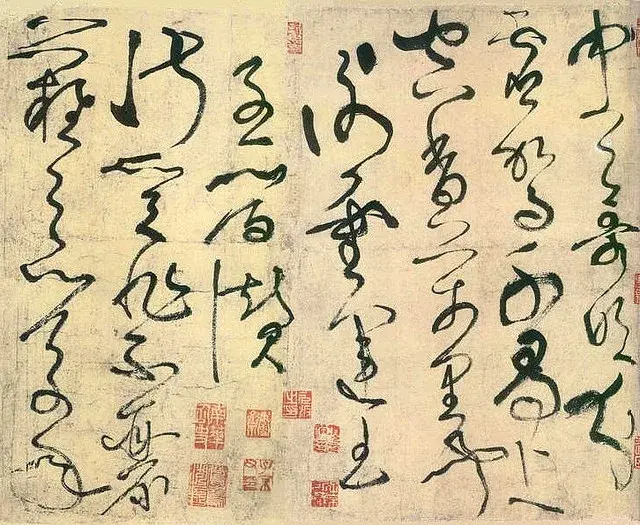
Among Zhang Xu's surviving cursive scrolls, Gushi Sitie (Four Ancient Poems Scroll) and Dutong Tie (Bellyache Letter) stand as twin summits of wild cursive art. Gushi Sitie, executed on five-color paper, comprises forty columns and one hundred and eighty-eight characters. The first two poems transcribe Yu Xin's Buxuci, while the latter two transcribe Xie Lingyun's poetic hymns. The brushwork surges forward like thunderbolts and tempests, weaving coiling dragons and flying phoenixes across the paper with uninterrupted kinetic momentum, universally hailed by Ming master Dong Qichang as the supreme cursive work of the Tang dynasty.
The Dutong Tie is a spontaneous letter of thirty characters across six lines, written while Zhang suffered sudden abdominal spasms. The initial three lines exhibit restrained structural control; beginning with the fourth line, the brushwork violently accelerates; by the fifth and sixth lines, intense physical agony and expressive energy merge into frantic, soaring strokes. This piece directly translated raw somatic sensation into visual dynamism without calculated artifice, establishing an unmatched milestone of authentic emotional calligraphy.
Beyond cursive masterpieces, Zhang Xu's monumental regular script has been corroborated by critical archaeological excavations. The Langguan Shizhu Ji, carved in 741 within the Department of State Affairs, records the official titles and rosters of central bureau directors. Inscribed in exquisite small regular script, its stone rubbings have been prized for centuries, with Zhao Mengfu praising its immaculate structural law as Zhang's pinnacle achievement in regular script.
Late twentieth-century excavations in the Mangshan necropolis of Luoyang unearthed the original stones of the Yan Ren Epitaph (742) and the Wang Zhihuan Epitaph (743). Both exhibits demonstrate austere dignity, pure lines, and resonant gravitas. These authenticated Tang artifacts confirmed that Zhang's regular script served as the vital technical bridge connecting the early courtly styles of Yu Shinan and Chu Suiliang to the monumental forms of Yan Zhenqing.
Zhang Xu drew inspiration not only from nature, but also from deep interactions with contemporary master artists. While in Luoyang, the Painting Sage Wu Daozi was painting monumental Buddhist murals in a temple and felt the composition lacked sweeping momentum. He invited Zhang Xu to write large banner calligraphy upon the wall. Zhang stripped off his outer robe and unleashed his brush, swirling ink across the plaster like a tempest.
Watching Zhang's thunderous brushwork, Wu Daozi experienced an overwhelming burst of artistic epiphany, immediately applying his pigments in dynamic harmony with Zhang's lines. The synchronized creation of these two masters drew throngs of spectators, hailed as an unparalleled spectacle of calligraphic and painterly unity.
During his retirement in Luoyang, Zhang Xu provided meticulous instruction to Yan Zhenqing, later recorded in detail in Yan's Record of Chief Administrator Zhang's Twelve Principles of Brushwork. Yan visited Zhang repeatedly; deeply impressed by Yan's earnest dedication, Zhang set out wine and unveiled the essential secrets of twelve dynamic principles: levelness, straightness, uniformity, density, sharpness, vigor, lightness, gravity, turning, folding, initiating, and concluding.
Zhang emphasized that true brush mastery lies in harboring dynamic wonder within classical rectitude, moving like an awl carving sand or a seal pressing clay, plunging forward like a diving falcon or soaring roc without hesitation or retouching. Yan Zhenqing internalized these revelations, harmonizing ancient lineage with monumental independence to create the immortal Yan style.
Zhang Xu functioned as the indispensable pivot in the transmission of orthodox Chinese brush methods. By the early eighth century, the imperial court's patronage of the Two Wangs had stiffened into rigid academic formulas. Zhang inherited the esoteric brush secrets of the Six Dynasties and generously passed them to younger contemporaries, sparking a massive renaissance across the calligraphy of the High and Mid-Tang.
During their extensive tutorials in Luoyang, Zhang guided Yan Zhenqing to internalize the techniques of "drawing in the sand with an awl" and "stamping seals into clay." Yan would subsequently forge these insights into his monumental "Yan Style" (Yanti), creating the majestic moral aesthetic that defined subsequent imperial orthodoxy. Furthermore, Zhang's expressive philosophy directly inspired the Mid-Tang monk Huaisu. Expanding upon Zhang's breakthroughs with his own distinctively wiry and round strokes, Huaisu formed the second half of the legendary duo "Crazy Zhang and Drunken Su," cementing wild cursive as an immortal pillar of world art.
At the philosophical level, Zhang Xu elevated traditional Daoist aesthetics to unprecedented heights of artistic practice. The philosophies of Laozi and Zhuangzi emphasized spontaneous resonance with nature (ziran), spiritual detachment, and freedom from artificial contrivance. Zhang internalized this Daoist ethos, cultivating a pure, unclouded interior beneath his boisterous exterior. Rather than regarding calligraphy as an administrative or courtly utility, he transformed it into a sacred conduit between the individual soul and cosmic transformation.
In Zhang's creative act, the ceaseless generative forces of the universe found immediate physical manifestation. He gathered the fury of tempests, the tranquility of mountain forests, and the swirling commotion of human assemblies into his heart, casting off social rank and courtly restraint to achieve the ecstatic liberation of selfhood. This profound synthesis of external nature with internal subjectivity not only elevated calligraphy to the supreme status among literati arts, but also provided the theoretical foundation for the later rise of Song dynasty literati painting and expressive aesthetics.
FIGURES ASSOCIATED WITH THIS DYNASTY