Seclusion in Mount Zhongtiao
Practiced internal alchemy and ascetic meditation across Hengzhou and the Zhongtiao Mountains; feigned death to evade summons by Wu Zetian.
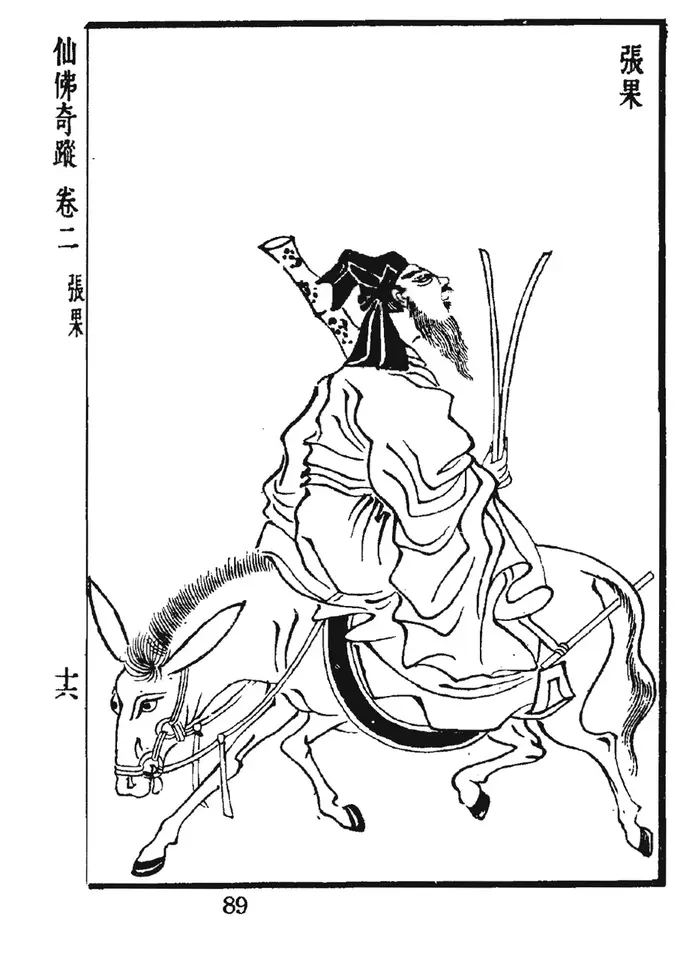
张果
Zhang Guo (dates of birth and death unrecorded, active late 7th to early 8th century), commonly known in vernacular tradition as Zhang Guolao, was a native of Guangzong, Xingzhou (present-day Guangzong, Hebei). He was an illustrious Tang Dynasty Daoist master, astrological theorist, and founding patriarch of Chinese natal astrology, widely revered as the eldest of the Daoist Eight Immortals. For decades, Zhang Guo lived as an…
Zhang Guo (dates of birth and death unrecorded, active late 7th to early 8th century), commonly known in vernacular tradition as Zhang Guolao, was a native of Guangzong, Xingzhou (present-day Guangzong, Hebei). He was an illustrious Tang Dynasty Daoist master, astrological theorist, and founding patriarch of Chinese natal astrology, widely revered as the eldest of the Daoist Eight Immortals. For decades, Zhang Guo lived as an ascetic recluse in the Zhongtiao Mountains of Hengzhou, roaming the Fen and Jin river basins while mastering esoteric techniques of breath circulation, internal alchemy, and astronomical harmonics. When Wu Zetian sent imperial couriers to summon him to Luoyang, Zhang Guo feigned death to preserve his mountain seclusion. In 733 CE (twenty-first year of Kaiyuan), Emperor Xuanzong dispatched Palace Attendant Pei Wu to escort him to the court in Chang'an, according him the exceptional privilege of entering the inner palace on a shoulder palanquin. Emperor Xuanzong interrogated Zhang Guo regarding governance, Daoist metaphysics, and longevity arts, conferring upon him the court rank of Grand Master for Closing Court alongside the honorific title "Master Tongxuan" (Master of Penetrating the Mysterious), and decreeing his appointment to the Academy of Scholarly Worthies. Astrologers revere Zhang Guo as the father of "Guolao Star Astrology," whose doctrines are preserved in dialogues with courtier Li Deng titled Questions and Answers of Li Deng, along with treatises including Nine Essential Heart-Seal Wondrous Scripture and Commentary on the Yellow Emperor's Hidden Talisman Classic. His system established an intricate astrological model based upon the Twenty-Eight Lunar Mansions and the Eleven Luminaries. Endowed with humorous wit, eccentric charm, and unbending detachment from secular power, Zhang Guo inspired enduring folk legends, including riding a white donkey backward, playing the Daoist fish drum, and testing Lu Ban's stone bridge at Zhaozhou. Declining Emperor Xuanzong's proposal of marriage to Princess Yuzhen, he soon petitioned to return to his mountain sanctuary, where the emperor ordered the construction of Qixia Monastery in his honor. Following his transcendence, he was canonized as an immortal patriarch, exerting an immense and lasting impact on Chinese Daoism, mantic arts, and folklore.
Practiced internal alchemy and ascetic meditation across Hengzhou and the Zhongtiao Mountains; feigned death to evade summons by Wu Zetian.
Emperor Xuanzong dispatched Pei Wu to escort him to the capital; entered the imperial palace on a shoulder palanquin to discuss statecraft and longevity.
Invested as Grand Master for Closing Court and granted the title Master Tongxuan; installed in the Academy of Scholarly Worthies to expound Daoist teachings.
Declined marriage to Princess Yuzhen and petitioned to return to the wilderness; Emperor Xuanzong decreed the construction of Qixia Monastery for his retreat.
Venerated as the patriarchal elder among the Eight Immortals; honored as the patron ancestor of Daoist musical narrative (Daoqing) and star astrology.
Zhang Guo was born during the transitional decades between the Sui and early Tang dynasties in Guangzong, Xingzhou. From his earliest youth, he immersed himself in Daoist classics, embracing Laozi's doctrines of stillness, non-action, and natural simplicity. Early in life, he severed worldly ambitions and retreated into the mountain wilderness. For decades, he secluded himself amidst the deep pine ridges of Mount Zhongtiao in Hengzhou, wandering between the Fen and Jin river valleys to master embryonic breathing, internal circulation, and astronomical calendars. Contemporary locals remarked that although he had lived through generations, his vitality remained robust, leading people to address him respectfully as "Old Master Zhang" (Zhang Guolao).
During the reign of Empress Wu Zetian, imperial interest in supernatural portents and longevity masters intensified. Having heard reports of Zhang Guo's profound cultivation and extraordinary age, Wu Zetian dispatched court envoys carrying imperial edicts to Hengzhou to summon him to the imperial capital. Possessing a serene disposition detached from political intrigue, Zhang Guo had no desire to enter the perilous atmosphere of the Wu Zhou court. When the imperial envoy arrived at his mountain hermitage and read aloud the decree, Zhang Guo collapsed onto the ground and ceased breathing, his body growing instantly rigid and cold. Terrified by his apparent death, the envoy returned to the capital to report the demise. Yet shortly afterward, woodcutters and scholars in Hengzhou repeatedly encountered Zhang Guo wandering freely through mountain glens, establishing his legendary reputation for eluding political entanglement through simulated death.
Following the advent of the Kaiyuan era, Emperor Xuanzong of Tang exhibited an intense devotion to Daoist learning, constructing Daoist temples across both capitals and seeking out recluses of spiritual attainment. In 733 CE (twenty-first year of Kaiyuan), learning that Zhang Guo was still residing in Mount Zhongtiao with growing spiritual renown, Emperor Xuanzong ordered Palace Attendant Pei Wu to travel post-haste to Hengzhou to invite him to court. When Pei Wu first arrived, Zhang Guo collapsed into death once again. Pei Wu burned incense and prostrated himself, recounting the emperor's earnest reverence, whereupon Zhang Guo slowly revived and consented to journey to the capital.
Emperor Xuanzong subsequently dispatched Imperial Diarist Xu Qiao with imperial letters of greeting to receive Zhang Guo on the road. In 734 CE, when Zhang Guo arrived at the Eastern Capital Luoyang, Emperor Xuanzong granted him unprecedented imperial honors, permitting him to ride a shoulder palanquin directly into the private palace halls. Upon receiving Zhang Guo, Emperor Xuanzong observed that although the master's beard and hair were sparse and white, his movements were light and his eyes gleamed with piercing clarity. Curious, the emperor inquired with a smile: "Sir, you are a master of the Dao; why then are your teeth missing and your hair so white, resembling a frail old man?"
Zhang Guo replied with playful wit: "Your servant attained the Dao at an advanced age, hence this withered countenance. If Your Majesty finds it unsightly, I had best discard them entirely!" With that, he plucked out his white sideburns and struck out his remaining teeth before the imperial throne, blood flowing freely. Shocked and alarmed, Emperor Xuanzong hastily commanded palace attendants to assist Zhang Guo to an adjoining chamber to rest. Yet moments later, Zhang Guo re-entered the hall with raven-black hair, youthful skin, and a full set of gleaming white teeth, astounding the emperor and assembled ministers.
Impressed by Zhang Guo's profound comprehension of celestial mysteries and Daoist philosophy, Emperor Xuanzong issued an imperial edict appointing him Grand Master for Closing Court and conferring upon him the honorific title "Master Tongxuan" (Master of Penetrating the Mysterious). Xuanzong repeatedly hosted banquets in the inner palace, seeking Zhang Guo's counsel on self-cultivation, state governance, and the preservation of vitality. Drawing upon the Daodejing, Zhang Guo urged the emperor to reduce taxation, minimize military campaigns, and nurture the populace with stillness, winning the emperor's deep assent.
To preserve and disseminate Zhang Guo's philosophical insights, Emperor Xuanzong installed him within the Academy of Scholarly Worthies, the supreme imperial institution of academic learning. During this period, prominent scholars, including the imperial astronomer-monk Yi Xing and Chancellor Yao Chong, consulted Zhang Guo regarding cosmological cycles. Within the academy, Zhang Guo systematically explicated his doctrines on astrology, internal alchemy, and classical Daoism. The historical compendium Questions and Answers of Li Deng records the extensive dialogues between courtier Li Deng and Zhang Guo regarding the mechanisms of stellar divination and human destiny.
As Emperor Xuanzong's affection for Zhang Guo deepened, the imperial house sought to bind the immortal master through marriage. Xuanzong privately proposed bestowing his younger sister Princess Yuzhen in marriage upon Zhang Guo. Upon learning of the proposal, Zhang Guo laughed heartily, exclaiming to his companions: "Taking a princess as a wife elevates one instantly into an imperial mansion! Others might find it a joy, but to me it is terrifying!" Tapping his Daoist fish drum and bamboo clappers, he sang satirical narrative ballads declining the match, reaffirming his unyielding determination to avoid mundane worldly entrapment.
After residing in the capital for several months, Zhang Guo submitted a memorial pleading to return to the solitude of Mount Zhongtiao, citing advanced age and weariness of urban clamor. Unable to persuade him to remain, Emperor Xuanzong granted his request, commanding local officials in Hengzhou to construct the splendid Qixia Monastery for his residence and endowing it with estates. Shortly after returning to his mountain retreat, Zhang Guo passed away serenely within a secluded cave. Xuanzong grieved deeply, ordering a memorial shrine erected at his dwelling, cementing his immortal stature in Chinese history.
Zhang Guo's paramount academic achievement was founding "Guolao Star Astrology" (Guolao Xingzong), the foundational school of classical Chinese natal horoscopy. Subsequent astrological traditions unanimously revere him as their ancestral master. According to imperial bibliographies and treatises preserved in the Ming Dynasty Tianyige library, Zhang Guo synthesized pre-Tang cosmological theories to construct a rigorous predictive methodology based on the "Twenty-Eight Lunar Mansions as the foundation and the Eleven Luminaries as the active agents."
In treatises such as Innate Mind-Dharma, Acquired Oral Instructions, and Treatise on Refining Gold, Zhang Guo posited that horoscopic analysis must examine the Primary Luminary (the ruling star of the ascendant degree) and the Body Star (the lunar degree). His astrological framework investigated human fortune across five primary dimensions: office, blessings, rank, wealth, and lifespan. He constructed an intricate interpretive model mapping the Seven Regulants (Sun, Moon, Five Planets) against the Four Transits (Ziqi, Yuebo, Luohou, and Jidu).
In Questions and Answers of Li Deng, Zhang Guo illustrated his methods with detailed analyses of historical figures, most notably the Early Tang genius Wang Bo. He calculated that Wang Bo's ascendant was in the Wing Mansion (ruled by Fire), while his career star Mercury rested in the Chariot Mansion, creating the configuration "Water Retreats Toward the Sun." Although the beneficent Ziqi transit in the Room Mansion granted extraordinary literary brilliance and fame, Mercury conflicted with his life star while his major decan reached the Well Mansion under severe transit collisions, leading to his fatal drowning at age twenty-nine. This theoretical system profoundly shaped later traditions, including Ziwei Doushu.
In Daoist theology and inner cultivation, Zhang Guo authored a substantial corpus of authoritative texts. He was an insightful interpreter of the Yellow Emperor's Hidden Talisman Classic (Huangdi Yinfu Jing), composing Commentary on the Yinfu Jing, Taiyuan Commentary on the Yinfu Jing, and Discourse on Fate in the Yinfu Jing, explicating the esoteric harmony between cosmic dynamics and human vital essence. In internal alchemy (Neidan), he composed the Nine Essential Heart-Seal Wondrous Scripture, Secrets of Breath, Scripture on Attaining Immortality Through Numinous Elixirs, Discourse on the Dao Body, and Song of the Dark Pearl.
Zhang Guo championed the dual cultivation of inner nature and vital force, rejecting the consumption of toxic mineral elixirs containing mercury and lead. He argued that true alchemy utilized internal qi as the medicine and mind as the crucible, returning to natural simplicity through breath regulation and meditative introspection. His Nine Essential Heart-Seal Wondrous Scripture detailed nine developmental stages from detachment from sensory phenomena to golden elixir crystallization, bridging Tang Twofold Mystery philosophy and Song-Yuan internal alchemy.
Beyond formal history and technical treatises, Zhang Guo occupies an iconic position in Chinese vernacular folklore. Through Song-Yuan operatic plays and the Ming novel Journey to the East, he became universally recognized as the venerable elder among the Eight Immortals. His signature posture of riding his white donkey backward became a cultural symbol of Daoist paradoxical wisdom—signifying looking backward at the follies of humanity while advancing forward, transcending conventional worldly pursuits.
Furthermore, folk performative arts revere Zhang Guolao as the patron deity of Daoist musical narrative (Daoqing). Following his rejection of imperial marriage, he traveled the country with a fish drum and bamboo clappers, chanting moral verses urging benevolence and mental tranquility. This tradition directly birthed regional ballad forms such as Shaanxi Daoqing, Yiwu Daoqing, Yangzhou Daoqing, and Hubei fish-drum chanting, embedding Zhang Guo's persona deeply within Chinese folk culture.
FIGURES ASSOCIATED WITH THIS DYNASTY