Birth in Kaifeng
Born in Xiangfu county into the family of Zhang Guoji, an impoverished scholar.
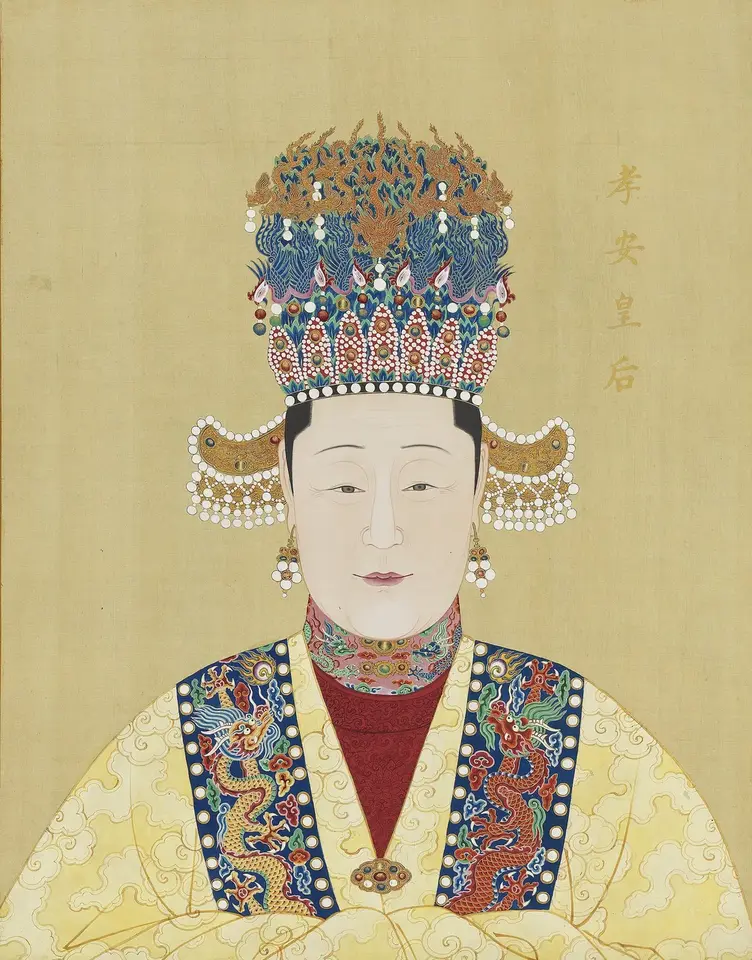
1607 CE–1644 CE
张嫣(明熹宗皇后)
Zhang Yan (张嫣), styled Zu'e and affectionately called Baozhu, was the principal empress consort of Emperor Xizong of Ming (the Tianqi Emperor, Zhu Youxiao), historically revered as Empress Yi'an (懿安皇后). In the first year of the Tianqi era (1621), she was chosen from thousands of candidates across the empire to be consecrated as Empress of the Ming Dynasty. Celebrated for her peerless grace and unwavering moral integrity,…
Zhang Yan (张嫣), styled Zu'e and affectionately called Baozhu, was the principal empress consort of Emperor Xizong of Ming (the Tianqi Emperor, Zhu Youxiao), historically revered as Empress Yi'an (懿安皇后). In the first year of the Tianqi era (1621), she was chosen from thousands of candidates across the empire to be consecrated as Empress of the Ming Dynasty. Celebrated for her peerless grace and unwavering moral integrity, Empress Zhang stood as a courageous defender of dynastic propriety in an era dominated by the notorious eunuch Wei Zhongxian and the imperial wet nurse Madame Ke. She repeatedly rebuked the eunuch faction, sheltered upright Confucian officials, and survived dangerous court conspiracies, including an engineered miscarriage in 1623 that deprived her of her only son, Crown Prince Zhu Ciran. In 1627, when the Tianqi Emperor fell terminally ill without surviving heirs, Empress Zhang firmly rejected Wei Zhongxian's plot to usurp the throne and persuaded the dying emperor to transmit the sovereign succession to his younger brother, the Prince of Xin (Emperor Sizong, Chongzhen). Chongzhen revered her as Empress Yi'an, providing her with the highest honors. In March 1644, when Li Zicheng's rebel army captured Beijing, Empress Zhang hanged herself in her palace to preserve her chastity and dynastic honor, passing away at age thirty-nine. She was later interred alongside the Tianqi Emperor in the Deling Mausoleum.
Born in Xiangfu county into the family of Zhang Guoji, an impoverished scholar.
Selected as the foremost candidate in a nationwide imperial selection and invested as Empress of the Ming Dynasty.
Targeted by Madame Ke and Wei Zhongxian; suffered an engineered miscarriage that killed Crown Prince Zhu Ciran.
Intervened on the Tianqi Emperor's deathbed, securing the throne for his brother Zhu Youjian and blocking eunuch usurpation.
Chongzhen eliminated the eunuch faction, honoring his sister-in-law as Empress Yi'an and installing her in the Ciqing Palace.
Hanged herself in the inner palace as rebel forces breached the capital; interred in the Deling Mausoleum.
Zhang Yan was born in 1606 in Xiangfu county, Henan province, the daughter of Zhang Guoji, an educated provincial scholar. Following the accession of the young Tianqi Emperor in 1620, the imperial court initiated a nationwide search to select a principal empress. Over five thousand young women from respectable families across the empire were brought to Beijing for an arduous multi-stage examination evaluating deportment, moral propriety, calligraphy, and physical elegance. Zhang Yan emerged as the preeminent candidate. On May 18, 1621 (the twenty-seventh day of the fourth lunar month), she was ceremoniously consecrated as Empress of the Ming Dynasty, and her father was ennobled as Count of Taikang.
Empress Zhang presided over the imperial palace during one of the most corrupt epochs of the late Ming dynasty. The Tianqi Emperor, absorbed in architectural craftsmanship, abdicated administrative governance to his favorite eunuch, Wei Zhongxian, and his former wet nurse, Madame Ke. Wei Zhongxian established a tyrannical eunuch regime, brutally purging Confucian scholars of the Donglin Academy, while Madame Ke terrorized the inner quarters.
Empress Zhang emerged as a steadfast moral sanctuary in the Forbidden City. She repeatedly admonished the emperor to dismiss flatterers and restore state governance. On one famous occasion, when the Tianqi Emperor visited the Kunning Palace and asked what she was reading, the empress replied: "I am reading the Biography of Zhao Gao," directly comparing Wei Zhongxian to the treacherous eunuch who subverted the Qin dynasty. She openly ordered her attendants to discipline Madame Ke for breaching court etiquette and refused to defer to Wei Zhongxian's demands, earning the implacable hatred of the eunuch clique.
In 1623, while Empress Zhang was pregnant, Madame Ke conspired with palace medical attendants during a massage to induce severe contractions, causing a miscarriage. The imperial heir, posthumously titled Crown Prince Huaichong, died in the womb, leaving Empress Zhang unable to bear further children. Subsequently, the eunuch faction fabricated treason charges against her father, Count Taikang, attempting to engineer her deposition, though ministerial resistance and the emperor's lingering respect for her averted the plot.
In the autumn of 1627, the twenty-three-year-old Tianqi Emperor became critically ill after falling into water in the Western Park. Lacking surviving heirs, the imperial succession faced a perilous crisis. Wei Zhongxian plotted to smuggle a pregnant woman from his clientage into the palace to claim a newborn child as the emperor's posthumous son, aiming to monopolize regency power indefinitely.
Empress Zhang acted with heroic resolution. Rushing to the emperor's deathbed, she tearfully pleaded: "The empire of our ancestors must not be handed to treacherous villains! Your younger brother, the Prince of Xin, is reverent, filial, and wise; he alone should succeed the throne!" The emperor accepted her counsel, summoning Prince Zhu Youjian to his bedside. Before the prince entered the palace, Empress Zhang secretly warned him: "Accept no food or drink prepared in the palace; bring dry cakes in your sleeves for sustenance!" This advice saved the prince from potential poisoning. On September 30, 1627, the Tianqi Emperor died, and Zhu Youjian ascended the throne as the Chongzhen Emperor.
Upon taking power, the Chongzhen Emperor dismantled the eunuch apparatus, executing Wei Zhongxian and Madame Ke. Indebted to his sister-in-law for preserving the dynasty, Chongzhen bestowed upon her the honorific Empress Yi'an, settled her in the serene Ciqing Palace, and accorded her imperial honors. Throughout Chongzhen's seventeen-year reign, Empress Zhang lived in quiet seclusion, detached from political interference.
On April 25, 1644 (the nineteenth day of the third lunar month of the seventeenth year of Chongzhen), the insurgent forces of Li Zicheng breached the gates of Beijing, and the Chongzhen Emperor hanged himself on Jingshan Hill. Prior to his demise, the emperor sent orders directing the palace women to sacrifice themselves to preserve their honor. Thirty-nine-year-old Empress Zhang dressed in full ceremonial robes, prostrated herself before the ancestral altar, and calmly hanged herself in her bedchamber. The rebel commanders, moved by her virtue, provided a proper coffin for her burial. In the first year of the Shunzhi era (1644), the Qing court interred her alongside the Tianqi Emperor in the subterranean chambers of the Deling Mausoleum in the Ming Tombs. The Southern Ming court later posthumously honored her with the grand title Empress Xiao'aizhe.
Through her courageous stance against Wei Zhongxian and Madame Ke, Empress Zhang provided vital moral support to reformist scholar-officials, standing as an enduring symbol of upright Confucian virtue within the decadent late Ming court.
Her intervention during the succession crisis of 1627 preserved the dynastic line, defeating the eunuch conspiracy and facilitating the smooth enthronement of the Chongzhen Emperor.
Her dignified suicide in 1644 exemplified the highest ideals of dynastic loyalty and personal chastity, establishing her as one of the most respected imperial consorts in traditional Chinese history.
In both late Ming and subsequent Qing historiography, Empress Zhang is celebrated as a peerless model of maternal dignity, political clarity, and noble martyrdom.
The History of Ming (Ming Shi) records: "The Empress was strict and upright, repeatedly confounding Ke and Wei with her wisdom before the Emperor. When Xizong was on his deathbed, the Empress forcefully advocated establishing the Prince of Xin. When Emperor Zhuanglie took the throne, he honored her as Empress Yi'an. In the third month of Jiashen, when the capital fell, the Empress hanged herself. In the first year of the Qing dynasty, she was buried with Xizong in the Deling Mausoleum."
The late Ming chronicler Ji Liuqi praised her in his Northern Briefs of the Ming Era: "Empress Yi'an was dignified and righteous, standing steadfast amid the chaos wrought by Wei and Ke. By determining the succession of the Prince of Xin, she secured the imperial altars, and her calm martyrdom commanded universal reverence across the realm."
Modern historians evaluate Empress Zhang as an exceptional historical figure whose decisive moral agency altered the political trajectory of the late Ming dynasty, providing a fleeting opportunity for administrative renewal under the Chongzhen Emperor.
FIGURES ASSOCIATED WITH THIS DYNASTY