Born | Chiting, Nan'an (west of present-day Longxi County, Gansu)
384 CE–394 CE
Emperor
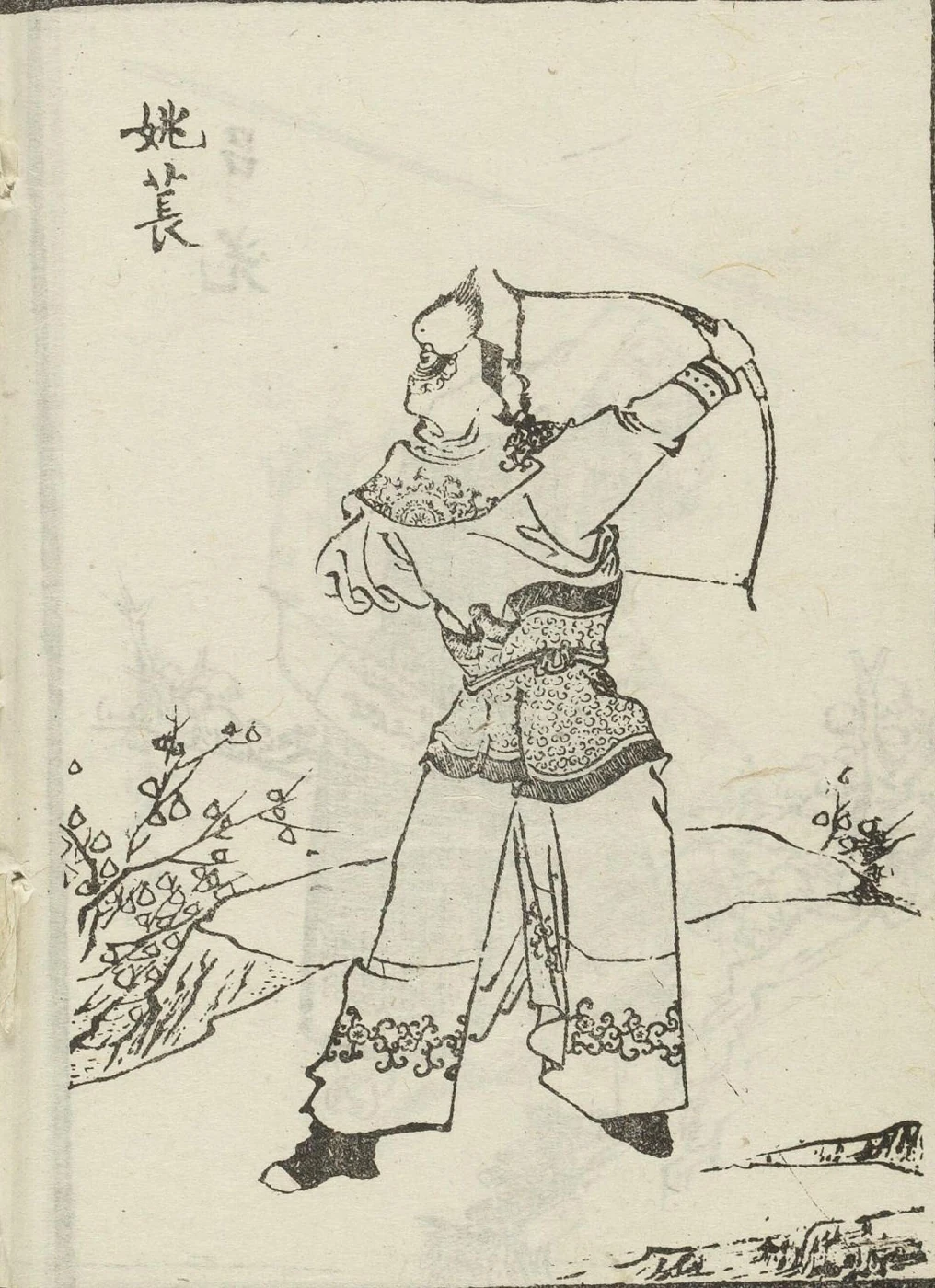
Yao Chang
姚苌
Yao Chang (331–394), courtesy name Jingmao, was a native of Chiting County in Nan'an Commandery (west of present-day Longxi County, Gansu) and a member of the Qiang people. He was the founding emperor of Later Qin, reigning from 386 to 394. His temple name was Taizu and his posthumous title was Emperor Wuzhao of Later Qin. He was the twenty-fourth son of the late Later Zhao Qiang chieftain Yao Yizhong, the younger brother of…
384 CE–394 CELater Qin
PROFILE
Yao Chang (331–394), courtesy name Jingmao, was a native of Chiting County in Nan'an Commandery (west of present-day Longxi County, Gansu) and a member of the Qiang people. He was the founding emperor of Later Qin, reigning from 386 to 394. His temple name was Taizu and his posthumous title was Emperor Wuzhao of Later Qin. He was the twenty-fourth son of the late Later Zhao Qiang chieftain Yao Yizhong, the younger brother of Yao Xiang, and the father of Yao Xing.
- Alternative Name
- Yao Jingmao
- Courtesy Name
- Jingmao
- Period
- Later Qin
- Date of Birth
- 331
- Date of Death
- 394
- Dynasty/Regime
- Later Qin
- Identity
- Emperor
- Ethnicity
- Qiang people
- Native Place
- Chiting County, Nan'an Commandery (west of present-day Longxi County, Gansu)
- Place of Birth
- Not recorded in historical sources
- Reign
- 386–394
- Predecessor
- Not applicable (founding emperor)
- Successor
- Emperor Wenhuan of Later Qin (Yao Xing)
- Era Name
- Nineteen, Twenty
- Temple Name
- Taizu
- Posthumous Title
- Emperor Wuzhao of Later Qin
- Major Achievements
- Qiang leader who founded Later Qin after the collapse of Former Qin, killed Fu Jian, and unified most of the Guanzhong-Longxi region
LIFE TIMELINE
Age twenty-two | His father Yao Yizhong died; campaigned with his elder brother Yao Xiang and gave Yao Xiang his horse to save him at the Battle of Matian
Age twenty-seven | Yao Xiang was killed at Sanyuan; Yao Chang led his followers in surrendering to Former Qin
Age twenty-seven | Fu Jian took power and appointed Yao Chang General Who Displays Martial Might
Age thirty-six | With Wang Meng, Yang An, and others attacked Jing Province of Eastern Jin and carried off more than ten thousand households from Anyang
Age thirty-seven | Followed Wang Meng against Lian Qi; former followers surrendered to him, helping secure victory; appointed governor of Longdong
Age forty-one | Followed Fu Ya and others against Yang Zuan of Chouchi and compelled his surrender
Age forty-three | Appointed governor of Ningzhou and stationed at Dianjiang
Age forty-four | Defeated by Eastern Jin forces and withdrew to Wucheng
Age forty-six | Participated in the conquest of Former Liang and, as vanguard, defeated Ma Jian
Age forty-eight | Led fifty thousand troops out of Nanxiang with Murong Chui and participated in the attack on Xiangyang
Age fifty-three | Fu Jian appointed him General of the Flying Dragon and commander of military affairs in Yi and Liang provinces; Former Qin suffered a major defeat at the Battle of the Fei River
Age fifty-four | Followed Fu Rui against Murong Hong; after Fu Rui ignored his advice and was killed in defeat, Yao fled in fear of punishment to Mamu north of the Wei River; Qiang notables acclaimed him leader, and he styled himself General-in-Chief, Grand Chanyu, and Prince of Qin for Ten Thousand Years, establishing the Baique era
Age fifty-five | Captured Xinping and buried surrendered troops alive; captured Fu Jian and had him strangled; defeated an attack by Gao Gai of Western Yan
Age fifty-six | After Western Yan withdrew eastward, advanced on Chang'an, proclaimed himself emperor, and changed the era name to Jianchu
Age fifty-eight | Faced Fu Deng at Chaona and Wuduchuan, with victories and defeats on both sides
Age fifty-nine | Launched a night raid on Dajie, heavily defeated Fu Deng, killed Empress Mao, and captured dozens of senior Former Qin commanders
Age sixty | Personally campaigned against Wei Jiefei, killed him in battle, and induced Lei Edi to surrender
Age sixty-one | Defeated Fu Deng east of Anding city
Age sixty-two | After recovering from illness, used a stratagem to frighten Fu Deng into retreat
Age sixty-three | Returned gravely ill to Chang'an in the tenth month and in the twelfth month summoned regents to entrust them with the heir
Age sixty-four | Died; received the posthumous title Emperor Wuzhao and temple name Taizu; his son Yao Xing concealed the death and announced it the following year
BIOGRAPHY
Biography
Family Background and Early Years
Yao Chang came from the Qiang Yao clan of Chiting in Nan'an. His father Yao Yizhong commanded the Qiang toward the end of Later Zhao, rose to the office of Grand Commander of the Western Qiang, was enfeoffed as Duke of Xiangping County, and had forty-two sons. Yao Chang was the twenty-fourth son and bore the courtesy name Jingmao.
The Book of Jin, in the “Record of Yao Chang,” says that he was “intelligent and discerning from youth, rich in stratagems, broad-minded and spontaneous, inattentive to conventional cultivation; all his elder brothers thought him extraordinary.” Yao was intelligent and quick-witted from childhood, good at strategy, open and unconstrained, and unconcerned with minor conventions. Although he did not emphasize moral self-cultivation, his brothers all regarded him as exceptional. Yao Xiang once dreamed that Yao Chang wore the imperial dragon robe and mounted the throne while tribal leaders stood respectfully in attendance. On waking, he told his officers that the boy's ambitions and bearing were unusual and that he might one day greatly raise their clan.
Campaigning with Yao Xiang and Surrender to Former Qin
Yao Chang followed Yao Xiang in campaigns and frequently participated in military planning. In 352, the eighth year of the Yonghe era, Yao Yizhong died. Yao Xiang concealed the death and led sixty thousand households southward against Yangping, Yuancheng, Fagan, and other places. In fighting with Former Qin, the Yao regime lost more than thirty thousand households. At the Battle of Matian, Yao Xiang's horse was shot dead by Qin troops. Yao Chang gave him his own mount, saying that so long as his elder brother escaped, the enemy would not dare harm him. Relief troops arrived and the two brothers survived.
In the fifth month of 357, the first year of the Shengping era, Yao Xiang attempted to take Guanzhong and fought Former Qin generals Fu Huangmei and Deng Qiang at Sanyuan. Deng feigned defeat and lured Yao Xiang into pursuit. At Sanyuan, the Qin cavalry turned and counterattacked, defeating and killing him. Yao Chang led his younger brothers and followers in surrendering to Former Qin. The same year, Fu Jian overthrew Fu Sheng in a coup, took the title Heavenly King, and appointed Yao General Who Displays Martial Might.
As a Former Qin General
Yao repeatedly distinguished himself while serving Former Qin. In 366, the second year of the Jianyuan era, he joined General Who Supports the State Wang Meng and Former General Yang An with twenty thousand troops in attacking Jing Province of Eastern Jin. They attacked Nanxiang Commandery and carried off more than ten thousand households from Anyang. In 367, he followed Wang Meng against the rebel Qiang leader Lian Qi. Lian Qi's people had formerly served under Yao Yizhong and surrendered in large numbers when Yao Chang arrived, allowing Former Qin to take Lüeyang. Yao was afterward appointed governor of Longdong.
In 371, the seventh year of the Jianyuan era, Yao followed Fu Ya, Yang An, Wang Tong, and others with seventy thousand infantry and cavalry against Yang Zuan, Duke of Chouchi, and compelled his surrender. In 373, the ninth year of the Jianyuan era, after Former Qin took Yi and Liang provinces from Eastern Jin, Yao became governor of Ningzhou and was stationed at Dianjiang. In the fifth month of the following year, Eastern Jin governor Zhu Yao of Yizhou and General Who Spreads Awe Afar Huan Shiqian defeated him with thirty thousand troops, forcing him to withdraw to Wucheng. He later became Commandant of Infantry and was enfeoffed as Marquis of Yidu.
In 376, the twelfth year of the Jianyuan era, Fu Jian launched a major campaign against Former Liang. Yao, Liang Xi, Wang Tong, Li Bian, and others crossed Qingshijin and defeated Former Liang's General of Fierce Valor Liang Ji. Gou Chang placed Yao in the vanguard with three thousand armored troops against Ma Jian, who came with ten thousand men to surrender. Former Liang was destroyed. In 378, the fourteenth year of the Jianyuan era, when Fu Jian launched a major attack on Xiangyang in Eastern Jin, Yao and Murong Chui led fifty thousand troops out of Nanxiang.
In 383, the nineteenth year of the Jianyuan era, Fu Jian ordered a massive southern campaign against Eastern Jin. Most officials opposed it, but Murong Chui, Yao Chang, and young men from prominent families supported the plan. Fu Rong warned Fu Jian that the Xianbei and Qiang were enemies who were waiting for disorder to fulfill their own ambitions and that their advice should not be trusted. Fu Jian ignored him. In the eighth month Fu Jian appointed Yao General of the Flying Dragon and commander of military affairs in Yi and Liang provinces, telling him that this was the title with which Fu Jian himself had risen and that he had never lightly granted it to another. Left General Dou Chong immediately remarked that a ruler's words were not to be spoken in jest and that this was an ominous sign. Fu Jian fell silent. In the eleventh month, Former Qin suffered a disastrous defeat at the Battle of the Fei River and its power sharply declined.
Founding Later Qin
In the first month of 384, the twentieth year of the Jianyuan era, Murong Chui rebelled in Hebei and established Later Yan. In the third month, Murong Chui's nephew Murong Hong raised several thousand Xianbei followers east of the passes and camped at Huayin, styling himself Commander of Military Affairs of Shaanxi, General-in-Chief, Governor of Yongzhou, and Prince of Jibei. Fu Jian ordered Fu Rui, Duke of Julu, to command fifty thousand troops against him, with Yao Chang serving as adjutant.
When Murong Hong heard that the army was approaching, he wished to lead his people eastward out of the passes. Fu Rui rashly underestimated him and insisted on pursuit. Yao advised that the Xianbei had risen because they longed to return east and should be driven out rather than blocked; even a trapped mouse, he warned, could turn and bite. If they knew themselves cornered, they would fight to the death, and a single defeat would bring irreparable regret. It would be enough simply to beat the drums and follow them, since they would be too busy fleeing to resist. Fu Rui refused to listen and was defeated and killed fighting Murong Hong at Huaze.
Yao sent his chief secretary Zhao Du and staff officer Jiang Xie to Fu Jian to confess fault. Fu Jian was furious and killed both men. Terrified, Yao fled to Mamu north of the Wei River. Qiang notables Yin Wei and Yin Xiang of Tianshui, Pang Yan of Nan'an, and others then gathered more than fifty thousand households and submitted to Yao, acclaiming him as their leader. Yao styled himself General-in-Chief, Grand Chanyu, and Prince of Qin for Ten Thousand Years, declared a general amnesty, established the Baique era, and founded Later Qin. Yin Xiang and Pang Yan became left and right chief secretaries; Yao Huang and Yin Wei became left and right adjutants; Di Bozhi and others were appointed attendant gentlemen; Wang Ju and others became staff officers; and Wang Qinlu, Yao Fangcheng, and others became commanders.
Killing Fu Jian and Proclaiming Himself Emperor in Chang'an
Yao advanced to Beidi, and more than one hundred thousand Qiang and non-Han households from Huayin, Beidi, Xinping, and Anding submitted to him. Fu Jian personally led troops against him. Yao was repeatedly defeated and his water supply was cut off. Some men died of thirst and morale collapsed, but heavy rain suddenly fell and water accumulated three feet deep in the camp, restoring confidence. Yao counterattacked and captured Former Qin generals Yang Bi, Xu Cheng, Mao Sheng, and dozens of others, treating them courteously and sending them back.
Western Yan forces under Murong Hong, and later Murong Chong, approached Chang'an, forcing Fu Jian to return to defend it. Yao's ministers proposed entering the contest for the capital, but Yao judged that the Murong forces would not remain long in Guanzhong and would eventually return east to Hebei. He therefore stationed north of Jiuzong Mountain in the Lingbei region to accumulate strength, intending to take Chang'an after Former Qin collapsed and Western Yan withdrew.
Yao attacked Xinping Commandery (present-day Bin County, Shaanxi), whose defender Gou Fu resisted stubbornly. Gou feigned surrender to lure Yao into the city. Yao detected the deception before entering but nevertheless suffered an ambush that cost more than ten thousand men. In the first month of 385, the second year of the Baique era, Yao left troops to continue the siege while personally attacking Anding. He captured Former Qin General Who Pacifies the West Fu Zhen, and the cities north of the ridges submitted one after another. In the fourth month, with supplies exhausted and outside aid cut off, Gou Fu came out with five thousand men to surrender. Yao ordered all of the surrendered soldiers buried alive.
In the fifth month Fu Jian left Chang'an and camped at Wujian Mountain. In the seventh month Yao's officer Wu Zhong captured Fu Jian and sent him to Xinping. In the eighth month Yao demanded the imperial seal. Fu Jian refused and insulted him, so Yao had Fu Jian strangled at a Buddhist monastery in Xinping, identified in the source with present-day Jingguang Temple south of Bin County. To disguise the act of regicide, Yao posthumously titled Fu Jian “Heavenly King Zhuanglie.”
In the tenth month of the second year of Baique, Western Yan ruler Murong Chong, then holding Chang'an, sent Gao Gai against Yao but was defeated by Later Qin. In 386, the third year of Baique, Western Yan was repeatedly torn by internal conflict and abandoned Chang'an to move east. Hao Nu of the Lushuihu took advantage of the vacuum, occupied Chang'an, proclaimed himself emperor, and sent his younger brother Hao Duo to attack Wang Lin at Mawei. Yao advanced east from Anding, drove Wang Lin away, captured Hao Duo, and attacked Chang'an. Hao Nu, frightened, submitted. In the fifth month Yao proclaimed himself emperor, changed the era name to Jianchu, and called the state Great Qin. Soon afterward he defeated Wang Tong, Former Qin governor of Qinzhou, and seized Qinzhou.
Prolonged War with Fu Deng
In the same year that Yao proclaimed himself emperor, Fu Deng, a member of the Former Qin imperial clan, was raised by surviving Di forces in Guanzhong to resist Later Qin and later became emperor after the death of Fu Pi. Fu Deng was initially strong. He heavily defeated Yao Shuode at Jingyang, forcing Yao Chang to come personally to the relief. Thereafter the two sides fought back and forth across Guanzhong.
In 388, the third year of Jianchu, Yao held Chaona while Fu Deng occupied Wuduchuan in Anding Commandery. Their prolonged confrontation brought victories and defeats to both sides. Because Later Qin had not yet firmly secured Guanzhong, many western heroes went over to Former Qin; only Qi Nan, Xu Luosheng, Liu Guodan, and others remained loyal to Later Qin.
In 389, the fourth year of Jianchu, after repeated defeats by Fu Deng, Yao changed strategy. He refused a pitched battle and led thirty thousand picked troops in a night attack on Fu Deng's rear base at Dajie. He captured it, killed Fu Deng's wife Empress Mao and several commanders, and took dozens of senior Former Qin generals alive. Fu Deng was severely weakened and withdrew to Hukong Fort. Yao then arranged for Ren Pen to feign surrender in an attempt to lure Fu Deng to his death. Lei Edi exposed the ruse, but Fu Deng became suspicious of Lei as a result and eventually drove him into surrendering to Yao.
In 390, the fifth year of Jianchu, Wei Jiefei attacked Later Qin and Lei Edi rebelled to join him. Considering Lei unusually intelligent and strategic, Yao personally led an army against them. Seeing Yao's force was small, Wei attacked with his entire army. Yao feigned weakness and refused battle, sent Yao Chong to strike the enemy rear, and then attacked frontally, routing the enemy and killing Wei Jiefei in battle. Lei Edi surrendered again. Yao treated him as before, and Lei thereafter became sincerely loyal.
The same year, Qiang Jinchui, Former Qin governor of Yanzhou, feigned surrender. Yao, unafraid of treachery, went to his camp with only a few hundred cavalry. His frankness won Qiang's trust and persuaded him to reject plots by other Di groups to kill Yao.
In the twelfth month of 391, the sixth year of Jianchu, Fu Deng attacked Anding and Yao defeated him east of the city. In the third month of 392, Former Qin commander Moyigan surrendered. Soon afterward Yao fell ill and Fu Deng seized the opportunity to attack Anding. By the eighth month Yao had recovered and personally led resistance. When Fu Deng left his camp to engage him, Yao ordered Yao Xilong to raid the Former Qin encampment, frightening Fu Deng into retreat. Yao also sent troops out on a flank to trail him. When Fu Deng later saw the Later Qin camp empty and no sign of Yao's army, he became still more alarmed and retreated in defeat to Yongcheng.
Later Years and Death
In the tenth month of 393, the eighth year of Jianchu, Yao returned to Chang'an gravely ill. In the twelfth month he summoned Defender-in-chief Yao Min, Vice Director Yin Wei, Yao Huang, General Yao Damu, and Master of Writing Di Bozhi and entrusted them with a testamentary order to assist Crown Prince Yao Xing. Yao died in 394, the ninth year of Jianchu, aged sixty-four. Yao Xing concealed his death and did not announce it until the following year, conferring the posthumous title Emperor Wuzhao and temple name Taizu.
According to the Book of Jin, while gravely ill Yao dreamed that Fu Jian entered the camp with heavenly envoys and several hundred ghost soldiers. Soldiers who came to Yao's rescue accidentally wounded him in the genitals, causing unceasing bleeding. On waking, his genitals were swollen; when a physician lanced the swelling, blood flowed just as in the dream. Terrified and delirious, Yao begged Fu Jian for forgiveness and soon died of the injury, repeatedly kneeling and knocking his head against the bed before death. Although supernatural in tone, the account reflects the moral judgment contemporaries associated with Yao's killing of his former ruler.
His Family, Early Years, and Campaigns with His Brother
Yao Chang, courtesy name Jingmao, was a Qiang whose ancestral home was Chiting county in Nan'an, the twenty-fourth son of Yao Yizhong, later Emperor Jingyuan, the younger brother of Yao Xiang, later prince Wu of Wei, and the father of Yao Xing, later Emperor Wenhuan. By the records of the chieftains in the History of Jin he was "from youth intelligent and shrewd, full of stratagems, open and unconstrained, careless of his conduct, and his elder brothers all thought him extraordinary." Following Yao Xiang on campaign he took part in the great plans of the army; and Yao Xiang once dreamed that Yao Chang wore the imperial dragon robe and mounted the throne while the tribal chiefs stood in attendance, and waking he told his officers that such a dream of this boy, whose ambition and measure were not ordinary, might mean that he would greatly raise their clan. When Yao Yizhong died, Yao Xiang kept his death secret and led sixty thousand households south against Yangping, Yuancheng and Fagan, taking them all, and camped at the Qiao'ao ferry, with Wang Liang of Taiyuan as senior secretary, Yin Chi of Tianshui as master of horse, Fu Zicheng of Lüeyang as commander of the left, Lian Qi of Nan'an of the right, Hei Na of Lüeyang of the van, Qiang Bai of the rear, and Xue Zan of Taiyuan and Quan Yi of Lüeyang as military advisers; and only reaching Xingyang did he go into mourning and put on the mourning dress. In the battle at Matian against Gao Chang and Li Li, Yao Xiang's horse was killed by a stray arrow and he escaped only through his brother: Yao Chang gave him his own horse, and Yao Xiang asking how he would save himself, Yao Chang answered that so long as his brother got away the wretches would not dare to harm him; and the relief coming, both were saved. Yao Xiang then led his people over to the Jin and sent his five younger brothers as hostages.
The Death of Yao Xiang, His Submission to Qin, and His Service to the Former Qin
In the fifth month of the first year of Shengping, 357, the Qin troops pressed up to the gate of his rampart and formed their line; and Yao Xiang in a rage led out his whole force, whereupon the Qin feigned defeat and fled, and Yao Xiang pursuing them to Sanyuan, the Qin wheeled about and, Huangmei and the rest coming up with the main body, Yao Xiang's army was heavily defeated; and his fine horse, named the black-browed piebald, falling, he was taken by the Qin and beheaded, and his brother Yao Chang led his people over to the Former Qin. After this, on Fu Jian's accession, Yao Chang was made general of the fierce warriors, and he led the armies of the Former Qin on many campaigns with great merit, serving successively as colonel of foot, governor of Longdong and inspector of Ningzhou, and rising to general of the dragon charger. He raided Jingzhou with Wang Meng, attacking Nanxiang commandery and carrying off more than ten thousand households of Anyang; and he subdued Lian Qi, whose people had formerly been Yao Yizhong's subordinates and who, hearing that Yao Chang had come, surrendered to him in a body, so that Wang Meng took Lüeyang and Lian Qi fled defeated to Baima. In the Jianyuan period, when the Former Qin attacked the Former Liang, Fu Jian decreed that the guard general Gou Chang, the general of the left Mao Sheng, the president of the secretariat Liang Xi and the colonel of foot Yao Chang should lead troops to the western river; and in the eighth month Liang Xi, Yao Chang, Wang Tong and Li Bian crossed at Qingshi ferry and attacked the Liang general Liang Ji at Hehui city and brought him over, after which Gou Chang sent Yao Chang with three thousand armored men as the van and Ma Jian came over with ten thousand. Afterwards, when the Former Qin attacked Xiangyang in force, Murong Chui, governor of the capital region, and Yao Chang, general of the fierce warriors, led fifty thousand out of Nanxiang. In the seventh month of the nineteenth year of Jianyuan, 383, Fu Jian decreed the great invasion of the Eastern Jin, one soldier for every ten able-bodied men, and all sons of good families under twenty with strength and courage were made guards of the feathered forest; and when the ministers were all unwilling that Fu Jian should go in person, only Murong Chui, Yao Chang and the sons of good families urged him, while the duke of Yangping, Fu Rong, remonstrated that the Xianbei and the Qiang barbarians were their enemies and ever hoped for a change in the wind and dust to work their will, so that their plans were not to be followed. Fu Jian would not hear it. In the eighth month he sent Fu Rong with Zhang Hao and Murong Chui and two hundred and fifty thousand foot and horse as the van, and made Yao Chang, inspector of Yanzhou, general of the dragon charger with command of the military affairs of Yi and Liangzhou, telling him that he himself had built his enterprise in that rank and had never lightly given it to another, and that Yao Chang should exert himself; whereupon the general of the left Dou Chong said that a king does not speak in jest and that this was an ill omen, and Fu Jian was silent.
His Rebellion against Qin
After the defeat at the Fei river, Fu Jian told Quan Yi that he had not used his advice and had let the Xianbei come to this, that he would no longer contend for the lands east of the pass, and asked what was to be done about Murong Hong; and he made Fu Xi, duke of Guangping, inspector of Yongzhou, holding Puban, and summoned the duke of Julu, Fu Rui, to be commander-in-chief of all military affairs with fifty thousand men, taking Dou Chong as senior secretary and Yao Chang, general of the dragon charger, as master of horse to attack Murong Hong. Murong Hong, hearing that the Qin army was coming, was afraid and meant to flee east of the pass to Murong Chui; and Fu Rui, rough and rash and contemptuous of the enemy, wished to send his horse to intercept him, but Yao Chang remonstrated, saying that the Xianbei all had the will to return home and had therefore risen in rebellion, so that they should be driven out of the pass and not stopped, for even a rat seized by the tail can bite, and if they knew themselves cornered they would fight to the death, and that to follow them with drums would leave them no leisure but to flee. Fu Rui would not follow him, and fighting at Huaze he was defeated and killed by Murong Hong. Yao Chang sent his senior secretary Zhao Du and his military adviser Jiang Xie to Fu Jian to apologise for the fault, and Fu Jian in anger killed them; and Yao Chang in fear fled to the horse pastures north of the Wei. Thereupon Yin Wei and Yin Xiang of Tianshui and Nan Pangyan and others stirred up the Qiang chiefs, and five hundred thousand households came over to Yao Chang, who was made their leader; and he styled himself general-in-chief, great shanyu and prince of Wannian of Qin, proclaimed a general amnesty, changed the era name to Baique, and made Yin Xiang and Pang Yan his senior secretaries of left and right, Yao Huang of Nan'an and Yin Wei masters of horse of left and right, Di Bozhi of Tianshui and others masters of the interior, and Wang Qinlu, Yao Fangcheng and others his commanders. Advancing to camp at Beidi, the Qiang and Hu of Huayin, Beidi, Xinping and Anding surrendered to him more than a hundred thousand, and his following grew to that number.
The Struggle for Guanzhong, the Massacre at Xinping, and the Killing of Fu Jian
In the sixth month of the twentieth year of Jianyuan, 384, Fu Jian led twenty thousand foot and horse in person against Yao Chang, sending the guard general Yang Bi and others by several roads, and the Later Qin troops were beaten again and again; and worse, their camp had no wells and the Qin stopped the waters of the Angong valley and dammed the Tongguan river, so that the soldiers were terrified and some died of thirst. When the Later Qin was at its last gasp a great rain fell, and the water in their camp stood three feet deep while beyond a hundred paces from it the ground was wet but an inch, so that their spirit revived; and Fu Jian, hearing of it, sighed and asked whether heaven too was helping the rebels. In the tenth month of that year Yao Chang, hearing that the Western Yan was attacking Chang'an, called his officers to consider what to do, and they all said he should take Chang'an before the Western Yan and establish his base there; but Yao Chang said it should not be so, for the men of Yan had risen because their people wished to go home and would not long remain in Guanzhong, and that he should move his camp north of the mountains, gather stores widely, and wait until Qin perished and Yan departed, and then take Chang'an with hands folded. He therefore left his eldest son Yao Xing to hold Beidi and the general Yao Mu to hold the Tongguan river, and led his own troops against Xinping. The governor of Xinping, Gou Fu of Nan'an, was inclined to surrender, but the men of the commandery, Feng Jie, Feng Yu, Zhao Yi and Feng Miao, remonstrated that Tian Dan had once preserved Qi with a single city and that the Qin still had more than a hundred linked cities, asking how he could so soon become a rebel; and Gou Fu, rejoicing, held the city obstinately. The Later Qin built earthworks and tunnels and Gou Fu did the same within, fighting now below ground and now on the hill, and more than ten thousand of the Later Qin were killed; and Gou Fu feigned surrender to lure Yao Chang, who, coming to the city and perceiving the trick, hurried away, whereupon Gou Fu attacked him and nearly took him, killing more than ten thousand more. Only in the fourth month of the twenty-first year of Jianyuan, 385, when Xinping's grain and arrows were spent and no help came, Yao Chang sent to say that he took the realm by righteousness and was no enemy to a loyal minister, and that Gou Fu might lead the people of the city back to Chang'an, for he wanted only the city; and Gou Fu believing him led five thousand souls out of the city, whereupon Yao Chang surrounded and buried them all alive, men and women without exception, only Feng Jie's son Feng Zhong escaping to Chang'an, and Fu Jian conferring posthumous ranks on Gou Fu and the rest with the name marquis of Jiemin, and making Feng Zhong governor of Xinping. In the seventh month Fu Jian was surrounded on the Wujiang mountain by the Later Qin swift cavalry general Wu Zhong, and all his troops scattered, only a dozen attendants remaining; and Fu Jian, calm, sat waiting and called for his cook to serve food, until Wu Zhong came and took him and sent him to Xinping and shut him in a side chamber. Yao Chang sent to demand the imperial seal of transmission from him, saying that the succession had come to him and that it would be a kindness; and Fu Jian glared and reviled him, saying that a petty Qiang dared to press the Son of Heaven and that among the five barbarians there was no place for the Qiang, and that the seal had already been sent to the Jin and could not be had. Yao Chang then sent his master of horse of the right, Yin Wei, to urge Fu Jian to abdicate in his favour, and Fu Jian said that abdication was the business of sages and that Yao Chang was a rebel and no fit man for it; and talking with Yin Wei he asked what office he had held in his court, and Yin Wei answering a clerk of the secretariat, Fu Jian sighed that he was the equal of Wang Jinglüe and a chancellor's talent, and that not knowing him was why he had lost his realm. Fu Jian, thinking himself to have been kind to Yao Chang in former days, was the more furious and reviled him repeatedly, seeking death, and told lady Zhang that he could not let the Qiang slave insult his sons, and killed Fu Bao and Fu Jin first; and on the day xinchou Yao Chang had Fu Jian strangled in the Buddhist temple at Xinping, and lady Zhang and the duke of Zhongshan, Fu Shen, both killed themselves, and the officers of the Later Qin all mourned him; and Yao Chang, wishing to hide his own name, gave Fu Jian the posthumous title of the valiant heavenly king.
His Accession, and the Standoff with Fu Deng
The Xianbei having gone east and Chang'an being empty, the former governor of Xingyang, Zhao Gu, brought in the Lushui Hu of Xingcheng under Hao Nu with four thousand households into Chang'an, and all north of Wen answered him with Zhao Gu as chancellor; and the prince of Fufeng, Zhao Gu, having several thousand men, held Mawei while Hao Nu sent his brother Hao Duo against him. In the summer of the next year Yao Chang came from Anding against them, took Hao Duo and advanced, and Hao Nu in fear surrendered, being made general of the northern garrison and commander of the six valleys. Yao Chang then took the imperial throne at Chang'an, proclaimed a general amnesty, changed the era name to Jianchu and the dynasty's name to Great Qin, honoured his father Yao Yizhong as Emperor Jingyuan, made his wife lady She empress and his son Yao Xing heir apparent, and set up the hundred offices. Once at a banquet with his ministers, when the wine had gone round, he said that they had all once faced the Qin court with him and now were suddenly sovereign and subjects, and asked whether they were not ashamed; and Zhao Qian answered that heaven was not ashamed to have him for a son, so why should they be ashamed to be his ministers, and Yao Chang laughed aloud. Afterwards, when Fu Deng of the Former Qin had taken Nan'an and thirty thousand households of Chinese and barbarians had come over to him, he attacked Yao Shuode in Qinzhou, and Yao Chang going in person to relieve him was heavily defeated at Hunufu with more than twenty thousand heads taken, and the general Dan Qing shot Yao Chang himself, so that, gravely wounded, he fell back on Shanggui and Yao Shuode took command of the troops in his place. Fu Deng set up the tablet of Fu Jian in his army, carried it in a curtained carriage with a yellow banner and blue canopy and a guard of three hundred braves, and would do nothing without first reporting to it; and leading fifty thousand troops east against the Later Qin, his officers and men cut the characters for death and rest on their halberds and armour, and in every battle formed square and circular arrays with the swords and lances, so that each man fought for himself and none could stand before them. Yao Chang fighting Fu Deng was beaten several times, and sending his general Yao Chong against Dajie, Fu Deng intercepted and beat him again at Anqiu; and when Fu Deng took Pingliang from the general Wu Zhong and in the eighth month occupied Goutou plain to press on Anding, his officers urging a decisive battle, Yao Chang said that to contend for victory with a cornered bandit was the error of strategists, and that he would take him by a plan; and leaving his president Yao Min to hold Anding he led thirty thousand horse by night against the Qin baggage at Dajie and took it, killing the empress Mao and the princes Fu Bian of Nan'an and Fu Shang of Beihai, taking several dozen famous officers prisoner and driving off more than fifty thousand souls. Afterwards the Later Qin general Yao Fangcheng stormed the rampart of the Qin inspector of Yongzhou, Xu Song, and had him cut in three and buried his soldiers alive; and Xu Song reviled Yao Chang as worthy of ten thousand deaths, for when Fu Huangmei would have beheaded him the late emperor had stopped it, and he was worse than a dog or horse that knows the hand that feeds it; and Yao Chang dug up Fu Jian's body and whipped it without number, stripped it naked, wrapped it in thorns and buried it in a pit. In the tenth month of the third year of Jianchu, 388, Fu Deng led more than ten thousand horse to surround Yao Chang's camp and wail on every side so that the sound moved men, and Yao Chang, disgusted, ordered his whole army to wail in answer, whereupon Fu Deng withdrew. In the first month of the fourth year, Yao Chang, thinking that Fu Jian's spirit was helping Fu Deng in his repeated victories, set up a tablet of Fu Jian in his army and prayed to it that the disaster at Xinping had not been his crime, that his brother Yao Xiang had ordered him to do it, and that Fu Jian had himself encouraged him in the rank of dragon charger, begging him to rest here and not count his fault; and Fu Deng, learning of it, mounted the wall and called to him that from of old no man had killed his lord and then set up an image to pray for blessing, and shouted to the regicide Yao Chang to come out and settle it with him and not harm the innocent. Yao Chang, afraid, did not answer; and his image bringing him no advantage and his camp terrified every night, he had the image beheaded with drums and sent the head to Fu Deng. In the fourth month of the fifth year, the Former Qin general Wei Jiefei styled himself the heavenly rushing king and with the Di and Hu attacked Yao Dangcheng at Xingcheng, and the general Lei Edi rebelled in support; and Yao Chang wishing to go against Wei Jiefei himself, his ministers asked why he feared Wei Jiefei six hundred li away and not Fu Deng sixty li away, and Yao Chang answered that Fu Deng could not be destroyed at once nor his cities suddenly taken, but that Lei Edi's wisdom and strategy were out of the common, and that if he drew in Wei Jiefei in the south and Dong Cheng in the east and held Xingcheng and Lirun, the northeast of Chang'an would be lost to him. He therefore took sixteen hundred picked troops secretly against him, and seeing the enemy coming in one after another was glad, thinking that gathered thus like crows they could all be taken at one blow; and holding his rampart and not fighting he showed weakness, secretly sending his son Yao Chong with several hundred horse behind the enemy, and when their ranks were thrown into confusion he sent the general Wang Chao and others in, beheading Wei Jiefei and more than ten thousand of his officers and men. Lei Edi surrendered again and Yao Chang treated him as before, and Lei Edi said that he had thought his own wisdom and courage the first of the age, yet whenever he met Lord Yao he was trapped, which was his fate. In the sixth year Yao Chang beat Fu Deng east of Anding and Fu Deng fell back on Lucheng fort, and Yao Chang holding a great drinking, his officers said that had prince Wu of Wei been alive he would not have let this bandit flourish so long, and that the emperor was too cautious; and Yao Chang laughed and said he was inferior to his dead brother in four things — his brother was eight feet five inches tall with arms hanging below the knee so that men feared him at sight; he could lead a hundred thousand against the realm, advancing at the wave of his banner with nothing to stop him; he knew the old and the new, discoursed of the arts and the way and gathered in the able; and he commanded his brothers' hosts so that high and low rejoiced and all gave their strength — and that what had let him build his work and drive the worthies was only that he had a little more in the way of calculation. In the seventh month of the seventh year of Jianchu Yao Chang fell ill and Fu Deng rejoiced, fed his horses and sharpened his weapons, and pressed on Anding to within ninety li; and in the eighth month, somewhat recovered, Yao Chang came out against him, and as Fu Deng led his troops out to give battle Yao Chang sent the general Yao Xilong by another road against the Qin camp, so that Fu Deng in fear withdrew; and Yao Chang led his troops out by night to follow behind him, and at dawn the scouts reported that the camps of the enemy were all empty and they were gone no one knew where, and Fu Deng in amazement said that here was a man who went without his knowing and came without his perceiving, of whom he had thought that he was dying, when suddenly he came again, and that to live in the same age as this Qiang was indeed misfortune.
His Death and After
Coming to Chang'an, Yao Chang summoned the grand commandant Yao Min, the president of the left of the secretariat Yin Wei, the president of the right Yao Huang and the minister Di Bozhi and charged them to assist Yao Xing, warning him that if any man slandered these ministers he should not believe it, and that if he cherished his kin with kindness, met his ministers with courtesy, dealt with others in good faith and treated the common people with grace, then with these four complete he would have no care. By the History of Jin Yao Chang died in the eighteenth year of Taiyuan, 394, at sixty-four, having reigned eight years, with the posthumous title Emperor Wuzhao, the temple name Taizu and the tomb called Yuanling. The same history records that in his last illness he dreamed that Fu Jian came with the heavenly officers and several hundred ghost soldiers into his camp, and that he in fear fled into his palace, where the palace women, receiving him, thrust at the ghosts and by mistake struck Yao Chang's privy parts, and the ghosts said to one another that the fatal spot had been hit, and drawing out the spear he bled more than a peck; and waking in terror he suffered from a swelling there, and the physicians piercing it, the blood flowed as in the dream, so that he raved, saying that he was Yao Chang's subject and that it was his brother Xiang, not he, who had killed the emperor, and begging not to be wronged. Other histories give his death as on the day gengzi of the twelfth month of the eighth year of Jianchu, but no gengzi day exists in that month, so that the true date of his death cannot be determined.
Major Activities
Founding Later Qin
Yao's principal historical achievement was the establishment of Later Qin. In 384 he was acclaimed leader by Qiang notables at Mamu north of the Wei River, styled himself General-in-Chief, Grand Chanyu, and Prince of Qin for Ten Thousand Years, and established the Baique era. In 386 he proclaimed himself emperor at Chang'an and changed the era name to Jianchu. Later Qin was the only Sixteen Kingdoms regime founded by the Qiang people. It controlled most of Guanzhong and Longxi and lasted for more than thirty years, from 384 to 417.
Killing Fu Jian
Yao had earlier received generous treatment from Fu Jian, who bestowed on him the title General of the Flying Dragon, the same title associated with Fu Jian's own rise. Yet after Fu Rui's defeat, Yao rebelled out of fear of punishment and, after capturing Fu Jian in 385, had him strangled. This became the main basis on which Former Qin survivors and later historians condemned him. The source also records that Yao once exhumed and whipped Fu Jian's corpse to vent his anger, later set up an image of Fu Jian and prayed for forgiveness when repeatedly defeated by Fu Deng, and then destroyed the image when the war again went badly. These actions are presented as reflecting his complicated psychological burden over the regicide.
Military Campaigns
Yao's military career can be divided into three stages. First, as a Former Qin general he participated in attacks on Eastern Jin's Jing Province, the campaign against Lian Qi, the expedition against Chouchi, the conquest of Former Liang, and the attack on Xiangyang. Second, during the founding of Later Qin, he defeated Gao Gai of Western Yan, took Xinping and Anding, captured and killed Fu Jian, and ultimately seized Chang'an and proclaimed himself emperor. Third, in the long war with Fu Deng from 388 to 392, he reversed an unfavorable situation through such tactics as the night raid on Dajie, feigned surrender, and deliberately showing weakness to encourage enemy overconfidence, laying the groundwork for Later Qin's final destruction of Former Qin forces.
Political Measures
Although Yao's reign was dominated by war, the source states that he still valued education. He established the National University, treated descendants of earlier worthies with honor, and ordered regional commands to establish educational officials. A reconstructed version of the Spring and Autumn Annals of the Sixteen Kingdoms records that Yao “established the National University and honored the descendants of former worthies.” He also often treated surrendered commanders leniently: he released Yang Bi, Xu Cheng, Mao Sheng, and others, continued to treat Lei Edi as before after his surrender, and won Qiang Jinchui through frankness and trust. Such measures helped him gain supporters.
Character
Yao was described as straightforward and unadorned. Even after becoming ruler he openly scolded subordinates for their faults. Quan Yi once advised him to pay more attention to imperial dignity, but Yao said this was simply his nature and claimed that he listened to upright criticism and could recognize his own mistakes. He was skilled in stratagem and repeatedly won through tactics such as the night raid on Dajie, feigned surrender, and deliberate weakness. His killing of Fu Jian, however, gave him a lasting reputation for betraying benefaction. When the Former Qin commander Xu Song was captured, he cursed Yao for betraying former favor and declared that he would rather die as a ghost of the Fu clan than become minister to a Qiang rebel.
His Strategy of State and the Character of His Generalship
From the founding of his state Yao Chang laid down the strategy of taking the north of the mountains first and planning for Guanzhong afterwards: rather than contend for Chang'an at close quarters with the Western Yan and the former Qin, he "moved his camp north of the mountains, gathered stores widely and waited until Qin perished and Yan departed, and then took Chang'an with hands folded," first controlling the north of the mountains and putting Fu Jian to death, and then, when the Xianbei had gone east and Chang'an was empty, taking it and assuming the throne. In war he excelled in showing weakness to draw the enemy and in winning by surprise: against Wei Jiefei he held his rampart and refused battle while secretly sending cavalry round behind the enemy, beheading their leader and more than ten thousand of their officers and men at one blow; against Fu Deng he refused a decisive battle on the ground that to contend for victory with a cornered bandit was the error of strategists, and led thirty thousand horse by night against his baggage; and his coming and going were such that Fu Deng exclaimed that he went without his knowing and came without his perceiving. He was also a good judge of the enemy, urging Fu Rui that the Xianbei all had the will to return home and should be driven out of the pass and not stopped, though his counsel was not taken.
His Good Government, His Pardons and His Winning of Men by Kindness
Within the Later Qin Yao Chang practised good government: he cut administrative expenses and reduced superfluous outlay on the one hand, and on the other issued orders commending the good deeds of the common people to encourage a goodly spirit in the land. He abolished the charge of "monstrous words and slander" and pardoned those previously punished for it, and expressly provided that any man who continued to accuse others on such groundless grounds should be punished with the very crime he had falsely alleged. When he fought Fu Deng in heavy snow he ordered all the silks and treasures of the palace women to be given over to the army's funds, ate coarse food himself and forbade the palace women to wear fine clothes and ornaments. To those who surrendered he showed the same spirit of winning the distant by kindness: when Lei Edi rose in rebellion, was defeated and asked to submit, Yao Chang "treated him as before"; and when Qiang Jinchui, holding Xinping, surrendered and sent his son as hostage, Yao Chang would have entered his camp with several hundred horse, and his subordinates remonstrating, he said that Qiang Jinchui having left Fu Deng and having nowhere else to turn, and having come newly to submit, he should open his heart to him and not meet him with distrust, so that though the Di of his command wished to kill Yao Chang Qiang Jinchui would not consent. The people of Guanzhong, however, were still largely unwilling to accept him: several hundred thousand of the people of Yong and Qin provinces went over one after another to the former Qin emperor Fu Deng, and Guo Zhi of Fengyi rose at Guangxiang in answer to Fu Deng, proclaiming in a manifesto through the three garrisons that Yao Chang was a monster of cruelty whose poison had reached men and gods.
The Building of His Legitimacy
With his assumption of the imperial title the Later Qin also began to construct its own legitimacy: it rearranged the succession of the five powers among the five barbarian states, making the Later Zhao the water power succeeding the Jin, the former Qin the wood succeeding the Later Zhao, and the Later Qin the fire succeeding the former Qin; it took Shun, the Chinese sage king of the earth power, as the ancestor to whom it attached itself; and following the notion that only the descendants of those who had accumulated virtue and merit could become rulers, it shaped Yao Yizhong as a pure minister of loyalty and integrity and Yao Xiang as a potential king whose virtue had reached the people.
Personal Relations
- Father: Yao Yizhong, Qiang leader under Later Zhao and father of forty-two sons
- Elder brother: Yao Xiang, under whom Yao Chang campaigned in his youth; after Yao Xiang's death, Yao surrendered to Former Qin
- Elder brother: Yao Shuode, twenty-second son of Yao Yizhong and an important Later Qin commander
- Son: Yao Xing, who succeeded him as Emperor Wenhuan of Later Qin and ultimately eliminated Former Qin forces
- Clansmen: Yao Chong, Yao Huang, Yao Fangcheng, Yao Xilong, and others, Later Qin imperial relatives and commanders
- Fu Jian: Emperor Xuanzhao of Former Qin; Yao once served him, later rebelled and killed him
- Fu Rui: Duke of Julu of Former Qin; Yao served as his adjutant when Fu Rui was defeated and killed
- Fu Deng: Last emperor of Former Qin and Yao's principal opponent
- Wang Meng: Former Qin General Who Supports the State; campaigned alongside Yao
- Yin Wei: Later Qin vice director and important adviser; entrusted with regency by testamentary order
- Di Bozhi: Later Qin Master of Writing; entrusted with regency
- Yao Min: Later Qin Defender-in-chief; entrusted with regency
- Lei Edi: Rebelled and later surrendered, ultimately becoming loyal to Yao
- Murong Hong: Founder of Western Yan, whose victory at Huaze killed Fu Rui
- Murong Chong: Western Yan ruler who held Chang'an before withdrawing east
- Gou Fu: Former Qin governor of Xinping who resisted Yao's siege and was later killed
- Wei Jiefei: Killed by Yao in battle
Historical Assessment
Contemporary Assessments
- Yao Xiang said that Yao Chang's ambition and bearing were extraordinary and that he might greatly raise their clan. (Book of Jin, “Record of Yao Chang”)
- Fu Rong called Yao one of the “Qiang enemies” and warned Fu Jian that such peoples were foes who constantly waited for disorder to fulfill their ambitions, arguing that Yao's advice could not be trusted. (Comprehensive Mirror in Aid of Governance, vol. 105)
- Xu Song, after capture by Yao Fangcheng, cursed Yao for betraying former favor and said he would rather become a ghost of the Fu clan than a minister to a Qiang rebel. (Book of Jin, “Record of Fu Deng”)
- In proclamations against Yao, Fu Deng denounced him for regicide, calling “Yao Chang a rebel against the state,” and repeatedly invoked Fu Jian's spirit to undermine Later Qin morale.
Northern and Southern Dynasties through Sui-Tang
- The historical commentary in the Book of Jin described Yao as possessing a heroic and martial character, rising amid crisis and eventually dominating the lands west of the passes, but also condemned his cruelty and destruction of worthy men and said that even though he changed the mandate, he had reason for shame.
- The Book of Jin's introduction to the hereditary records listed Yao among rulers who “usurped names and institutions,” describing such rulers as exploiting disorder and indulging in conquest.
- Northern Wei historian Cui Hong's Spring and Autumn Annals of the Sixteen Kingdoms placed Yao among “illegitimate regimes,” while recording the establishment of Later Qin in comparatively factual detail.
Song and Yuan Periods
- Sima Guang's Comprehensive Mirror in Aid of Governance strongly condemned Yao's killing of Fu Jian; although its authorial comments do not devote a separate essay to Yao, the narrative repeatedly treats him as a rebel and presents Fu Jian's death as a landmark in Former Qin's collapse.
- Hu Sanxing, in his commentary on the Comprehensive Mirror in Aid of Governance, acknowledged that Yao, as a Qiang leader who exploited Qin's collapse, possessed abilities worth noting, but disapproved of his betrayal and killing of his ruler.
- Zhu Xi's Outline and Details of the Comprehensive Mirror recorded the event as “the Qiang commander Yao Chang killed his ruler Fu Jian,” using the verb “killed one's ruler” to make a moral judgment in the orthodox historiographical tradition.
Ming and Qing Periods
- Wang Fuzhi, in Du Tongjian Lun, argued that Yao's cunning was more than sufficient to control Fu Deng, but judged Yao's wrongdoing far greater than Fu Deng's and strongly condemned his regicide.
- Qing scholar Zhao Yi, in Notes on the Twenty-Two Histories, described Yao as a Qiang figure who rose amid chaos and was indeed a hero of his age, but condemned the killing of Fu Jian as an act against humanity.
- Qing scholar Tang Qiu's reconstruction of the Spring and Autumn Annals of the Sixteen Kingdoms preserves detailed materials on Yao and became an important source for later study of Later Qin.
Modern and Contemporary
- Lü Simian, in History of the Jin and Northern and Southern Dynasties, acknowledged Yao's military ability and his rise from the Qiang amid Former Qin's collapse while treating the killing of Fu Jian as a permanent moral stain.
- Wang Zhongluo, in History of the Wei, Jin, and Northern and Southern Dynasties, viewed Yao's establishment of Later Qin as an important turning point in the late Sixteen Kingdoms political order of Guanzhong and Longxi and highlighted his strategy of first taking Lingbei and then targeting Guanzhong.
- Tian Yuqing, in Aristocratic Politics of the Eastern Jin, treated Yao as a representative figure who rose amid the collapse of Former Qin after the Battle of the Fei River and argued that his success lay in accurately exploiting the political vacuum that followed.
FIGURES ASSOCIATED WITH THIS DYNASTY
Bibliography
- Book of Jin*, vol. 116, Hereditary Record 16, “Yao Chang”
- Reconstructed Spring and Autumn Annals of the Sixteen Kingdoms (originally by Cui Hong, reconstructed by Tang Qiu)
- Lü Simian, History of the Jin and Northern and Southern Dynasties, Shanghai Classics Publishing House, 2005
- Wang Zhongluo, History of the Wei, Jin, and Northern and Southern Dynasties, Shanghai People's Publishing House, 2003
- Tian Yuqing, Aristocratic Politics of the Eastern Jin, Peking University Press, 2012