Birth | Born
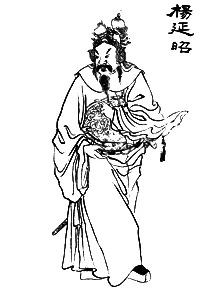
958 CE–1014 CE
General
Yang Yanzhao
杨延昭
Yang Yanzhao, eldest son of Yang Ye, was a frontier commander who repeatedly repelled Liao forces and became a renowned member of the Yang military family, carrying on his father's aspirations.
958 CE–1014 CENorthern Song
PROFILE
Yang Yanzhao, eldest son of Yang Ye, was a frontier commander who repeatedly repelled Liao forces and became a renowned member of the Yang military family, carrying on his father's aspirations.
- Alternative Name
- Yang Liulang
- Art Name
- Wei
- Period
- Northern Song
- Date of Birth
- 958
- Date of Death
- 1014
- Dynasty/Regime
- Northern Song
- Identity
- General
- Ethnicity
- Not recorded in historical sources
- Native Place
- Taiyuan, Bingzhou (present-day Taiyuan, Shanxi)
- Place of Birth
- Not recorded in historical sources
- Place of Death
- Not recorded in historical sources
- Highest Office
- See Biography and Major Achievements
- Major Achievements
- Eldest son of Yang Ye; frontier commander who repeatedly repelled Liao forces and carried on his father's military legacy
LIFE TIMELINE
Selected as a palace service officer and accompanied his father on campaigns | Selected as a palace service officer and accompanied his father on campaigns
Followed his father Yang Ye in attacks on Yingzhou and Shuozhou | Followed his father Yang Ye in attacks on Yingzhou and Shuozhou, served as vanguard, and continued fighting beneath Shuozhou's walls after an arrow pierced his arm; after Yang Ye died that year, Yang Yanzhao was appointed Deputy Commissioner of Chongyi and sent out as prefect of Jingzhou
Served as regional patrol commissioner for Jiangnan and Huainan | Served as regional patrol commissioner for Jiangnan and Huainan, later Commissioner of Chongyi and commander of Dingyuan Army, then frontier patrol commissioner of Baozhou, with an additional court-commissioner title
Defended Suicheng against Liao attack by pouring water over the walls to create an ice bar | Defended Suicheng against Liao attack by pouring water over the walls to create an ice barrier; promoted to prefect of Mozhou
Set an ambush at Yangshan and heavily defeated Liao forces | Set an ambush at Yangshan and heavily defeated Liao forces; promoted to Military Training Commissioner of Mozhou
Went to relieve Baozhou | Went to relieve Baozhou; attacked before the formation was ready and suffered losses, but was pardoned
Restored as regional patrol commissioner and transferred to command Ningbian Army | Restored as regional patrol commissioner and transferred to command Ningbian Army
Memorialized that key routes should be blocked and the You and Yi prefectures recovered | Memorialized that key routes should be blocked and the You and Yi prefectures recovered, but received no answer; led troops deep into Liao territory, captured Gucheng, and took many prisoners; after the Chanyuan Treaty, became prefect of Baozhou and concurrent frontier patrol commissioner
Promoted to Defense Commissioner of Baozhou and transferred to deputy commander of Gaoyang | Promoted to Defense Commissioner of Baozhou and transferred to deputy commander of Gaoyang Pass
Died of illness at his post | Died of illness at his post, aged fifty-seven
BIOGRAPHY
Biography
Family Background and Early Years
Yang Yanzhao was originally named Yang Yanlang and was the son of the famous Northern Song general Yang Ye. Yang Ye, a native of Taiyuan in Bingzhou, had originally served Northern Han and was known as “Yang the Invincible.” After surrendering to Song in 979, the fourth year of the Taiping Xingguo era, he eventually became surveillance commissioner of Yunzhou and administrator of Daizhou with concurrent command of the Sanjiao stationed forces. Yang Yanzhao was quiet and reserved as a child and enjoyed playing at military formations. Yang Ye once said, “This boy resembles me,” and thereafter took him along on every campaign.
During the Taiping Xingguo era, Yang Yanzhao was selected as a palace service officer and thereby entered the military official hierarchy. When Yang Ye led troops against Yingzhou and Shuozhou, Yang Yanzhao served as vanguard. Fighting below the walls of Shuozhou, he was struck through the arm by an arrow but fought even harder. The court later sent him out as prefect of Jingzhou while he held the rank of Deputy Commissioner of Chongyi. When famine struck the Yangtze and Huai regions, he was appointed regional patrol commissioner for Jiangnan and Huainan to maintain local order. He was later made Commissioner of Chongyi and commander of Dingyuan Army, transferred to frontier patrol commissioner of Baozhou, and given an additional court-commissioner title.
Frontier Defense and Military Merit
In the winter of 999, the second year of the Xianping era, Liao forces raided the frontier. Yang was then defending Suicheng. The town was small and unprepared, and Liao troops pressed the siege for several days. Empress Dowager Xiao, mother of Emperor Shengzong of Liao, personally supervised the attack, causing fear among Song troops. Yang summoned all able-bodied men in the town, put them on the parapets, and issued them armor and weapons. During bitterly cold weather he ordered water poured over the walls. By morning it had frozen into hard, smooth ice that the attackers could not scale. The Liao army withdrew, leaving behind many weapons. For this merit Yang was promoted to prefect of Mozhou.
At the time Emperor Zhenzong of Song was stationed at Daming Prefecture, while Fu Qian held a large army at Zhongshan. Yang Yanzhao, Yang Si, and Shi Pu repeatedly requested reinforcements to fight, but Fu refused. After Fu was punished, Emperor Zhenzong summoned Yang to the field headquarters and questioned him on frontier defense. Pleased with his answers, the emperor pointed to him before the princes and said that Yang's father had been a famous general of the preceding reign and that Yanzhao commanded troops and guarded the passes in his father's manner, which was greatly praiseworthy. He rewarded Yang generously and sent him back to his post.
Victory at Yangshan and Setbacks
In the winter of 1000, the third year of Xianping, Liao forces invaded Song territory. Yang concealed elite troops west of Yangshan, about fifty li west of present-day Xushui in Hebei and now called Yangshan. He attacked the Liao army from the north when it was unprepared and then fought while withdrawing. When he reached the western hills, the ambush force emerged and the Liao troops were heavily defeated. Song forces captured a Liao officer and presented the enemy commander's head in a box as proof of victory. Yang was promoted to Military Training Commissioner of Mozhou along with Yang Si of Baozhou. Emperor Zhenzong told his grand councilors that Yang Si and Yanzhao had come from distant provincial backgrounds and had proved themselves through loyalty and courage; although many at court envied them, the emperor had personally protected them to allow them to reach their positions.
In 1002, the fifth year of Xianping, Liao forces attacked Baozhou. Yang and Yang Si led troops to the relief, but before the Song army had formed its lines it was struck by the enemy and suffered substantial losses. The court sent Li Jixuan and Wang Ting to replace them and planned to punish them. Emperor Zhenzong said that men such as Yang and Yang Si had long been known for courage and that he wished to see later achievements from them, and so pardoned them. In the summer of 1003, Liao troops again attacked Wangdu. Li Jixuan delayed and would not advance and was punished and stripped of rank. Yang was restored as regional patrol commissioner. While plans were being made for autumn defense, the emperor ordered Yang Si and Yang Yanzhao to submit itemized assessments of advantages and disadvantages and transferred Yang to command Ningbian Army.
Before and After the Chanyuan Treaty
In 1004, the first year of the Jingde era, Emperor Zhenzong ordered Yang's force increased to ten thousand men and instructed him, if Liao cavalry invaded, to station east of Jing'an Army. Shi Pu, commander at Mozhou, was ordered to camp west of Macun to protect military farms, block cavalry routes through Heilukou and Wannian Bridge, coordinate with troops from the other circuits, and pursue the enemy from multiple directions. Wei Neng, Zhang Ning, and Tian Min were assigned mobile forces for diversion. Wang Chao was then chief commander, while Yang's duties were not subordinated to him.
Yang memorialized that the Khitan army was halted at Chanyuan, a thousand li from its northern frontier and short of both men and horses; although numerous, it could therefore be defeated. Since raiding troops traveled mainly on horseback, he proposed ordering the armies to block strategic routes so the enemy could be annihilated and the prefectures of You and Yi recovered by surprise. The memorial received no response. Yang then led troops directly into Liao territory, captured Gucheng, southwest of present-day Guangling in Shanxi, and took many prisoners.
After the Chanyuan Treaty, Emperor Zhenzong personally reviewed candidates for frontier prefectures and showed his written choices to the grand councilors. He appointed Yang prefect of Baozhou and concurrent frontier patrol commissioner. In 1005, the second year of Jingde, Yang was promoted for his frontier service to Defense Commissioner of Baozhou and soon transferred to deputy commander of Gaoyang Pass.
Later Years and Death
Yang remained at Gaoyang Pass for nine years. He was not skilled in civil administration and often entrusted military paperwork and petitions to a junior officer named Zhou Zheng. Zhou deceived him and exploited the situation for wrongdoing. When Emperor Zhenzong learned of this, he rebuked Zhou, ordered him returned to the barracks, and warned Yang about the matter.
In 1014, the seventh year of the Dazhong Xiangfu era, Yang died at age fifty-seven. Emperor Zhenzong mourned him and sent a eunuch to escort his coffin home. People across the Hebei frontier reportedly wept when they saw the funeral procession. The court appointed three of his sons to office and also assessed his close followers and retainers for official employment according to ability.
Yang Yanzhao was a son of the Northern Song general Yang Ye. Silent and sparing of speech as a boy, he played at drawing up battle lines, and his father, pointing to him, said that this son was like himself and took him on every campaign. In the Taiping Xingguo years he was made an attendant of the imperial table; when Yang Ye attacked Yingzhou and Shuozhou he served as vanguard, fighting beneath the walls of Shuozhou with an arrow through his arm and pressing the harder. He was then sent out with the title of assistant commissioner of ceremonial to govern Jingzhou; when the Yangtze and Huai regions suffered famine he was made inspector-general of Jiang and Huainan, and later commissioner of ceremonial, administrator of the Dingyuan army and inspector-general of the Baozhou frontier, with the added title of commissioner.
In 999, when the Liao invaded in force, Yang Yanzhao was at Suicheng. The town was small and unprepared and the siege was fierce; he mustered the able-bodied to man the walls and, taking advantage of the cold, had water poured over them, so that in one night the walls froze and the Liao could not climb, and withdrew — the affair giving Suicheng the name Iron Suicheng. He defeated the Liao repeatedly afterward at Yangshan and elsewhere, rising through the offices of training commissioner of Mozhou and defense commissioner of Baozhou.
After the treaty of Chanyuan in 1004 peace held long between Song and Liao, and Yang Yanzhao remained on the Hebei frontier for more than twenty years, serving as deputy commander of the Gaoyang pass among other posts. He kept his troops in strict order, shared hardship with them and distributed his rewards among them, and the Liao feared him, calling him Yang the Sixth. He died in 1014 at fifty-seven, his descendants such as Yang Wenguang also serving in the army.
His deeds and his father's were elaborated in later drama and fiction into the widely known stories of the Yang family generals. In the histories, however, his activity centers on the Hebei frontier defense of the Northern Song and his merit lies chiefly in holding ground; the distance between the literary figure and the record should be noted in studying Song military history.
Yang Yanzhao's defense arrangements in Hebei join on to his father's experience in Hedong. Yang Ye had been a general of the Northern Han and came over to the Song when that state fell in 979, defending Daizhou and Yanmen against the Liao for years, until in the 986 northern campaign he was captured through the errors of the commander Pan Mei and the overseer Wang Shen and starved himself to death. Yang Yanzhao inherited his father's military experience, the Song's defensive weight against the Liao shifting from Hedong to Hebei in this period.
Though the frontier was largely peaceful after the treaty of Chanyuan, small clashes still occurred. His chief tasks then were repairing forts, training troops and keeping up the frontier defenses. He once memorialized proposing an attack on the Liao and was not heeded — a sign that the Northern Song's basic policy after the treaty was to hold and not lightly open war.
His manner of command over more than twenty years is recorded fairly concretely in the History of Song: he shared hardship with his soldiers and gave most of his rewards to them, leading from the front when the enemy appeared. His son Yang Wenguang also served as a general, taking part in the campaigns against the Tangut, and rose to deputy commander of the Dingzhou route. Three generations of generals make the Yangs an instance of a Northern Song military family.
The name Yang the Sixth was current among the Liao themselves, explanations differing: some say he was sixth among his brothers, others that the Liao took him for the sixth star of the Northern Dipper. The name shows the reputation he had on the other side.
Later stories of the Yang family generals added a great deal to his record: such figures as Yang Zongbao and Mu Guiying in fiction and drama are mostly invented, and his own image was given much legendary color. In studying Northern Song military history the record in the History of Song must be distinguished from these elaborations.
The Northern Song defense against the Liao after the treaty of Chanyuan rested chiefly on the marshlands, stockades and military farming. The marshes about Xiongzhou and Bazhou formed an artificial water network to limit the movement of Liao cavalry, while Baozhou, Dingzhou and Zhending had stockades and farm colonies garrisoned by imperial and provincial troops. Yang Yanzhao served long within this system, his duties including the frontier inspectorate, the repair of forts, the training of troops and the handling of border negotiations.
His device of pouring water to freeze the walls at Suicheng is a famous example of Song siege defense. Song military writings such as the Essentials of the Military Classics describe the building and holding of fortifications in systematic terms, including the use of weather, terrain, water and fire, and his practice matches them, showing how well frontier commanders knew the techniques of their time.
His career also reflects the Song system of holding the military under civil control: the posts he held — inspector-general, training commissioner, defense commissioner — were largely subordinate to the prefects and pacification commissioners of the region, leaving him limited freedom of action. The peace after Chanyuan made frontier commanders' work a matter of routine defense rather than large operations.
The History of Song judges him on two points, wisdom and valor in battle and shared hardship with his soldiers. When he died the soldiers and people of Hebei grieved for him and offerings were made along the route as his coffin went south, a notice showing his local standing. His descendants continued in the army, the Yangs holding a place among the military families of the Northern Song.
He and such contemporary Hebei frontier commanders as Wei Neng and Tian Min held the same line, coordinating and sometimes differing over the disposition of forces and the chain of command; these records are concrete material for studying how the Northern Song's Hebei defense actually worked.
The sources for him are chiefly his biography in the History of Song and the relevant volumes of the Extended Continuation of the Comprehensive Mirror, with some additions from the institutional compendia and local gazetteers. Compared with the material on his father, his record centers more on frontier business and touches little on politics, in keeping with a long-serving border commander.
In the later Northern Song and in the Southern Song, as the wars with the Liao and Jin changed, his name rose steadily in official narrative and popular tradition. With the region lost in the south, the fashion for commemorating Northern Song generals grew, and the stories of the Yang family took shape in that setting, gaining a fuller plot in later drama and fiction.
His service on the Hebei frontier came as Northern Song policy toward the Liao shifted from attack to defense. After the failure of the two northern campaigns under Taizong the dynasty turned to holding the interior and leaving the frontier thin, and the defenses of Hebei and Hedong were strengthened accordingly, the work of fort repair and military farming he directed unfolding in that setting.
His tomb lies in the area of present-day Hebei, later gazetteers recording his deeds in some detail. Local sacrifice and commemoration continued in Hebei after the Northern Song, the related shrines and inscriptions forming part of local memory.
His defense of Suicheng is a classic instance of using natural conditions against an enemy in Northern Song fortification tactics, described in later military writings and local gazetteers.
Later discussions of Northern Song frontier defense often cite him to show both the role and the limits of frontier commanders under a defensive system.
His long service in Hebei matched the strategic position of the region, the steadiness of his sector mattering directly to the safety of the Northern Song capital.
His name and deeds survive in both official Song records and popular memory, the two together forming the basis of present knowledge of him.
The rise of his later reputation is connected with the fashion for commemorating frontier commanders after the Northern Song.
The fort system in his sector was steadily extended under Zhenzong and Renzong, becoming the backbone of the Hebei frontier defense.
His concrete measures in defense are scattered through his biography in the History of Song and the notices of the Extended Continuation of the Comprehensive Mirror.
No clear posthumous name or posthumous office for him is recorded, his name surviving in Song sources chiefly as a frontier commander.
His place in the Northern Song frontier system makes him a common case in studying the defense policy of the Zhenzong and Renzong reigns.
The chief material on his life is his biography in the History of Song.
His frontier work helped keep the Northern Song's Hebei line steady.
Major Activities
Repelling the Enemy with an Ice Wall at Suicheng
In the winter of 999, Liao forces launched a major invasion and Empress Dowager Xiao personally supervised the siege of Suicheng. The town was small and unprepared. Yang gathered able-bodied residents to defend the walls and, taking advantage of extreme cold, ordered water poured over the fortifications. By morning the water had frozen, leaving the walls hard and slippery and impossible to climb. The Liao army withdrew. The battle gave Suicheng the later name “Iron Suicheng” and was the victory that made Yang famous.
Ambush at Yangshan
In the winter of 1000, Yang placed an ambush west of Yangshan, struck the Liao army from the north, and withdrew while fighting to lure it forward. Once the enemy entered the western-hill ambush zone, the hidden Song troops attacked and heavily defeated it. A Liao commander was captured and a severed enemy head was submitted as proof of victory. Yang was promoted to Military Training Commissioner of Mozhou.
Capture of Gucheng
In 1004, when the main Liao army advanced to Chanyuan, Yang memorialized a plan to block key routes, destroy the Liao force, and recover You and Yi prefectures, but the court did not respond. He then took the initiative, advanced deep into Liao territory, captured Gucheng, and took many prisoners. The source presents this as one of the relatively few offensive Song actions during the Chanyuan campaign.
More than Twenty Years on the Frontier
From the defense of Suicheng in 999 onward, Yang spent more than twenty years on the Hebei frontier, serving successively as prefect of Mozhou, Military Training Commissioner of Mozhou, prefect of Baozhou, Defense Commissioner of Baozhou, and deputy commander of Gaoyang Pass. He maintained strict discipline, shared hardship with his soldiers, personally led from the front when the enemy appeared, credited victories to his subordinates, and distributed his rewards to the army while paying little attention to household affairs. The troops were therefore willing to serve him. Liao forces feared him and called him “Yang Liulang.”
Administrative Weakness in the Army
Although a capable general, Yang was not proficient in administrative affairs. At Gaoyang Pass he left much military correspondence and litigation to the junior officer Zhou Zheng, who deceived him and abused the opportunity. Emperor Zhenzong reprimanded Zhou and warned Yang. This episode, recorded in the History of Song, is one of the more negative elements in Yang's biography.
Personal Relations
- Father: Yang Ye, famous Northern Song general who died in 986
- Brothers: Yang Yanyu, who died campaigning with their father; Yang Yanpu; Yang Yanxun; Yang Yangui; Yang Yangui; Yang Yanbin
- Sons: Yang Chuanyong, Yang Dezheng, and Yang Wenguang; the History of Song records that three sons received office, while their names appear in the Longping Collection
- Yang Si: Military Training Commissioner of Baozhou; repeatedly cooperated with Yang Yanzhao and was likewise known for loyalty and courage
- Shi Pu: Commander at Mozhou; joined Yang in requesting reinforcements against Liao
- Fu Qian: Chief commander of the Zhen, Ding, and Gaoyang Pass routes; held a large army but refused battle despite Yang's requests
- Li Jixuan: Punished for delaying and refusing to advance; Yang later replaced him
- Wei Neng, Zhang Ning, Tian Min: Song commanders assigned to cooperate in the Jingde-era campaign
- Emperor Zhenzong of Song: Highly appreciated Yang, personally praised him as possessing his father's manner, mourned him after death, and sent an envoy to escort his coffin
- Empress Dowager Xiao: Personally supervised the attack at Suicheng and was repelled by Yang's defense
Historical Assessment
Northern Song / Contemporary
- Emperor Zhenzong of Song said that Yanzhao's father had been a famous general of the previous reign and that Yanzhao “commanded troops and guarded the passes with his father's manner, greatly worthy of praise.” (History of Song, “Biography of Yang Yanzhao”)
- Emperor Zhenzong also said that Yang Si and Yanzhao had come from remote backgrounds but demonstrated loyalty and courage and that, despite many jealous people at court, he had personally protected them to allow them to reach their posts.
- The History of Song states that Yanzhao was intelligent, brave, and skilled in battle, gave all salary and rewards to the troops, did not concern himself with household affairs, served on the frontier for more than twenty years, and was so feared by the Khitan that they called him Yang Liulang.
Song and Yuan Periods
- Zeng Gong's Longping Collection records that after Yang's death an imperial eunuch was ordered to escort the coffin home, his three sons Chuanyong, Dezheng, and Wenguang received office, and his regular retainers were tested and appointed according to ability, showing the favorable treatment of his household after death.
- Yuan writer Luo Ye's Record of the Old Drunkard's Talks included Yang Yanzhao in the storytelling tradition of the Yang family generals, showing that his story was widely circulated among the public from the Southern Song into the Yuan.
Ming and Qing Periods
- Ming novel Romance of the Yang Family Mansion and Qing works on the Yang family generals made Yang Yanzhao a central figure but added many fictional episodes, such as accusations against Pan Renmei and marriage stories involving Lady Chai, moving increasingly far from historical record.
- Qing scholar Kang Jitian's Collected Notes on Jin examined Yang's deeds and argued that the title “Yang Liulang” originated in Liao fear of him as a military star.
Modern and Contemporary
- Modern scholars generally regard Yang Yanzhao as a genuine Northern Song frontier general, with the defense of Suicheng and victory at Yangshan securely attested in official histories.
- Scholars disagree over the origin of “Yang Liulang.” One explanation treats “sixth son” as a Tang-Song generational birth order within the wider patriline; another says the Liao regarded him as the incarnation of the sixth star of the Northern Dipper, associated with warfare in the Yan region. Both explanations remain in circulation without a definitive conclusion.
- In contemporary local culture, stories of Yang's frontier defense have blended with folklore such as ox formations and tunnel warfare. Scholars therefore advocate using the History of Song biography as the basis for distinguishing historical record from legend.
FIGURES ASSOCIATED WITH THIS DYNASTY
Bibliography
- History of Song, vol. 272, Biography 31